Key Takeaways
- AI turns a drone from a remote-controlled camera into a system that perceives its surroundings, navigates on its own and interprets what it captures.
- Most commercial value sits in the analytics, not the aircraft. The drone collects data; AI turns it into a decision.
- Full autonomy is still the minority. Most commercial flights are remotely piloted and stay within the pilot’s visual line of sight.
- Onboard edge processing is what makes real autonomy possible, because a drone cannot wait for a round trip to the cloud to avoid a power line.
- Regulation, not technology, is the main brake on beyond-visual-line-of-sight operations in most markets.
- Training data is the hard part. Models need labelled aerial imagery from the conditions your drones will actually fly in.
- Start with one repeatable inspection or survey workflow, prove the accuracy, then expand.
AI and drones come together when machine learning gives an unmanned aircraft the ability to see, decide and act. Computer vision identifies objects below, navigation models plan routes and avoid obstacles, and analytics turn captured imagery into findings a person can act on. The drone becomes a data-gathering system rather than a flying camera.
Investment reflects that shift. Grand View Research values the global AI in drone market is projected to increase $51.33 billion by 2033 at a compound annual growth rate of 17.9%. The gap between the marketing and the flight line is wide, though.
This guide covers how AI makes drones smarter, how autonomous they genuinely are today, where they deliver real returns, what building AI drone software involves, and the regulatory limits that still shape what is possible.

What Is the Role of AI in Drones?
AI gives a drone three capabilities it does not have on its own: perception, decision-making, and interpretation. Without AI, a drone follows commands or a preset path. With AI, it understands what it sees and adjusts.
1. From Remote Control to Autonomous System
A conventional drone executes instructions. An AI-powered drone builds a picture of its environment from cameras and sensors, decides how to respond, and analyses what it records. The hardware often looks identical. The difference is software.
2. The Three Layers of Drone AI
Perception comes first: computer vision and sensor fusion that identify what is below and around the aircraft. Then autonomy: navigation, obstacle avoidance and mission planning. Then analytics: turning captured imagery into measurements, defect reports or counts that feed a business decision.
3. Why Drones Suit AI So Well
Drones generate exactly the kind of data modern AI handles best: high volumes of images and video, captured repeatedly over the same assets. Comparing this week’s roof scan against last quarter’s is a task models do well and people find tedious.
How Does AI Make Drones Smarter?
Six capabilities do most of the work. Each one moves the drone further from remote control and closer to a system that completes a task on its own.
1. Computer Vision and Object Detection
Models trained on aerial imagery identify what appears in the frame: cracks in concrete, corroded joints, crop stress, vehicles, people, livestock or inventory. Accuracy depends heavily on training data that matches the altitude, angle, lighting and weather your drones actually fly in. Building that dataset usually means data annotation services work before any model performs well.
2. Autonomous Navigation and Obstacle Avoidance
Sensor fusion combines camera, lidar, GPS, and inertial data so the drone maps its surroundings and adjusts its path in real time. This is what allows flight near structures, under bridges or inside warehouses where GPS is unreliable.
3. Onboard Edge Processing
Avoiding a power line cannot wait for a cloud round trip. Models compressed to run on onboard chips handle time-critical decisions locally, while heavier analysis happens later on the ground. This is the constraint that shapes most drone AI architecture, and it is standard edge AI development territory.
4. Intelligent Mission Planning
AI plans flight paths that cover an area efficiently within battery limits, adapting to wind, obstacles and changing conditions. For repeat inspections it can prioritise areas where change is most likely.
5. Automated Data Analysis
The capability that produces most of the commercial value. Instead of an operator reviewing thousands of images, models flag defects, measure volumes, count assets and compare against previous flights. The output is a report, not a folder of photographs.
6. Swarm and Fleet Coordination
Multiple drones dividing an area, sharing findings and adjusting to each other’s progress. Still early in commercial use, but the coordination logic mirrors the patterns used in AI agent development more broadly.
How Autonomous Are Drones Really?
Less than the marketing suggests. Most commercial drone flights today are still flown by a human operator who can see the aircraft, and regulation is the main reason.
1. What Autonomy Means in Practice
Most commercial drones today are best described as assisted rather than autonomous. They hold position, avoid obstacles, follow a planned route, and return home automatically. A qualified pilot remains responsible and usually remains watching.
2. Regulation Is the Brake, Not Technology
Beyond visual line of sight operations unlock the economics of drone inspection, since one operator could then cover far more ground. Most jurisdictions still require a waiver or special authorisation. Rule-making is advancing, including the FAA’s proposed framework for routine beyond-visual-line-of-sight flights, but approvals remain the gating factor for most operators.
3. Drone-in-a-Box and Docked Operations
The workaround is gaining traction. A drone lives in a weatherproof base station on site, flies scheduled routes, returns to charge and uploads data automatically. Human involvement drops sharply even where full autonomy is not yet permitted.
4. Plan for the Rules You Have
Build for supervised autonomy now, with the architecture ready for wider permissions later. Operators who assumed approvals would arrive on schedule have repeatedly been disappointed.
What Does It Take to Build AI Drone Software?
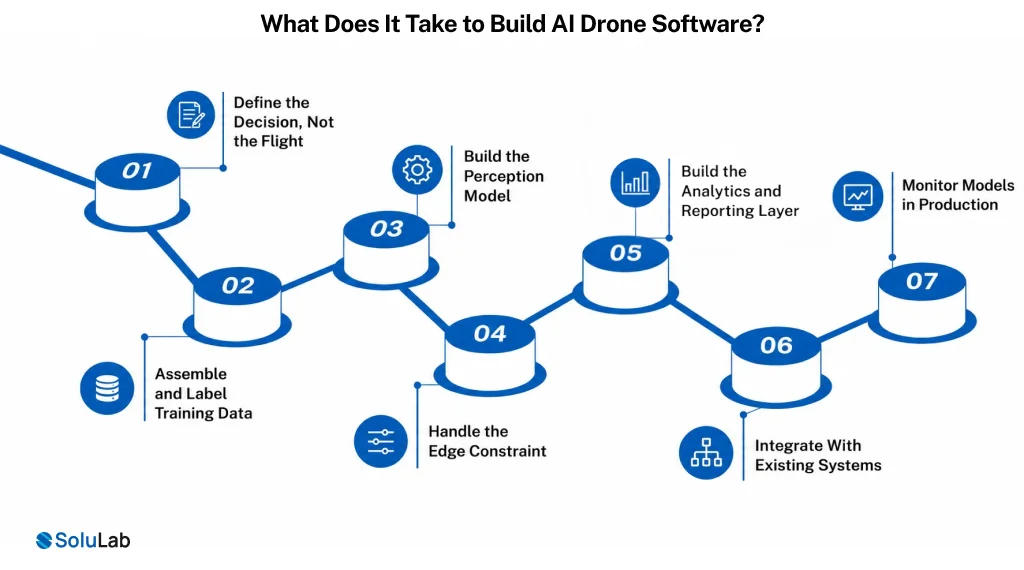
More data work than flight code. The aircraft is usually bought, not built. What gets built is the perception model, the autonomy layer, and the analytics pipeline that produces a usable result.
1. Define the Decision, Not the Flight
Start from what someone will do with the output. “Flag corroded joints above a severity threshold” is buildable and testable. “Inspect the site with AI” is not.
2. Assemble and Label Training Data
Collect imagery from the altitudes, angles, seasons and weather your drones will fly in. Public datasets rarely transfer well, because a model trained on sunny European rooftops performs poorly on monsoon-season Indian ones. Expect this to be the longest phase.
3. Build the Perception Model
Train detection or segmentation models on your labelled data, then validate on flights the model has never seen. Report accuracy by condition, not just overall, because failures cluster in low light and bad weather.
4. Handle the Edge Constraint
Compress and optimise models to run within the drone’s compute, power and weight limits. Decide deliberately what runs onboard and what runs on the ground.
5. Build the Analytics and Reporting Layer
Turn detections into the artefact the customer wants: a defect report, a volume figure, a map overlay or a work order. This layer is what people pay for.
6. Integrate With Existing Systems
Push findings into asset management, GIS, maintenance or claims systems so drone data reaches the people who act on it. Standalone dashboards get abandoned. Most of this is AI integration services work, often alongside IoT development for ground sensors and docking stations.
7. Monitor Models in Production
Accuracy drifts as equipment, seasons and sites change. Track performance, sample outputs for review and retrain on a schedule, following normal MLOps discipline.
What Are the Limits, Risks and Regulations?
Drone AI faces physical, legal and data constraints that no model solves. Knowing them early prevents expensive surprises.
1. Regulatory Approvals
Airspace rules, pilot certification, altitude limits and restrictions near airports and crowds all apply. Beyond visual line of sight generally needs specific authorisation. Rules differ sharply by country, so a workflow approved in one market may be unlawful in another.
2. Privacy and Data Protection
Aerial cameras capture people and neighbouring property incidentally. Surveillance use cases need a lawful basis, retention limits, redaction where appropriate and clear signage or notification. Treat this as a design requirement, not a policy document written after launch.
3. Physical Limits
Battery endurance, payload weight, wind, rain and temperature all constrain operations. AI improves efficiency within those limits but does not remove them.
4. Model Failure in Poor Conditions
Detection accuracy drops in low light, glare, fog and unusual angles. Set confidence thresholds so the system flags uncertainty for human review rather than reporting confidently wrong results.
5. Security of the Aircraft and Its Data
Drones are connected devices carrying sensitive imagery. Secure the communication link, the onboard storage and the ground systems. Supply chain and component sourcing rules have also tightened in several markets, which affects hardware choices.
6. Human Oversight Remains Required
Even in highly automated operations, a qualified person remains accountable for the flight and for decisions taken on the data. Design the handover points deliberately.
What Are the Top Use Cases of AI-Powered Drones?
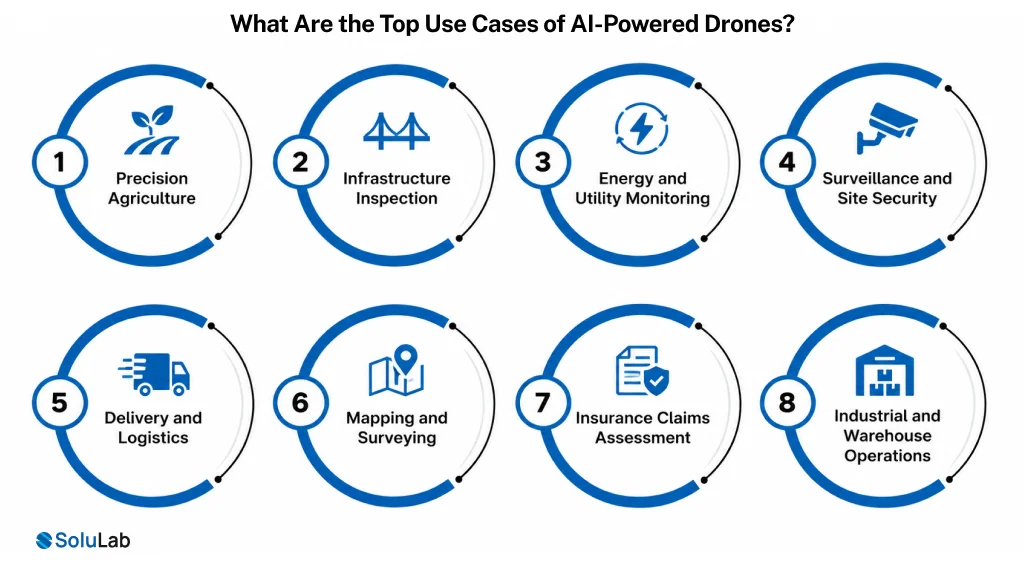
The strongest use cases share one trait: a repeatable flight over the same area, where the value comes from spotting change. Eight stand out commercially.
1. Precision Agriculture
Multispectral imaging detects crop stress, disease, and irrigation problems before they are visible from the ground. AI maps which zones need treatment, so inputs go where they are needed rather than across the whole field.
2. Infrastructure Inspection
Bridges, towers, pipelines, wind turbines and roofs are inspected without scaffolding or rope access. Models detect cracks, corrosion and missing components, then compare against previous flights to show what changed. This is among the clearest safety cases, since it removes people from height.
3. Energy and Utility Monitoring
Power lines, substations and solar farms inspected at scale, with thermal imaging spotting faulty panels and overheating joints. Utilities are consistently one of the largest buyers of drone analytics, and the findings feed into the kind of optimisation covered in our work on AI agents for energy consumption.
4. Surveillance and Site Security
Perimeter patrols, intrusion detection and incident response across large sites such as ports, plants and construction yards. Privacy and data handling rules matter enormously here, and the same governance questions covered in AI in surveillance systems apply in the air.
5. Delivery and Logistics
Medical supplies, spare parts and last-mile parcels, particularly where roads are poor or time matters. Route optimisation and autonomous landing are the AI-heavy parts. Integration with wider AI agents in supply chain and logistics systems is what turns single flights into a service.
6. Mapping and Surveying
Photogrammetry and lidar producing 3D models, volume measurements and progress tracking for construction and mining. AI handles the processing that used to take surveyors days.
7. Insurance Claims Assessment
Roof and property damage assessed after storms without sending an adjuster onto a ladder. Models estimate damage extent and produce consistent reports, feeding the workflows described in our overview of AI in insurance.
8. Industrial and Warehouse Operations
Stockpile measurement, indoor inventory scanning and equipment monitoring inside facilities where GPS does not reach. This connects closely to the role of AI in the manufacturing industry.
What Is the Future of AI and Drones?
Toward more autonomy, longer flights and deeper integration with ground systems, with regulation gradually catching up. Five shifts are visible now.
1. Wider Beyond-Line-of-Sight Permissions
As rule-making progresses, one operator supervising several drones over long distances becomes viable. That single change transforms inspection economics more than any model improvement.
2. Docked Autonomous Fleets
Drone-in-a-box stations flying scheduled missions with minimal human involvement, becoming standard for large fixed sites such as substations, ports, and solar farms.
3. Smarter Onboard Intelligence
More capable chips allow richer models to run in flight, so drones decide in the air what is worth capturing rather than recording everything and sorting it later.
4. Drone Data as an Enterprise Feed
Findings flow automatically into maintenance, planning, and reporting systems, so a detected defect becomes a scheduled work order without a person in between.
5. Specialised Models Over General Ones
Models tuned for one asset class and one environment consistently outperform general-purpose vision models. Expect vertical specialisation rather than a single drone AI platform for everything.

Conclusion
AI and drones together are most valuable when the flight is routine, and the insight is the product. Perception models find what matters, autonomy reduces the piloting burden, and analytics turn imagery into findings someone can act on. The aircraft is increasingly the least interesting part of the system.
If you are starting, pick one repeatable workflow with a clear decision attached, collect data from the conditions you actually fly in, and measure accuracy honestly before expanding. And build for the regulatory permissions you have today, not the ones you hope will arrive.
SoluLab, an AI development company, can help your business identify which drone workflows are worth automating, build and train perception models on your own data, deploy them to edge hardware, and connect the results to the systems your teams already use.
FAQs
Neha is a curious content writer with a knack for breaking down complex technologies into meaningful, reader-friendly insights. With experience in blockchain, digital assets, and enterprise tech, she focuses on creating content that informs, connects, and supports strategic decision-making.