Key Takeaways
- AI diagnostics uses trained models to find patterns in images, signals, lab data, and records that point to disease, usually to support a clinician rather than replace one.
- Radiology dominates. About three in four FDA-authorised AI medical devices are imaging tools.
- The clearest wins are triage and prioritisation, putting the most urgent cases at the top of the worklist so time-critical conditions get seen faster.
- Performance on the developer’s test set does not guarantee performance in your hospital. Local validation is not optional.
- Bias, dataset shift, and automation bias are the three risks that matter most once a tool is live.
- Integration into existing imaging and records systems usually decides adoption more than model accuracy does.
AI diagnostics is the use of machine learning to detect signs of disease in medical data, including scans, pathology slides, ECGs, retinal images, lab results and clinical notes. Most tools flag findings, prioritise urgent cases or quantify measurements for a clinician to review. A small number are authorised to reach a diagnostic decision on their own within tightly defined conditions.
The market is growing quickly from a modest base. Grand View Research values the global AI in diagnostics market at $2.4 billion in 2026, projecting $9.68 billion by 2033 at a compound annual growth rate of 21.7%. Growth is real.
This guide covers how AI diagnostic systems work, where they genuinely improve detection, what regulators have and have not approved, the risks that matter, and what it takes to build or adopt one.
What Are AI Diagnostics?
AI diagnostics are software systems, sometimes embedded in medical hardware, that analyse clinical data to detect, classify or measure signs of disease. They are trained on large sets of labelled examples and then applied to new patients.
1. Assistive, Triage and Autonomous Tools
Most AI diagnostic tools fall into one of three roles. Assistive tools highlight suspicious areas or provide measurements while the clinician makes the call. Triage tools, often called computer-aided triage, reorder worklists so urgent cases are read first. Autonomous tools reach a diagnostic output without a specialist reading the case, and only a handful have been authorised to do so.
The distinction matters because it defines responsibility, regulatory pathway and how the tool should be deployed.
2. What Kind of AI Is Involved
Almost all authorised diagnostic AI is deep learning trained on one specific task. Detecting a bleed on a head CT. Measuring cardiac function on an ultrasound. Grading diabetic retinopathy from a retinal photograph. It is narrow by design. That narrowness is part of why it can be validated and regulated.
3. How It Fits Alongside Broader Healthcare AI
Diagnostics is one part of a much wider set of applications, from scheduling to documentation to drug discovery. Our overview of machine learning use cases in healthcare covers where diagnostic work sits relative to operational and research uses.
How Do AI Diagnostic Systems Work?
Six stages, from the moment data is captured to the moment a clinician acts on a result. Each stage is a place where accuracy can be gained or lost.
1. Data Capture
A scanner, microscope, ECG, camera or lab analyser produces the raw data. Image quality, device settings and acquisition protocol all affect what the model sees.
2. Pre-Processing
The data is standardised: images normalised, noise reduced, relevant regions isolated, formats converted. Differences between scanner manufacturers are one of the most common reasons a model that worked in testing underperforms elsewhere.
3. Model Inference
The trained model analyses the input and produces an output, such as a probability that a finding is present, a segmentation outlining a lesion, or a measurement.
4. Output and Triage
The result is turned into something useful: a flag, a heat map, a priority level or a structured report. For triage tools, this step moves the case up the worklist and may alert a specialist directly.
5. Clinician Review
A qualified clinician reviews the output alongside the patient’s full context and makes the diagnostic decision. Designing this step well, including how confidence is displayed, determines whether the tool helps or distracts.
6. Integration and Feedback
Results flow into the picture archiving system, the electronic health record and reporting tools. Clinician agreement and disagreement can be captured to monitor performance over time. Connecting all of this is usually the largest engineering task, and it is where AI integration services work concentrates on most diagnostic projects.
Where Is AI Diagnostics Improving Disease Detection?
Across most specialities that rely on images or signals, with radiology far ahead. The FDA’s own register shows how concentrated adoption is.
The FDA’s list of AI-enabled medical devices reached 1,524 authorisations through the end of the first quarter of 2026, with radiology accounting for 1,164 of them, or 76%. In that quarter alone the agency authorised 92 AI-enabled devices, 28% more than the previous quarter (The Imaging Wire, from FDA data).
1. Radiology and Medical Imaging
The most mature area. AI tools detect intracranial haemorrhage, pulmonary embolism, fractures, lung nodules and breast lesions, and reduce scan times through image reconstruction. Large imaging companies hold the most authorisations, alongside specialist firms such as Aidoc.
Mammography is a good example of measurable impact. The Swedish MASAI randomised trial of AI-supported breast screening reported a higher cancer detection rate than standard double reading. It also cut radiologist screen-reading workload by roughly 44%.
2. Stroke and Neurology
In stroke, minutes decide outcomes. Triage tools such as those from Viz.ai and Rapid analyse CT scans for large vessel occlusions and alert the stroke team directly. Treatment starts sooner. Neurology also leads the diagnostics market by revenue in Grand View Research’s analysis.
3. Cardiology
The second-largest speciality on the FDA list. AI analyses ECGs to detect atrial fibrillation and reduced heart function, and helps less experienced users capture and interpret cardiac ultrasound.
4. Ophthalmology
Home of the best-known autonomous system. LumineticsCore, formerly IDx-DR, was the first FDA-authorised autonomous AI diagnostic, detecting more-than-mild diabetic retinopathy in primary care without a specialist reading the image. It shows how autonomy becomes possible when the task is narrow and the evidence is strong.
5. Pathology and Oncology
Digital pathology tools help pathologists detect and grade cancers on scanned slides, with prostate cancer an early focus. Oncology is the fastest-growing diagnostic segment in Grand View Research’s forecast. Related agent-based work across cancer and infectious disease is covered in our piece on AI agents for cancer, HIV and COVID.
6. Genomics and Precision Diagnostics
Models interpret genetic variants and link them to disease risk or treatment response, speeding up analysis that would otherwise take specialists days. This intersects directly with AI in genomics.
How Does AI Diagnostics Improve Patient Care?
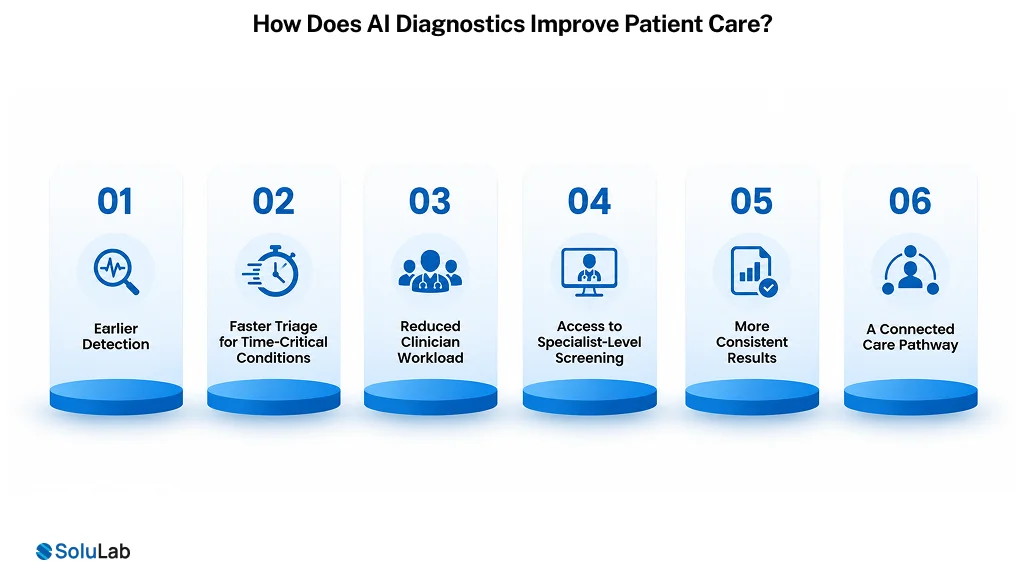
Mostly by getting the right case in front of the right clinician sooner, and by reducing the workload that causes delays and missed findings.
1. Earlier Detection
Models can flag subtle patterns that are easy to miss under time pressure, such as small nodules or early retinal changes. Earlier detection generally means more treatment options.
2. Faster Triage for Time-Critical Conditions
For stroke, haemorrhage and pulmonary embolism, moving an urgent scan from the middle of a queue to the top can save critical time. This is the most consistently demonstrated benefit of diagnostic AI. It is also the least glamorous.
3. Reduced Clinician Workload
Imaging volumes have grown faster than the radiology workforce in many health systems. Tools that handle measurements, flag normal studies or act as a second reader free specialists for complex cases.
4. Access to Specialist-Level Screening
Autonomous and assistive tools can bring screening to primary care, rural clinics and places without specialists on site, as retinal screening in primary care already shows.
5. More Consistent Results
A model applies the same criteria every time, which reduces variation between readers and across shifts. Useful, but conditional. That consistency only holds if the model was validated for the local patient population.
6. A Connected Care Pathway
Diagnostic results increasingly trigger next steps automatically, such as booking follow-up or alerting a care team. That is where diagnostics meets AI agents in healthcare, and where patient-facing tools such as symptom checkers and healthcare chatbots can guide people toward the right test.
What Do the Regulations and Evidence Actually Say?
Three things. Diagnostic AI is regulated as a medical device. Most authorisations rely on comparison to existing products. And the evidence base is thinner than the headlines suggest.
1. How the FDA Authorises Diagnostic AI
Most AI devices reach the US market through the 510(k) pathway, by showing substantial equivalence to a device already on the market. Novel lower-risk devices use De Novo classification. Higher-risk devices require premarket approval. The pathway shapes the evidence a developer needs to produce.
3. Updating Models After Authorisation
AI models may need retraining as data changes. The FDA’s predetermined change control plan framework lets manufacturers describe planned model updates in advance, so defined changes can be made without a fresh submission each time.
4. The EU Treats Diagnostic AI as High-Risk
In Europe, AI embedded in regulated medical devices is classed as high-risk under the EU AI Act, on top of existing medical device regulation. Following the 2026 Digital Omnibus amendments, obligations for high-risk AI embedded in regulated products apply from 2 August 2028.
5. The Evidence Gap
Many authorised devices were cleared on retrospective data, and relatively few have published prospective or randomised evidence of patient outcome benefit. That does not mean they do not work. It means buyers should ask for evidence from settings like their own, not just the headline accuracy figure.
How to Build an AI Diagnostic Platform?
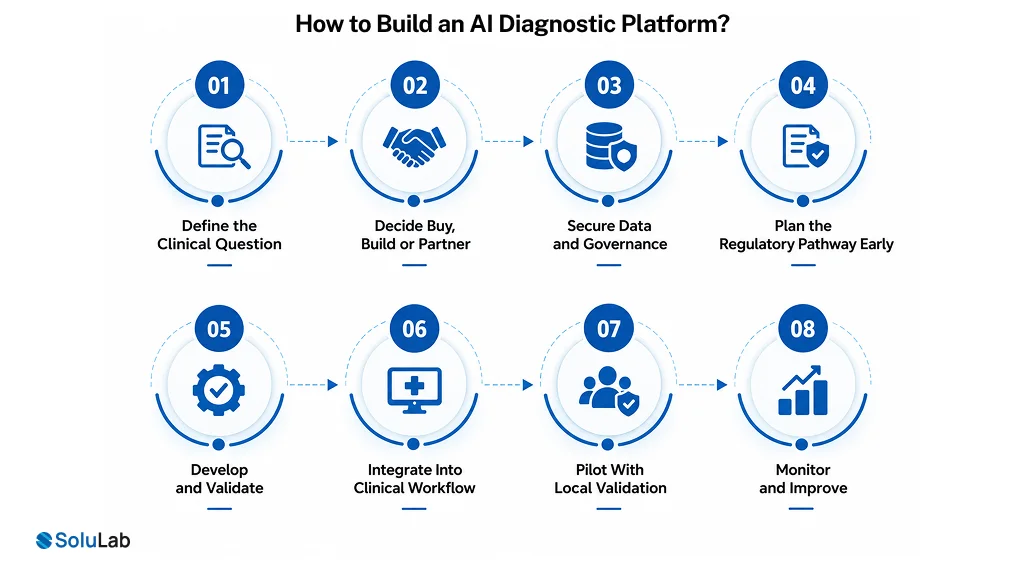
The first two decide whether the project is worth doing, and neither involves training a model.
Here’s a complete step-by-step guide on building an AI diagnostic platform:
1. Define the Clinical Question
Name the specific decision the tool will support, who will use it, and what happens differently when it flags a case. A vague goal such as “use AI in radiology” produces tools nobody uses.
2. Decide Buy, Build or Partner
For common imaging tasks, authorised commercial tools already exist and are usually the faster route. Custom development makes sense for unmet needs, specialised populations or proprietary data. Many projects combine a vendor model with custom integration.
3. Secure Data and Governance
Assemble representative, well-labelled data with appropriate consent, de-identification and data protection. Label quality from qualified clinicians is often the biggest bottleneck.
4. Plan the Regulatory Pathway Early
If the tool will influence diagnosis, it is likely a regulated medical device. Deciding the intended use and pathway early shapes the data and evidence you collect.
5. Develop and Validate
Train and test on separate data, then validate externally on data from different sites and devices. Report performance across patient subgroups, not just overall.
6. Integrate Into Clinical Workflow
Connect to imaging systems, health records and reporting tools so results appear where clinicians already work. Mobile and point-of-care tools may need healthcare app development built to clinical standards.
7. Pilot With Local Validation
Run the tool in parallel with normal practice before relying on it. Compare its output against clinician decisions on your own patients, and tune thresholds accordingly.
8. Monitor and Improve
Track performance, overrides and drift after go-live, with a clear owner and escalation route. Teams without in-house capacity often hire AI developers with medical imaging experience for defined phrases.

Conclusion
AI diagnostics is already improving disease detection in measurable ways, most clearly in imaging, stroke triage and retinal screening. Its greatest value today is getting urgent cases seen faster, taking routine measurement off specialists’ plates, and extending screening to places without specialists. It works best as a well-integrated support tool, validated on local patients, with clinicians firmly in the decision loop.
Health systems that treat validation and governance as part of the product, not an afterthought, are the ones seeing lasting benefit. Our view of the future of AI in healthcare follows the same thread.
SoluLab, an AI development company, can help your business scope clinical use cases, build or integrate AI diagnostic tools, and put validation, monitoring, and governance in place from the start. We will also tell you plainly when an existing authorised product would serve you better than a custom build.
FAQs
Neha is a curious content writer with a knack for breaking down complex technologies into meaningful, reader-friendly insights. With experience in blockchain, digital assets, and enterprise tech, she focuses on creating content that informs, connects, and supports strategic decision-making.