Key Takeaways
- Traditional RPA is reaching its limits in handling dynamic, decision-heavy workflows
- AI workflow orchestration enables systems to interpret, decide, and act in real time
- Multi-Agent Systems (MAS) for business are replacing single-bot automation with coordinated intelligence
- LLM orchestration frameworks 2026 are powering reasoning across workflows, not just responses
- Enterprises are moving from task automation to decision orchestration
- Adoption is happening in phases, not overnight replacement
- Governance, auditability, and guardrails are critical for scaling safely
- The biggest ROI comes from improved decisions, not just reduced effort
There was a time when automation felt like control.
Enterprises mapped processes, defined rules, and deployed bots to execute them with precision. It worked because business environments were relatively stable. Systems changed slowly. The data was predictable. Exceptions were manageable.
That world no longer exists.
Today, workflows are shaped by:
- Unstructured inputs like emails, chats, and documents
- Real-time decision requirements
- Constant system updates
- Increasing regulatory and operational complexity
The result is subtle but important. Automation is no longer about repeating steps. It is about navigating uncertainty.
This is exactly where traditional RPA starts to feel out of place.
Not because it failed, but because it was built for a different kind of problem.
And this is where AI development solutions begin to take over. Not as a replacement in theory, but as a necessity in practice.
Why Traditional RPA Is Quietly Hitting Its Limits?
RPA still has value. It is not disappearing overnight.
But if you look closely inside most enterprises, you will notice a pattern. RPA initiatives tend to plateau.
Not due to lack of effort. But because of structural limitations.
Where Things Start Slowing Down
It struggles with anything that is not predictable
Robotic process automation (RPA) depends on predefined rules. The moment a process involves ambiguity or variation, it either breaks or escalates.
Think of scenarios like:
- Reading emails with different formats
- Processing invoices with inconsistent layouts
- Handling customer requests with contextual nuance
These are not edge cases anymore. They are the norm.
Maintenance quietly becomes the real cost
Bots need constant updates.
A small UI change. A field rename. A system upgrade.
Suddenly, multiple workflows require reconfiguration.
Over time, the cost of maintaining automation starts competing with the value it was supposed to deliver.
It automates tasks, not decisions
This is the most important limitation.
RPA can move data. It can trigger actions. It can follow sequences. But it cannot decide what should happen next when the situation changes.
And modern workflows are increasingly decision-heavy.
The Shift Enterprises Are Beginning to Realize
The conversation is no longer:
“How do we automate this process?”
It is becoming:
“How do we let systems figure out the process as it evolves?”
That shift changes everything.
AI Workflow Orchestration Is Not Just Better Automation
When people first hear about AI-driven automation, they often assume it is just RPA with artificial intelligence added on top.
That framing misses the point.
AI workflow orchestration is not an upgrade.
It is a different model altogether.
What Actually Changes
Instead of building fixed workflows, you start designing systems that can:
- Interpret inputs in real time
- Decide actions based on context
- Coordinate multiple capabilities dynamically
- Adapt without constant reprogramming
In simple terms, workflows stop being rigid pipelines. They start behaving more like systems.
A More Realistic Way to Think About It
Imagine two approaches to the same process.
RPA mindset
- Step 1 happens
- Then Step 2
- Then Step 3
- If something breaks, escalate
AI orchestration mindset
- Understand what just came in
- Decide what needs to happen
- Choose the best path
- Execute and adjust as needed
The difference is subtle in description, but massive in execution.
Why This Matters in 2026
Because enterprise operations today are no longer linear.
They involve:
- Multiple systems talking to each other
- Decisions influenced by external data
- Exceptions that are not exceptions anymore
- Continuous changes in logic and rules
This is exactly where AI workflow automation is gaining traction. Not because they are new. But because they finally match the shape of real-world workflows.
From Bots to Agents: Why Multi-Agent Systems
Are Taking Over
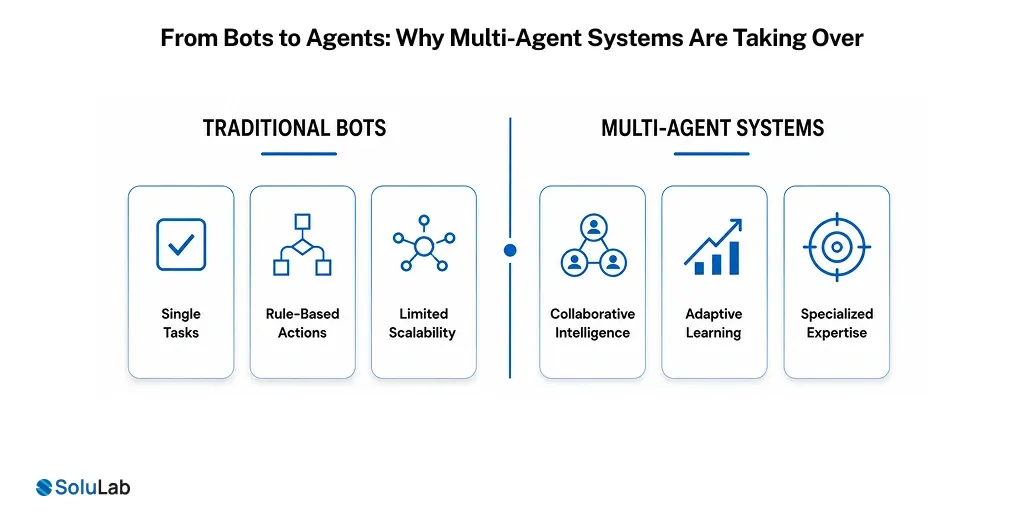
If RPA was built around bots, AI orchestration is being built around agents.
At first glance, the difference may sound semantic.
It is not.
Bots are designed to execute.
Agents are designed to reason.
That single shift changes how entire workflows are structured.
What Makes an Agent Different
An AI agent is not just following instructions. It is:
- Interpreting inputs
- Evaluating context
- Making decisions
- Triggering actions across systems
And more importantly, it does not operate in isolation.
This is where Multi-Agent Systems (MAS) for Business come in.
How Multi-Agent Systems Actually Work
Instead of building one long automation flow, enterprises are now designing systems where multiple agents collaborate.
Each agent has a role.
For example:
- One agent understands incoming data
- Another evaluates risk or priority
- A third decides the next action
- A fourth executes across systems
What you get is not a workflow. You get a coordinated system.
Why This Model Is Scaling Faster
There are a few reasons this AI native approach is quietly outperforming traditional automation.
It handles complexity without becoming fragile
Each agent operates independently. If one fails or needs updating, the entire system does not collapse.
It adapts without constant rebuilding
You are not rewriting workflows. You are adjusting agent behavior.
It mirrors how real organizations operate
Different roles, different responsibilities, coordinated outcomes.
A Practical Example
Take something like customer onboarding in a financial system.
Earlier, you would define:
- Data extraction
- Validation
- Approval
- Notification
Now, with AI agent orchestration:
- An agent reads and interprets documents
- Another cross-checks compliance rules dynamically
- A third flags inconsistencies
- A decision agent evaluates eligibility
- Execution happens based on context
This is what agentic workflow automation solutions actually look like in production.
Not scripted. Coordinated.
Read more- build multi agent platfom like updateIA
What an Enterprise AI Orchestration Platform Really Looks Like
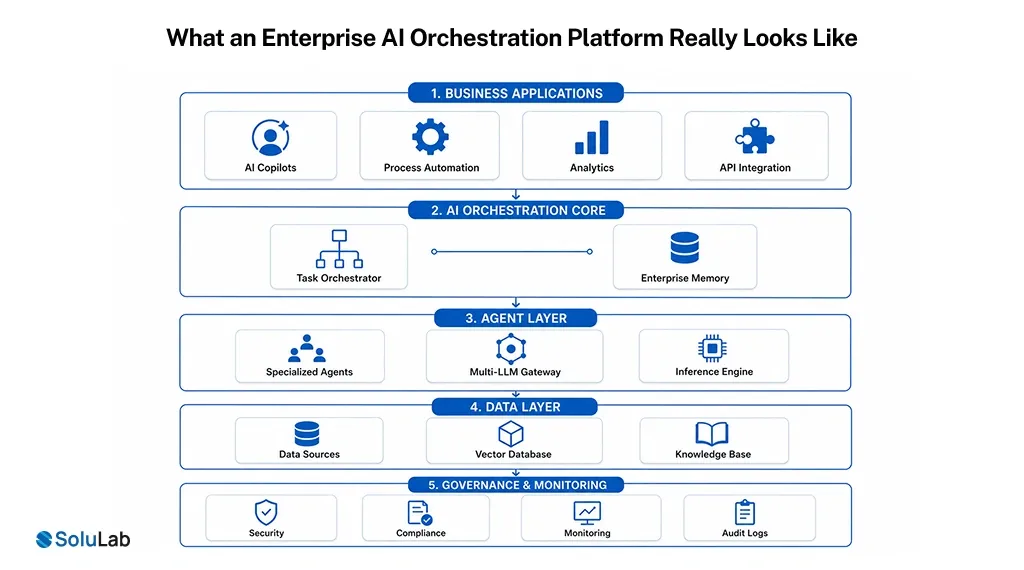
A lot of discussions around AI orchestration stay abstract.
But when enterprises start implementing it, the question becomes very real:
What are we actually building?
At Its Core, It Is Not One System
An Enterprise AI Orchestration Platform is not a single tool. It is a layered system that connects intelligence, execution, and control.
The Layers That Matter
1. Orchestration Layer
This is where workflows are coordinated. Not predefined, but dynamically managed.
It decides:
- Which agent should act
- In what sequence
- Based on what context
2. Agent Layer
This is the operational core.
Each agent is designed for a specific capability:
- Document understanding
- Decision-making
- API interaction
- Communication
Together, they form the execution fabric.
3. Data and Integration Layer
No orchestration works without access to systems.
This layer connects:
- CRMs
- ERPs
- Internal databases
- External APIs
It also handles unstructured data, which is increasingly where most decisions originate.
Read more—AI in ERP Systems: Revolutionizing Business Operations
4. Intelligence Layer
This is where things get interesting.
Large language models and other AI systems are used not just for responses, but for reasoning. This is where LLM orchestration frameworks 2026 are becoming critical.
They allow:
- Multi-step reasoning
- Context retention
- Decision support across workflows
5. Governance and Monitoring Layer
This is non-negotiable.
Enterprises need:
- Visibility into decisions
- Audit trails
- Control over agent behavior
Especially in regulated industries.
The Subtle but Important Shift
In RPA, control came from predefined logic.
In AI orchestration, control comes from:
- Constraints
- Guardrails
- Observability
That is a very different engineering mindset.
Where LLM Orchestration Frameworks Are Changing the Game
A big reason this shift is happening now, and not earlier, is because of how fast LLM capabilities have matured.
But raw models are not enough.
What enterprises actually need is orchestration around them.
Why LLMs Alone Are Not Enough
A single model can:
- Generate text
- Summarize information
- Answer questions
But enterprise workflows require more than that.
They require:
- Structured reasoning
- Multi-step execution
- Context persistence across tasks
- Integration with systems
This is where orchestration frameworks come in.
What LLM Orchestration Frameworks Enable
Instead of using one AI model in isolation, these frameworks allow you to:
- Chain multiple reasoning steps
- Combine different models for different tasks
- Maintain context across workflows
- Integrate with enterprise systems
In simple terms, they turn models into usable infrastructure.
What This Looks Like in Practice
Let’s say an enterprise is processing insurance claims.
With orchestration:
- One model extracts data from documents
- Another evaluates policy conditions
- A third assesses risk or fraud signals
- A decision layer determines approval or escalation
All of this happens within a coordinated system, not separate tools.
Why This Matters for 2026
Because workflows are no longer linear.
They require:
- Interpretation
- Reasoning
- Decision-making
- Execution
And that combination is only possible when models are orchestrated, not just deployed.
AI Workflow Orchestration vs RPA: What Changes on the Ground
At a high level, the difference between RPA development solutions and AI orchestration is easy to explain.
But inside an enterprise, the shift is not theoretical. It shows up in very practical ways.
How the Same Workflow Behaves Differently
Take a simple example like invoice processing.
With RPA:
- Extract fields from a predefined template
- Validate against fixed rules
- Push into ERP
- Flag exceptions manually
It works well until variability increases.
Now look at the same workflow with AI workflow orchestration:
- Interpret invoices regardless of format
- Cross-check vendor history and transaction patterns
- Identify anomalies based on context, not just rules
- Decide whether to auto-process, escalate, or request clarification
The process is no longer rigid. It adapts based on what it sees.
Where Enterprises Feel the Difference Most
1. Handling edge cases becomes normal behavior
What used to be exceptions are now part of the workflow itself.
2. Decision latency reduces significantly
Instead of waiting for manual review, systems can make informed decisions in real time.
3. Operational teams shift roles
People move from execution to oversight and exception management.
The Quiet but Important Impact
This shift is not just about efficiency.
It changes how organizations think about operations.
- Less dependency on predefined flows
- More reliance on system intelligence
- Greater flexibility without constant re-engineering
That is why many enterprises are not asking whether to move beyond RPA.
They are asking how fast they can transition.
How Enterprises Are Actually Deploying AI Workflow Orchestration?
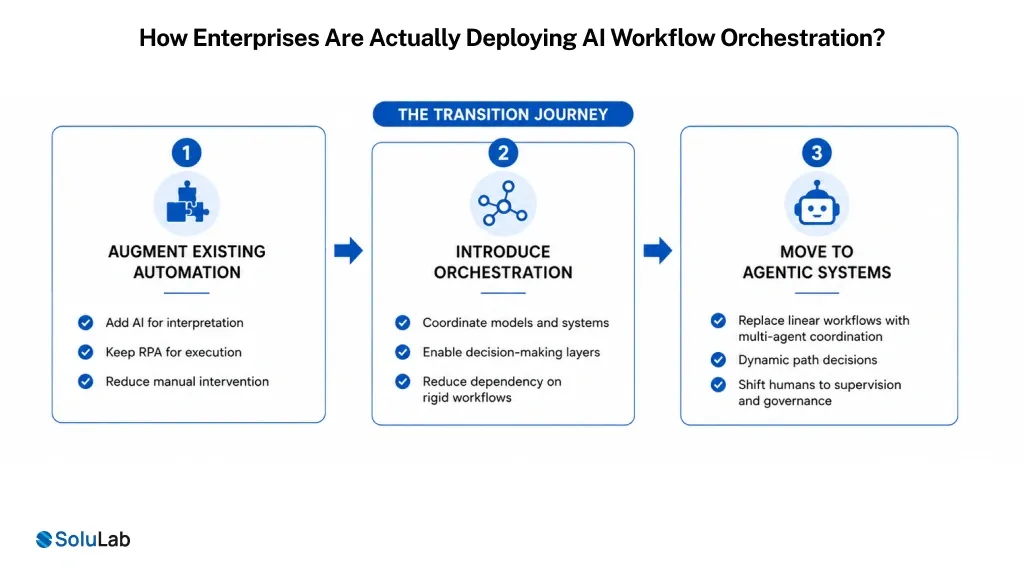
Adopting AI orchestration is not a plug-and-play exercise.
Most enterprises are not replacing RPA overnight. They are layering intelligence on top of existing systems and gradually shifting control.
The Common Starting Point
It usually begins with one or two high-friction workflows.
These are processes where:
- Exceptions are high
- Manual intervention is frequent
- Decision-making is repetitive but complex
Think:
- Claims processing
- Customer support triaging
- Compliance checks
- Financial approvals
What the Transition Looks Like
Phase 1: Augment existing automation
- Introduce AI models for interpretation
- Keep RPA for execution
- Reduce manual intervention
Phase 2: Introduce orchestration
- Add coordination between models and systems
- Enable decision-making layers
- Start reducing dependency on rigid workflows
Phase 3: Move to agentic systems
- Replace linear workflows with multi-agent coordination
- Allow systems to decide paths dynamically
- Shift human roles to supervision and governance
Where Most Challenges Actually Lie
The biggest challenge is not technology.
It is alignment.
- Aligning data across systems
- Aligning teams around new operating models
- Aligning governance frameworks with autonomous decisions
This is where enterprise AI development services often come into play.
Not as vendors, but as partners helping design systems that can scale without breaking.
Risk, Compliance, and Governance in Autonomous Workflows
The moment workflows start making decisions, a new layer of responsibility emerges. This is where many conversations around AI orchestration become cautious. And rightly so.
The Core Concern
If a system is making decisions, enterprises need to answer:
- Why was this decision made?
- Can it be audited?
- Can it be controlled?
What Changes Compared to RPA
With RPA:
- Decisions are predefined
- Logic is transparent
- Behavior is predictable
With AI orchestration:
- Decisions are contextual
- Logic is probabilistic
- Behavior evolves over time
That does not mean less control. It means control needs to be redesigned.
What Enterprises Are Putting in Place
1. Decision Traceability
Every action taken by an agent needs to be explainable.
- What inputs were used
- What reasoning was applied
- What outcome was chosen
2. Guardrails and Constraints
Instead of hardcoding logic, enterprises define boundaries.
- What agents can and cannot do
- Thresholds for escalation
- Risk-based controls
3. Human-in-the-Loop Design
Not every decision is fully autonomous.
Critical workflows still involve:
- Approval layers
- Override capabilities
- Exception handling
4. Continuous Monitoring
Systems are observed, not just deployed.
- Performance tracking
- Bias detection
- Outcome validation
Why This Becomes a Strategic Advantage
Enterprises that get governance right early:
- Move faster with confidence
- Scale automation without fear
- Build trust internally and externally
This is also where working with an AI agent development company becomes less about building features and more about designing responsible systems.
Build vs Partner: How Enterprises Are Making the Call
By this stage, most leadership teams are aligned on one thing.
AI workflow orchestration is not optional anymore.
The real question becomes:
Do we build this internally or work with a partner?
When Building In-House Makes Sense
Some enterprises choose to build internally when:
- They already have strong AI and data engineering teams
- Their workflows are highly proprietary
- They want full control over orchestration logic and infrastructure
But even then, the challenge is rarely the initial AI app development. It is sustaining and evolving the system.
Where Internal Teams Typically Struggle
- Designing multi-agent coordination at scale
- Managing orchestration across multiple models and systems
- Building governance frameworks alongside execution layers
- Keeping pace with rapidly evolving LLM orchestration frameworks
This is not just software engineering. It is systems design.
Why Many Enterprises Choose to Partner
Working with a specialized AI consulting company allows enterprises to:
- Accelerate time to deployment
- Avoid early architectural mistakes
- Build with compliance and governance in mind from day one
- Access proven frameworks for AI workflow orchestration development
What a Strong Partner Actually Brings
The value is not just technical execution.
It is in:
- Designing scalable orchestration architectures
- Structuring agent interactions effectively
- Embedding governance into the system
- Planning phased rollouts that reduce risk
This is where firms like SoluLab typically position themselves.
Not as vendors building features, but as partners designing long-term orchestration infrastructure aligned with enterprise realities.
Where AI Workflow Orchestration Is Already Delivering ROI
This shift is not theoretical anymore.
There are clear areas where AI workflow orchestration services are already showing measurable impact.
1. Financial Operations
- Invoice processing
- Reconciliation workflows
- Fraud detection
Impact:
- Faster processing cycles
- Reduced manual intervention
- Improved accuracy in decision-making
2. Customer Operations
- Support ticket triaging
- Complaint resolution
- Personalized response generation
Impact:
- Lower response times
- Better customer experience
- Reduced operational load
3. Compliance and Risk
- KYC verification
- Transaction monitoring
- Policy validation
Impact:
- Faster compliance checks
- Better anomaly detection
- Stronger audit readiness
4. Internal Decision Workflows
- Approvals
- Vendor evaluations
- Resource allocation
Impact:
- Reduced bottlenecks
- Data-driven decision-making
- More consistent outcomes
The Pattern Across All Use Cases
It is not just about automation anymore.
It is about:
- Better decisions
- Faster execution
- Systems that adapt instead of breaking
That is the real ROI.
Read more –Agentic AI Orchestration for Banking
The Direction Is Clear, Even If the Path Isn’t Fully Defined
Most enterprises are somewhere in transition.
Some are still scaling RPA.
Some are experimenting with AI layers.
A few are already moving toward full orchestration.
But the direction is becoming difficult to ignore.
Workflows are becoming:
- Less predictable
- More data-driven
- Increasingly dependent on real-time decisions
And systems need to reflect that.
What This Means for Leaders
The goal is not to replace everything overnight.
It is time to start rethinking how workflows are designed.
- Where do decisions happen?
- Where does context matter?
- Where are humans still doing repeatable reasoning work?
These are the starting points for AI orchestration.
A Subtle but Important Shift
Automation used to be about reducing effort. Now it is about increasing capability.
That is a very different conversation.
Conclusion
RPA did what it was supposed to do. It brought structure to repetitive work. But enterprise operations have evolved.
They now require systems that can:
- Understand context
- Make decisions
- Adapt continuously
This is where AI workflow orchestration fits in. Not as a replacement for everything that came before, but as the next layer of evolution.
The shift will not happen all at once.
But it is already happening, quietly, inside workflows that are becoming harder to script and easier to reason through.
And over time, that difference will define how efficiently organizations operate.
FAQs
AI workflow orchestration is the coordination of AI models, agents, and systems to execute workflows dynamically, allowing real-time decision-making and adaptive execution.
RPA automates predefined tasks, while AI workflow orchestration enables systems to interpret context, make decisions, and adapt workflows dynamically.
Multi-Agent Systems involve multiple AI agents working together, each handling specific responsibilities within a workflow to enable scalable and flexible automation.
These frameworks coordinate multiple AI models and reasoning steps, enabling structured decision-making, context retention, and integration with enterprise systems.
It is particularly valuable in industries with complex, decision-heavy workflows such as finance, healthcare, insurance, and customer operations.
No. Most organizations are layering AI orchestration on top of existing RPA systems and gradually transitioning over time.
These solutions use AI agents to independently interpret, decide, and execute tasks within workflows, reducing reliance on predefined scripts.
Key risks include lack of explainability, governance challenges, and compliance concerns, which can be managed through proper guardrails and monitoring.
Most begin with high-friction workflows that involve frequent exceptions and decision-making, then gradually expand to broader systems.
Look for partners with experience in orchestration architecture, multi-agent systems, governance design, and enterprise-scale deployments.
Shipra Garg is a tech-focused content strategist and copywriter specializing in Web3, blockchain, and artificial intelligence. She has worked with startups and enterprise teams to craft high-conversion content that bridges deep tech with business impact. Her work translates complex innovations into clear, credible, and engaging narratives that drive growth and build trust in emerging tech markets.