Cosmetic dentistry practices across the UAE are under more pressure than ever to deliver faster, more precise results — without inflating costs. The problem is, traditional smile design workflows weren’t built for that reality.
Manual mock-ups, back-and-forth lab communication, and subjective treatment planning leave too much room for error, rework, and lost revenue. Clinics and dental groups adopting AI development tools are cutting planning time significantly, standardizing case presentations, and closing higher-value treatment plans with greater confidence.
The technology isn’t a— it’s becoming a genuine competitive differentiator in a market where patient expectations and clinical standards are both rising fast.
Key Takeaways
- The issue: The current smile design has been very much dependent on assessment and adjustments done manually and experimentally, thus giving inconsistent results, increased treatment planning, and reduced trust in the patients in the outcome of cosmetic dentistry.
- The fix: AI smile design involves the use of sophisticated imaging, predictive models, and digital simulations to design personalized treatment plans that are accurate, have a higher rate of case acceptance, and overall patient satisfaction.
- Solution: SoluLab develops secure and scalable AI-based dental solutions by combining imaging with predictive analytics and cloud computing to enable clinics to update and modernize their workflows and provide technology-driven solutions to their cosmetic dentistry.
What Is AI Smile Design and How Does It Work?
AI Smile Design is a technology-driven approach to cosmetic dentistry that uses artificial intelligence to analyze facial structure, dental alignment, lip symmetry, and bite patterns to create a personalized smile preview before treatment begins. Instead of relying only on manual impressions and visual judgment, dentists use AI smile design software to generate highly accurate digital simulations tailored to each patient’s features.
This innovation represents a major shift in AI in cosmetic dentistry, where machine learning models evaluate thousands of dental cases to recommend ideal proportions, tooth shapes, and alignment strategies based on facial harmony.
Here is how AI smile design works:
- Digital Scanning and Imaging: The high-resolution intraoral scanners and facial scan devices record detailed data of the patient in 3D images of the teeth, gums, and the facial structure.
- Facial and Dental Analysis (AI): It is a software that analyzes symmetry, spacing, proportions, and the dynamics of the bite through trained algorithms, which compare the data with optimized aesthetic standards.
- Smile Simulation and Predictive Modeling: The system will create various options of smiles, which will be previewed by patients before the commencement of veneers, aligners, or restorative procedures.
- Integration Treatment Planning: The approved digital design is sent into CAD/CAM systems, where the veneers, crowns, or aligners are precisely fabricated to ensure that the end product is close to the simulation.
Why the UAE Is Rapidly Adopting AI in dental cosmetic dentistry?
AI adoption across the UAE’s healthcare sector is happening fast because the country has made innovation and digital transformation a national priority, creating an environment where technology like predictive diagnostics and AI-driven workflows deliver real value to providers and patients alike.
- National perspective vision: The digital health efforts and AI in the UAE are supported by well-planned policies and substantial investment, resulting in the growing digital healthcare market, which is projected to increase significantly by 2030 with the double-digit CAGR trends.
- Government facilities and resources: The automation of healthcare, the use of electronic records, and AI-based solutions targeting the enhancement of healthcare efficiency have led clinics to implement new and more sophisticated systems that can assist with quicker diagnostics and simplified administrative tasks.
- Increased patient care and clinical efficiency: AI applications are implemented in real-time image analysis, predictive treatment plans, and customized care plans to assist dental clinics and hospitals in achieving better outcomes and decreasing manual work.
- Ecosystem and employee preparedness to technology: The overall rate of adoption of AI tools in industries has made the UAE a leader in terms of digital innovation, with professionals and consumers becoming more comfortable with the use of AI-enabled services.
- Changing dental practice: The AI is being applied first to diagnose second opinions in the field of dentistry and conduct advanced imaging to cut bottlenecks in the planning process and enhance the accuracy of the cosmetic procedures.
Benefits of AI Smile Design For Dental Clinics
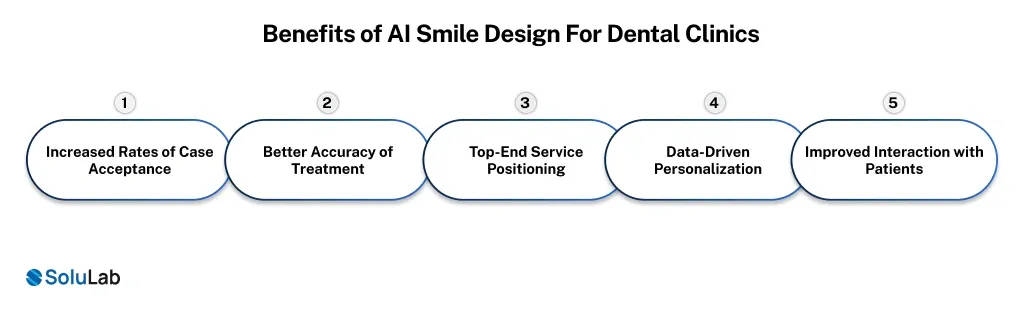
AI smile design is assisting dental clinics to go beyond conventional cosmetic planning by integrating accurate imaging, predictive analytics, and computer simulations to provide superior results, greater efficiency, and consumer confidence.
- Increased Rates of Case Acceptance: The confidence of the patients increases when they are able to visualize realistic smiles prior to treatment. The clinics with digital preview systems have been reported to record greater acceptance of treatment, as patients are well aware of what they should be expecting, and there is less hesitation in relation to veneers, aligners,s or full smile makeovers.
- Better Accuracy of Treatment: The facial mapping and proportion analysis of the AI minimizes the guesses in aesthetic planning. Through a comparison of scans of patients and optimized smile datasets, the clinics are able to create restorations in accordance with the principles of facial symmetry released in dental research and digital dentistry studies.
- Top-End Service Positioning: Clinics that use advanced digital tools have a chance to be technology-advanced providers. When competing with other clinics in Dubai and Abu Dhabi, the ability to provide smile simulations with AI advantages can distinguish the individual clinic and boost the prices of more lucrative cosmetic treatment procedures.
- Data-Driven Personalization: Artificial intelligence systems are used to compare bites, facial features, tooth size proportions, etc., to suggest individual design options. An illustration of this is when a patient presents with a small smile arc, and he or she could be given greater tooth contour recommendations based on the predictive aesthetic modeling.
- Improved Interaction with Patients: Complex dental procedures can be explained only with the help of the visual simulations. Investing in transparency and fostering trust throughout the decision-making process, dentists can communicate with their patients through interactive previews instead of technical descriptions.
Read More: Build HIPAA-Compliant AI Health Platforms
The Core AI Technologies Behind Digital Dentistry
Digital dentistry is a combination of high-quality imaging, automation, and intelligent software to enhance the accuracy of diagnostic processes, treatment planning, and restorative outcomes and make dental procedures more predictable and lightning-fast, as well as more personalized to the needs of modern patients.
- Intraoral Scanners: Intraoral scanners are used to make impressions of teeth and gums with high accuracy that are scanned in 3D, unlike traditional molds, which enhance patient comfort and accuracy. The American Dental Association (ADA) cites that digital impressions are more accurate and lead to fewer remakes. Application: automatic scanning of crown preparation.
- 3D Imaging and Printing: The Cone Beam Computed Tomography (CBCT) and 3D printers enable dentists to see the bone structure and create surgical guides, aligners, and crowns in their own offices. CBCT enhances the accuracy of implant planning as observed by the Radiological Society of North America (RSNA). Case in point: printed surgical instructions on the same day.
- CAD/CAM Restorations: Computer-aided design and mill restorations with a precision of microns. A study conducted in the Journal of Prosthetic Dentistry points to enhanced fit and longevity. Example: chairside ceramic crowns that are made during one appointment.
- Artificial Intelligence (AI): AI interprets radiographs, forecasts the outcome of treatments, and helps simulate the smile with the help of machine learning models that are trained on clinical data. The insights of AI in healthcare created by Deloitte indicate that AI enhances diagnostic consistency. Application: computer-aided cavity image recognition using computerized X-rays.
- Digital Orthodontics: The digital orthodontics application involves a 3D-modelling and simulation tool to plan the movement of the teeth and the design of clear aligners. According to the findings of the American Association of Orthodontists, digital planning enhances the predictability of treatment. Application: implant series that are custom-made based on computer scans.
How to Build AI Smile Design Software in the UAE?
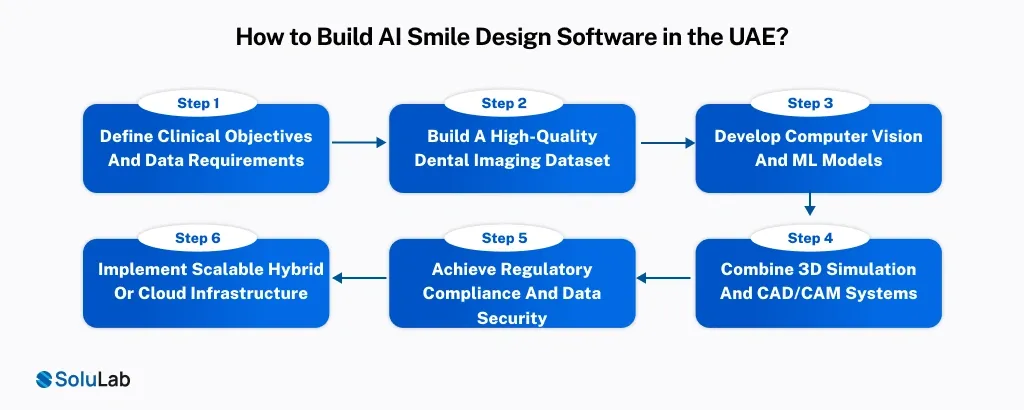
AI smile design systems are computer vision-based, machine learning-based, and secure medical infrastructure systems that create predictive simulated smiles to enable dental clinics to enhance accuracy, personalization, operational effectiveness, and the rate of patient case acceptance.
1. Define Clinical Objectives and Data Requirements
Start by identifying core use cases such as veneers, orthodontics, or full smile makeovers. Collect a structured dental imaging dataset, including intraoral scans and facial photos. WHO digital health frameworks (who.int) highlight the importance of standardized healthcare data foundations.
2. Build a High-Quality Dental Imaging Dataset
Train models using annotated 2D and 3D dental images. Partner with clinics to gather diverse cases covering age groups, facial structures, and dental conditions. MarketsandMarkets reports growing AI medical imaging adoption supporting this data-driven approach (marketsandmarkets.com).
3. Develop Computer Vision and ML Models
Use computer vision to detect tooth boundaries, symmetry, gum lines, and facial proportions. Machine learning models predict optimal shapes and alignment outcomes. For example, convolutional neural networks help identify irregular spacing before simulation rendering.
4. Combine 3D Simulation and CAD/CAM Systems.
Outputs associated with the work of veneers and aligners: connect AI to CAD/CAM. Grand View Research reports that AI integration in healthcare imaging is growing at a high rate (grandviewresearch.com). This makes the simulation outcomes give exact physical restorations.
5. Achieve Regulatory Compliance and Data Security.
Adopt an encrypted cloud structure and adhere to UAE healthcare data requirements and international best practices. Secure AI deployment in controlled industries is a priority of Deloitte Healthcare Insights (deloitte.com). Imaging data of the patients should be secured and compliant.
6. Implement Scalable Hybrid or Cloud Infrastructure.
Select a scalable cloud or hybrid edge infrastructure to render more quickly. Centralized AI engines can be used in multi-location clinics via real-time simulations across branches to enhance consistency and scalability of operations.

Conclusion
Precise imaging, predictive intelligence, and individual treatment planning are the elements that are redefining cosmetic dentistry in the UAE with the use of AI smile design. Clinics are no longer relying on the traditional designs but are instead shifting to data-driven designs that enhance precision, patient trust, and the overall rate of acceptance of the case.
With the increasing demand for high-technical aesthetic procedures, AI dental software development becomes not only a strategic but also a luxury option. Custom AI dental solutions can be scaled to enable the clinic to stand out in an already competitive market and still comply with regulations.
By having the right partner who specializes in developing AI in dental clinics, the practices have an opportunity to achieve innovation, efficiency, and long-term sustainable growth.
SoluLab, an AI development company, can help your business design, develop, and deploy custom AI smile design platforms tailored to your clinical workflows and growth goals.
FAQs
Neha is a curious content writer with a knack for breaking down complex technologies into meaningful, reader-friendly insights. With experience in blockchain, digital assets, and enterprise tech, she focuses on creating content that informs, connects, and supports strategic decision-making.