Key Takeaways
- Corporate AI Security is essential for protecting sensitive business information as AI adoption continues to grow across organizations.
- Customer data, financial records, intellectual property, internal documents, and proprietary AI models are among the most vulnerable assets.
- Shadow AI can create significant security risks by allowing employees to use unauthorized AI tools outside organizational oversight.
- AI governance policies help organizations maintain compliance, accountability, and secure AI adoption at scale.
- Organizations that invest in AI security today will be better positioned to scale AI initiatives confidently and responsibly in the future.
You’re using AI across your organization to improve productivity, automate workflows, and accelerate decision-making.
How do you protect sensitive business information while ensuring employees use AI responsibly?
As AI tools become deeply integrated into daily operations, businesses face growing risks related to data leakage, Shadow AI, unauthorized access, compliance violations, and intellectual property exposure.
That’s why organizations are investing in corporate AI security governance frameworks, access controls, monitoring systems, and employee training to secure their AI environments.
This guide explores the biggest AI security risks, the data most at risk, and the best practices businesses can implement to protect sensitive information in the age of AI. Let’s get started!
Why Do Many Employees Not Recognize the Risk?
According to IBM, 63% of organizations do not have AI governance policies or are still developing them, highlighting a significant oversight gap in enterprise AI adoption.
As AI adoption grows across workplaces, many employees focus on productivity benefits without fully understanding the security implications. Strengthening AI security for employees is essential for reducing accidental data exposure.
- Lack of awareness: Employees underestimate risks of data exposure.
- Convenience over security: Faster workflows outweigh security considerations.
- Limited AI training: Insufficient guidance on safe AI usage.
- Misunderstanding AI platforms: Users assume AI tools are private.
- Unapproved AI adoption: Employees use tools without oversight.
- Poor data handling practices: Sensitive information shared without verification.
- Overreliance on AI: Trusting outputs without security checks.
Can Companies See What Data Employees Are Sharing?
As AI adoption grows across workplaces, organizations are increasingly concerned about what information employees share with AI tools. While some visibility exists, tracking all AI-related data sharing remains a significant challenge.
Visibility Is Often Limited
This is one of the most difficult questions organizations face. In some cases, companies can see what employees share, but only within approved tools and monitored environments that support workplace AI security.
- Visibility limited to approved platforms
- Monitoring varies across AI tools
- External usage often remains hidden
Security Controls Help Track Activity
Organizations may use activity logs, Data Loss Prevention (DLP) policies, and security monitoring solutions to identify how employees interact with authorized AI applications.
- Monitor approved AI tool activity
- Enforce data protection policies
- Detect potential security incidents
The Challenge of External AI Platforms
The situation becomes more complex when employees use personal accounts, public AI tools, or unauthorized applications outside the company’s security controls.
- Personal accounts bypass oversight
- Public AI tools increase risks
- Unauthorized apps reduce visibility
Understanding the Rise of Shadow AI
This challenge has led to the rise of Shadow AI, where employees use AI tools without the knowledge or approval of IT and security teams.
- Employees adopt unapproved AI tools
- IT teams lack visibility
- Governance frameworks often lag adoption
Shadow AI Is Not Always Intentional
In many cases, employees adopt useful AI tools to improve productivity before formal policies are established. However, this creates serious concerns for AI data security in the workplace.
- Productivity drives AI adoption
- Policies often develop later
- Security risks increase significantly
Unknown Data Sharing Creates Risks
When organizations cannot see what information is being shared, they may lose visibility into where data is processed, stored, or used.
- Sensitive data may be exposed
- Processing locations remain unclear
- Compliance risks become harder to manage
How Can Access Controls Protect Sensitive Information in AI Systems?
As organizations adopt AI across critical operations, secure AI solutions for businesses rely heavily on access controls to ensure sensitive data is only available to authorized users and systems.
- Role-based permissions: Grant access based on job responsibilities.
- Least-privilege access: Limit data exposure to essentials.
- User authentication: Verify identities before granting system access.
- Multi-factor authentication: Add extra layers of security.
- Access monitoring: Track user activity and data interactions.
- Permission reviews: Regularly update and remove outdated access.
- Data segregation: Restrict access across departments securely.
- Audit trails: Maintain records of access activities.
What Sensitive Business Information Is Most at Risk When Using AI?
Organizations increasingly rely on AI to process vast amounts of sensitive information, making data protection a critical priority. Understanding what information is most vulnerable helps businesses implement stronger security controls.
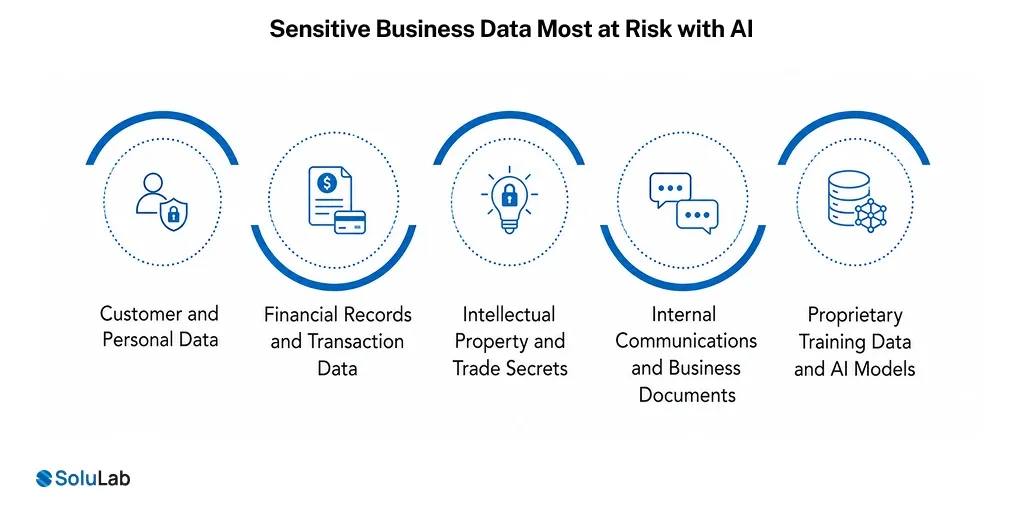
- Customer and Personal Data: AI systems often process customer names, contact details, account information, and behavioral data, making them attractive targets for cybercriminals seeking valuable personal information.
- Financial Records and Transaction Data: Payment details, banking information, invoices, and transaction histories can be exposed through unsecured AI applications, leading to financial losses and regulatory penalties.
- Intellectual Property and Trade Secrets: Proprietary algorithms, product designs, business strategies, and research data shared with AI tools may be compromised without a robust corporate AI security strategy.
- Internal Communications and Business Documents: Confidential emails, reports, contracts, and operational documents can be unintentionally exposed when employees upload sensitive content into AI platforms.
- Proprietary Training Data and AI Models: Custom datasets and AI models represent significant business investments and require protection through enterprise AI security solutions to prevent theft, misuse, or unauthorized access.
Best Practices for Protecting Sensitive Business Information in AI Systems
As AI becomes deeply integrated into business operations, organizations must implement strong security measures to protect sensitive information, maintain compliance, and reduce the risk of data exposure.
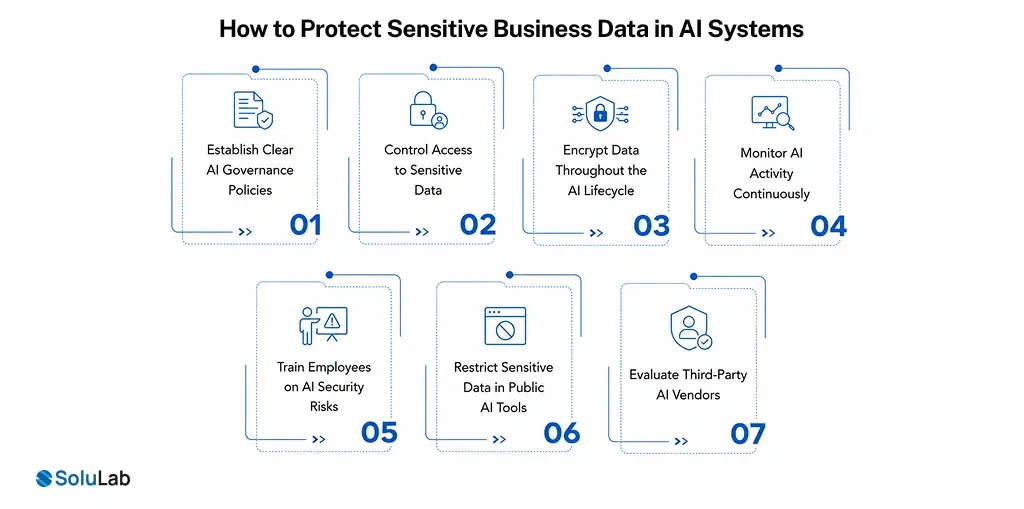
1. Establish Clear AI Governance Policies
Define guidelines for AI usage, data handling, and employee responsibilities to ensure consistent security practices across the organization.
- Create AI usage policies
- Define data handling rules
- Assign security responsibilities
2. Control Access to Sensitive Data
Limit access to AI systems and business information based on job roles to reduce unauthorized exposure and strengthen AI security in the workplace.
- Implement role-based permissions
- Follow least-privilege access principles
- Regularly review user access
3. Encrypt Data Throughout the AI Lifecycle
Protect sensitive information during storage, transmission, and processing using strong encryption standards.
- Encrypt data at rest
- Secure data in transit
- Protect processing environments
4. Monitor AI Activity Continuously
Track AI usage, user behavior, and data interactions to identify unusual activity and potential security threats.
- Monitor AI system activity
- Maintain detailed audit logs
- Detect suspicious user behavior
5. Train Employees on AI Security Risks
Educate staff on responsible AI usage and the importance of protecting confidential information to improve employee data security with AI.
- Conduct regular security training
- Promote responsible AI usage
- Reduce accidental data exposure
6. Restrict Sensitive Data in Public AI Tools
Prevent employees from sharing confidential business information with unauthorized or public AI platforms.
- Block unauthorized AI platforms
- Limit confidential data sharing
- Enforce approved tool usage
7. Evaluate Third-Party AI Vendors
Assess AI vendors for security, compliance, and privacy standards before integrating their solutions into business operations.
- Review vendor security practices
- Verify compliance certifications
- Monitor third-party risks regularly
AI Security Checklist For Businesses
As AI adoption accelerates, businesses need a structured approach to protect sensitive information, reduce security risks, and ensure compliance. A comprehensive checklist helps strengthen AI governance and safeguard critical assets.
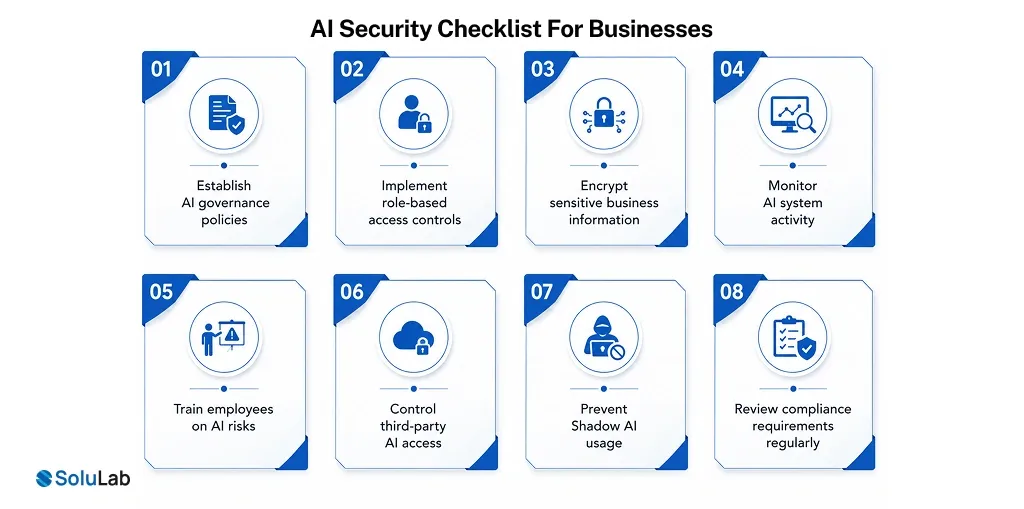
- Establish AI governance policies: Define clear rules for responsible AI usage.
- Implement role-based access controls: Restrict data access based on responsibilities.
- Encrypt sensitive business information: Protect data during storage and transmission.
- Monitor AI system activity: Detect suspicious behavior and unauthorized access.
- Train employees on AI risks: Improve awareness of secure AI practices.
- Control third-party AI access: Evaluate vendors before sharing sensitive information.
- Prevent Shadow AI usage: Enforce approved AI tools and policies.
- Review compliance requirements regularly: Ensure alignment with evolving regulations.
How SoluLab Helps Protect Sensitive Information in the Age of AI?
As businesses adopt AI, protecting sensitive information becomes essential for maintaining trust, compliance, and operational security. SoluLab, an AI native company helps organizations implement secure AI frameworks that minimize risks while enabling innovation.
- AI Security Strategy Development
- Enterprise AI Governance Solutions
- AI Risk Assessment and Auditing
- Secure AI Application Development
- Role-Based Access Control Implementation
- AI Compliance and Regulatory Support
- Secure AI Integration Services
- Data Loss Prevention (DLP) Solutions
- Third-Party AI Vendor Security Assessments
- AI Infrastructure Security Management
- Custom Enterprise AI Security Solutions
Conclusion
AI is changing how businesses operate, innovate, and make decisions, but it also introduces new security challenges that cannot be ignored. From protecting customer data and intellectual property to preventing Shadow AI and ensuring regulatory compliance, organizations need a proactive approach to AI security.
Implementing strong governance, access controls, employee training, and continuous monitoring can significantly reduce risks while enabling safe AI adoption.
Businesses that prioritize AI security today will be better positioned to scale innovation with confidence tomorrow. If you’re looking to build secure, compliant, and future-ready AI solutions, SoluLab, an AI development company, can help your business design, deploy, and protect enterprise-grade AI systems.
FAQs
Neha is a curious content writer with a knack for breaking down complex technologies into meaningful, reader-friendly insights. With experience in blockchain, digital assets, and enterprise tech, she focuses on creating content that informs, connects, and supports strategic decision-making.