Key Takeaways
- AI vibe coding lets startups turn an idea into a working prototype in days instead of weeks, which is exactly why so many early-stage teams have adopted it as their default workflow.
- Speed without structure creates real cost. Industry research analyzing over 8 million pull requests found that technical debt increases 30-41% after teams adopt AI coding tools without a review process in place.
- A production-ready AI vibe coding framework runs through eight stages, from idea validation to continuous monitoring, not just “prompt and ship.”
- Startups that treat vibe coding as a first draft rather than a finished product avoid the technical debt that later forces expensive rescue engineering.
- Where AI vibe coding is heading next includes autonomous coding agents, multi-agent development workflows, AI-native IDEs, and context engineering as a core skill, not just prompting.
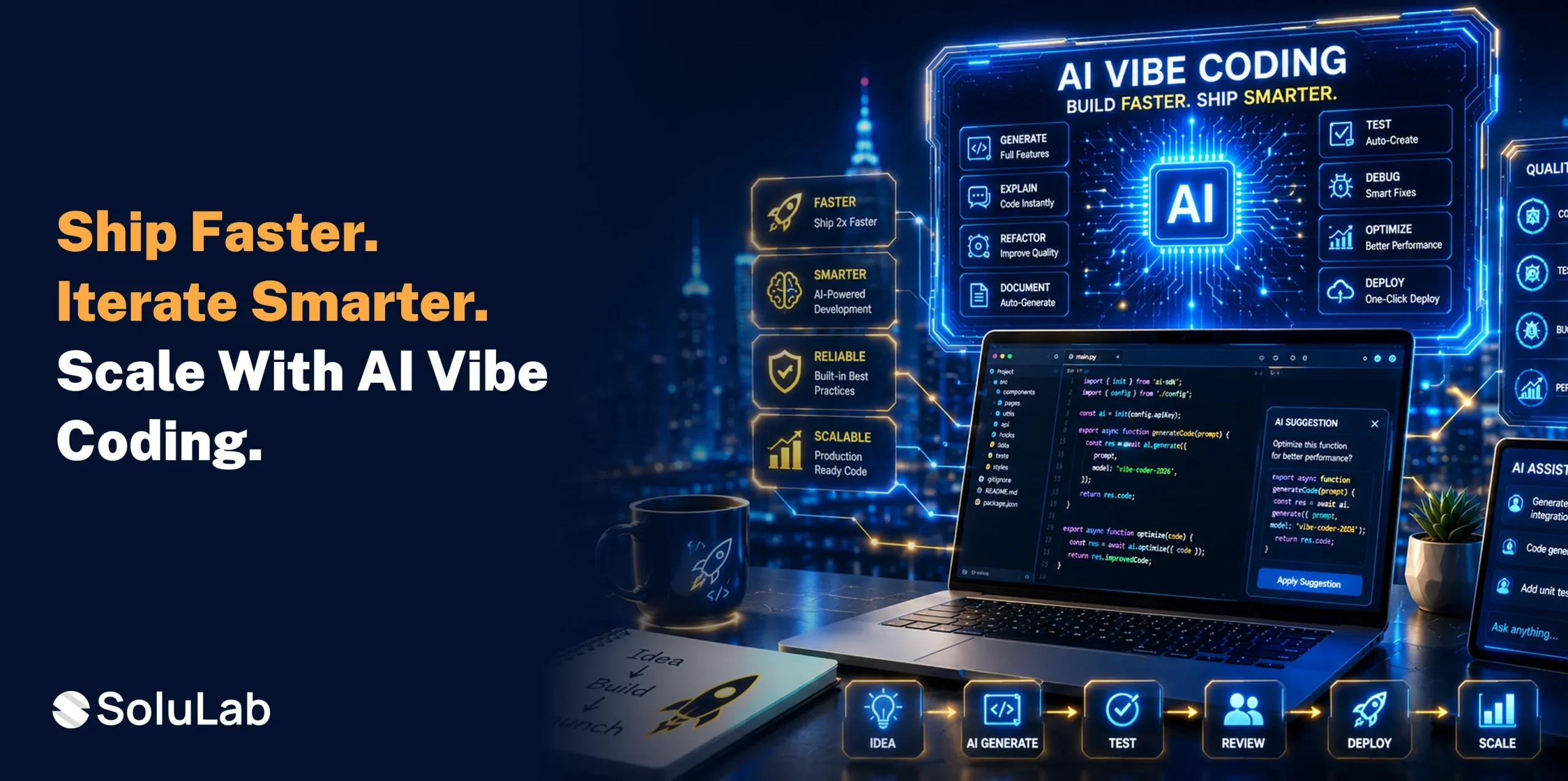
AI Vibe Coding is changing how software gets built in 2026. With AI capable of generating code, designing interfaces, fixing bugs, and even creating full-stack applications from simple prompts, startups can move from idea to MVP in days instead of months.
This speed has made AI-powered coding tools an essential part of modern product development. However, rapid development doesn’t automatically result in reliable software.
Without proper architecture, code reviews, testing, and security practices, AI application development can accumulate technical debt, introduce vulnerabilities, and struggle to scale. The key is balancing AI-driven speed with sound engineering principles.
In this guide, we’ll explore how startups can use AI vibe coding effectively, avoid common pitfalls, and build high-quality software that grows with their business.
Why should startups and SMB owners explore vibe coding?
Startups run on speed and limited resources, and AI vibe coding is built for exactly that constraint. A founder with no engineering background can validate an idea before hiring a single developer, which changes the entire cost structure of testing a new product.
90% of engineering teams now use AI coding tools (up from 61% the previous year). Additionally, 62% of engineers report at least a 25% productivity boost,
- Small teams that would normally need weeks to build a clickable prototype can get one in days, freeing up budget to spend on customer discovery instead of early engineering headcount.
- It also changes who gets to build. Product managers, designers, and non-technical founders can now contribute working code, not just wireframes and specs, which shortens the distance between an idea and something a user can actually try.
- For SMB owners without the budget for a full engineering team, AI-assisted coding often means the difference between shipping this quarter and not shipping at all.
- None of that means it replaces solid engineering. It means engineering effort can be pointed at the parts of the product that actually need human judgment.

Where AI Vibe Coding Breaks Down?
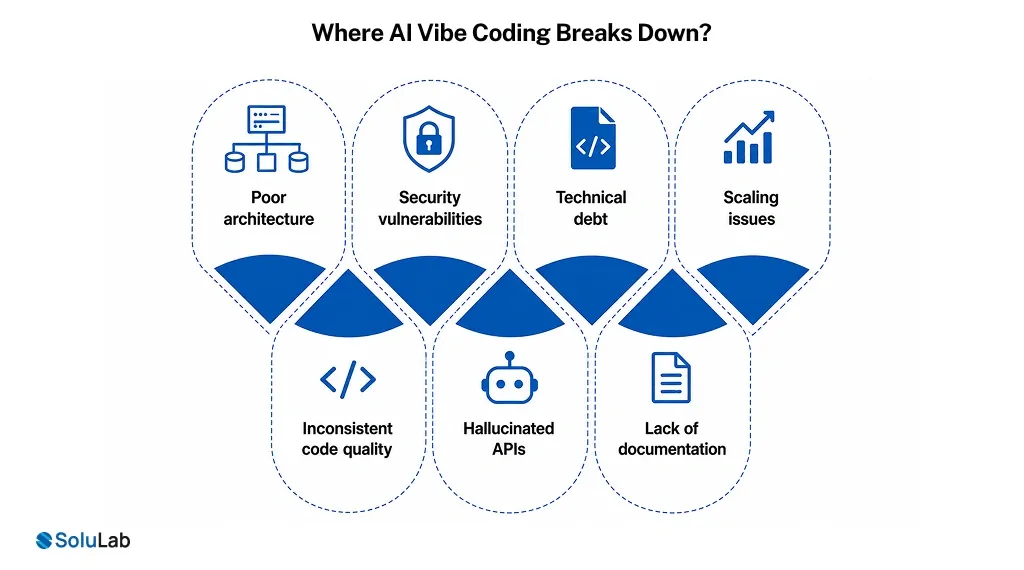
The honest version of the vibe coding story includes where it fails, because it does fail, predictably, in the same handful of ways.
- Poor architecture: AI coding tools optimize for the prompt in front of them, not the system as a whole, so features get bolted on without a coherent structure underneath.
- Security vulnerabilities: Recent industry analysis found close to half of AI-generated code fails basic security checks, often things as fundamental as disabled row-level security or hardcoded API keys.
- Technical debt: Code that works today but nobody fully understands becomes expensive fast, especially once the original prompts and context are gone.
- Scaling issues: What runs fine with ten test users can buckle under real traffic, since AI-generated queries and schemas often aren’t built with production load in mind.
- Inconsistent code quality: Different prompts produce different patterns, so a single codebase can end up with five different ways of doing the same thing.
- Hallucinated APIs: AI assistants sometimes reference libraries, endpoints, or functions that don’t actually exist, and those errors aren’t always caught before deployment.
- Lack of documentation: Code generated in a single prompt-and-accept motion rarely comes with the comments or context a human developer would normally leave behind.
A Startup Framework for Production-Ready AI Vibe Coding
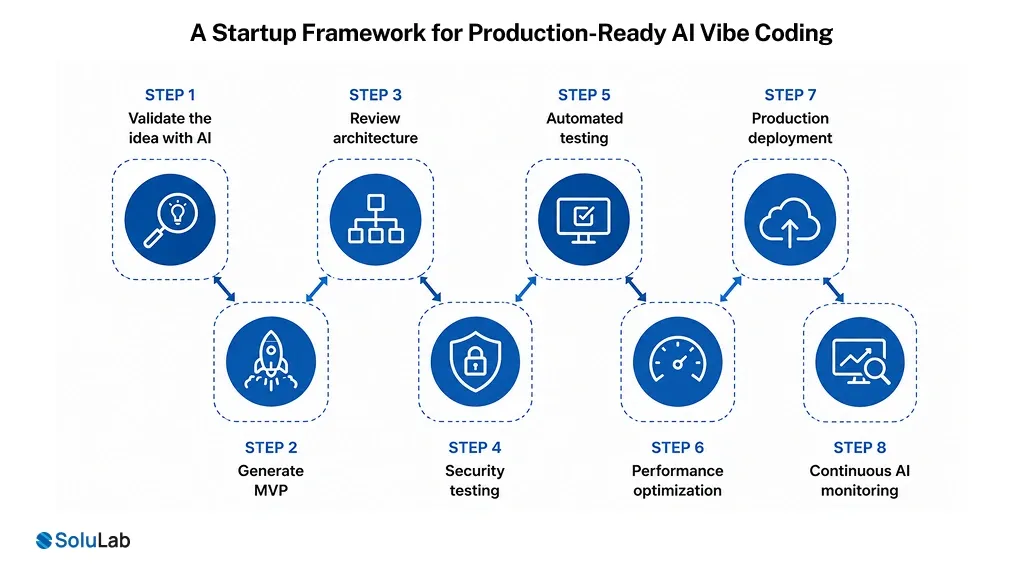
The startups getting real value from AI-assisted coding aren’t skipping the engineering discipline. They’re just compressing it into a faster cycle. Here’s what that looks like stage by stage.
Step 1: Validate the idea with AI
Before writing a single line of production code, AI tools can help test whether the idea is even worth building, using rapid prototyping to get something in front of real users fast.
This step is about learning cheaply, not about shipping the final product.
- Generate a quick clickable prototype
- Test the core value proposition
- Gather early user feedback fast
Step 2: Generate MVP
Once the idea holds up, AI code generation tools can build out a working minimum viable product far faster than a traditional development cycle would allow.
The goal here is a functional first version, not a polished, fully hardened product.
- Build core features with AI assistance
- Keep scope tight and focused
- Ship something users can test
Step 3: Review architecture
This is the step most vibe-coded projects skip, and it’s usually the one that determines whether the app can grow past its first hundred users.
A developer needs to look at what the AI actually built and decide what stays, what gets restructured, and what gets rebuilt properly. Teams without a senior engineer to make that call often bring in outside AI consulting support for just this step.
- Assess overall system structure
- Identify tightly coupled components
- Plan refactors before scaling further
Step 4: Security testing
AI-generated code doesn’t configure security by default, which means it needs to be checked explicitly rather than assumed to be handled.
This step catches the exposed databases, missing authentication, and hardcoded credentials that show up again and again in AI-generated apps.
- Audit authentication and access controls
- Check for exposed API keys
- Run automated vulnerability scans
Step 5: Automated testing
Manual QA doesn’t scale at the pace AI generates code, so automated tests become the safety net that catches regressions before users do.
Building this early means every future AI-generated change gets checked against the same standard.
- Write unit tests for core logic
- Add integration tests for key flows
- Set up continuous test execution
Step 6: Performance optimization
Code that works fine in a demo can behave very differently under real traffic, particularly around database queries and API calls.
This step looks specifically at the places AI-generated code tends to be inefficient by default.
- Review database query efficiency
- Check for redundant API calls
- Load-test before major launches
Step 7: Production deployment
AI deployment is where a lot of the earlier shortcuts either pay off or catch up with a team, depending on how much rigor happened upstream.
A staged rollout catches problems before they hit every user at once.
- Deploy behind feature flags first
- Monitor error rates closely
- Roll back quickly if needed
Step 8: Continuous AI monitoring
AI vibe coding doesn’t stop being a risk once the product ships. New AI-generated changes keep entering the codebase every sprint.
Ongoing monitoring is what keeps the technical debt from quietly building back up after launch.
- Track performance and error metrics
- Review new AI-generated code regularly
- Flag architectural drift early
AI Vibe Coding vs Traditional Software Development
The two approaches aren’t really competitors so much as tools suited to different stages of a product’s life.
| Parameters | AI Vibe Coding | Traditional Software Development |
| Speed to first prototype | Days | Weeks to months |
| Upfront cost | Low, minimal engineering hours | Higher, requires dedicated developers |
| Best suited for | Idea validation, MVPs, internal tools | Complex, long-term production systems |
| Architecture discipline | Often minimal unless enforced | Built in from the start |
| Documentation | Frequently missing or thin | Standard practice |
| Risk profile | Higher without review checkpoints | Lower, but slower to ship |
In practice, the strongest startup teams use both: AI-assisted coding to move fast early, and traditional custom software development discipline layered on top once the product needs to hold up under real users.
How to Prevent Technical Debt When Using AI Vibe Coding
Technical debt from AI-generated code isn’t inevitable. It’s what happens when speed isn’t paired with a few basic habits.
1. Modular architecture
AI tools generate cleaner code when they’re working within clear boundaries instead of one sprawling, tightly coupled file.
Setting this structure up early keeps the codebase workable as more AI-generated features get added.
- Break features into separate modules
- Define clear component boundaries early
- Avoid tightly coupled dependencies
2. Code reviews
Every AI-generated pull request should go through the same review bar as a human-written one would, not a lighter one because “the AI wrote it.”
This is the single most effective checkpoint for catching architectural and security problems before they ship.
- Review every AI-generated pull request
- Check for architectural consistency
- Flag risky patterns before merge
3. Documentation
AI coding tools don’t document their own reasoning, which means someone has to, or the next prompt loses all the context the last one had.
Without this, future changes (AI-assisted or not) end up guessing at intent.
- Document key architectural decisions
- Comment on complex or unusual logic
- Keep a running technical changelog
4. Testing strategy
A strong testing strategy is what lets a team keep shipping AI-generated changes quickly without quietly breaking things that already worked.
Tests act as the guardrail that catches regressions before a user does.
- Automate tests for core flows
- Test AI-generated code before merging
- Track test coverage over time
5. Version control
Good version control discipline keeps a team from losing track of what the AI actually changed and why, especially across dozens of prompts.
This makes it possible to roll back a bad AI-generated change without losing everything around it.
- Commit in small, reviewable chunks
- Write clear, specific commit messages
- Branch before major AI-generated changes
6. Prompt management
The prompts used to generate code are part of the project’s history, and losing them makes future changes much harder to reason about.
Treating prompts as documentation, not throwaway input, saves real time later.
- Save prompts alongside generated code
- Reuse tested prompt templates
- Track which prompts produced which features
Future Trends in AI Vibe Coding
Vibe coding in 2026 is still mostly a single developer prompting a single AI coding agent. That’s already starting to shift.
- Autonomous coding agents: Agents that can plan multi-step tasks, write code, test it, and fix their own bugs without constant human prompting are moving from experimental to genuinely useful, part of a broader shift in AI agent development that goes well beyond coding.
- Multi-agent software development: Instead of one AI handling an entire feature, specialized agents are starting to split work the way a real engineering team would, one for architecture, one for testing, one for security review.
- AI-native IDEs: AI led development environments built around AI from the ground up, rather than AI bolted onto an existing editor, are starting to change how much context an AI coding assistant actually has access to.
- Context engineering: As prompting matures, the real skill is shifting from writing a good single prompt to structuring the ongoing context, requirements, prior decisions, and constraints that an AI coding agent needs to keep producing consistent, high-quality output over time.

Conclusion
AI vibe coding isn’t a shortcut around good engineering. It’s a genuinely faster way to get to a first version, as long as a team treats that first version as exactly that, a starting point that still needs architecture review, security testing, and documentation before it’s carrying real users and real data.
The startups that get this right aren’t the ones avoiding AI-assisted coding. They’re the ones pairing it with just enough process to keep the speed from turning into a rebuild six months later.
If you’re weighing whether your team can vibe code your way to an MVP or needs more structured support to get there safely, SoluLab, an AI development company in USA, can walk through your current codebase and tell you honestly where it stands before you keep prompting.
FAQs
Neha is a curious content writer with a knack for breaking down complex technologies into meaningful, reader-friendly insights. With experience in blockchain, digital assets, and enterprise tech, she focuses on creating content that informs, connects, and supports strategic decision-making.