AI has moved beyond experimentation and into the core of business strategy, but not every investment delivers real value. According to Mckinsey, 92 percent of companies plan to increase their AI investments. But while nearly all companies are investing in AI, only 1 percent of leaders say their companies are getting AI ROI from the deployment.
The difference lies in how they approach AI development implementation, align AI initiatives with business goals, and track performance consistently. Instead of chasing trends, they prioritize high-impact use cases and scalable deployment.
This shift is changing how success is measured. In this blog, we explore how top organizations turn AI into tangible, measurable ROI through practical strategies and disciplined execution.
Key Takeaways
- The problem: Organizations are spending a lot of money on AI, yet do not see the actual business results, hence have no idea of ROI, and end up with bands of money spent on pilots that do not scale.
- The Solution: Concentrate on the high-impact use cases, associated with revenue, cost savings, or efficiency, and quantify the success with objective KPIs early on.
- How SoluLab helps: SoluLab is an AI-native organization that applies AI to its own processes to achieve faster implementations at a reduced cost and align each solution with quantifiable business results.
Why ROI Is the True Measure of AI Success?
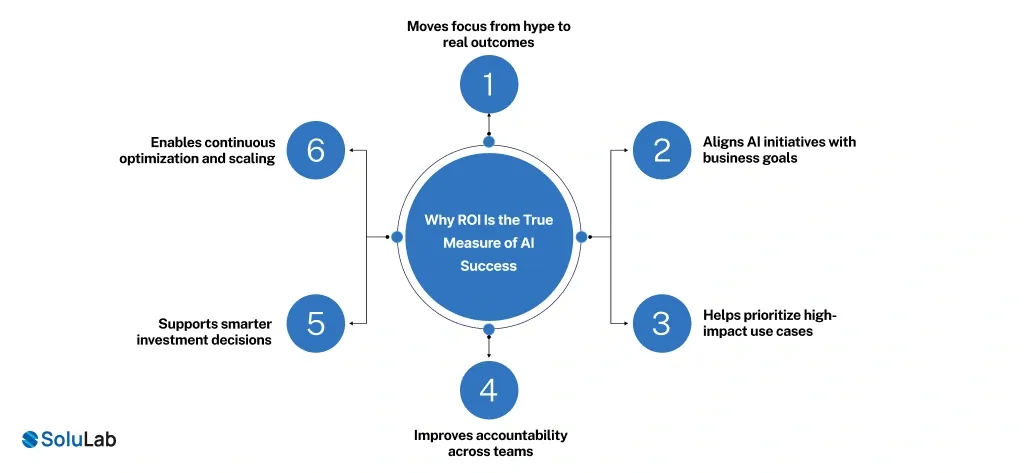
Artificial Intelligence success is not defined by adoption or innovation alone, but by measurable business impact, making ROI the most reliable way to evaluate whether AI investments truly deliver value.
- Moves focus from hype to real outcomes: ROI shifts the conversation from experimentation and buzzwords to tangible results like revenue growth, cost savings, and efficiency improvements that directly impact business performance.
- Aligns AI initiatives with business goals: By measuring ROI, organizations ensure AI projects are tied to key metrics such as conversions, retention, and operational efficiency instead of isolated technical achievements.
- Helps prioritize high-impact use cases: ROI-driven thinking forces companies to focus on AI applications that solve real problems, avoiding low-value experiments and ensuring resources are invested where returns are highest.
- Improves accountability across teams: Tracking ROI creates ownership among stakeholders, ensuring both technical and business teams are responsible for delivering measurable outcomes rather than just deploying AI models.
- Supports smarter investment decisions: ROI provides a clear framework for evaluating which AI initiatives to scale, pause, or stop, helping organizations allocate budgets more effectively and reduce wasted spending.
- Enables continuous optimization and scaling: When ROI is measured consistently, organizations can refine models, improve performance, and scale successful AI solutions across departments to maximize long-term value.
How AI ROI Impacts Business Strategies and Decision-Making?
The way businesses plan, invest, and compete is by connecting decision-making based on data to actual results, efficiency, and long-term strategic development in industries. Here’s how it impacts:
1. Strategic Alignment with ROI
Organizations become less intuitive in their approaches and shift to more result-oriented strategies, making every AI project connected to well-defined financial or operational effects, enhancing accountability and more intelligent resource distribution.
2. Bias Data-Supported Decision Making
With the help of AI, the leaders can make use of information that is readily available rather than guessing, at the expense of businesses being able to predict trends, minimize uncertainty, and make prompt and more confident strategic decisions in different departments.
3. Improves Competitive Advantage
The advantage of using AI in business is that the company can remove manual labor, enhance customer experience, and react more quickly to market changes than other enterprises that operate using conventional tools.
4. Enhances Forecasting and Risk Management
The use of AI models to detect patterns and anomalies enables organizations to anticipate risk, avoid losses, and create more resilient strategies that react to conditions in the market and uncertainties in operations.
5. Enhances Long-term strategic planning
The insights delivered by AI assist the leaders to shift the focus of their actions and decisions between reactive and proactive planning to implement sustainable growth strategies anchored on predictive analytics and market trends, and not past information.
The AI-to-ROI Framework Used by Leading Organizations
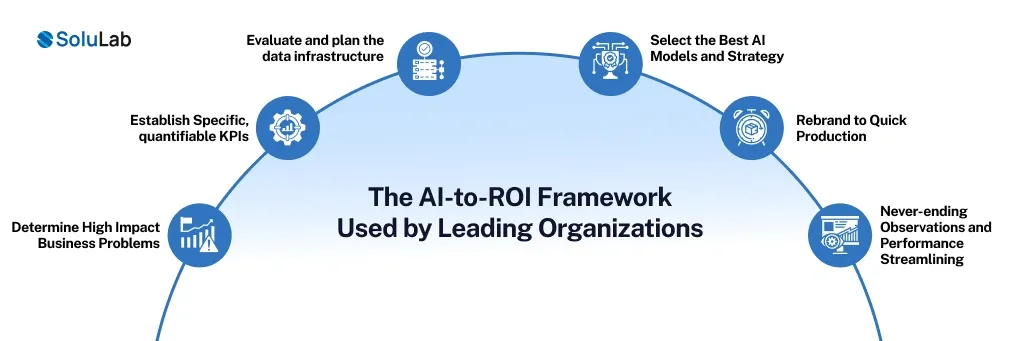
To make AI turn into quantifiable ROI is not an experiment with models, but a systematic way that relates data, implementation, and business results to accountable and responsible results at each phase.
1. Determine High Impact Business Problems
Begin with the issues that are directly associated with revenue growth, cost reduction, or even risk mitigation. Top companies do not focus on ambiguous applications, and instead, focus on the domains where AI can offer quantifiable and traceable financial or business impact in the short run.
2. Establish Specific, quantifiable KPIs.
All AI projects need to be aligned with certain business indicators, such as conversion rates, churn, or operational efficiency. In the absence of a set of KPIs, it is not possible to measure success and justify a subsequent investment in AI projects.
3. Evaluate and plan the data infrastructure.
High ROI requires well-organized and clean data. To be able to train AI models on quality data, organizations invest in data pipelines, governance, and integration earlier in order to guarantee that the models are trained with quality data that depicts real business conditions.
4. Select the Best AI Models and Strategy.
Instead of overengineering, the dominant companies choose models that are appropriate to the issue and the level of data maturity. Strauss stall models that are not complicated and have been trained to give quick results are likely to realize quicker ROI when compared to the more complex systems that need more time to be deployed and optimized.
5. Rebrand to Quick Production.
The greatest gap in ROI is in projects that are in the experimentation stage. Leading performing organizations are preoccupied with rapid implementation to make sure that the AI solutions are implemented into the actual workflows where they can produce quantifiable business value.
6. Never-ending Observations and Performance Streamlining.
The AI systems should be continuously tested on the basis of technical and business KPIs. Feedback loops, A/B testing, and performance tracking are methods used in organizations to ensure improved outcomes are achieved and that all long-term ROI is maximized.
Real-World Examples of AI Driving Growth
The top brands no longer consider AI experimental. It is in the process of creating quantifiable industry growth, whether in customer experience, operations, or both, by making better decisions, personalization, and scale.
1. Netflix: Individualization that Increases the involvement
Netflix employs AI-based recommendation systems to analyze the viewing behaviour and recommend content, which greatly improves watch time, retention, and growth of subscriptions by increasing personalised experiences.
2. Sephora: Customer Support AI
Sephora uses AI chatbots and virtual assistants to provide customers with custom product recommendations and immediate support to enhance customer satisfaction and decrease the cost of support, as well as the overall shopping experience.
3. Coca-Cola
The use of AI by Coca-Cola to process consumer data, supply chains, and demand forecasting allows the company to make decisions faster, decrease inefficiencies during operations, and promote smarter marketing strategies in all the global markets.
4. Telenor: Higher Customer Satisfaction and Revenue Increase.
Telenor engages AI in anticipating customer churn and personalization of the offers to improve retention rates, customer satisfaction, and additional income streams acquired with the assistance of targeted engagement strategies.
5. Wayfair: E-Commerce Shopping
Wayfair employs AI to make recommendations on products, provide visual search, and optimize inventory, which provides a smooth shopping experience leading to increased conversion rates and enhanced customer engagement, along with a steady rise in revenues.
Future of AI ROI: From Efficiency to Autonomous Value Creation
AI is not only evolving into cost savings but also systems that think, act, and optimize results independently. The future of ROI is in independence, rapidity, and constant value development.
AI agents driving decisions: Artificial intelligence agents are becoming decision-makers, replacing support tools, including pricing, supply chains, and customer interactions, with the least human involvement and enhancing speed, accuracy, and consistency.
Predictive + prescriptive AI: Companies are integrating predictive analytics with prescriptive behaviors, enabling AI to predict as well as prescribe and implement the most optimal solutions to business impacts in measurements.
ROI oriented outcomes: AI systems are tracking and optimizing performance continuously, which allows businesses to compute ROI on a real-time basis, change strategies in real time, and optimize value without having to wait until the quarterly reviews.

How AI Development Partners Help Accelerate ROI?
The combination of technical expertise with the established models allows AI integration and development partners to enable businesses to accelerate, limit risks, and generate quantifiable returns through measured business results.
- Faster deployment cycles: AI partners leverage workflows, components, and established deployment pipelines to accelerate the time between idea and production to enable businesses to achieve ROI far sooner.
- Access to pre-built models: Partners provide ready-to-use models and accelerators instead of starting all over again, which enables a company to rapidly customize solutions and concentrate on resolving business challenges.
- Lowers the cost of experimentation: The AI partners can reduce the cost of trial and error by using previous experience, proven methods, and industry-specific knowledge, reduce the number of failed pilots, and maximize the use of budget and resources.
- Greater business alignment: They help make the gap between technical teams and business objectives, making AI solutions directly related to quantifiable KPIs such as revenue increase, cost reduction, and efficiency.
Conclusion
Major organizations are already demonstrating that, in case of alignment with clear business goals, it yields quantifiable ROI in terms of cost reduction, increased revenues, and smarter decisions.
The distinction is not in adoption, but in execution. Firms specializing in high-impact use cases, robust data foundation, and continuous optimization are always ahead of others.
With the continued development of AI, the difference between leaders and laggards will continue to grow. SoluLab, an AI development company, can help your business identify, build, and scale the right solutions. Book a free consultation now!
FAQs
Neha is a curious content writer with a knack for breaking down complex technologies into meaningful, reader-friendly insights. With experience in blockchain, digital assets, and enterprise tech, she focuses on creating content that informs, connects, and supports strategic decision-making.