
Key Takeaways
- AI-powered DeFi solutions combine machine learning with smart contracts for faster, adaptive trading.
- Platforms like Aave and Uniswap now sit next to AI-native players like aixbt and Virtuals Protocol.
- AI DeFi development costs generally range from $25,000 to $400,000+, depending on scope.
- Risk management, yield optimization, and natural language interfaces are the biggest wins.
- Choosing the right AI DeFi development company matters more than picking the fanciest features.
DeFi in 2026 doesn’t look like DeFi in 2021. Back then, you clicked buttons and hoped for the best. Now, AI agents watch the charts so you don’t have to. Over 60% of new crypto platforms are testing some form of AI automation this year, and that number keeps climbing. If you’re building, investing, or just curious, this shift matters.
We’re talking milliseconds instead of minutes, smarter risk calls, and zero guesswork. This is the biggest glow-up decentralized finance has seen in years.
What Are AI-Powered DeFi Solutions, and Why Do They Matter Now?
AI-powered DeFi solutions blend artificial intelligence with blockchain-based finance. Instead of static smart contracts, you get systems that learn. They watch price movements. They study liquidity pools. They adjust positions before a human even notices the trend.
Traditional DeFi runs on fixed rules. If a condition is met, the contract is executed. That’s it. AI in decentralized finance flips this script. The system studies patterns and updates its own logic over time.
Why This Shift Is Happening Right Now?
A few forces are pushing AI DeFi platform development forward this year.
- Market volatility demands faster reaction time than humans can offer.
- Retail investors want simple, conversational tools instead of technical dashboards.
- Institutions need better risk controls before allocating serious capital.
- Cross-chain activity has made manual monitoring nearly impossible.
If you’ve ever missed a trade because you were asleep, you already understand the appeal.
The Core Building Blocks
Every solid AI-powered DeFi platform generally includes a few key pieces.
- Data pipelines that pull market signals in real time.
- Machine learning models trained on trading and liquidity patterns.
- Smart contracts that execute the AI’s decisions on-chain.
- A natural language layer that allows users to type what they want.
Moreover, these pieces need to talk to each other constantly. Latency kills trust in this space.
How Does AI DeFi Development Actually Work?
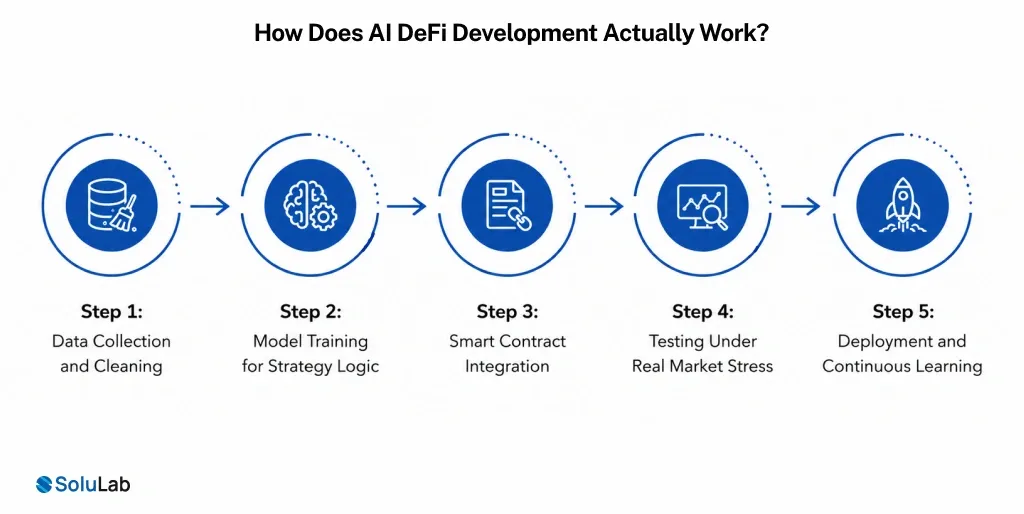
Building an AI-native platform isn’t the same as bolting a chatbot onto Uniswap. It’s a layered process, and each layer needs its own care.
Step 1: Data Collection and Cleaning
AI models are only as good as the data feeding them. Developers pull historical price data, order book depth, and on-chain transaction records. However, raw blockchain data is messy. It needs cleaning before any model can learn from it.
Step 2: Model Training for Strategy Logic
This is where AI crypto trading solutions get their edge. Teams train models on past market cycles. The goal is pattern recognition, not prediction magic. A well-trained model spots setups similar to past winners and losers.
Step 3: Smart Contract Integration
Once the AI decides on an action, it needs a way to execute it. This is handled through smart contract development, connecting AI outputs to on-chain functions like swaps, staking, or rebalancing.
Step 4: Testing Under Real Market Stress
In case a model performs well in backtests but fails live, that’s a red flag. Good developers stress-test using volatile historical periods, not just calm markets.
Step 5: Deployment and Continuous Learning
The platform goes live, but the work doesn’t stop. AI DeFi development includes ongoing retraining as new data comes in. Markets change, and static models age quickly.
What Are the Best AI-Powered DeFi Platform Examples in 2026?
Real examples help more than theory ever will. Here’s how traditional and AI-native platforms actually compare.
| Feature | Traditional DeFi | AI-Powered DeFi |
| Automation | Manual monitoring required | AI agents execute tasks automatically. |
| Intelligence | Fixed smart contract rules | Learns and adapts strategies over time |
| User Experience | Often technical and intimidating | Natural language, beginner-friendly |
| Risk Management | Depends on user attention | Continuously adjusts based on live data |
| Speed | Manual rebalancing, slower cycles | Trades and rebalances in milliseconds |
Real-World Names Worth Knowing
Generally, a few projects define this category right now.
- Aave, Uniswap, and Compound represent the traditional DeFi backbone, still widely used.
- aixbt by Virtuals applies AI to market data aggregation and automated trading calls.
- Virtuals Protocol lets non-technical users deploy their own AI agents for DeFi tasks.
- Hey Anon and ChainGPT, focus on conversational interfaces for blockchain actions.
- GRIFFAIN targets automated portfolio and liquidity management.

What Makes These Platforms Stand Out
Aixbt, for instance, reduces the need for constant manual chart-watching. Virtuals Protocol, on the other hand, lowers the technical bar for launching AI agents. Together, these examples show where AI DeFi platform development is actually heading, not just where it’s marketed to go.
How Much Does AI DeFi Platform Development Cost?
This is usually the first question founders ask, and fair enough. AI development costs vary a lot based on complexity, so let’s break it down honestly.
| Development Scope | Estimated Cost Range | What’s Included |
| Basic AI trading bot | $25,000 to $60,000 | Simple strategy logic, single-chain support |
| Mid-level AI DeFi platform | $60,000 to $180,000 | Multi-strategy AI, dashboard, wallet integration |
| Advanced AI liquidity management system | $180,000 to $300,000 | Cross-chain support, real-time risk engine |
| Enterprise-grade AI DeFi platform | $300,000 to $500,000+ | Full custom AI models, compliance layers, audits |
What Drives the Price Up or Down
A few factors swing these numbers significantly.
- Data preparation and labeling, especially for custom AI liquidity management models.
- Cloud infrastructure and GPU usage, which scale with trading volume and model size.
- Smart contract audits, which are non-negotiable for anything holding user funds.
- Ongoing maintenance, since markets shift and models need retraining regularly.
Additionally, teams that skip proper scoping often see budgets balloon by 30% to 50% mid-project. Planning upfront genuinely saves money later.
A Practical Suggestion
If you’re testing an idea, start small. Build a basic AI yield farming platform first. Prove the concept works. Then scale into enterprise AI DeFi solutions once you have real user data backing your decisions. This staged approach protects your budget and your sanity.
How Do You Choose an AI DeFi Development Company?
Not every dev shop understands both AI and blockchain deeply. This combination is rarer than it sounds, so vetting matters.
Questions to Ask Before You Hire
- Have they shipped a live AI-powered DeFi platform before, not just prototypes?
- Do they offer custom AI DeFi solutions or just template-based builds?
- What’s their approach to smart contract audits and security testing?
- Can they support DeFi automation solutions across multiple chains?
Red Flags to Watch For
If a company promises guaranteed trading returns, walk away. No AI model can promise that, and honest teams won’t claim it. Similarly, be cautious in case a vendor can’t explain their model’s decision logic in plain language.
Why Experience with Related Services Matters
Look for teams that also offer AI agent development services, blockchain development services, and cryptocurrency exchange development. This overlap usually signals deeper technical range. A DeFi development company with broader experience tends to anticipate problems before they happen.

Conclusion
AI-powered DeFi solutions aren’t hype anymore; they’re infrastructure. From Aixbt’s market analysis to Virtuals Protocol’s agent deployment tools, the shift toward smarter, adaptive finance is already here. However, success still depends on solid planning, realistic budgets, and picking the right development partner.
If you’re weighing AI DeFi development for your next project, start with a clear scope, a trusted team like SoluLab, and a budget that matches your actual goals. The technology is ready. The question is whether your strategy is too. Contact SoluLab and clear your questions, and start building your DeFi platform.
FAQs
Neha is a curious content writer with a knack for breaking down complex technologies into meaningful, reader-friendly insights. With experience in blockchain, digital assets, and enterprise tech, she focuses on creating content that informs, connects, and supports strategic decision-making.