Every decade, enterprises convince themselves they can defer transformation one more year. In 2026, that illusion has expired.
Legacy systems that once powered growth are now throttling it. Core banking platforms built in the early 2000s, insurance claims engines patched across cycles, ERP stacks layered with middleware after middleware – these environments are not just old. They are economically misaligned with modern business velocity.
AI-First Legacy Modernization in 2026 is not a technology upgrade conversation. It is a strategic shift often led by an experienced AI development company capable of aligning modernization with long-term business outcomes.
Boards are no longer asking, ‘Can we afford to modernize legacy systems?’ They are asking, ‘What is the cost of not modernizing?’
Three structural shifts drive enterprise legacy transformation 2026:
- Regulatory complexity demands traceable, real-time reporting
- Customer expectations shaped by instant digital experiences
- AI-native development competitors building on clean, modular infrastructure
Legacy infrastructure modernization has shifted from the CIO backlog to the CEO’s priority. Maintaining and patching no longer preserves stability. It compounds fragility. This is why enterprises are increasingly working with AI consulting partners to evaluate modernization pathways before committing capital.
Understanding the True Cost of Doing Nothing
Most legacy system upgrade cost analysis models underestimate the cost of inaction.
The visible costs are easy to calculate:
- Maintenance contracts
- Infrastructure hosting
- Legacy vendor licensing
- Specialist developer salaries
The invisible costs are harder to quantify, but far more dangerous.
- Operational drag: Teams spend disproportionate time debugging brittle integrations instead of building new capabilities.
- Security exposure: Outdated dependencies create expanding attack surfaces. Regulatory penalties amplify downside risk.
- Vendor lock-in economics: Legacy stacks often rely on proprietary frameworks that restrict modernization flexibility.
- Opportunity cost: Many organizations fail to integrate AI capabilities simply because their legacy stack cannot support modern AI models or LLM-powered workflows built by expert AI developers.
In a 5-year horizon, the cost of maintaining legacy systems often exceeds the cost of modernizing them.
A serious Cost-Benefit Analysis of Legacy Modernization must include:
- Productivity recovery modeling
- Innovation velocity metrics
- Risk exposure probability weighting
- Compliance penalty scenario analysis
Legacy Modernization is no longer about technical debt. It is about enterprise competitiveness.
Legacy System Upgrade Cost Analysis: Where the Money Actually Goes
When organizations evaluate modernization, they typically focus on migration expenses. That is only part of the picture. A comprehensive Legacy System Upgrade Cost Analysis includes five primary buckets.
1. Discovery and Audit
- Codebase analysis
- Dependency mapping
- Data lineage tracing
- Regulatory documentation review
This phase determines whether Manual Legacy System Migration or AI-Augmented Migration is viable.
2. Engineering Labor
Manual Application Migration involves:
- Code rewriting
- Re-platforming
- Manual testing cycles
- Refactoring integrations
Labor costs escalate quickly due to specialized skill requirements. This is where businesses start evaluating whether to rely on traditional teams or collaborate with specialized machine learning development companies that can accelerate modernization using automation.
3. Infrastructure Transition
- Cloud re-architecture
- Parallel system operation
- Data replication environments
- Rollback safety layers
Running dual systems during migration significantly increases short-term spend.
4. Business Disruption Modeling
Downtime, retraining, and operational adjustments carry measurable costs. Even minor interruptions in banking or fintech environments can translate to substantial financial impact.
5. Long-Term Maintenance Delta
Post-migration, cost structures change:
- Reduced maintenance overhead
- Lower infrastructure redundancy
- Improved scalability efficiency
- Automation-enabled monitoring
The strategic question is not “What does migration cost?”
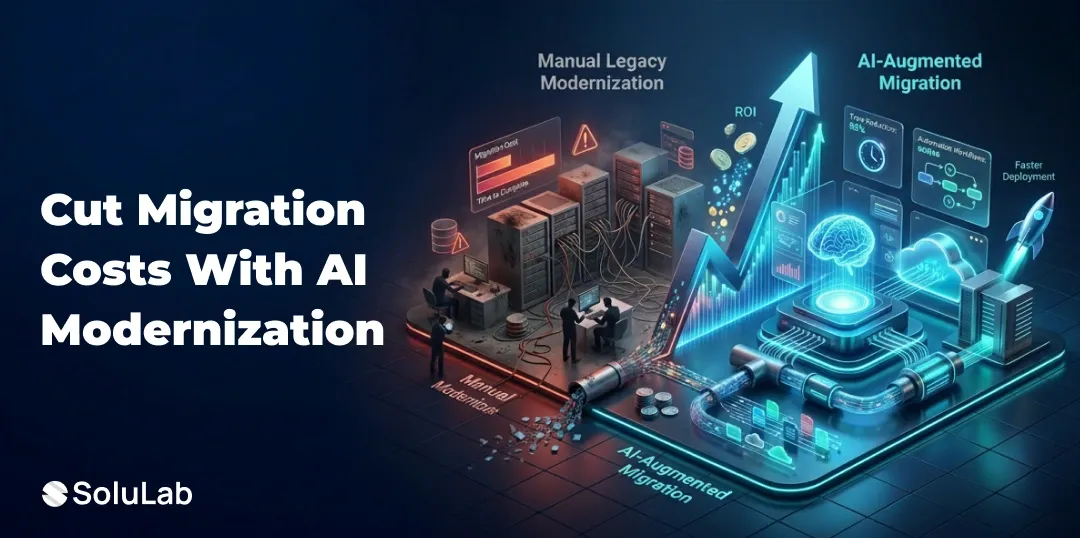
It is: “How does the cost curve behave over five years under Manual Legacy System Migration versus AI-Augmented Legacy Modernization?”
This is where the AI vs Manual Migration Cost Comparison becomes economically decisive.
In the following sections, we will break down the structural mechanics of Manual Legacy System Migration before examining how AI-powered legacy system modernization fundamentally alters the economics of enterprise legacy transformation in 2026.
Manual Legacy System Migration: The Traditional Approach
Before AI-assisted modernization entered the enterprise stack, modernization meant one thing: people. Manual Legacy System Migration is built on human-led discovery, rewriting, re-platforming, and testing. It is linear, resource-intensive, and dependent on institutional memory.
At its core, Manual Application Migration follows this sequence:
- System audit and documentation reconstruction
- Codebase decomposition
- Business logic rewriting
- Integration remapping
- Manual regression testing
- Controlled deployment
This approach works. It has powered decades of Legacy Modernization. However, by 2026, the constraints are evident.
Timeline Reality
Manual migrations for mid-sized enterprises often run 18 to 36 months. Large financial institutions can stretch beyond 48 months. During this time:
- Dual systems operate in parallel
- Talent churn increases risk
- Scope creep becomes likely
The longer the migration window, the higher the cumulative cost.
Human Dependency Risk
Many legacy systems were built by engineers who are no longer with the organization. Documentation gaps create reverse-engineering challenges. Manual teams must infer logic from code that was never designed for clarity.
This increases:
- Error probability
- Compliance blind spots
- Testing burden
Financial Implications
Manual Legacy System Migration scales cost almost linearly with codebase complexity. Larger systems require proportionally larger teams. This is where the traditional Legacy System Modernization Strategy begins to strain.
Manual migration is predictable. But predictability in 2026 does not equal efficiency.

AI-Augmented Legacy Modernization: What It Actually Means in 2026
AI-Augmented Legacy Modernization is often misunderstood as simple automation. It is not.
AI-Powered Legacy System Modernization uses machine learning models, code intelligence engines, and dependency graph reconstruction to accelerate and de-risk migration workflows.
AI-Augmented Migration typically includes:
- Automated codebase scanning
- Business logic pattern recognition
- Dependency mapping through graph models
- AI-driven refactoring suggestions
- Automated test case generation
- Compliance documentation extraction
Modern Automated code migration tools are capable of:
- Translating legacy languages into modern frameworks
- Identifying redundant logic
- Highlighting security vulnerabilities
- Generating migration-ready architecture templates
AI-Driven System Migration does not remove engineers. It amplifies them.
What Changes Structurally
- Discovery becomes faster
This is typically enabled by platforms designed by enterprise-grade AI consulting firms.
- Error density decreases
Pattern-based anomaly detection flags inconsistencies early.
- Testing accelerates
Automated testing frameworks are often developed by experienced AI development companies working on large-scale transformation.
- Documentation improves
AI extracts traceable logic pathways for regulatory audits.
In Enterprise legacy transformation 2026, the shift is from labor-heavy transformation to intelligence-augmented transformation.
The result is not just speed. It is economic rebalancing.
AI vs Manual Migration: Structural Differences That Matter
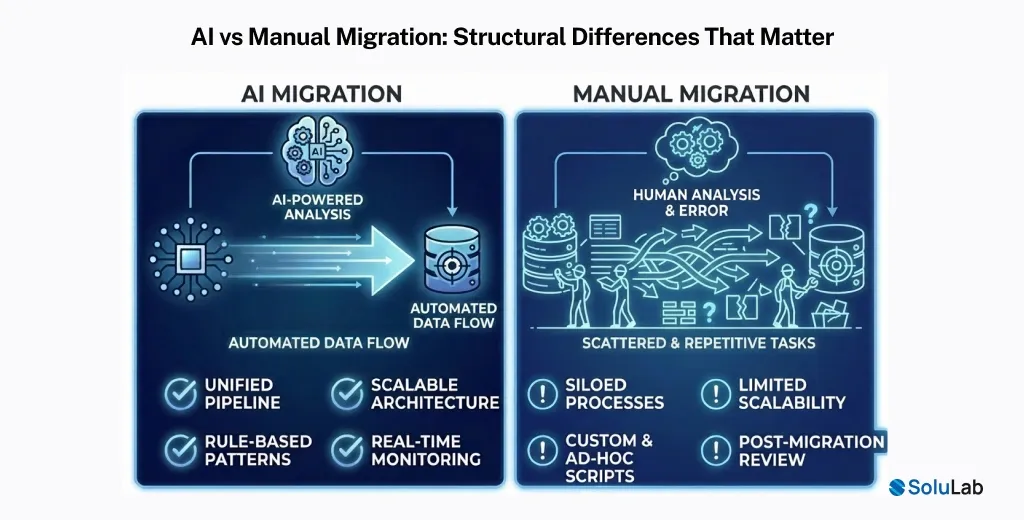
The debate around AI vs Manual Migration is not ideological.
It is structural.
Below is a practical comparison that influences real-world Legacy infrastructure modernization decisions.
Speed of Execution
Manual Legacy System Migration
- Sequential discovery and rewrite cycles
- Extended dependency analysis time
- Human testing bottlenecks
AI-Augmented Legacy Modernization
- Parallelized code analysis
- Automated refactoring suggestions
- Rapid regression test generation
Speed affects cost directly through time compression.
Error Density
Manual Application Migration
- Prone to human oversight
- Institutional knowledge dependency
- Testing coverage limitations
AI-assisted modernization
- Pattern-based anomaly detection
- Full codebase coverage scanning
- Automated compliance checks
Governance Visibility
Manual processes often lack real-time dashboards.
AI-Driven System Migration platforms can provide:
- Code lineage tracking
- Audit logs
- Risk scoring models
- Compliance traceability layers
For regulated industries, this governance visibility materially impacts risk exposure.
Cost Curve Behavior
In the AI vs Manual Migration Cost Comparison, the financial difference becomes clear:
Manual Migration
- Lower upfront tooling cost
- Higher labor expenditure
- Longer disruption window
- Slower ROI realization
AI-Augmented Migration
- Higher initial platform investment
- Reduced labor hours
- Shorter parallel system run
- Faster break-even
A 5-year Cost-Benefit Analysis of Legacy Modernization often shows AI-powered approaches overtaking manual cost structures within 18 to 24 months.
The economics of Legacy Modernization in 2026 are no longer centered on whether AI technology can migrate systems.
They are centered on whether enterprises can afford not to use AI.
Architecture Perspective: How AI-Augmented Migration Is Built
AI-Augmented Legacy Modernization is not a single tool. It is an architecture stack.
Organizations that successfully modernize legacy systems with AI treat migration as an orchestrated system rather than a one-time project. This architecture is often supported by mature MLOps frameworks and AI-led DevOps pipelines, ensuring continuous validation, scalability, and governance across enterprise AI systems.
A typical AI-Driven System Migration framework includes five structural layers.
1. Discovery and Code Intelligence Layer
This layer performs:
- Full codebase ingestion
- Language parsing
- Dependency graph reconstruction
- Data flow mapping
- API endpoint identification
Instead of manual walkthroughs, AI models analyze structural patterns across millions of lines of code. The output is not just documentation. It is a machine-readable migration blueprint.
2. Business Logic Mapping Engine
AI identifies:
- Repeated logic clusters
- Conditional decision trees
- Regulatory calculation modules
- Data transformation sequences
This is critical in financial systems where hidden logic can affect compliance and reporting.
3. Refactoring and Translation Engine
Automated code migration tools:
- Suggest modernization pathways
- Translate outdated frameworks into cloud-native equivalents
- Optimize inefficient logic
- Surface deprecated libraries
Engineers validate and refine rather than rewrite from scratch.
4. Automated Testing and Validation Layer
AI-assisted modernization generates:
- Regression test suites
- Edge-case simulations
- Data validation scripts
- Performance benchmarking scenarios
Testing moves from reactive to predictive.
5. Governance and Observability Layer
For Enterprise legacy transformation 2026, governance is non-negotiable.
This layer enables:
- Code lineage tracking
- Version comparison dashboards
- Risk scoring alerts
- Compliance traceability logs
The architecture reduces uncertainty while accelerating modernization.
This is the structural difference between AI-Powered Legacy System Modernization and traditional re-platforming.
Risk and Compliance Considerations in Modernizing Legacy Systems
Modernizing legacy systems without governance planning introduces risk. Regulated enterprises cannot afford an undocumented transformation.
A mature Legacy System Modernization Strategy addresses five key risk domains.
Regulatory Continuity
Financial institutions must preserve:
- Audit trails
- Historical transaction records
- Calculation logic traceability
- Reporting integrity
AI-driven systems can automatically extract and map regulatory logic during migration.
Data Lineage Preservation
Legacy infrastructure modernization often involves:
- Database restructuring
- Data model normalization
- Cloud migration
AI tools can reconstruct lineage maps to ensure no reporting gaps emerge.
Version Control and Rollback Safety
Parallel run environments should include:
- Snapshot comparison
- Incremental rollout
- Fail-safe rollback mechanisms
Manual migration frequently relies on checkpoint testing. AI-assisted modernization enables continuous validation.
Operational Resilience
Migration must not compromise:
- Uptime SLAs
- Customer access
- Transaction processing reliability
Phased deployment and real-time monitoring are essential components of AI-Augmented Migration.
Governance Controls in AI-Assisted Modernization
Boards increasingly require visibility into:
- Risk exposure
- Modernization progress
- Compliance verification
AI development solutions can provide structured dashboards to support executive oversight.
Legacy Modernization in 2026 is not about speed alone. It is about controlled acceleration.
Operational Model: Build Internally or Partner?
The next decision is organizational. Should enterprises build AI-powered migration capabilities internally or partner with specialized teams? The answer depends on capability depth and risk tolerance.
Internal Build Model
Advantages:
- Full control over architecture
- Institutional data security
- Long-term capability ownership
Challenges:
- High upfront R and D cost
- Talent scarcity in AI-driven system migration
- Delayed implementation timelines
AI-assisted modernization requires expertise in:
- Code intelligence systems
- Graph modeling
- Regulatory-aware refactoring
- Cloud-native re-architecture
These are rarely overlapping skill sets within legacy engineering teams.
Partner-Led Modernization
Advantages:
- Faster deployment
- Proven frameworks
- Reduced experimentation risk
- Structured modernization roadmap
In Enterprise legacy transformation 2026, infrastructure-first partners with compliance readiness experience can accelerate modernization without compromising governance.
Leading AI integration service providers, such as SoluLab, operate from an architecture-led approach. The focus is not on quick rewrites, but on phased modernization aligned with regulatory continuity and long-term scalability. The decision is rarely binary.
A hybrid model often works best:
- Internal teams retain domain expertise
- External partners provide AI-augmented modernization infrastructure
- Governance remains centralized
Modernizing legacy systems with AI is not simply a technology shift. It is an operating model redesign.

AI vs Manual Migration Cost Comparison: A 5 Year Financial Model
Modernization debates often collapse into technical arguments. In 2026, the decision is financial.
A serious AI vs Manual Migration Cost Comparison must evaluate a five year horizon across capital expenditure, operating expense, productivity impact, and risk exposure. Organizations adopting an AI-led development approach consistently achieve faster break-even timelines.
Let us break this down structurally.
Year 0 to Year 1: Upfront Investment
Manual Legacy System Migration
- Large engineering teams
- External consultants for niche legacy expertise
- Extended discovery cycles
- Long dual system operation
Costs are distributed primarily across labor and time.
AI-Augmented Legacy Modernization
- Investment in automated code migration tools
- AI-assisted discovery platforms
- Shorter audit window
- Smaller, augmented engineering teams
Upfront tooling may appear higher in AI-driven approaches. But labor compression immediately alters the cost slope. This shift is made possible by advancements delivered by modern AI developers and LLM experts.
Year 1 to Year 3: Execution and Parallel Run
Manual Application Migration
- Sustained labor costs
- High testing overhead
- Greater risk of rework
- Extended business disruption window
AI-Driven System Migration
- Accelerated refactoring cycles
- Automated regression testing
- Reduced rework through pattern detection
- Faster cutover
Parallel system operation is one of the largest hidden expenses in Legacy infrastructure modernization. AI native strategy reduces the duration of that parallel window.
Year 3 to Year 5: Post-Migration Economics
Manual migration typically delivers modernization, but operational efficiency gains may take longer to materialize.
AI-Powered Legacy System Modernization tends to produce:
- Cleaner architecture
- Better documentation
- Higher automation maturity
- Lower long term maintenance burden
When modeled across five years, the Cost-Benefit Analysis of Legacy Modernization often shows:
- AI approaches reaching break even faster
- Lower cumulative operational expense
- Reduced regulatory penalty risk
- Improved innovation velocity
The financial shift is not marginal. It is structural.
Legacy Modernization in 2026 is now evaluated through capital efficiency, not just technical necessity.
Enterprise Legacy Transformation 2026: Strategic Decision Framework
Not every organization should take the same path. Enterprise legacy transformation 2026 requires structured decision logic.
A practical Legacy System Modernization Strategy should assess five dimensions.
1. System Criticality
Is the legacy system:
- Core transaction processing
- Customer facing
- Internal operational support
Mission-critical systems demand phased AI-Augmented Migration with strong rollback frameworks.
2. Regulatory Sensitivity
Highly regulated environments benefit significantly from AI-assisted modernization due to:
- Automated lineage extraction
- Audit documentation generation
- Compliance traceability mapping
Manual approaches increase documentation burden.
3. Codebase Complexity
Systems with:
- Decades of patch layers
- Multiple integration points
- Sparse documentation
Are prime candidates for AI-Driven System Migration.
4. Internal Capability Maturity
Organizations with strong in-house AI engineering teams may adopt internal AI-Powered Legacy System Modernization frameworks.
Others may choose a partner-led hybrid model.
5. Time to Market Pressure
If competitive pressure demands rapid modernization, AI-Augmented Legacy Modernization reduces cycle time dramatically.
The decision matrix becomes clearer when leaders quantify:
- Five-year cost differential
- Risk exposure variance
- Strategic agility impact
Modernize legacy systems is no longer a yes or no decision.
It is a how and when decision.
Implementation Roadmap: Phased AI-Augmented Migration Model
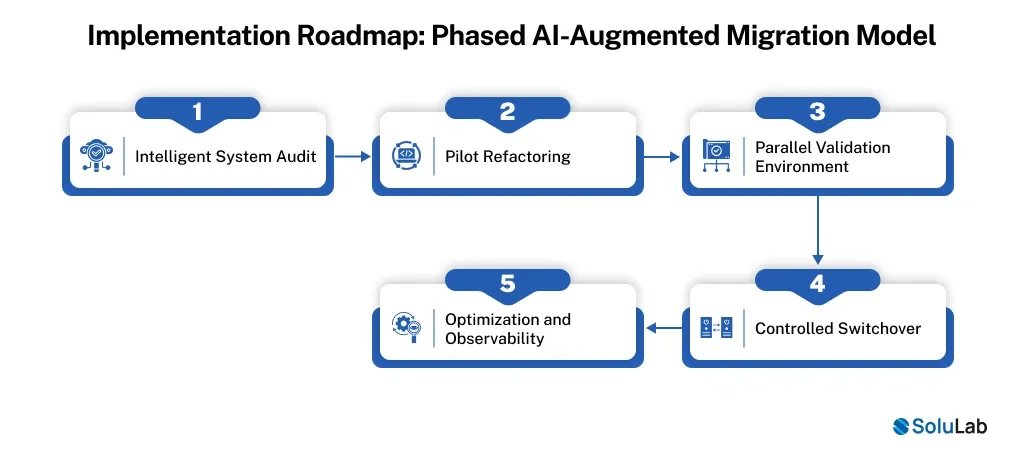
Modernization failure often stems from attempting a full transformation in a single leap. AI-Powered Legacy System Modernization uses advanced generative AI solutions, LLM development frameworks, and intelligent AI agents to automate code analysis, refactoring, and validation.
A phased AI-assisted modernization roadmap reduces operational shock.
Phase 1: Intelligent System Audit
- AI codebase ingestion
- Dependency graph creation
- Data lineage mapping
- Risk scoring assessment
This phase defines modernization scope and prioritization.
Phase 2: Pilot Refactoring
- Select non-critical modules
- Apply AI-Augmented Migration workflows
- Validate automated test coverage
- Compare manual vs AI output quality
Proof of viability is established here.
Phase 3: Parallel Validation Environment
- Run legacy and modernized systems concurrently
- Monitor output parity
- Track anomaly alerts
- Perform compliance checks
AI-Driven System Migration platforms assist with automated comparison reports.
Phase 4: Controlled Switchover
- Gradual traffic redirection
- Real time performance monitoring
- Rollback readiness
Operational resilience is preserved.
Phase 5: Optimization and Observability
- Performance tuning
- Architecture simplification
- Automation enhancement
- Governance dashboard implementation
This is where Legacy Modernization delivers sustained return. Modernizing legacy systems with AI is not about speed alone. It is about risk-managed acceleration.
Case Patterns Emerging in 2026
By 2026, certain modernization patterns will repeat across industries. These are not isolated experiments. They reflect structural shifts in how enterprises approach Legacy Modernization.
Banking Core Platform Modernization
Traditional core banking systems often contain:
- Monolithic transaction engines
- Hard-coded compliance logic
- Batch processing limitations
Manual Legacy System Migration in such environments can stretch across multiple years.
AI-Augmented Legacy Modernization enables:
- Extraction of regulatory calculation logic
- Automated refactoring into modular microservices
- Real-time processing enablement
- Automated documentation for regulators
Banks pursuing Enterprise legacy transformation 2026 are prioritizing AI-Driven System Migration because regulatory continuity and traceability are critical.
Insurance Claims Platform Migration
Legacy claims systems frequently rely on outdated workflow engines and brittle integrations.
AI-assisted modernization allows:
- Workflow mapping through dependency graph reconstruction
- Business rule translation into configurable engines
- Automated regression testing of edge-case scenarios
The reduction in error density materially lowers claims risk exposure.
Fintech Payment Stack Refactoring
High-growth fintechs often face scaling bottlenecks due to early architectural shortcuts. Legacy infrastructure modernization through AI-Powered Legacy System Modernization helps:
- Identify performance bottlenecks
- Rebuild API layers
- Automate test harness creation
- Improve observability
For fintechs, speed is competitive survival.
Enterprise ERP Cloud Re-Architecture
Large enterprises modernizing ERP systems benefit from:
- Automated code migration tools are translating legacy modules
- AI-driven anomaly detection
- Incremental module-based migration
These patterns demonstrate that AI vs Manual Migration is no longer theoretical. It is operational. Partnering with a proven AI integration company enables enterprises to accelerate transformation while maintaining compliance, scalability, and long-term architectural integrity.

Conclusion: The Economics of Modernization Have Shifted
For years, Legacy Modernization was treated as a technical backlog. In 2026, it is a capital strategy decision. Manual Legacy System Migration remains viable, but its cost curve is increasingly misaligned with enterprise velocity demands. This shift represents the evolution of AI software development, where systems are no longer manually rewritten but intelligently transformed.
AI-Augmented Legacy Modernization changes the equation:
- Faster discovery
- Lower cumulative labor cost
- Improved governance visibility
- Reduced operational disruption
The Cost-Benefit Analysis of Legacy Modernization now favors intelligence-augmented approaches for most mid-to-large enterprises.
- To modernize legacy systems is to secure competitive resilience.
- To modernize legacy systems with AI is to do so with speed, structure, and strategic clarity.
The question is no longer whether modernization is required. It is whether organizations will approach Enterprise legacy transformation 2026 with manual inertia or AI-enabled precision.
Frequently Asked Questions
Shipra Garg is a tech-focused content strategist and copywriter specializing in Web3, blockchain, and artificial intelligence. She has worked with startups and enterprise teams to craft high-conversion content that bridges deep tech with business impact. Her work translates complex innovations into clear, credible, and engaging narratives that drive growth and build trust in emerging tech markets.