Key Takeaways
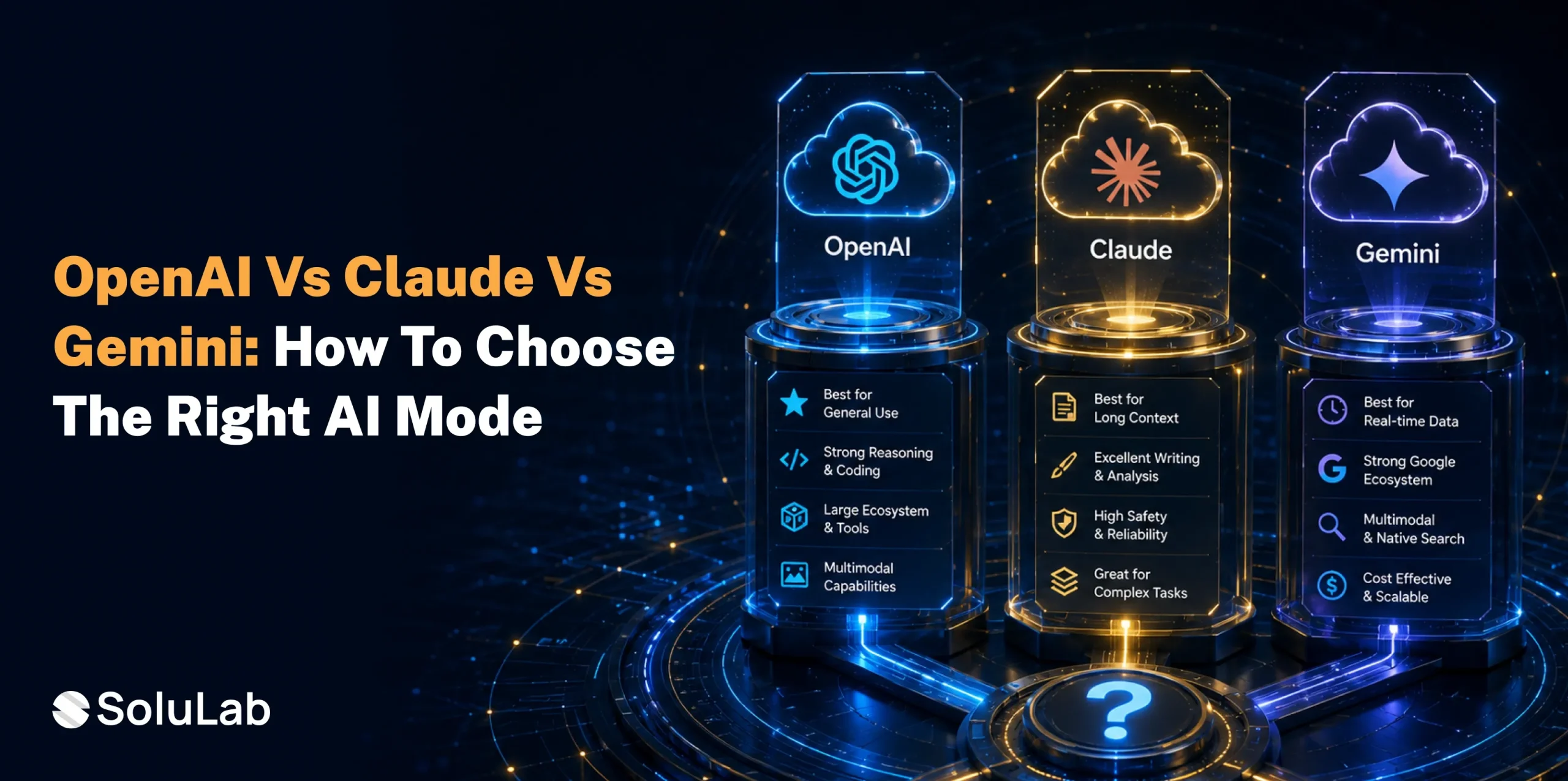
- OpenAI (GPT-5), Claude (Anthropic), and Gemini (Google) each lead in different areas; there is no single “best” AI model, only the best model for a specific use case.
- Claude is generally favored for coding, long-form writing, and instruction-following; GPT for ecosystem breadth, multimodal tools, and third-party integrations; Gemini for massive context windows, native multimodality, and Google Workspace/GCP environments.
- For businesses, the model is only one part of the decision API pricing, context window, security/compliance, and integration effort matter just as much as raw benchmark scores.
- Working with an experienced AI development company helps businesses test, benchmark, and deploy the right model (or combination of models) instead of guessing based on marketing claims.
Choosing between OpenAI, Claude, and Gemini used to be simple: pick the one you’d heard of. That’s no longer true. In 2026, all three models will ship frontier-level models on tight release cycles, each with genuine strengths in different areas: coding, reasoning, multimodal understanding, agentic workflows, and enterprise integration.
For individual users, this comparison is about convenience for choosing AI development solutions. For businesses, it’s a real technical and financial decision. The AI model comparison you choose to believe determines your API costs, your integration timeline, your compliance posture, and how well the tool actually performs on your specific workflows.
This guide breaks down OpenAI vs Claude vs Gemini across the dimensions that matter for real decision-making, not just chatbot demos, and shows how to think about AI model implementation and deployment once you’ve made a choice.
OpenAI, Claude, and Gemini: A Quick Overview
Before comparing GPT-5 vs Claude 4 vs Gemini 2.5 head-to-head, it helps to understand where each model comes from and what it was built to optimize for.
- OpenAI (GPT models): Best known for ChatGPT, OpenAI’s GPT line prioritizes broad general-purpose capability for text, code, image, and audio in one interface, backed by the largest third-party plugin and API ecosystem of the three.
- Anthropic (Claude models): Claude is built with an emphasis on reasoning quality, instruction-following, safety, and long-context reliability. It has become the best AI model for coding tools and agentic developer workflows. Claude’s enterprise adoption increased from 63.9% to 95.3% of organizations in one year, one of the fastest growth rates among AI applications.
- Google (Gemini models): Gemini is developed by Google DeepMind and is deeply integrated with Google Workspace, Search, and Google Cloud. It typically depends on the context window size and native multimodal (video/audio) understanding. It’s the best AI model for enterprises.
OpenAI vs Claude vs Gemini: Quick Comparison Table
Here’s a quick comparison between OpenAI vs Claude vs Gemini.
| Dimension | OpenAI (GPT) | Claude (Anthropic) | Gemini (Google) |
| Strongest At | Ecosystem breadth, multimodal capabilities, and versatile AI applications | High-quality coding, reasoning, and long-form writing | Massive context window and multimodal understanding |
| Context Window | Large (varies by model) | Large with excellent long-context accuracy | Typically the largest context window among the three |
| Coding Performance | Strong coding capabilities with mature IDE integrations | Frequently ranks among the top models on coding benchmarks | Rapidly improving, especially for large and complex codebases |
| Agentic & Tool Use | Advanced AI agents, browser automation, and tool calling | Powerful coding agents and computer-use capabilities | Best integrated with Google’s AI agent ecosystem |
| Enterprise Integration | Broadest third-party integrations and API ecosystem | Available through APIs, AWS Bedrock, and Vertex AI | Deep integration with Google Workspace and Google Cloud Platform (GCP) |
| Pricing Model | Per-token pricing with multiple model tiers | Competitive per-token pricing for flagship models | Often the most cost-effective at comparable performance tiers |
| Best For | General-purpose AI, business automation, content creation, and app development | Software development, document analysis, research, and complex reasoning | Multimodal workflows, large-context tasks, and Google-native enterprise environments |
OpenAI vs Claude: Which Should You Choose?
This is the comparison most businesses actually start with, since GPT and Claude are the two most widely deployed models in production. OpenAI tends to win on ecosystem maturity more plugins, more documented integrations, more community solutions.
Claude tends to win on instruction-following and coding reliability, especially for complex, multi-step prompts and long documents where consistency matters more than speed.
Claude vs Gemini: Which Should You Choose?
Claude vs Gemini often comes down to the environment. If your organization already runs on Google Workspace or Google Cloud, Gemini’s native integration reduces friction significantly. In fact, Gemini has crossed 900 million users.
If your priority is code quality, nuanced writing, or careful multi-step reasoning, Claude is usually the stronger fit — particularly for teams already using Claude Code or MCP-based agent workflows.
GPT vs Claude vs Gemini for Specific Use Cases
Rather than declaring one universal winner, most real evaluations come down to matching the model to the job.
- Best AI model for coding: Claude and GPT are the most commonly cited leaders here, with Claude particularly strong in full-file refactors and large-codebase reasoning, and GPT well-supported across IDE plugins and coding assistants.
- Best AI model for developers: All three now offer capable APIs and SDKs, but developer experience differs — OpenAI has the largest community and third-party tooling, Claude offers deep agentic and tool-use capabilities via its API and MCP, and Gemini integrates tightly with Vertex AI for teams already on GCP.
- Best AI model for business: This depends on the workflow. Customer-facing content and long-document work often favor Claude; broad automation and off-the-shelf integrations favor GPT; large-scale document or video processing favors Gemini.
- Best AI model for enterprises: Enterprise decisions weigh compliance certifications, data residency, admin controls, and vendor lock-in as heavily as model quality — which is why many enterprises end up running more than one model rather than standardizing on a single provider.
How to Choose the Right AI Model for Your Business?
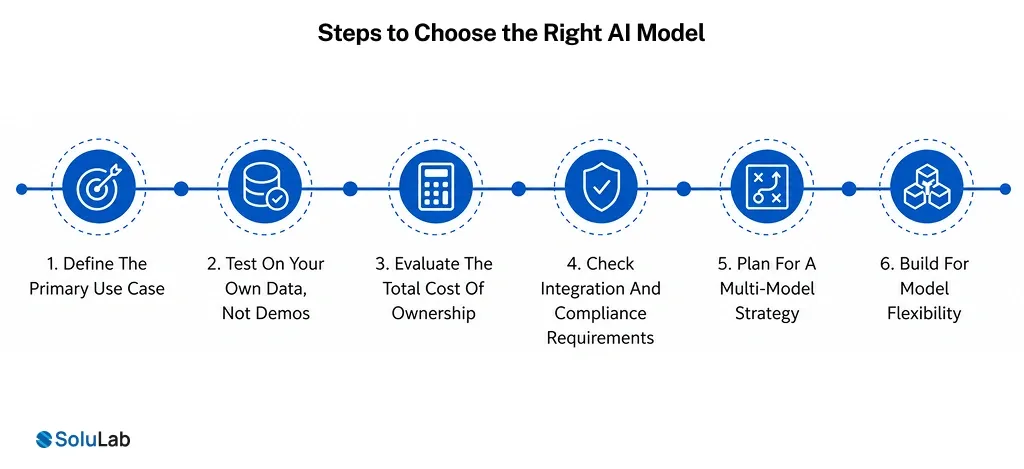
Comparing benchmark scores is only step one. Choosing an AI model for a real business use case requires a structured evaluation process.
1. Define The Primary Use Case
Coding, customer support, content generation, and data analysis each favor different models — decide what you’re optimizing for before comparing options.
2. Test On Your Own Data, Not Demos
Public benchmarks rarely reflect your actual prompts, documents, or workflows. Run a pilot with your real use cases before committing.
3. Evaluate The Total Cost Of Ownership
Token efficiency per completed task, output length limits, and caching options usually matter more than headline per-million-token pricing.
4. Check Integration And Compliance Requirements
Confirm that the model’s certifications, data-handling policies, and available deployment paths (direct API, AWS Bedrock, Google Cloud, Azure) align with your regulatory environment.
5. Plan For A Multi-Model Strategy
Many businesses route different tasks to different models, for example, a lightweight model for simple queries and a flagship model for complex reasoning, rather than relying on one provider for everything.
6. Build For Model Flexibility
Architect your application so the underlying model can be swapped or upgraded without a full rebuild, since all three providers ship new versions frequently.
Real-World Applications: OpenAI, Claude, and Gemini in Action
- Software development: Engineering teams commonly use Claude or GPT-powered coding assistants for code review, refactoring, and test generation, often embedded directly in IDEs.
- Customer support automation: Businesses deploy all three models behind AI agents for multi-turn support conversations, typically paired with retrieval and human escalation rather than run as raw chatbots.
- Enterprise document and data analysis: Gemini’s large context window is frequently used for processing lengthy contracts, reports, or transcripts in a single pass; Claude is often chosen for tasks requiring careful, nuanced synthesis.
- Content and marketing operations: Claude is frequently used for long-form writing and brand-voice-consistent content, while GPT’s ecosystem supports broader content-and-image workflows in one interface.
Why Choose SoluLab for AI Model Implementation and LLM Development?
Choosing between OpenAI, Claude, and Gemini isn’t a one-time decision — it’s an ongoing evaluation as all three release new models throughout the year. SoluLab, an AI native company, helps businesses cut through the noise with hands-on AI model implementation and deployment support.
- AI Model Selection & Benchmarking for Your Use Case
- LLM Integration Services (OpenAI, Claude, Gemini, and open-source models)
- Custom AI Application Development
- AI Agent & Workflow Development
- Multi-Model Architecture Design
- API Integration & Cloud Deployment (AWS, GCP, Azure)
- AI Model Migration & Upgrades
- Enterprise AI Consulting & Roadmapping
SoluLab’s LLM development services are model-agnostic by design — we help you evaluate GPT-5, Claude, and Gemini 2.5 against your actual workflows, then build and deploy the solution that fits, without locking you into a single vendor before you’ve proven it’s the right one.
Conclusion
There’s no single winner in the OpenAI vs Claude vs Gemini models. What matters is a structured evaluation: define your primary workflow, test candidate models against your own data, account for the full cost of implementation, and build in the flexibility to switch or combine models as the landscape keeps shifting.
SoluLab, an AI development company in USA, can help your business evaluate, implement, and deploy the right AI model or the right combination of models so your investment holds up as the technology evolves.
FAQs
Neha is a curious content writer with a knack for breaking down complex technologies into meaningful, reader-friendly insights. With experience in blockchain, digital assets, and enterprise tech, she focuses on creating content that informs, connects, and supports strategic decision-making.