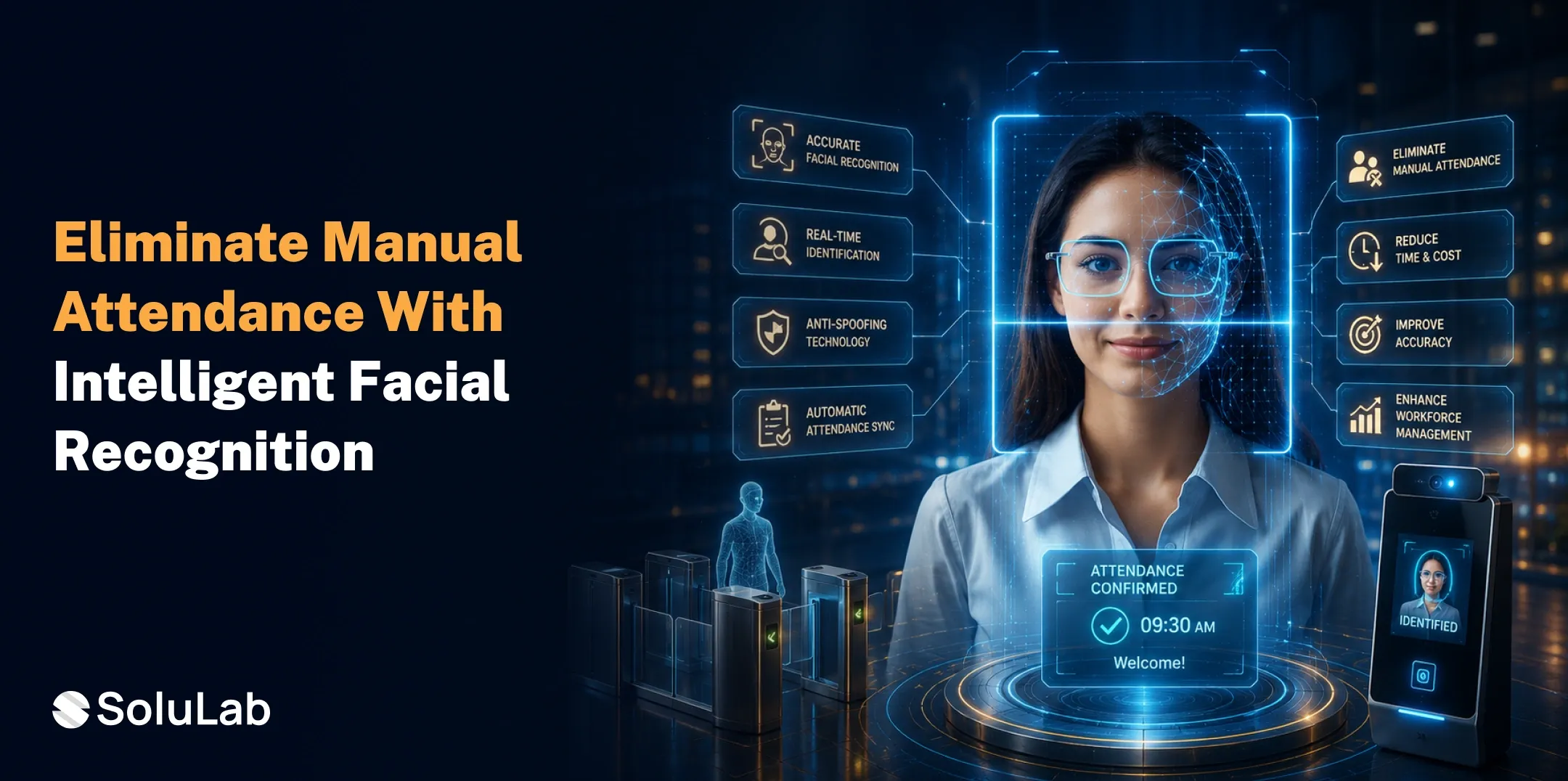
You manage a growing business with hundreds or even thousands of employees across multiple offices, branches, or job sites.
How do you eliminate manual attendance tracking, prevent buddy punching, reduce payroll errors, and monitor employee attendance in real time?
The answer lies in an AI-powered face recognition attendance system.
These AI development solutions for attendance automatically identify employees using facial recognition, record attendance within seconds, and integrate with HRMS and payroll systems. All without requiring physical cards, fingerprints, or manual intervention.
This guide will walk you through building an AI-powered face-recognition attendance system, the technologies involved, and best practices for creating a scalable, secure solution.
Key Takeaways
- AI-powered face recognition attendance systems automate attendance tracking, improve accuracy, and eliminate manual processes while reducing payroll errors and attendance fraud.
- Recognition performance depends on multiple factors, including lighting, camera quality, facial pose, image resolution, and proper model training for consistent accuracy.
- Organizations across industries such as healthcare, manufacturing, retail, education, and government are adopting face recognition attendance to streamline workforce management and enhance security.
- Long-term success relies on scalability and compliance, ensuring the system remains secure, privacy-compliant, and adaptable to future ai advancements and growing business needs.
What is an AI-Powered Face Recognition Attendance System?
An AI-powered face recognition attendance system uses artificial intelligence and computer vision to automatically identify employees through their facial features and record attendance without requiring physical contact.
The global facial recognition market is projected to grow from USD 8.5 billion in 2026 to USD 19.6 billion by 2033, growing at a CAGR of 12.8% from 2026 to 2033.
- Uses AI to recognize unique facial characteristics.
- Automates employee check-in and check-out.
- Eliminates manual, RFID, or fingerprint attendance.
- Prevents buddy punching and attendance fraud.
- Integrates with HRMS, payroll, and workforce management systems.
- Provides real-time attendance tracking and analytics.
How Does an AI-Powered Face Recognition Attendance System Work?
- Face Capture: A camera captures the employee’s facial image.
- Face Detection: AI locates and isolates the face from the image.
- Face Analysis: Facial features are converted into a unique digital template (face embedding).
- Face Matching: The template is compared with enrolled employee records.
- Liveness Detection: Verifies the presence of a real person to prevent spoofing using photos or videos.
- Attendance Logging: On successful verification, the system records attendance and syncs it with HR or payroll software in real time.
Why Are Businesses Switching to AI Attendance Systems?
Businesses are moving beyond traditional attendance methods to AI-driven solutions that improve accuracy, reduce administrative workload, and support modern workforce management. Here are the key reasons behind this shift.
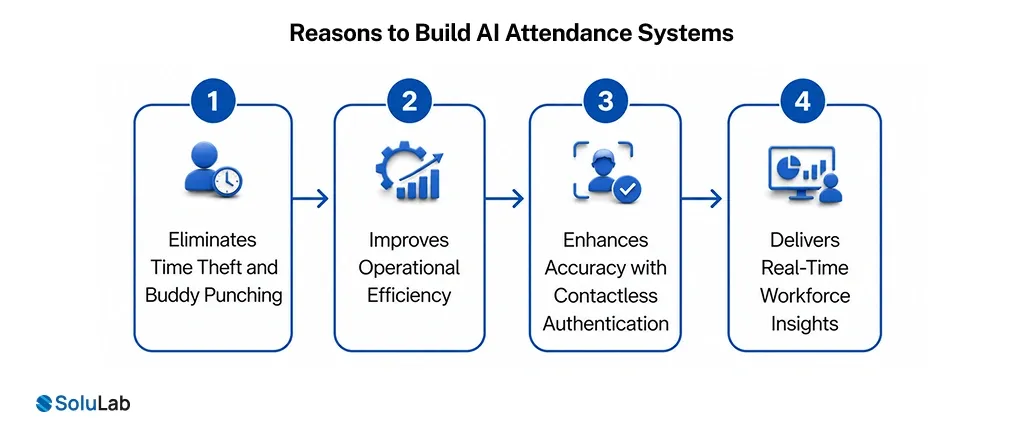
1. Eliminates Time Theft and Buddy Punching
Traditional attendance methods are vulnerable to proxy check-ins and manual errors. A face recognition attendance app verifies each employee’s identity using unique facial features, ensuring authentic attendance records.
2. Improves Operational Efficiency
AI automates attendance tracking, reducing HR workload and minimizing manual data entry. It delivers real-time attendance records, faster processing, and seamless integration with payroll and HR systems.
3. Enhances Accuracy with Contactless Authentication
Unlike fingerprint scanners or ID cards, facial recognition offers fast, touch-free authentication. It accurately identifies employees in seconds, reducing queues while maintaining a smooth attendance experience.
4. Delivers Real-Time Workforce Insights
A face attendance management system provides centralized dashboards, attendance reports, shift tracking, and productivity analytics, enabling managers to make informed workforce decisions and improve operational planning.
Step-by-Step Guide to Build an AI-Based Smart Attendance System using Face Recognition
A well-planned development process ensures your attendance solution is accurate, scalable, and secure. Follow these essential steps to build an AI-based attendance system using face recognition that meets modern business requirements.
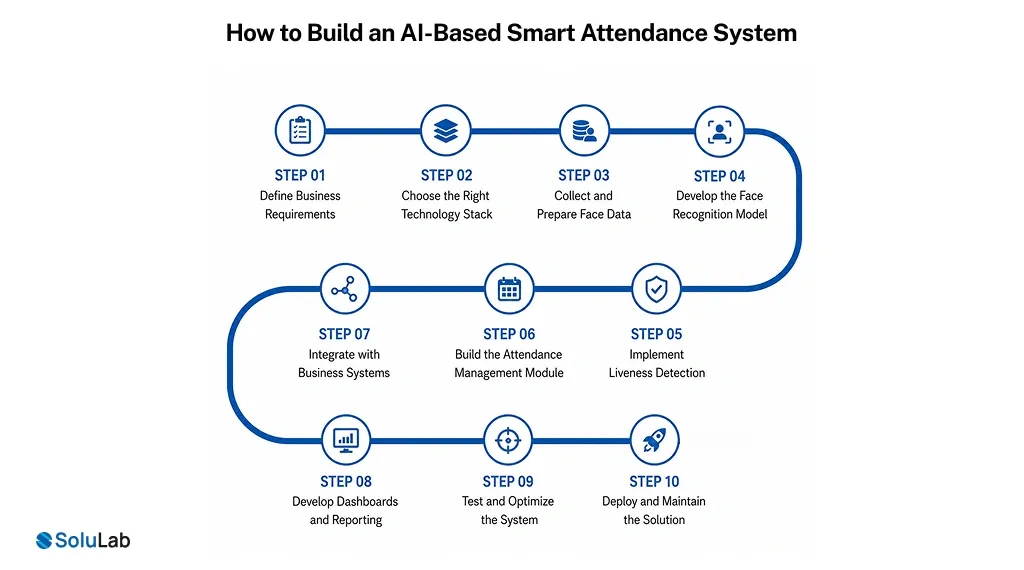
1. Define Business Requirements
Start by identifying your business goals, workforce size, attendance policies, and AI integration needs. This helps define the system architecture and ensures the solution aligns with operational requirements.
- Identify business objectives clearly
- Define attendance workflows early
- Plan future scalability needs
2. Choose the Right Technology Stack
Select technologies that support fast processing, secure data storage, and seamless integrations. The right AI tech stack improves performance, maintenance, and long-term scalability.
- Choose a scalable backend framework
- Select a reliable cloud platform
- Use secure database solutions
3. Collect and Prepare Face Data
Gather high-quality facial images under different lighting conditions and angles. A diverse dataset improves recognition accuracy and minimizes false matches.
- Capture multiple facial angles
- Ensure consistent image quality
- Include varied lighting conditions
4. Develop the Face Recognition Model
Train or integrate a face recognition model capable of detecting and identifying faces accurately. Optimize the model for speed and real-time attendance verification.
- Train accurate recognition model
- Optimize inference performance
- Validate model accuracy regularly
5. Implement Liveness Detection
Add anti-spoofing capabilities to prevent attendance fraud using AI powered cameras, videos, or digital images. This improves system security and trustworthiness.
- Detect spoofing attempts instantly
- Verify real user presence
- Strengthen attendance security
6. Build the Attendance Management Module
Develop the core attendance engine to record check-ins, check-outs, shift timings, and leave information while automating attendance logs.
- Automate attendance recording
- Manage shift schedules efficiently
- Generate attendance reports
7. Integrate with Business Systems
Connect the attendance platform with HRMS, payroll, and access control software to streamline workforce operations and eliminate manual data entry.
- Integrate HRMs
- Automate payroll synchronization
- Connect access control systems
8. Develop Dashboards and Reporting
Create intuitive dashboards for administrators and employees to monitor attendance records, productivity metrics, and workforce trends in real time.
- Display attendance analytics
- Generate custom reports
- Monitor workforce performance
9. Test and Optimize the System
Perform extensive testing across different environments to identify performance issues, improve recognition accuracy, and ensure system reliability.
- Conduct performance testing
- Improve recognition accuracy
- Resolve system bottlenecks
10. Deploy and Maintain the Solution
Deploy the AI-based attendance system on cloud, edge, or on-premises infrastructure. Continuously monitor performance, update AI models, and maintain system security.
- Monitor system performance continuously
- Update recognition models regularly
- Maintain strong data security

Essential Features Every AI Attendance Solution Should Include
A feature-rich AI attendance solution goes beyond recording employee check-ins. It combines intelligent automation, security, and seamless integrations to improve workforce management, enhance accuracy, and simplify daily attendance operations.
- Face recognition and liveness detection: Verifies employee identity in real time while preventing attendance fraud through anti-spoofing techniques such as photo, video, and mask detection.
- Real-time attendance tracking: Automatically records employee check-ins, check-outs, shift timings, and overtime while providing instant attendance updates across multiple locations.
- HRMS and payroll integration: Synchronizes attendance data with HRMs, payroll, and leave management systems to eliminate manual data entry and improve payroll accuracy.
- Analytics and reporting dashboard: Generates real-time attendance reports, workforce insights, absenteeism trends, and productivity metrics, enabling managers to make faster, data-driven decisions.
- Role-based security and data protection: Protects sensitive biometric data using encryption, secure authentication, access controls, and compliance features to ensure privacy and regulatory adherence.
Face Recognition Accuracy: Factors That Affect Performance
Accurate facial recognition depends on several environmental and technical factors that directly influence system performance. Optimizing these variables helps an AI face attendance system deliver reliable, fast, and consistent attendance tracking.
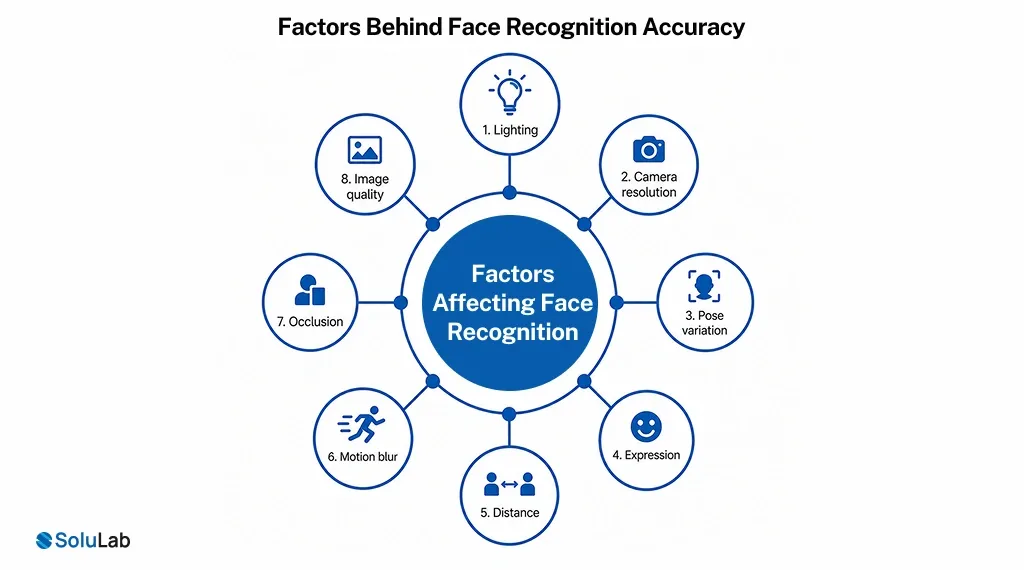
- Lighting: Poor or uneven lighting reduces facial visibility, significantly lowering recognition accuracy.
- Camera resolution: Low-resolution cameras capture fewer facial details, increasing identification errors.
- Pose variation: Extreme head angles make facial feature extraction less accurate and reliable.
- Expression: Significant facial expressions can slightly alter features, affecting matching consistency.
- Distance: Excessive camera distance decreases facial detail, making accurate recognition more difficult.
- Motion blur: Rapid movement creates blurred images, reducing detection and matching performance.
- Occlusion: Masks, glasses, or objects covering the face hinder accurate facial recognition.
- Image quality: Noisy or compressed images limit feature extraction, decreasing overall recognition precision.
Use Cases of Face Recognition Attendance System using AI
Face recognition attendance systems are transforming workforce management across industries by automating attendance, improving security, and reducing manual effort. Businesses increasingly rely on computer vision development services to build scalable, intelligent solutions.
1. Corporate Offices
Corporate organizations use face recognition to automate employee attendance, improve workplace security, and integrate attendance records with HRMs and payroll systems through face recognition software development.
- Eliminate manual attendance tracking
- Prevent buddy punching fraud
- Simplify payroll processing
2. Manufacturing
Manufacturing facilities monitor employee attendance across multiple production units while ensuring only authorized personnel have access to restricted work areas.
- Track multi-shift workforce
- Control factory floor access
- Improve workforce productivity
3. Hospitals
Hospitals use AI-powered attendance to accurately manage doctors, nurses, and staff working across rotating shifts and emergency schedules.
- Manage rotating shift attendance
- Improve staff accountability
- Reduce administrative workload
4. Schools
Schools automate teacher and staff attendance while reducing paperwork and improving administrative efficiency through contactless attendance systems.
- Record attendance automatically
- Reduce manual administration
- Improve attendance accuracy
5. Universities
Universities streamline attendance for faculty, staff, and students while generating centralized attendance reports across departments.
- Automate campus attendance
- Generate attendance reports
- Improve academic administration
6. Co-working Spaces
Co-working spaces use face recognition to manage member access, automate attendance, and enhance security without physical cards or badges.
- Enable contactless workspace access
- Track member attendance
- Improve facility security
ROI and Cost-Benefit Analysis of AI Face Recognition Attendance System
ROI and cost-benefit analysis help businesses evaluate the long-term value of intelligent attendance solutions. A smart attendance system using AI reduces operational costs while improving workforce efficiency, security, and compliance.
1. Reduced Administrative Costs
Automating attendance eliminates manual recordkeeping, minimizes payroll errors, and reduces the need for dedicated administrative resources, resulting in significant operational cost savings over time.
2. Lower Attendance Fraud and Payroll Losses
Face recognition prevents buddy punching and unauthorized attendance entries, ensuring employees are paid accurately while reducing financial losses caused by fraudulent time tracking.
3. Improved Workforce Productivity
Automated attendance allows HR teams and managers to focus on strategic tasks instead of manual verification, increasing operational efficiency and improving overall workforce productivity.
4. Faster Return on Investment
Although implementation requires an initial investment, businesses recover costs through reduced labor expenses, streamlined operations, accurate payroll processing, and lower compliance risks.
Future Trends in AI Attendance Systems
Evolving AI trends are changing attendance management by improving speed and security. These innovations will make every smart attendance system using AI more accurate, adaptive, and future-ready.
1. Edge AI Inference
Edge AI enables facial recognition directly on local devices instead of relying on cloud servers, reducing latency, improving privacy, and ensuring uninterrupted attendance verification even with limited internet connectivity.
2. Vision Transformers (ViTs)
Vision transformers deliver higher recognition accuracy by understanding complex facial patterns and contextual information, making attendance systems more reliable across varying lighting conditions, poses, and facial expressions.
3. Multimodal Biometrics
Future attendance systems will combine facial recognition with voice, iris, fingerprint, or palm recognition to strengthen identity verification, minimize spoofing risks, and enhance overall authentication accuracy.
4. Agentic AI Monitoring
Agentic AI will continuously monitor attendance patterns, detect anomalies, automate workforce insights, and proactively recommend scheduling or compliance improvements without requiring constant human intervention.
Partner with SoluLab to Build Your Custom AI Face Recognition Attendance System
As an AI native company, we build an AI-powered face recognition attendance system that requires expertise across AI, computer vision, cloud infrastructure, and enterprise integration.
Solulab delivers end-to-end development services tailored to your business needs.
- Employee face enrollment solutions
- Liveness detection implementation
- Attendance management software development
- HRMS and payroll integration
- Mobile attendance application development
- Cloud-based attendance system development
- Biometric data security implementation
- Multi-location attendance management
- Access control system integration
As a leading AI software development company, Solulab designs scalable, secure, and enterprise-grade attendance solutions tailored to your workforce and operational requirements.
Our expertise in AI application development enables businesses to build intelligent face recognition attendance systems with integrations, high accuracy, and long-term scalability.
For example, SoluLab helped a leading Japanese supermarket chain implement AI face recognition, integrating CRM and billing data to enable personalized promotions, real-time analytics, and automated insights.
Resulting in increased footfall, higher revenue, improved customer loyalty, reduced walkouts, and enhanced operational efficiency. Connect with us to discuss an AI face recognition solution for your business.
Conclusion
Building an AI-powered face recognition attendance system requires more than integrating facial recognition models.
It involves selecting the right technology stack, implementing secure liveness detection, ensuring data privacy, and creating a scalable architecture that integrates with your existing business systems.
If you’re ready to develop a secure, scalable, and feature-rich solution, SoluLab, an AI development company in the USA, can help your business build a custom face recognition attendance system tailored to your unique needs.
FAQs
Neha is a curious content writer with a knack for breaking down complex technologies into meaningful, reader-friendly insights. With experience in blockchain, digital assets, and enterprise tech, she focuses on creating content that informs, connects, and supports strategic decision-making.