The document pile has always been the part of legal work nobody brags about, and it is exactly the part artificial intelligence went after first. These artificial intelligence (AI) agents are built for one job: processing legal paperwork faster, with fewer misses. Data volumes climb. Regulatory obligations climb with them. In-house teams and firms are stuck absorbing both, and AI agents are one of the few answers that scale.
The uptake curve is steep. Back in 2023, only 19% of legal practitioners were using AI tools at all. By 2024, that share increased to 79%, which tells you how quickly this moved from side experiment to standard practice inside legal operations. Hand the tedium to an agent and the strategic hours come back.
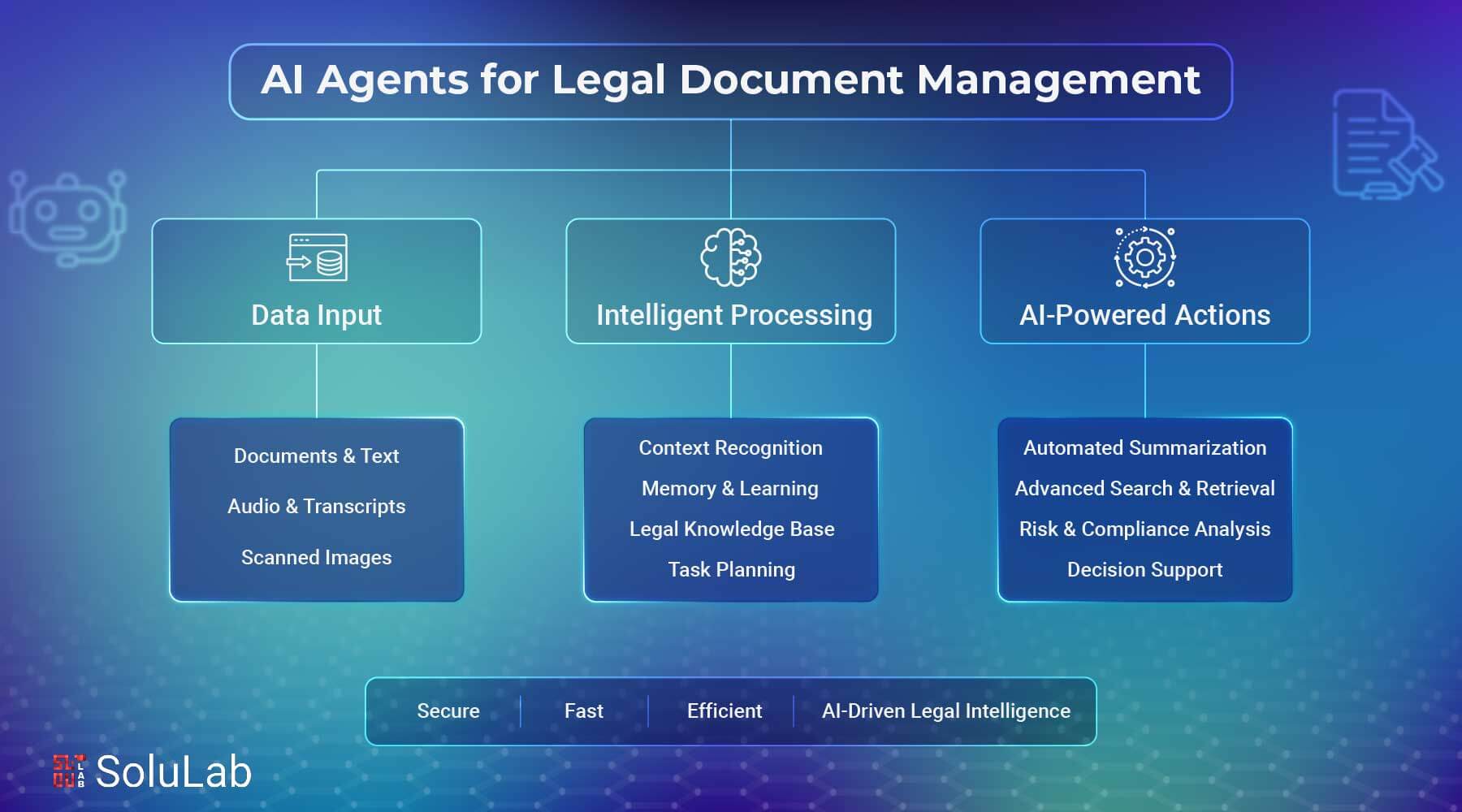
Retrieval stops being a scavenger hunt. Agents sort, tag, and surface what you asked for, and they also read across enormous datasets to pull out patterns that shape strategy. Below: the use cases, the parts under the hood, and what actually breaks.
Applications Of AI Agent in Legal Document Management

Simpler documents, fewer errors, less wasted time. That is the shape of the gain. Here are the applications and use cases worth knowing:
1. Drafting and Creating Documents
AI agents hand you a template and then suggest language drawn from existing legal texts and accepted practice. They check the draft against current regulations and flag whether the protective clauses each side expects are actually in there. Non-disclosure agreements, employment contracts, leasing agreements: the everyday stuff gets assembled in minutes. And because the agent can bend a template to a specific client’s demands, you get consistency without the copy-paste tax.
2. Contract Analysis
AI agents take contract review off the associate’s desk. Key terms, obligations, buried risks: found and extracted in one pass. That is hours saved, and more to the point, it is the tired-at-11pm mistakes that stop happening. Cross-reference the text against legal standards and your own historical data and the agent will start pointing at errors and proposing tighter wording, which is how contracts end up harder to break and easier to defend.
3. Managing and Organizing Documents
Categorizing, labeling, indexing. Nobody wants to do it, so it gets done badly, and then nobody can find anything. Agents automate all three, and the filing structure stops rotting. They will also read a hundred-page brief and give you the key points in a paragraph, which is the feature most lawyers end up using daily. AI-powered document management solutions cover the rest: storage, access, retrieval.
4. Legal Research and Case Law Analysis
Point an LLM-powered agent at the case law databases, the statutes, the journal archives, and it reads all of it. Precedents surface. Governing principles surface. What used to be a two-day research slog turns into a first draft of the legal context before lunch. AI agents lean on natural language processing to parse legal terminology properly, which is why the results are relevant rather than merely keyword-adjacent, and that is where a stronger argument starts.
5. Merger and Acquisition Diligence
Diligence is document review at industrial scale. Every risk and every obligation hiding in a deal has to be dug out of a data room nobody has time to read end to end. Agents work through the contracts, the financial statements, the compliance filings, and flag the inconsistencies. Not a verdict, a shortlist. Legal teams then spend their attention on the twelve things that matter instead of the twelve hundred that do not, and the deal gets assessed faster and for less money.
6. Monitoring Compliance and Regulations
Rules change and nobody sends you a memo. In banking and healthcare, where the rulebook is thick and moves constantly, that is a standing liability for firms and corporate legal departments alike. AI agents watch for the changes as they land and check documents and processes against the updated requirements. The payoff is boring and valuable: no surprise violations, no fines you could have avoided.

7. Predictive Analytics and Litigation Support
Can a machine tell you how your case will go? Not exactly, but it can read what happened in every comparable case and give you odds worth arguing about. That is the predictive analytics model. It sharpens strategy and it sharpens the go-or-settle call. Judicial tendencies, the patterns in opposing counsel’s past filings, how matters like yours resolved: all of it feeds the plan. Then there is e-discovery, where AI grinds through mountains of electronic data hunting for evidence, and the savings in hours and dollars are not subtle.
8. Better Client Communication And Service
Clients hate silence more than they hate bad news. Agents answer the simple legal questions instantly and push case progress updates without anyone drafting an email. AI-powered chatbots open the consultation, collect the intake details, and offer basic guidance from a programmed knowledge base. Fast, accurate replies keep people feeling looked after while their matter grinds on. The engagement process gets lighter, and legal services stop feeling like a black box.
How to Build AI Agents for Legal Document Management?

Building AI agents for legal document management is not a weekend project. You are stitching machine learning, NLP, and automation into workflows that lawyers already trust, and the order you do it in matters.
Step 1: Describe the Goals
Start with the contract terms, conditions, and clauses your analysis actually turns on. Then map the laws, regulations, and precedents that apply. Skip this and everything downstream drifts, because AI-powered contract review and compliance only work when the target is defined first.
Step 2: Choose a Suitable LLM
You want a model that can draft, condense, and hold legal context in its head at once. GPT-4 is strong on the advanced reasoning side, which is what complex documents demand when the meaning lives three clauses away from the sentence you are reading.
Step 3: Gathering and Preparing Data
Pull together good legal datasets: contracts, statutes, case law. Then clean them. Then preprocess and format them, properly, because a model fed messy text returns confident nonsense and you will not catch it until a client does. Reliable output starts here, not at the model.
Step 4: Educate the LLM
Customize and build a private LLM by fine-tuning it on legal data, so it learns how contracts are structured, what the terminology means in context, and how a rule gets applied to a set of facts. Without that step it is a general chatbot wearing a suit.
Step 5: Create an AI Agent
Build it modular. One module per legal task, each replaceable, each testable on its own. Wire those modules to the trained LLM and the agent can read a contract, lift the clauses that matter, and offer a perspective a lawyer can argue with.
Step 6: Design Output Production
Now the algorithms that do the review: spotting the clauses that carry weight and organizing what comes back into something readable. Build separate modules for condensing statutes, reading case law, and working through a legal question. Precision over polish, every time.
Read Also: How to Integrate AI Into Your App?
Integration of AI Agents in Legal Document Management
The tooling keeps improving, and firms that adopt it get more output per hour at lower cost. This is not a fad cycle. The daily mechanics of practicing law are being rearranged.
- Historical Context: Tracing how AI grew inside legal tech tells you what it has actually delivered versus what was promised. Useful context when a firm is deciding which new idea to bet on for efficiency or compliance.
- Document Classification: AI sorts papers by type and by what is inside them. Retrieval gets quicker, and a lawyer sitting on thousands of files can actually work through them.
- Initial AI Adoption: The first wave of tools made document review, contract analysis, and compliance checks less painful. Less grunt work, better accuracy. Modest by today’s standards, but it proved the point.
- Data Extraction: AI reads the text and pulls out the fields that matter. Fewer hands on the file means fewer transcription errors and a much shorter turnaround.
- Growth in AI Capabilities: The systems keep getting more capable. More tasks run unattended, judgment calls get better, and AI now carries a real share of the document work rather than assisting at the edges.
- Predictive Analysis: Run legal data through a model and patterns fall out, including how matters like yours have tended to end. Firms get to decide on evidence instead of instinct.
- Advanced AI Integration: AI now sits inside the workflow, not beside it. Compliance, research, and the gnarlier document tasks move along with minimal supervision.
AI agents vs. traditional LLMs for Legal documents
People use the two terms interchangeably and then buy the wrong thing. An AI agent and a traditional LLM are not the same purchase, and knowing where they diverge decides whether your rollout works. Blockchain for document management sits alongside both, handling the security and transparency layer. Here is the side-by-side.
| Parameters | AI Agents | Traditional LLMs |
| Goal | Run specific legal processes and tasks to completion inside set parameters. | Translate, analyze, generate content, and answer questions from whatever information you supply. |
| Focus | Task-first, and good at working a problem through. | Text in, text out. Information processing. |
| Usability | Reads data from many sources, talks to external systems, and decides with context in hand. | Mostly generating and processing text, usually boxed in by the context it was given. |
| Learning & Flexibility | Adjusts as legal conditions shift and as a client’s needs change, learning from what users tell it. | Trained on huge datasets, yet still trips on legal nuance and one-off client requirements. |
| Explainability & Transparency | The reasoning is easier to follow, because the task and the goal were narrow to begin with. | “Black box” behavior. Good luck reconstructing why it said what it said. |
| Security & Control | You keep tighter control over what it does and what data it reaches. | Training on vast datasets that may hold sensitive material raises real privacy questions. |
| Use Cases | Legal research, compliance management, contract review & drafting, case analysis, and forecasting. | Chatbots, legal research, contract analysis, document summarization, and translation. |
| Benefits | More customization, sharper decisions, fewer errors, and better speed and accuracy. | Strong multilingual support, quick text processing, and efficient content generation. |
| Future Potential | High, especially for automation and the complex legal tasks. | Strong on text-based work such as document analysis and summarization. |
Benefits of AI Agents for Legal Document Management
AI agents for the legal industry earn their keep in a simple way: the slow, repetitive, error-prone parts of document work get handled elsewhere, and lawyers spend their day on the work clients are actually paying for.
- Enhanced Risk Assessment and Due Diligence: An agent reads the whole stack and flags the problems, risks, and mismatches that a tired human reviewer skims past.
- Faster Research and Insights: Court cases, filings, rules: AI agents sweep the databases, surface what is relevant, and give the lawyer something to work from.
- Lower Costs: Simpler operations and higher throughput bring the cost of managing documents down. That budget goes somewhere it matters more.
- Improved Customer Experience: Better reporting, information that is actually available when asked for, and faster turnaround. Clients notice all three.
Check Out Our Blog Post: AI in Legal Industry
Future Trends in AI Agents for Legal Document Management
The tech moves whether or not you are watching, so staying ahead of it is part of the job. A few trends to keep on your radar:
1. Artificial Intelligence: AI automates the process work and hands back data-driven insight, and it is reshaping industry after industry. Predictive analytics, customer service chatbots, tailored marketing: bolt them together and both efficiency and ROI move.
2. IoT: the devices are everywhere now, collecting and analyzing data as it happens. IoT development companies build the specialized pieces that lift operational efficiency, customer experience, and how resources get allocated.
3. Blockchain Technology: Blockchain technology gives you transactions that are secure and open to inspection. Cryptocurrency was the first act. Supply chain management, smart contracts, and identity verification are where it earns its place now.
4. Remote Work Technologies: Distributed teams pushed collaboration and productivity tooling forward fast. Video conferencing, project management, and virtual reality meeting spaces all came out of that pressure.
5. Sustainability Technologies: Energy-efficient and waste-reduction technology keeps growing as sustainability climbs up the corporate priority list.
How to Address AI in Legal Document Management Challenges?
The upside is real. Getting there is where most projects stall.
So here are the sticking points, and what has worked against each one.
1. Data Privacy and Security Issues: Legal data is about as sensitive as data gets, and pushing it through an AI system opens questions the partners will ask on day one. Breaches and unauthorized access have to be designed out, not patched later.
Strong encryption is the floor. AI-driven security sits on top of it: continuous monitoring for anomalies, real-time alerts, and automated responses that fire before a human notices anything is wrong. That combination keeps the data safe and keeps you on the right side of the rules.
2. Integrating AI with Existing Systems: Document management systems are awkward and costly to touch. Most legal companies have processes and platforms that predate any of this, and the AI has to fit into them.
Integration is the answer, done deliberately. The AI should slot into what already runs without knocking it over. Interoperable, genuinely usable platforms make the switch survivable for the people doing the work.
3. AI-Enhanced Document Management: Use AI in legal work without an ethics position and you will lose trust before you lose compliance. Firms owe clients responsible, transparent use, with bias and unfair outcomes actively checked for.
Write the ethical rules before the features ship, and hold the deployment to them. Keep AI decision-making explainable, audit the algorithms for fairness and bias on a schedule, and both users and clients will stay with you.
4. Training and Support Challenge: Lawyers need ongoing training to get anything out of these tools. Skip it and you get the familiar outcome: frustrated users, an expensive system running at ten percent of what it can do. In practice, this is where most rollouts quietly die.
Getting the full value out of AI tools takes real training plus support that does not disappear after launch week. Cover every part of the tool, and staff a support team that answers questions when they come up. Then the AI becomes something lawyers use rather than something they avoid.
5. Managing Change and User Adoption: People who have done it the same way for twenty years will push back. Change management is not a soft add-on here, it is the difference between adoption and shelfware.
Take these on directly and a firm can fold AI into its document management system with security intact, ethics intact, and its people still on side.

Conclusion
Strip out the repetitive duties and what is left is the work lawyers trained for. That is the whole argument for AI agents in legal document management. Documents get handled properly and quickly, accuracy goes up, and the small mistakes that turn into big problems become much rarer.
AI’s share of this work is only going to grow. Attorneys who pick up the tools now will be better placed to handle what their field throws at them, with better results for clients and a firm that keeps pushing forward.
SoluLab helped Gradient, an AI platform, bring stable diffusion and GPT-3 together for image and text generation on AWS infrastructure. The sticking points were AI training, security, and the GPT-3 integration itself. With Amazon SageMaker, AWS security tooling, and API Gateway, Gradient tuned model performance and ended up with secure, scalable AI deployment that held steady and met its compliance obligations. Talk to SoluLab, an AI agent development company, about what that would look like for your document workflow.
FAQS
Shipra Garg is a tech-focused content strategist and copywriter specializing in Web3, blockchain, and artificial intelligence. She has worked with startups and enterprise teams to craft high-conversion content that bridges deep tech with business impact. Her work translates complex innovations into clear, credible, and engaging narratives that drive growth and build trust in emerging tech markets.