Key Takeaways
- Apartment rental apps simplify property discovery, booking, communication, and rent management through a single digital platform.
- Modern rental platforms use AI-powered recommendations, virtual tours, and smart search filters to improve user experience.
- A scalable apartment rental app requires strong backend architecture, secure integrations, and mobile-first UI/UX design.
- Development costs vary based on features, AI capabilities, platform complexity, and third-party service integrations.
- Real estate businesses are increasingly investing in rental marketplace apps to improve customer engagement and generate recurring revenue streams.
Finding a new apartment used to mean visiting brokers and spending days searching for the right place. Today, apartment rental apps have completely changed how people discover, compare, and rent properties online.
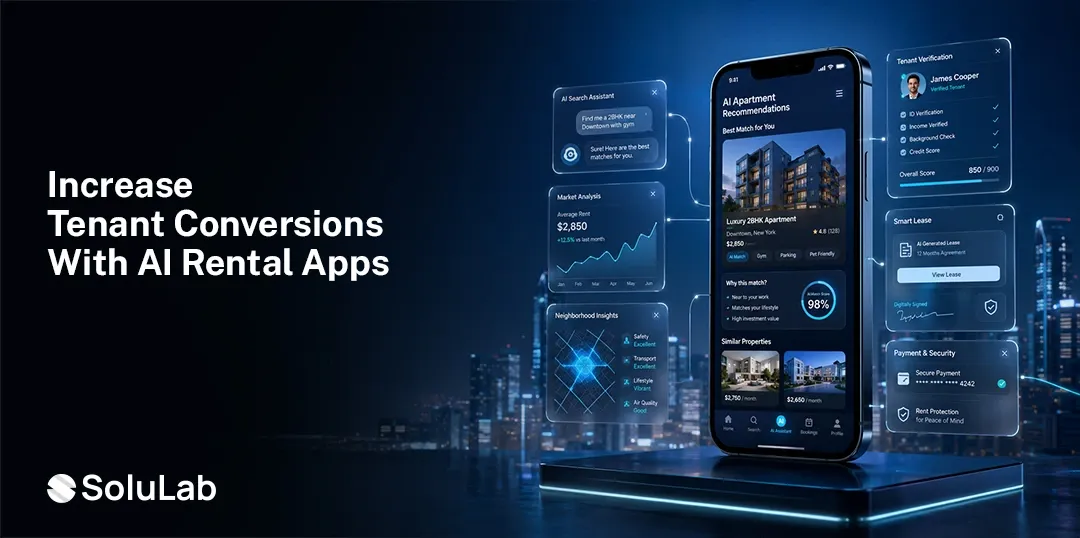
Modern users, including students, families, and working professionals, now expect smart, mobile-first, and highly personalized rental platforms that simplify every stage of the renting journey. With advancements in AI app development, businesses can offer intelligent property recommendations, AI-powered search filters, virtual property tours, automated tenant management, secure digital payments, and real-time communication within a single platform.
As demand for smarter real estate solutions continues to grow, investing in AI-powered apartment rental app development can help businesses improve user engagement, streamline operations, and create competitive digital rental ecosystems.
In this step-by-step guide, we will explore how businesses can develop a powerful AI-powered apartment rental app, essential features, development processes, costs, and the latest trends shaping the future of AI in real estate.
What Is an AI-powered Apartment Rental App?
An AI-powered apartment rental app is an intelligent real estate platform that uses AI development technologies to simplify property discovery, tenant management, rental recommendations, and operational workflows for landlords, tenants, and property managers.
These platforms combine automation, predictive analytics, and smart search capabilities to improve the apartment rental experience through web and mobile applications.
The global rental real estate market is expected to reach USD 3.73 trillion by 2033, growing at a CAGR of 6.9%.
These platforms improve the entire rental process by offering features such as:
- Property listings
- Advanced search filters
- Virtual property tours
- In-app messaging
- Rent payments
- Lease management
- Tenant verification
Apartment rental apps often use AI-powered recommendations, location intelligence, and real-time availability updates to improve property discovery and user experience.
Why Businesses Are Investing in AI-powered Apartment Rental Platform Development?
As AI in real estate demand grows, businesses are investing in custom apartment rental platforms to improve operational control, enhance user experiences, and create scalable, technology-driven rental ecosystems for long-term growth.
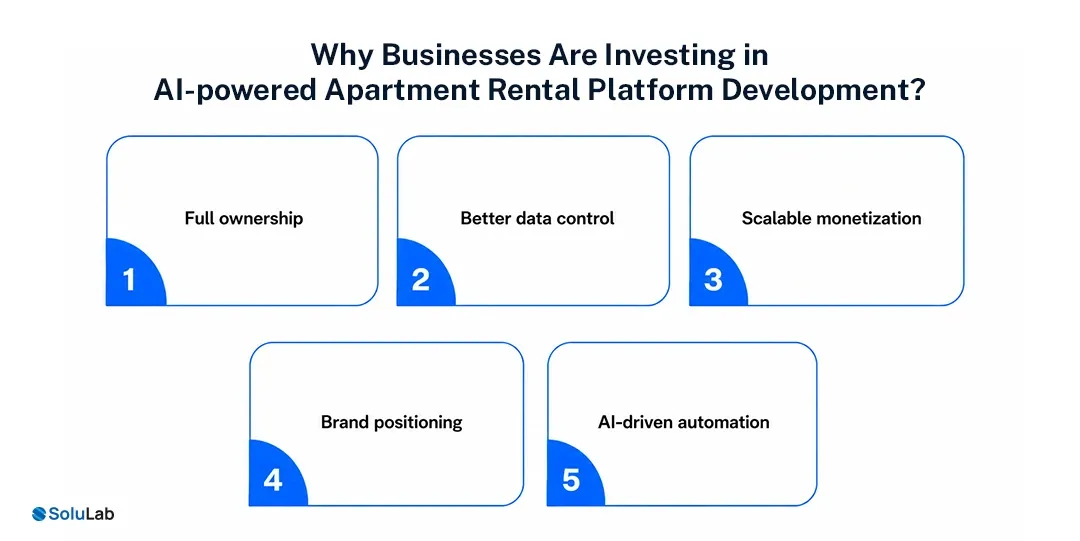
- Full ownership: Custom apartment rental platforms provide complete ownership over features, infrastructure, branding, and platform evolution, eliminating dependency on third-party marketplaces and restrictive platform policies.
- Better data control: Businesses gain direct access to tenant behavior, rental analytics, customer interactions, and operational insights, enabling smarter decisions, personalized experiences, and stronger data security management.
- Scalable monetization: Custom platforms support multiple revenue streams, including subscriptions, featured listings, booking commissions, premium services, advertisements, and property management solutions as the business expands.
- Brand positioning: A dedicated rental platform strengthens market credibility, improves customer trust, and helps businesses establish a recognizable digital presence within highly competitive real estate ecosystems.
- AI-driven automation: AI integration solutions automate property recommendations, tenant screening, pricing optimization, customer support, and workflow management, improving operational efficiency while reducing manual administrative workloads.
How Does An AI-Powered Apartment Rental Platform Work?
AI rental platforms simplify property discovery, tenant communication, lease processing, and rental management by digitally connecting landlords, tenants, and property managers through centralized, user-friendly web and mobile applications.
- User registration: Users create accounts for personalized rental experiences.
- Advanced property search: Tenants filter properties using location and preferences.
- AI-powered recommendations: Platforms suggest properties based on user behavior.
- Virtual property tours: Users explore apartments remotely through interactive viewing.
- Application management: Tenants submit rental applications directly through platforms.
- Tenant verification process: Platforms validate identity, documents, and rental history.
- Online rent payments: Secure payment gateways process recurring rental transactions.

What Features Are Essential In Rental Marketplace Apps?
Modern rental marketplace applications require intelligent automation, property discovery, and secure transaction management to deliver smooth experiences for tenants, landlords, and property managers across competitive digital real estate ecosystems.
- Advanced property search and filters: Rental apps should provide location-based search, pricing filters, amenities selection, and map integration, helping users quickly discover properties matching their lifestyle, budget, and preferences.
- AI-powered property recommendations: An AI rental solution improves tenant engagement by analyzing user behavior, search history, and preferences to deliver personalized apartment suggestions and smarter rental experiences.
- Virtual property tours and media galleries: High-quality images, video walkthroughs, and AI-powered virtual tours allow tenants to evaluate properties remotely, increasing trust, reducing site visits, and accelerating rental decision-making processes.
- Secure payment and lease management: Integrated payment gateways, digital lease signing, and automated invoicing simplify rent collection, improve transparency, and reduce operational complexity for landlords and tenants alike.
- Tenant verification and fraud detection: Identity verification, KYC integration, and fraud prevention systems enhance platform security by reducing fake listings, unauthorized transactions, and high-risk tenant applications.
- Scalable mobile-first architecture: Successful housing rental app development focuses on responsive interfaces, cloud scalability, and mobile performance to support growing user demand and multi-device accessibility.
Step-by-Step AI-Powered Apartment Rental App Development Process
Building an apartment rental app requires strategic planning, scalable architecture, an intuitive user experience, and smart integrations to create a digital marketplace connecting tenants, landlords, and property management businesses efficiently. The step-by-step process for AI-powered solution development involves:

Step 1. Conduct Market Research
Analyze competitors, identify target audiences, evaluate regional rental trends, and finalize monetization strategies to create a scalable apartment rental platform aligned with business objectives and user expectations.
Step 2. Finalize Core Features and Platform Requirements
With expert AI consultation, define essential functionalities such as property listings, advanced search filters, virtual tours, payment gateways, chat systems, and tenant management tools based on user and business needs.
Step 3. Design an Intuitive UI/UX Architecture
Create user-friendly wireframes and mobile-first interfaces that simplify property discovery, booking workflows, and landlord management while improving navigation, engagement, and overall user satisfaction across devices.
Step 4. Choose the Right Technology Stack
Pick the best from the AI tech stack. Select scalable frontend, backend, database, cloud infrastructure, and third-party integrations that support real-time property updates, secure transactions, and high traffic handling.
Step 5. Develop Backend, Frontend, and API Integrations
Build the application architecture, implement APIs, integrate maps, payment gateways, notifications, and authentication systems to ensure smooth communication between users, properties, and administrative modules.
Step 6. Test Security, Performance, and User Experience
Conduct functional, usability, scalability, and security testing to identify bugs, optimize performance, protect user data, and ensure operation across web and mobile environments.
Step 7. Launch, Monitor, and Continuously Optimize the Platform
Deploy the application, track user behavior, gather customer feedback, monitor analytics, and regularly introduce updates, AI capabilities, and feature improvements to maintain long-term platform growth.
Essential Integrations for a Rental Marketplace
Modern rental marketplaces rely on smart integrations to property discovery, automate operations, improve security, and deliver tenant experiences through scalable digital infrastructure and intelligent platform connectivity.
- Payment gateways: Secure payment gateway integrations enable tenants to pay rent, deposits, and maintenance charges online while supporting automated billing, recurring subscriptions, and multi-currency transaction management.
- GIS & maps: GIS and map integrations improve property discovery by offering location-based search, neighborhood insights, commute calculations, and nearby amenities for enhanced rental decision-making experiences.
- CRM integration: CRM systems help property businesses manage tenant communication, automate lead nurturing, track inquiries, and improve customer engagement throughout the rental lifecycle.
- KYC verification: KYC verification integrations strengthen platform security by validating tenant identities, reducing fraud risks, ensuring compliance, and onboarding for landlords and property managers.
- Cloud storage: Cloud storage solutions securely manage property images, lease agreements, tenant documents, and platform data while enabling scalable access, backups, and real-time collaboration capabilities.
- AI recommendation APIs: AI recommendation APIs personalize property suggestions using behavioral analytics, search preferences, budget patterns, and user activity to improve engagement and conversion rates through an AI-powered solution.
Read More: AI Agents in Real Estate
How a Rental Marketplace Can Optimise Expenses?
Rental marketplaces powered with AI agents help property businesses reduce operational costs, automate repetitive processes, and improve resource utilization by centralizing property management, tenant communication, payments, and marketing activities within a single digital ecosystem.
- Reduced manual operations: Automated listing management, digital documentation, tenant onboarding, and rent collection significantly reduce administrative workload, helping property businesses lower staffing and operational expenses efficiently.
- Lower marketing and vacancy costs: Smart search optimization, AI-based property recommendations, and centralized listing distribution improve property visibility, reduce vacancy periods, and minimize excessive advertising expenditures across platforms.
- Improved maintenance and resource efficiency: Integrated maintenance tracking, vendor coordination, and real-time communication systems help property managers optimize repair scheduling, reduce delays, and avoid unnecessary maintenance-related costs.
How Much Does it Cost to Build an AI-native Apartment Rental App?
Developing an apartment rental app requires investment across design, development, integrations, testing, and deployment to create a scalable, user-friendly, and feature-rich digital rental marketplace for modern real estate businesses. A basic AI app development cost structure goes like:
| Development Component | Estimated Cost | Description |
|---|---|---|
| UI/UX Design | $5,000 | Mobile-first interface design, wireframes, and user journey optimization. |
| Frontend Development | $11,000 | Responsive web and mobile application development with property browsing features. |
| Backend Development | $13,000 | Server architecture, APIs, databases, authentication, and admin management systems. |
| Third-Party Integrations | $4,000 | Payment gateways, maps, chat systems, and push notifications integration. |
| Testing & Quality Assurance | $4,000 | Security testing, bug fixing, and performance optimization before launch. |
| Deployment & Maintenance Setup | $5,000 | Cloud deployment, app publishing, and initial maintenance configuration. |
| AI-Based Recommendation Features | $8,000 | Smart property recommendations and personalized rental matching systems. |
| Total Estimated Cost | $50,000 | Scalable MVP-level apartment rental app with modern marketplace capabilities. |
Future Trends in Apartment Rental Apps
Modern rental platforms are evolving beyond basic property listings by opting AI native approach, technologies, automation, and flexible living models to deliver faster, smarter, and highly personalized tenant experiences across real estate ecosystems.
- AI-Powered Personalization & Search: Advanced AI algorithms in housing rental app development analyze user preferences, budgets, behavior, and locations to deliver personalized property recommendations and improve tenant engagement across rental marketplaces.
- Virtual/Augmented Reality (VR/AR) Tours: Businesses that develop AI rental apps for apartment marketplaces are integrating VR and AR walkthroughs, allowing tenants to explore properties remotely with immersive and interactive viewing experiences.
- End-to-End Digital Transactions: Rental applications support digital agreements, rent payments, tenant verification, and e-signatures, simplifying leasing operations while improving transaction security, transparency, and user convenience.
- Focus on Sustainability & Smart Living: Apartment rental apps increasingly showcase smart home integrations, energy-efficient systems, and eco-friendly housing options as sustainability becomes a major factor influencing tenant decisions.
- Co-living & Flexible Leases: Growing demand for flexible lifestyles is accelerating the adoption of co-living models and short-term lease options, helping rental platforms attract students, remote workers, and urban professionals.
Conclusion
Apartment rental apps are improving the real estate industry by simplifying property discovery, tenant management, digital leasing, and online payments through intelligent and user-friendly platforms.
Integrating AI-powered recommendations, real-time communication, and secure payment systems can further enhance user engagement and operational efficiency.
SoluLab, #1 AI development company, can help your business build scalable and future-ready apartment rental solutions.
FAQs
Neha is a curious content writer with a knack for breaking down complex technologies into meaningful, reader-friendly insights. With experience in blockchain, digital assets, and enterprise tech, she focuses on creating content that informs, connects, and supports strategic decision-making.