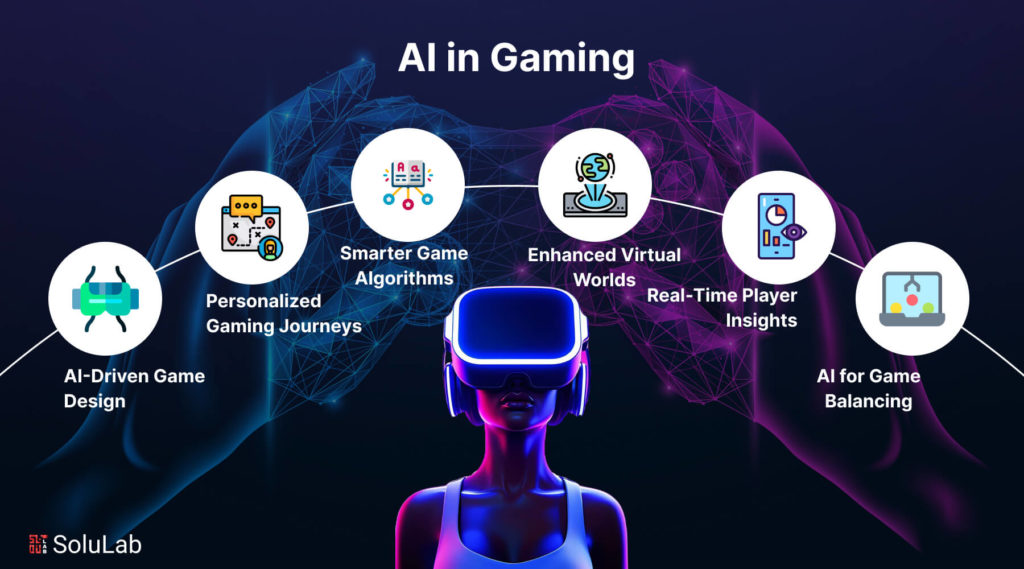
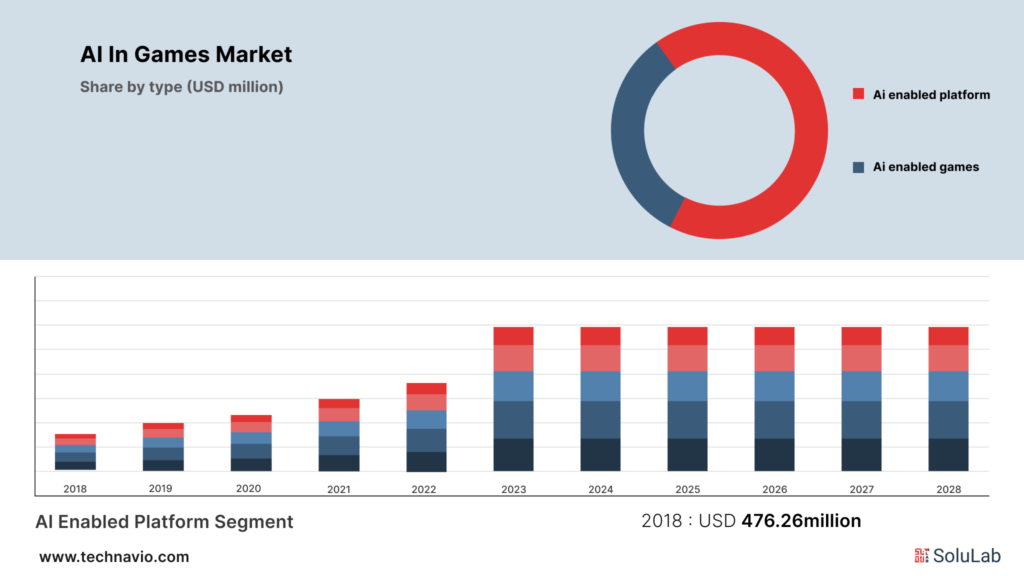
AI in gaming now runs NPC behavior, procedural content generation, player matchmaking, and real-time anti-cheat detection. Studios lean on behavior trees and reinforcement learning to get non-player characters adapting to individual playstyles instead of following a fixed script. Engines like Unity and Unreal plug in ML agents that train NPC combat, pathfinding, and dialogue with no hand-coded rules involved. Statista projects the AI in gaming market to grow by USD 4.50 billion between 2023 and 2028.

What Is AI in Gaming?
Think of AI in a game as the layer that makes an NPC feel less like a scripted prop and more like an actual opponent. AI-powered characters read the situation and respond with something closer to human judgment than a fixed if-then list. It’s the engine deciding what an NPC does and why, moment to moment. The future of AI in gaming isn’t some far-off idea, either; it’s already reshaping how studios build games and how players experience them. AI-driven titles keep handing more control to the player, so your choices end up shaping how the story actually plays out.
In game design, AI procedural generation (sometimes called procedural storytelling) means the game builds its own content algorithmically instead of a developer hand-placing every asset. That covers environments, characters, quests, whatever the system is set up to generate, and it’s why two playthroughs rarely look the same.
Demand for these experiences has pulled in a wave of startups and established studios building AI-driven gaming platforms. The money flowing into this space says a lot about where the AI in the entertainment industry is headed, especially in titles built around play-to-earn tokens.
Take Latitude: in January 2021, this AI app development company focused on AI-generated infinite stories inside video games raised $3.3 million in venture funding. Osmo, an interactive play company, pulled in $32.5 million. And Gosu Data Lab, a Lithuanian AI gaming outfit, landed $5 million to analyze gaming data and sharpen player skills through AI-driven insights.
These examples show just how widespread AI in gaming industry has become, and why it matters for where the industry goes next.
Use Cases of AI in the Gaming Industry
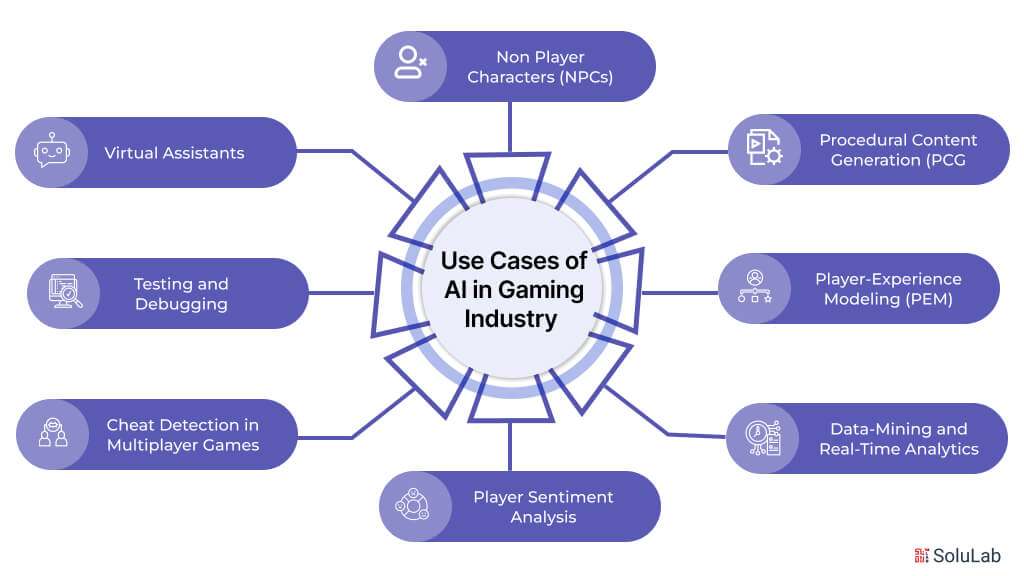
AI in the Gaming Industry has turned static gameplay into something adaptive. NPCs now act and decide in ways that mimic human players instead of just running a loop. The future of AI in gaming keeps expanding, touching engagement, adaptability, and how responsive a game feels moment to moment. On top of that, play-to-earn tokens are reshaping the landscape, letting players turn in-game achievements into real-world value. If you’re wondering how AI and video games actually connect, here’s where artificial intelligence is doing the real work in gaming today.
1. Non-Player Characters (NPCs)
One of AI’s biggest wins shows up in the application of AI in gaming, particularly building NPCs. These characters behave in ways that mimic real players, which makes games feel more immersive and less predictable. Still, they run on pre-programmed rules that a player can’t directly control. That setup allows for more natural interactions between characters and players, and it makes each playthrough feel a bit more personal.
Studios like SEED (EA) have caught on and are actively building with AI-enabled NPCs. They train NPCs by simulating the behaviors and strategies of top players. The result: NPCs that adapt and respond to what you’re doing in a way that feels more natural and, frankly, more challenging.
2. Image Enhancements and AI Upscaling
AI has another useful application of AI in gaming called “AI Upscaling,” which is all about sharpening visuals. The core idea: take a low-resolution image and turn it into a higher-resolution one without losing the original look. It’s a neat trick, and it doesn’t just revive old games, it lets players enjoy better visuals even on older hardware.
NVIDIA’s DLSS technology is a good example of what AI can do here. NVIDIA researchers built AI-driven upscaling into games like “Cyberpunk 2077” and “Control,” pushing higher-resolution graphics and better frame rates. That lets players move through and manipulate scenes smoothly, which adds up to a genuinely more immersive experience.
3. Procedural Content Generation (PCG)
Artificial intelligence in gaming has a lot to offer in PCG. It lets developers build richer, more varied worlds by speeding up the otherwise slow process of generating game assets at scale. AI can also spin up interactive narratives based on past storylines.
AI Dungeon 2 is a good example: this text-based adventure game runs on OpenAI’s GPT-3 language model to offer near-infinite adventures. Players feed it prompts, and the AI builds unique storylines for their characters to interact with.
4. Player-Experience Modeling (PEM)
Artificial intelligence in gaming shows up clearly in player experience modeling (PEM), which mathematically models a gamer’s experience to predict what they’ll enjoy or hate. This AI reads a player’s skill and emotional state to fine-tune the mechanics. Based on how skilled you are, AI can shift the game’s difficulty in real time to fit your interests, which keeps things interactive without feeling scripted. The end result is a game that stays engaging for your specific skill level, not some average player’s.

5. Data-Mining and Real-Time Analytics
Every day, 2.5 billion gamers worldwide generate around 50 terabytes of data. That’s a lot for gaming companies to track if they want to catch opportunities, or warning signs, before a player quits. So gaming businesses increasingly lean on artificial intelligence in gaming and machine learning in live streams to mine that data for something actionable.
DemonWare, an online multiplayer game, is a solid example of use of AI in gaming through real-time AI data analytics.
6. Player Sentiment Analysis
How AI is changing the gaming industry shows up in AI sentiment analysis too, which digs into what players actually want and helps studios fine-tune the experience around it. It scans player feedback, reviews, and other data sources to figure out preferences on levels, menu design, and opponents.
Developers use AI sentiment analysis to sort through player feedback and pinpoint what’s landing well and what needs fixing. League of Legends, for instance, a Riot Games title, uses AI sentiment analysis to track player discussions across platforms. That data lets Riot Games developers make sharper calls on updates and improvements.
7. Cheat Detection in Multiplayer Games
How AI is changing the gaming industry is obvious in the fight against cheating, which hurts the player experience and can do real damage to a platform’s reputation. As cheating tactics get more sophisticated, players worldwide keep running into opponents gaming the system for an unfair edge. That’s pushed studios to lean on AI to scrutinize movement patterns and catch cheating in the act.
Several well-known online games, PlayerUnknown’s Battlegrounds (PUBG) among them, have already built in AI to analyze player patterns and shut down cheating attempts. PUBG in particular made headlines for its hard line on cheating, including banning professional players who broke the rules.
8. Testing and Debugging
AI-driven testing and debugging tools let developers work through huge numbers of complex test cases much faster than manual testing allows. These tools can scan large codebases, catch errors, flag bugs, and even suggest fixes.
By automating this slow, labor-heavy work, developers get more time to strip out unnecessary elements from the game structure and focus on what matters. This is a clear example of how AI is changing the gaming industry, mostly by making things faster and more efficient.
9. Virtual Assistants
AI-driven assistants have become a real tool for boosting engagement and interactivity. These virtual assistants lean on natural language processing (NLP) to make sense of player questions and hand back answers tailored to their quests. By offering relevant info and guidance as players move through the game, these assistants don’t just help with navigation, they also drive engagement and retention, which is a big part of the story around AI in the Gaming Industry.
Different Types of AI in the Gaming World
In modern game development, AI plays a big role in shaping the player’s experience. It drives NPC behavior and the overall dynamics of the game in ways that can’t really be separated out. Here’s a rundown of the key types of AI used in game development:
Rule-Based AI
Rule-based AI runs on a fixed set of instructions and conditions that guide how NPCs behave. These rules govern how NPCs interact with players and their surroundings, which keeps outcomes consistent and predictable.
Take a racing game: if a player veers off the track, rule-based AI might slow down their car and flash a message telling them to get back on course. That keeps the game’s AI responding predictably, which matters for fairness, and it’s one of the clearer advantages of AI in gaming.
Machine Learning AI
In games, Machine Learning AI lets NPCs learn and adapt based on accumulated experience and data. That means NPCs get better through training and feedback loops instead of staying static. In a sports simulation game, for example, if a player keeps using the same tactic, machine learning AI picks up on it and adjusts, which makes for a tougher match and shows just how far AI in the gaming industry has come.
Finite State Machines
NPC behaviors often get modeled through finite state machines (FSMs). FSMs run through a sequence of states, each one standing in for a specific behavior or action. They’re especially useful in games where NPCs need to respond to shifting game states while sticking to state-driven behavior.
In a platformer, say, a hostile character might use a finite state machine to shift between patrolling, chasing, and attacking once the player gets close enough. That’s AI in the gaming industry.
Behavior Trees
Behavior Trees (BTs) give developers a hierarchical way to organize NPC behaviors. They’re built from nodes representing actions, conditions, and sequences, and each node handles a specific task or decision, which makes it easier to build complex NPC behavior without a tangled mess of code.
In an open-world RPG, a shopkeeper NPC might use behavior trees to handle tasks based on time of day and player interaction, restocking items, chatting with customers, closing up at night. That’s AI in the gaming industry at work in the background.
DO YOU KNOW?
The UK is on track to overtake Japan in gaming user penetration in the years ahead. By 2027, an estimated 70% of UK residents will count as gamers, which says a lot about how fast the market is growing there. As of 2022, the UK sits 6th in Newzoo’s ranking, pulling in an estimated $5.7 billion, cementing its spot as a major player in global gaming.
Pathfinding AI
Pathfinding AI handles how NPCs move through virtual environments efficiently. It factors in obstacles, terrain, and environmental changes to plot a route from one point to another without wasted motion.
In a strategy game, when a player sends a unit to a distant point, pathfinding AI kicks in. It works out the optimal route, weighing obstacles and picking the shortest path, so the unit gets there fast. That’s a good example of AI-powered PCG games doing the quiet work that makes gameplay feel smooth.
Reinforcement Learning AI
Building Reinforcement Learning (RL) into NPCs lets them pick up optimal behaviors through trial and error. With RL, NPCs keep sharpening their decision-making by analyzing outcomes and adjusting strategy toward long-term goals.
Fighting games are a good showcase for RL in action, where reinforcement learning AI trains itself to refine its combat techniques over time. Match after match, the AI learns from each outcome and slowly builds more advanced fighting strategies. Eventually it turns into a genuinely tough opponent, which is exactly the kind of role AI plays across the gaming industry now.
Innovations of AI in Games
The gaming industry keeps pushing forward with AI innovations that change how games get made and played, tilting toward more immersive, personalized experiences. From smarter NPCs to tighter gameplay balance, AI is reshaping a lot of what happens under the hood. Here’s where some of the more notable AI innovation is heading:
1. AI and Realistic NPCs
Advances in AI-powered PCG games have produced NPCs with genuinely lifelike behaviors, emotions, and interactions. These NPCs can make believable calls in social situations and adapt their responses based on what the player does. That extra layer of sophistication deepens the storytelling and makes game worlds feel more alive and responsive.
2. AI and Proactive Game Design
Bringing AI into game design opens up plenty of room for creativity. It can help build procedurally generated stories, tighten level design, and introduce adaptive mechanics that keep players engaged. From reading player data to inform design calls to crafting intricate puzzles and weaving in tighter narratives, AI is pushing developers to try things that weren’t practical before.
3. AI and Procedural Generation
AI advances have changed procedural generation quite a bit. Its ability to build intricate, varied worlds, complete with unique levels, environments, quests, and challenges, gives players near-endless replayability and keeps engagement high over time.
4. AI and Game Analytics
AI-powered analytics tools let developers read player data, spot trends early, and refine features accordingly. That data-driven approach doesn’t just improve performance, it also surfaces player preferences, informs future updates, and flags fraudulent activity.
5. AI and Game Difficulty Adjustment
AI in games watches player behavior and gameplay data in real time, then adjusts difficulty, encounter challenges, and item drop rates accordingly. That keeps the experience balanced and engaging for each player, tuned to their actual skill level rather than a fixed curve.
6. AI-Assisted Game Testing
AI-assisted game testing automates a process that used to eat a lot of developer time, catching bugs and tuning performance before release. That speeds up development cycles and raises overall quality at the same time. The payoff: players get a smoother experience from day one, and satisfaction goes up with it.
Emerging AI Trends in Gaming
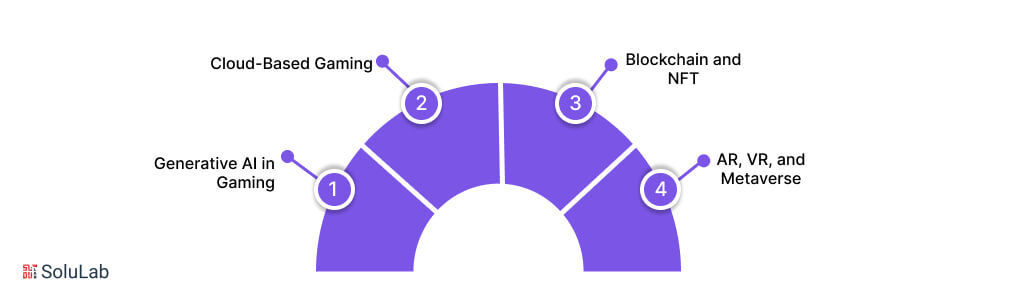
AI has become central to building experiences players actually want to stick around for. As we dig deeper into the use of AI in gaming, it’s worth looking at how, alongside other technologies, it’s shaping where this industry goes next. Here are the AI trends in gaming that have stood out in recent years.
Generative AI in Gaming
Generative AI gives developers the ability to keep generating content indefinitely, so players get something new nearly every time they log in. No Man’s Sky and Minecraft are the classic examples: players never quite run out of world to explore.
Generative AI games also push NPCs toward something more realistic, ones that evolve, learn, and adapt as the game goes on. That constant change adds unpredictability and replay value, which keeps players locked in.
Cloud-Based Gaming
Gaming’s future runs through streaming: players get high-end games on any device, phones included, without downloading or installing a thing. No need for an expensive console or gaming PC either. Progress carries over across devices, so you’re never stuck worrying about losing what you’ve earned.
Artificial intelligence in the gaming industry is central to how cloud gaming works. Powered by Deep Neural Networks (DNNs), AI helps cloud servers deliver solid performance, so even older hardware can run a smooth, immersive experience.
Blockchain and NFT
Non-fungible tokens (NFTs) sit at the core of in-game economies now, letting players trade digital tokens and making gameplay itself more rewarding. NFT games tap into blockchain technology to track and protect player ownership rights precisely, which builds a more transparent, inclusive ecosystem in online gaming.
Native AI gaming plays a big role in the NFT space too. AI-powered analytical tools let developers dig into player data and figure out what kind of assets people actually want. That data-driven approach lets game creators build more targeted content and tailor the experience to each player, which adds up to something more immersive and personal.
AR, VR, and Metaverse
Bring augmented reality (AR), virtual reality (VR), and the metaverse into gaming, and AI opens up new possibilities for interactive experiences. Picture building your own virtual world and inviting friends into it. That kind of immersive setup, made possible by AI’s ability to design detailed virtual scenes, is genuinely exciting territory.
Challenges of AI in Gaming
AI brings real advantages to video games, but gaming companies still need to think hard about the ethical challenges that come with it. Here are some of the key concerns tied to AI in the gaming industry:
1. Data Privacy
AI often runs on user data as the foundation for generating responses, and that raises real questions about privacy and protection. What data gets collected, how it’s stored, who can access it, these questions matter. Responsible AI development companies need to be upfront about how they use this data and back it up with solid security, especially in Native AI gaming, where trust is everything.
2. Game Addiction
Developers building AI-driven games should build in guardrails against addiction. Time limits or reminder messages nudging players to take breaks go a long way toward cutting down excessive screen time and building healthier habits.
DO YOU KNOW?
In 2022, the gaming industry contracted to roughly $182 billion in total market value. Mobile gaming still carried a big chunk of that revenue, pulling in an impressive $92 billion on its own.
3. Offensive Content
As AI-powered PCG games get more sophisticated and personalized, game characters can end up using offensive language, generating harmful content, or acting violently. That’s a real concern, especially for younger players who pick up on things fast and don’t always have the context to filter it.
Developers carry the responsibility of making sure their characters don’t promote offensive or damaging behavior. Where that kind of content is necessary for the story, clear warnings or age restrictions should be in place so players don’t carry it into real life.
The Future of AI in Gaming
artificial intelligence (AI) has upgraded plenty of industries, and gaming is no exception. Over the years, AI in video games has turned into a genuine force, pushing the boundaries of what’s possible in virtual worlds. It’s changed how games get built, played, and enjoyed.
One of the more notable impacts: AI drives better interactivity, sharper graphics, near-limitless story combinations, more believable NPCs, and personalized experiences. Studios also use AI’s predictive analytics to read player behavior and forecast winning teams. The benefits of artificial intelligence in gaming show up clearly in these advances, both in development and in how engaged players stay.
Looking ahead, Native AI gaming will play a bigger role in how online games get built and where the industry heads next. As AI game development pushes realism further, expect new ways for creators to monetize their platforms. The application of AI in gaming will matter a lot in shaping what comes next.
That said, as AI gets woven deeper into gaming, conversations around ethics, data privacy, and responsible practices are only going to get louder. Organizations will need real policies in place to keep future of AI in gaming ethical. Governments may well step in with stricter regulation, which would push explainable AI in gaming from nice-to-have to necessary.
How SoluLab Is Helping To Change The Industry With AI?
Native AI gaming isn’t some future promise, it’s already happening in how games get developed, played, and experienced. AI game development is reshaping everything from design and player interaction to in-game environments and adaptive challenges.
SoluLab, an AI development company, can help you build advanced AI into your games, from AI-driven character behavior to storytelling and personalized experiences. Our work across applications of AI in gaming means your project gets the latest innovations built in from the start.
We built an AI-powered chatbot for Digital Quest, a travel business looking to improve user engagement and customer service. The chatbot, built on Generative AI, gives personalized travel recommendations and streamlines reservations by pulling relevant data straight from Digital Quest’s website. We made sure it was user-friendly, secure, and built around what the travel industry actually needs. With ongoing support and multi-language capabilities, the chatbot has noticeably improved customer interaction while keeping costs down for Digital Quest. If you want a hand with your own project, feel free to Hire AI Developers from our AI development company.
FAQs
Bhavya is driving growth through data-backed demand generation for AI and Web3 solutions. With 9+ years in digital marketing, he has spearheaded initiatives that led to a 40% increase in qualified inbound leads. Bhavya shares insights on marketing ROI and scaling a digital presence via AI workflows. He is open to connecting with startups and enterprise teams to help them overcome their challenges.