Key Takeaways
- It removes manual work, not pipelines. AI handles mapping, matching and quality checks inside the data pipelines you already run.
- Unstructured data is the real new capability. Turning PDFs, emails and documents into rows is something traditional integration could not do.
- It fails quietly. A model-based pipeline can pass plausible wrong values, so confidence thresholds, human review and drift monitoring are required.
- Governance decides whether it is safe. Ownership, lineage, audit trails and agreed definitions have to exist before anything runs automatically.
- Start in suggestion mode. Measure agreement on one painful source, set the threshold from that measurement, then expand.
AI data integration, defined
Data integration is moving data from many sources into a form that can be used together. Traditionally that means engineers writing explicit rules: this field maps to that field, this value means that category, this record is the same customer as that one. It is one part of wider AI integration services.
AI data integration uses models to propose or make those decisions instead of hand-coding them. It shows up in five places:
- Schema mapping. Suggesting which source field corresponds to which target field, including where names give no clue.
- Entity resolution. Deciding that two records are the same real-world thing despite spelling, formatting and missing values.
- Data quality. Detecting values that are wrong rather than merely missing.
- Anomaly detection. Noticing that today’s load looks unlike every previous load, before it reaches a dashboard.
- Unstructured to structured. Turning PDFs, emails and documents into rows, which is the part traditional integration simply could not do.
The last one is the genuine expansion of capability. The first four are acceleration of work that was always possible. For the background, see our explainer on AI and ML in data integration.
Traditional data integration challenges
The problems that motivate all of this are not new:
- Mapping effort scales with sources. Every new system is a fresh mapping exercise.
- Schema drift breaks pipelines silently. A renamed column fails loudly. A changed meaning does not.
- Duplicate records across systems. The same customer exists three times with three identifiers.
- Data quality is discovered downstream, usually by someone who does not trust a report.
- Unstructured sources sit outside the pipeline entirely, so the knowledge in documents never reaches analysis.
- Lineage tracking is incomplete, so nobody can say where a number came from.
What makes AI data integration different from traditional ETL?
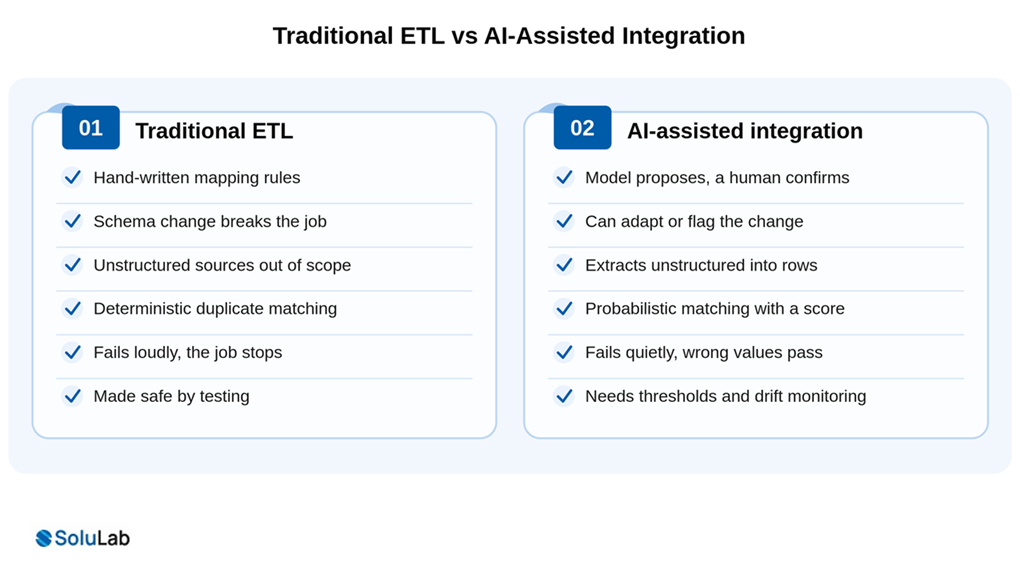
| Traditional ETL | AI-assisted integration | |
| Mapping | Hand-written rules | Model proposes, human confirms |
| Handling schema change | Breaks, then is fixed | Can adapt or flag, depending on design |
| Unstructured sources | Out of scope | Extraction into structured rows |
| Duplicate resolution | Deterministic matching rules | Probabilistic matching with a confidence score |
| Failure mode | Loud. The job fails | Quiet. Wrong values pass through |
| What it needs to be safe | Testing | Testing, plus confidence thresholds and monitoring |
The last two rows are why this is an engineering topic rather than a procurement one. A rules-based pipeline fails visibly. A model-based one produces plausible wrong answers that reach reports unnoticed, so confidence thresholds, human review and drift monitoring are not optional extras.
AI data integration use cases
- Onboarding a new data source quickly. Mapping suggested rather than specified, with review, cutting weeks from each integration.
- Customer and product master data. Entity resolution across CRM, billing and support systems.
- Document to data. Invoices, contracts, claims and forms turned into structured records.
- Continuous data quality. Anomaly detection on incoming loads rather than quarterly audits.
- Migration and consolidation. Mapping legacy schemas to a new model during a platform move.
- Preparing data for AI itself. Retrieval systems, such as those built through RAG development, need clean, current, well-chunked data. Most disappointing AI projects are data integration problems wearing an AI costume.
- Real-time data processing. Enriching and classifying events in flight rather than in a nightly batch.
How AI improves data quality during integration
Four concrete mechanisms, rather than the general claim:
- Validation against learned patterns, catching values that are the right type and the wrong meaning.
- Probabilistic matching, resolving duplicates that deterministic rules miss.
- Anomaly detection on volume, distribution and freshness, which catches upstream breakage before users do.
- Enrichment and standardisation, normalising addresses, names and categories consistently.
What it does not do: decide what your data should mean. If two departments define an active customer differently, that is a governance problem and no model resolves it.
Data governance, which decides whether this is safe
- Ownership. Every dataset needs a named owner who can approve a mapping decision.
- Lineage tracking. Where each value came from and what transformed it, including which model version.
- Confidence thresholds. Below the threshold, a human decides. This is the single most important control.
- Audit trail. Every automated decision logged, so a wrong number can be traced.
- Access and residency. What data may be processed where, and by which provider.
- Drift monitoring. Accuracy changes as your data changes, and nobody notices without measurement.
- Definitions. A shared meaning for core entities, agreed by humans before any automation.
Where AI data integration does not help
- When the problem is disagreement about definitions rather than mapping.
- When source data is sparse. Models cannot infer what was never captured.
- When the integration is small and stable. Hand-written rules are cheaper and more predictable.
- When no human review is acceptable and errors are unrecoverable.
- When there is no owner for the data, so nobody can approve the exceptions.
How to get started
- Pick one painful source, ideally one you are about to onboard anyway.
- Build the evaluation set. Known correct mappings and matches, so accuracy is measurable rather than asserted.
- Run in suggestion mode. The model proposes, engineers confirm, and you measure agreement.
- Set the confidence threshold from that measurement, not from a vendor default.
- Add lineage and audit logging before anything runs automatically.
- Automate above the threshold, route the rest to a person.
- Monitor accuracy, drift and volume, on a dashboard your team owns.
- Expand to the next source using the same evaluation method.
If you need help scoping the first source, our guide to AI integration consulting explains how that work is run.
How SoluLab helps
We build the integration itself: pipelines, mapping, entity resolution, document extraction, and the governance layer that makes automated decisions auditable. We start with an AI readiness assessment that assesses whether your data, ownership and definitions can support this, because that is where most programmes fail rather than in the modelling.
See our AI integration services for the wider integration picture, RAG development where the destination is a retrieval system, and AI and ML in data integration for the background explainer.
AI integration readiness check
Bring your source list and the integration that hurts most. You will get an assessment of whether AI-assisted integration will help, what governance has to exist first, and an estimate.

Frequently Asked Questions
Shipra Garg is a tech-focused content strategist and copywriter specializing in Web3, blockchain, and artificial intelligence. She has worked with startups and enterprise teams to craft high-conversion content that bridges deep tech with business impact. Her work translates complex innovations into clear, credible, and engaging narratives that drive growth and build trust in emerging tech markets.