Key Takeaways
- AI for inventory optimization studies real demand and helps businesses keep stock at the right level, not too much and not too little.
- Machine learning, predictive analytics, and computer vision all play a part in making inventory smarter.
- AI cuts down on stockouts and overstocking, and it frees up cash that would otherwise sit on a shelf.
- Retail, healthcare, manufacturing, and eCommerce businesses are already leaning on AI to manage stock.
- SoluLab builds custom AI inventory tools, from forecasting models to full AI agents.
Nobody likes running out of stock. Customers get annoyed, sales walk away, and the shelf sits empty until the next truck shows up. But the opposite problem is just as costly. A warehouse packed with things nobody’s buying ties up cash a business could use elsewhere. Finding the middle ground between the two used to take a lot of guesswork. Now it doesn’t have to.
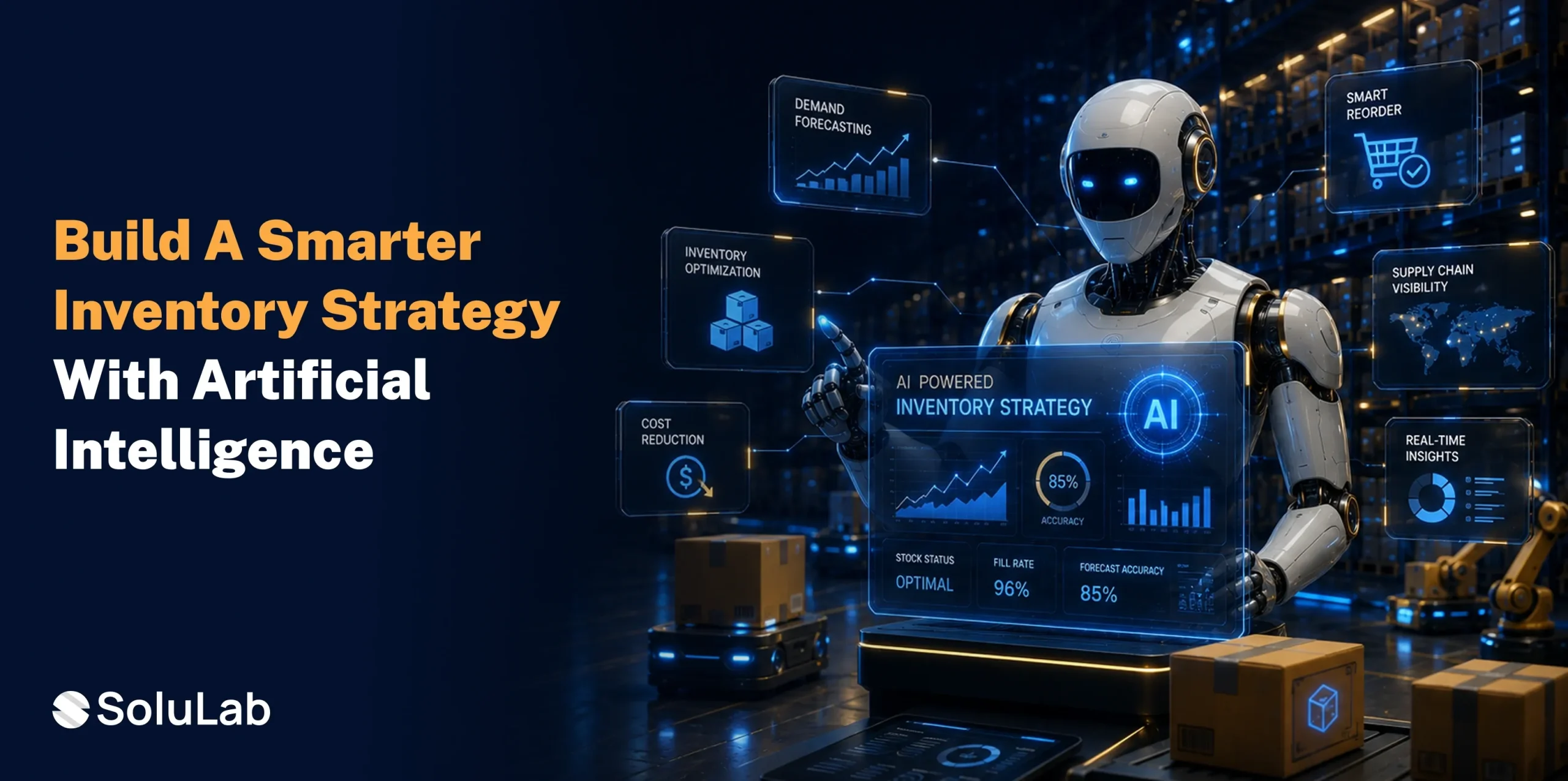
That’s the idea behind AI development solutions for inventory optimization. Instead of a planner eyeballing last year’s numbers, an AI system watches sales, supplier data, even the weather, and figures out what to order and when. It reacts to what’s actually happening, not what happened twelve months ago.
This post walks through what AI inventory optimization actually means, why the old spreadsheet-and-gut-feeling approach struggles, and how different industries are already putting it to work.
What Is AI Inventory Optimization?
At its core, AI for inventory optimization is just artificial intelligence deciding how much stock to keep, where to keep it, and when to reorder it. A human planner can maybe track a few hundred products closely. An AI system can watch thousands at once, and it never gets tired or distracted.
Picture a store manager who never sleeps, checks every shelf every hour, and flags a problem before it becomes one. That’s roughly what this looks like in practice. It’s a step beyond older inventory software, which mostly counts what’s already sitting in the warehouse rather than predicting what you’ll actually need.
Why Traditional Inventory Approaches Fall Short?
Systems run on fixed rules. Something like: reorder 100 units once stock drops below 20. That rule works fine until demand shifts, and demand always shifts. A holiday rush, a viral product moment, or a supplier running late can throw the whole plan off in a day.
Spreadsheets also just don’t scale. Nobody can manually check thousands of SKUs across multiple warehouses every morning, so problems tend to get caught late, after the stockout already happened or the excess stock has already piled up.
Retailers using machine learning for inventory replenishment have reduced out-of-stock rates by up to 80%, lowered write-offs by more than 10%, and increased gross margins by up to 9%. The old approach reacts. AI looks ahead.
The Benefits of AI Inventory Optimization
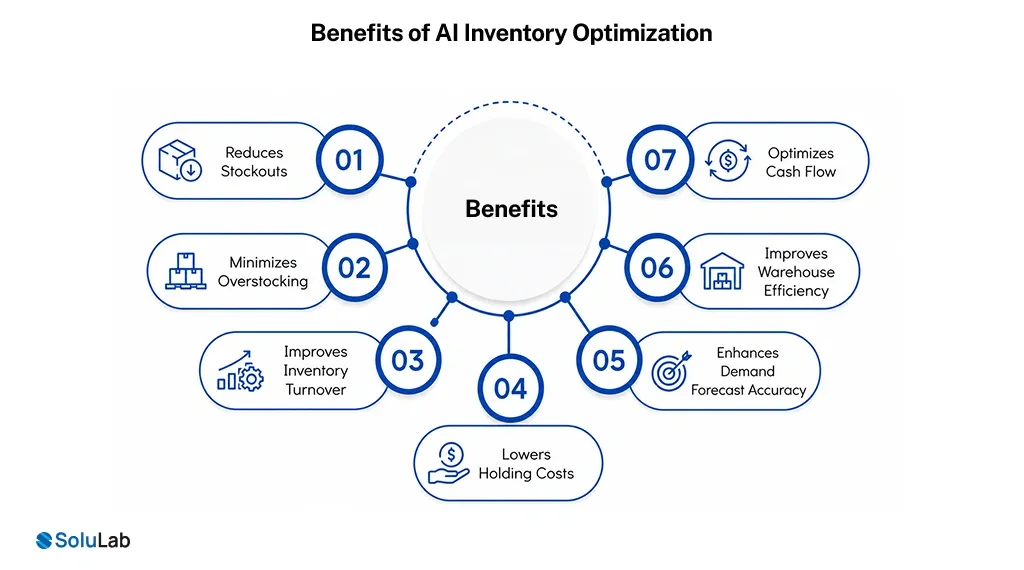
The upside here isn’t just “things run smoother.” It shows up in the numbers. McKinsey’s research on distribution operations found that embedding AI in operations can cut inventory levels by 20 to 30 percent, trim logistics costs by 5 to 20 percent, and reduce procurement spend by 5 to 15 percent.
1. Reduces Stockouts
AI keeps an eye on demand and reorders before shelves actually go empty, so “sorry, we’re out” happens a lot less often.
2. Minimizes Overstocking
Because the system predicts what will really sell, businesses stop over-ordering items that end up sitting around.
3. Improves Inventory Turnover
Stock that matches real demand moves faster. Nothing sits collecting dust in a back room.
4. Lowers Holding Costs
Less extra inventory means smaller storage bills, less spoilage, and more usable warehouse space.
5. Enhances Demand Forecast Accuracy
AI-driven demand forecasting cuts errors well below what manual, spreadsheet-based planning can manage, which means fewer last-minute surprises.
6. Improves Warehouse Efficiency
Workers waste less time wandering aisles when AI points them straight to the right bin and the right task.
7. Optimizes Cash Flow
Every dollar tied up in unsold stock is a dollar that can’t go toward something else. Leaner inventory means more cash actually available.
AI Technologies Powering Inventory Optimization
Inventory optimization isn’t one single tool doing all the work. It’s usually a handful of technologies stacked together. A lot of businesses bring in an AI development company to figure out which combination actually fits their operation.
1. Machine Learning
Machine learning digs through years of sales history and spots patterns a person would probably miss. The more data it sees, the sharper it gets. Teams often work with a machine learning development company to build these models properly from the start, instead of bolting one on later.
2. Predictive Analytics
This is where the patterns turn into an actual forecast, like how many units a store will move next month, broken down by location and even by weather pattern.
3. Generative AI
Generative AI can build out demand scenarios, draft reorder plans, and explain a forecast in plain English instead of a spreadsheet full of numbers. Some businesses go further and bring in a generative AI development team to build a tool tailored to their own product lines.
4. Computer Vision
Cameras paired with computer vision can scan shelves and warehouse bins, catching an empty spot or a miscount without anyone walking the aisle.
5. IoT Sensors
Sensors on shelves, pallets, and delivery trucks send live updates on where stock actually is. Warehouses connecting a lot of these sensors often turn to IoT development to get everything talking to one system.
6. Edge AI
Edge AI processes data right on the device, like a warehouse scanner, instead of shipping it to the cloud and waiting for an answer. On a busy floor, that speed actually matters.
How to Implement AI for Inventory Optimization?
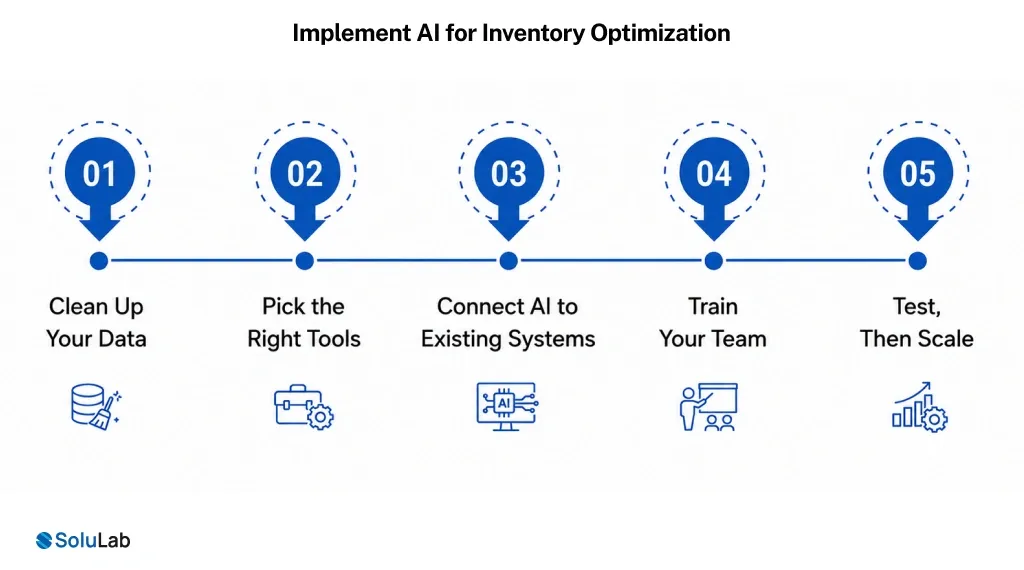
Rolling this out doesn’t have to be a massive overhaul on day one. Most businesses move through a handful of steps, starting small and expanding once the results show up.
1. Clean Up Your Data
AI is only as good as what it learns from. Messy records make weak forecasts.
- Check sales history for gaps
- Fix duplicate or wrong product codes
- Pull data from every sales channel into one place
2. Pick the Right Tools
Not every business needs every piece of this. Start with whatever solves the biggest headache first.
- Match tools to your top problem
- Start with forecasting if stockouts hurt most
- Add computer vision or sensors later
3. Connect AI to Existing Systems
None of this helps if the AI can’t talk to the ERP or warehouse software already in use. This is usually where an enterprise AI development partner earns its keep.
- Link AI into your ERP and WMS
- Test the data flow before going live
- Fix broken connections early, not after launch
4. Train Your Team
Even a great forecast is useless if nobody trusts it. People need to understand what the alerts actually mean before they act on them.
- Walk staff through how the forecasts work
- Explain what triggers an alert
- Build trust with a few small, visible wins first
5. Test, Then Scale
Try it on one warehouse or one product line before rolling it out everywhere. Keeps the risk small and the fixes cheap.
- Run a small pilot first
- Compare results against the old method
- Expand once the numbers actually improve
Use Cases of AI for Inventory Optimization
Here are some use cases of AI for inventory optimization:
1. Manufacturing
Factories use AI to predict which parts they’ll need and when, so a production line doesn’t sit idle waiting on a missing component. It’s part of a broader shift happening across AI in manufacturing, where AI is touching nearly every step of the floor.
2. Healthcare
Hospitals lean on AI to track medicine and supplies so a critical item, like a specific medication, never quietly runs low. This matters even more given how fast AI in healthcare is expanding across hospitals right now.
3. Retail
Retailers use AI to predict what shoppers will want around holidays, weather swings, or a big sale event, so the right shelves stay stocked at the right moment.
4. eCommerce
Online sellers use AI to manage inventory across several warehouses at once, so an order ships from whichever location actually has the item, not the one that’s out.
Future Trends in AI Inventory Optimization (2026 & Beyond)
Gartner’s 2026 supply chain technology report points to a clear shift: AI is moving past just giving advice and starting to actually take action.
1. Agentic AI for Autonomous Inventory Planning
Agentic AI doesn’t just suggest a reorder; it can place it, watch what happens, and adjust the next one on its own. Businesses exploring this often start by working with an AI agent development company to build agents that fit their own warehouse setup.
2. Multi-Agent Supply Chain Systems
Instead of one tool trying to do everything, several AI agents split the work, each handling one piece, like forecasting, ordering, or shipping, and coordinating with each other.
3. Digital Twins for Inventory Simulation
A digital twin is basically a virtual copy of a warehouse. Teams can run “what if” tests, like a supplier delay, before it ever happens in real life.
4. Real-Time Supplier Risk Intelligence
AI now scans news, weather, and shipping data to flag supplier trouble before it turns into an empty shelf.
5. Autonomous Procurement
Some systems now handle the whole buying process end-to-end, from spotting the need to placing the order, with barely any human involvement.
How SoluLab Can Help Build AI Inventory Optimization Solutions?
SoluLab, an AI native company, can help you with strategy, consulting and more:
1. AI Consulting for Inventory Strategy
SoluLab’s AI consulting team helps figure out where AI will actually move the needle before a single line of code gets written.
2. Custom Inventory Optimization Software
Every warehouse runs a little differently, so SoluLab builds tools shaped around a business’s actual products and processes, not a generic template.
3. Demand Forecasting Models
SoluLab trains forecasting models on a business’s own sales history, seasonal swings, and market signals, not a one-size-fits-all dataset.
4. ERP, WMS, and CRM Integration
New AI tools have to talk to the systems already running the business. SoluLab connects these models into ERP, WMS, and CRM platforms without disrupting day-to-day operations.
5. AI Agent Development for Inventory Automation
For teams ready to move past dashboards, SoluLab designs AI agents that can plan, reorder, and adjust stock levels on their own.
6. Supply Chain Analytics Dashboards
Builds dashboards that turn raw inventory numbers into charts and alerts any manager can read at a glance, no data science degree required.

Conclusion
Managing inventory by gut feeling and old spreadsheets doesn’t hold up anymore. Demand moves too fast, and businesses that can’t keep pace end up losing money one way or another, either from empty shelves or from stock that never sells. AI fixes both problems at once by working off real data.
Whether it’s a hospital tracking medicine, a factory tracking parts, or an online store tracking orders, the goal is the same: the right stock, in the right place, at the right time. Businesses that start now, even with a small pilot, will be well ahead of the ones still waiting to see what happens.
SoluLab an AI development company in USA can help map out where to start. Talk to SoluLab’s AI consulting team to see what fits your warehouse.
FAQs
Neha is a curious content writer with a knack for breaking down complex technologies into meaningful, reader-friendly insights. With experience in blockchain, digital assets, and enterprise tech, she focuses on creating content that informs, connects, and supports strategic decision-making.