Key Takeaways
- AI production planning applies machine learning to scheduling, inventory, and resource allocation, replacing static spreadsheets with models that adjust as real conditions change.
- AI-driven demand forecasting alone tends to improve forecast accuracy by 10-20%, which the McKinsey Global Institute ties to inventory reductions of up to 5% and measurable revenue gains.
- A working implementation runs through eight stages: assess planning challenges, collect historical data, integrate ERP and MES systems, build models, pilot, validate, scale, and monitor continuously.
- Industries from automotive to FMCG are already running AI production planning differently, shaped by their own volatility, shelf life, and compliance constraints.
- The next wave of AI production planning includes agentic AI, autonomous factories, edge AI, and self-optimizing production lines, moving planning from advisory to increasingly autonomous.
Production planning has always been a balancing act: enough inventory to avoid stockouts, not so much that it ties up working capital, a schedule tight enough to hit delivery dates without burning out a shift on overtime. AI-powered solutions don’t remove that balancing act.
It just gives planners a model that can hold far more variables in view at once than a person working from historical averages ever could.
According to McKinsey, manufacturers that implement AI can reduce forecasting errors by 20–50%, resulting in 65% lower lost sales and inventory reductions of 20–50%.
This shift is happening at a specific moment. Manufacturing AI spending grew sharply through 2025 and into 2026, concentrated heavily in predictive planning and forecasting tools rather than the flashier factory-floor robotics most people picture when they hear “AI in manufacturing.”
Why Manufacturers Are Investing in AI Production Planning?
The reasons behind this shift are less about chasing new technology and more about a handful of very old operational problems getting harder to ignore. Manufacturers weighing where to start often bring in outside AI consulting support just to map which of these problems is actually costing the most.
- Labor shortages. Fewer experienced planners are available to manually reconcile schedules, forecasts, and supplier constraints, which pushes more of that work toward AI resource planning tools.
- Supply chain disruptions. Suppliers miss dates more often than they used to, and a model that reacts to a delay in hours beats a planner catching it a week later.
- Demand volatility. AI demand forecasting handles sudden shifts in customer orders far better than a static forecast built on last year’s averages.
- Rising production costs. Every hour of downtime and every unit of excess inventory costs more than it did a few years ago, raising the stakes on getting planning decisions right.
- Need for real-time decision-making. Modern manufacturing generates far more sensor and ERP data than a planning team can review manually, and AI is what makes acting on that data in real time realistic.
How does AI in production planning work?
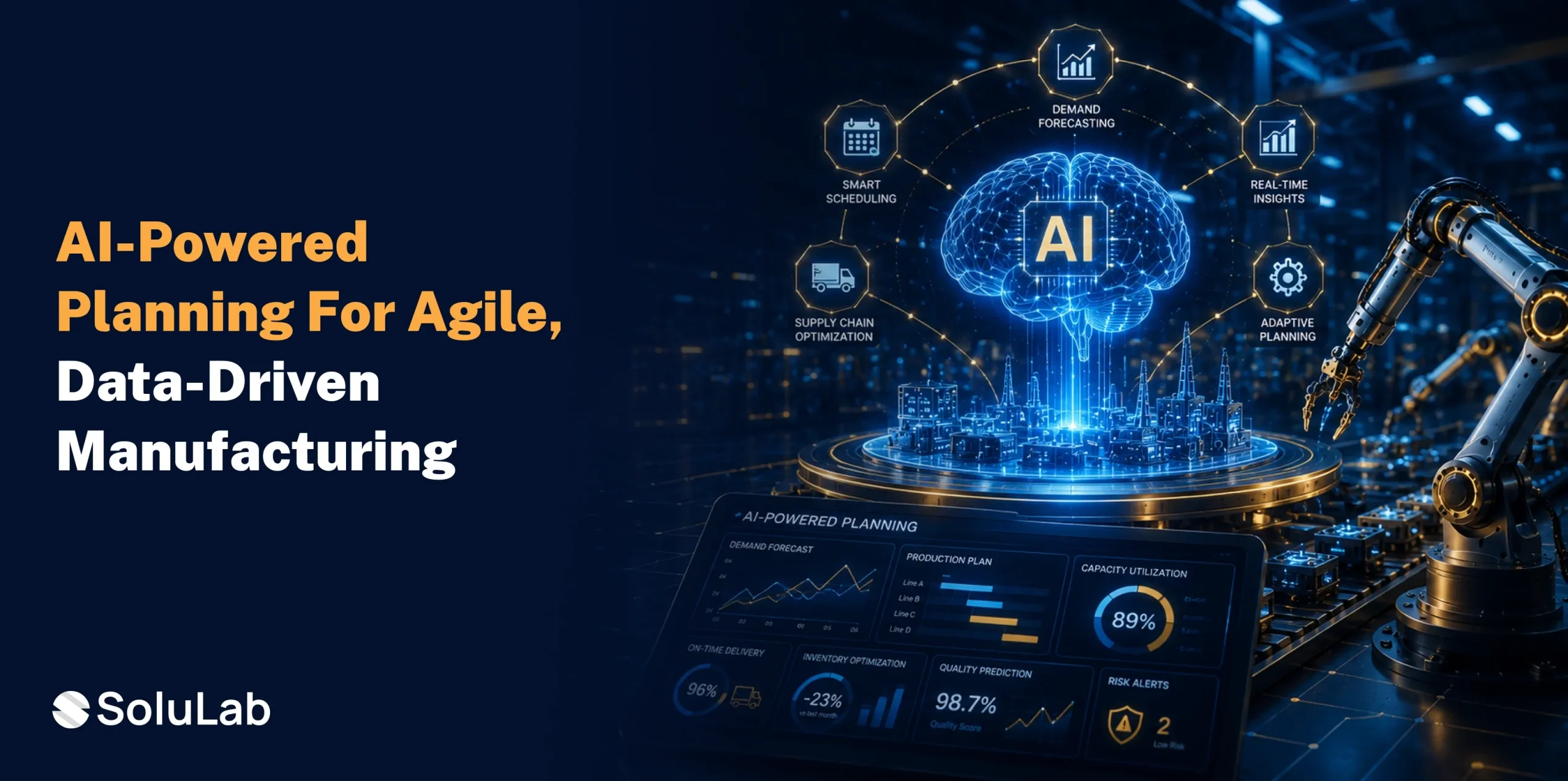
At a practical level, AI production scheduling tools pull data from a manufacturer’s ERP, MES, and shop-floor sensors, then use machine learning models to predict demand, flag scheduling conflicts, and recommend resource allocation before a human planner ever has to notice the problem manually.
- The forecasting layer is usually where the value shows up first. AI models trained on historical sales, seasonality, and external factors like commodity prices typically improve forecast accuracy by 10-20% over traditional statistical methods.
- According to McKinsey Global Institute research, this translates into meaningfully leaner inventory and fewer stockouts. From there, scheduling algorithms take that improved forecast and work backward, sequencing production runs against machine capacity, labor availability, and material constraints, something that used to take a planner hours to do manually and now happens continuously as conditions shift.
- Building this reliably usually takes custom AI development work, since off-the-shelf tools rarely account for a plant’s specific constraints out of the box.
How to Implement AI in Production Planning?
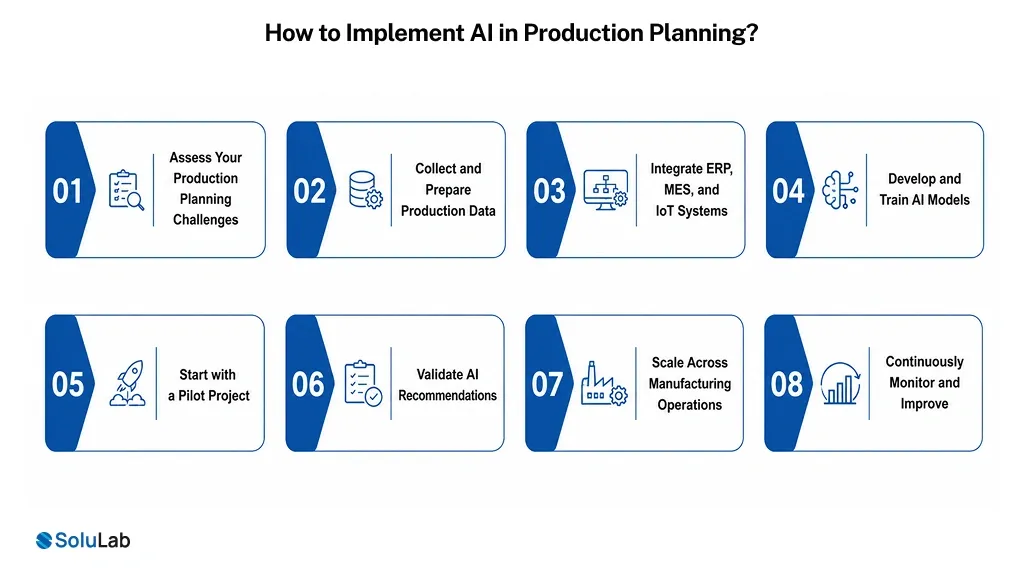
Manufacturers that get real value from this tend to follow a fairly consistent sequence, rather than jumping straight to a full plant-wide rollout.
1. Assess Your Production Planning Challenges
Start by identifying the biggest bottlenecks in your production planning process. Understanding these challenges helps define clear AI use cases and measurable business objectives.
- Identify planning bottlenecks
- Define measurable business goals
- Prioritize high-impact processes
2. Collect and Prepare Production Data
AI models rely on accurate, high-quality data. Gather historical production, inventory, sales, and machine performance data to build reliable forecasting and optimization models.
- Clean historical production records
- Consolidate data from systems
- Ensure consistent data quality
3. Integrate ERP, MES, and IoT Systems
Connect AI with existing manufacturing systems to enable real-time visibility across production, inventory, machines, and supply chain operations.
- Connect enterprise data sources
- Enable real-time data exchange
- Eliminate information silos
4. Develop and Train AI Models
Build AI models based on your production objectives, such as demand forecasting, scheduling optimization, or inventory planning, using historical and real-time operational data.
- Train forecasting algorithms
- Optimize scheduling models
- Validate model performance
5. Start with a Pilot Project
Begin implementation in a single production line or facility before expanding. A pilot helps validate results and identify improvements with minimal operational risk.
- Test one production line
- Measure initial performance gains
- Gather stakeholder feedback
6. Validate AI Recommendations
Review AI-generated schedules and planning recommendations with production managers to ensure they align with operational requirements before full deployment.
- Compare AI with planners
- Verify scheduling accuracy
- Refine optimization rules
7. Scale Across Manufacturing Operations
Once the pilot proves successful, expand AI capabilities across multiple plants, warehouses, or production units while maintaining standardized processes.
- Expand plant-wide deployment
- Standardize planning workflows
- Monitor implementation consistency
8. Continuously Monitor and Improve
Production environments constantly change. Regularly monitor AI performance, retrain models, and update planning strategies to maintain accuracy and improve operational efficiency.
- Track planning performance
- Retrain AI models regularly
Traditional planning vs AI-driven production planning
The contrast becomes clearest when you line the two approaches up side by side.
| Parameters | Traditional Planning | AI-Driven Production Planning |
| Forecast basis | Historical averages, manual adjustment | Continuously updated models with real-time inputs |
| Response to disruption | Reactive, often days behind | Near real-time flagging and rescheduling |
| Inventory levels | Buffered heavily to manage uncertainty | Leaner, tied to improved forecast accuracy |
| Planner’s role | Manually reconciling data across systems | Reviewing and approving AI-generated recommendations |
| Scalability | Harder to replicate across plants consistently | Models can extend across multiple facilities |
Neither approach eliminates the need for experienced planners. AI-driven planning just shifts their time from manual reconciliation toward judgment calls that the model genuinely can’t make on its own.
Real-World Use Cases of AI in Production Planning
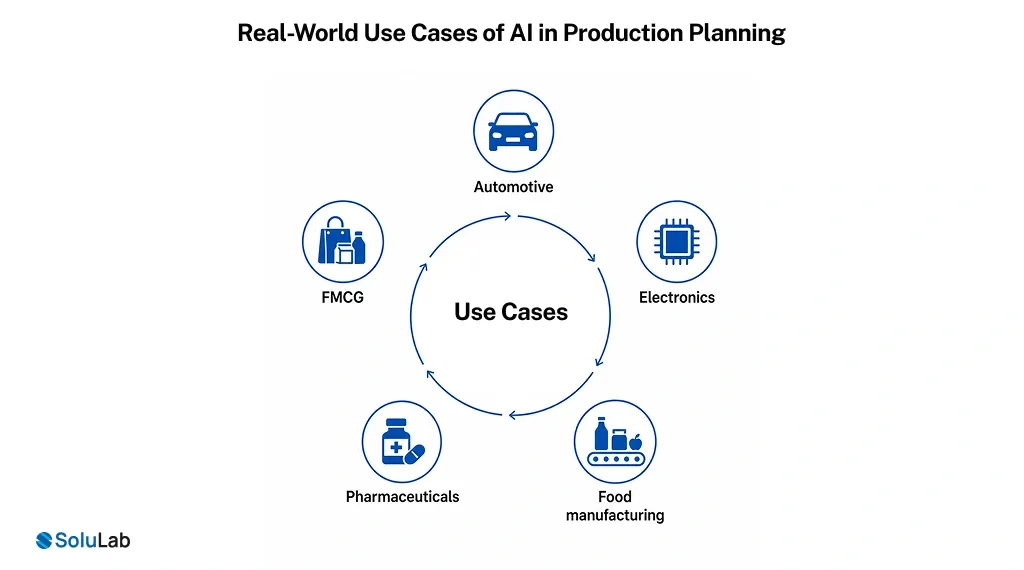
AI agents for manufacturing solutions look different depending on the industry, since each one carries its own volatility and constraints.
- Automotive: Predictive production planning helps sequence assembly lines around parts availability, particularly for manufacturers managing thousands of component variants across multiple models, often as part of a wider enterprise AI development effort spanning several plants.
- Electronics: Fast product cycles and volatile component pricing make AI supply chain optimization especially valuable for balancing inventory against rapidly shifting demand.
- Food manufacturing: Shelf life adds a constraint that traditional planning tools handle poorly, and AI demand forecasting helps reduce both spoilage and stockouts at the same time.
- Pharmaceuticals: Regulatory batch requirements and long lead times make scheduling accuracy critical, and AI resource planning helps avoid costly production delays.
- FMCG: High-velocity, promotion-driven demand makes smart manufacturing AI tools useful for adjusting production runs around campaigns and seasonal spikes in near real time.
Future Trends in AI Production Planning
Where AI production planning is heading next moves it from an advisory tool toward something closer to an active participant in day-to-day decisions.
- Agentic AI. Instead of just generating recommendations, agentic systems built through practices like AI agent development will increasingly execute routine scheduling and reordering decisions directly, with humans reviewing exceptions rather than every decision.
- Autonomous factories. Gartner projects that by 2030, semiautonomous AI agents will orchestrate around 10% of key production, quality, and maintenance decisions, up from roughly 2% today, while humans retain final approval on the ones that matter most.
- Edge AI. Processing data directly on shop-floor devices, rather than routing everything through the cloud, will make real-time scheduling adjustments faster and less dependent on network reliability.
- Self-optimizing production. Lines that adjust their own parameters based on live sensor data, without waiting for a planner to intervene, are moving from pilot projects to production use in early-adopter plants, often paired with generative AI and LLM-powered assistants that let planners ask questions about a schedule in plain language instead of digging through dashboards.
Why Choose SoluLab for AI Production Planning Solutions
Getting from a forecasting pilot to a system a plant actually depends on takes more than a generic AI tool. SoluLab, an AI native company, works with manufacturers across the full planning stack, from mapping where planning breaks down to building custom forecasting and scheduling models on your own production data to rolling out AI agents that handle scheduling exceptions instead of just flagging them.
That includes the computer vision and predictive analytics work that often supports quality checks alongside scheduling and PoC-stage builds for teams that want to prove a model against real plant data before committing to a full rollout.
For example, SoluLab helped RetailPro transform retail operations by implementing generative AI for personalized marketing, automated inventory, and data integration. This improved customer engagement, reduced costs, enhanced decision-making, and increased conversions across 500+ stores, delivering a seamless and data-driven shopping experience.
Conclusion
The manufacturers seeing real results from AI production planning aren’t the ones that automated everything at once. They’re the ones that started with the planning problem actually costing them money, whether that was forecast error, schedule conflicts, or excess inventory, proved the model against real data, and expanded plant by plant from there.
With adoption still concentrated among larger manufacturers and a wide gap between pilot and scaled impact, the opportunity for mid-sized manufacturers to move early is still genuinely open.
If you’re trying to figure out where AI actually fits into your production planning, SoluLab, an AI development company, can walk through your current scheduling and forecasting setup and tell you honestly what’s worth building first.
FAQs
Neha is a curious content writer with a knack for breaking down complex technologies into meaningful, reader-friendly insights. With experience in blockchain, digital assets, and enterprise tech, she focuses on creating content that informs, connects, and supports strategic decision-making.