Key Takeaways
- AI agents for operations go beyond basic automation by making decisions, adapting to changing conditions, and handling multi-step workflows without constant human input.
- Businesses using agentic AI for small business operations are seeing measurable gains in speed, cost, and accuracy across functions like support, logistics, and finance.
- Implementation works best as a phased rollout, starting with a narrow pilot before scaling AI agents for enterprise operations across departments.
- Industries from healthcare to banking are already running real deployments, not just pilots, with results tied to specific operational metrics.
- Governance, human oversight, and security controls matter as much as the technology itself when deploying AI agents at scale.
Ask most operations leaders what’s eating up their team’s time, and you’ll hear the same answers over and over. Chasing approvals across five different systems. Fixing the same recurring errors because no one owns the process end-to-end. It’s tedious work, and for years, the only real fix was hiring more people to do it faster.
AI agents for operations can take on those repetitive, multi-step workflows directly, not just flagging problems for a human to fix but actually working through them.
Deloitte reports that 39% of organizations have already funded agentic AI initiatives and predicts up to 75% of companies will invest in agentic AI.
By the end of 2026, AI agent development will have moved well past the experimental phase. Companies across healthcare, manufacturing, retail, and financial services are running agentic AI for business operations in production. This guide walks through why that shift matters, where AI agents fit best, and what a real implementation actually looks like.
Why Using AI for Operations Management Matters?
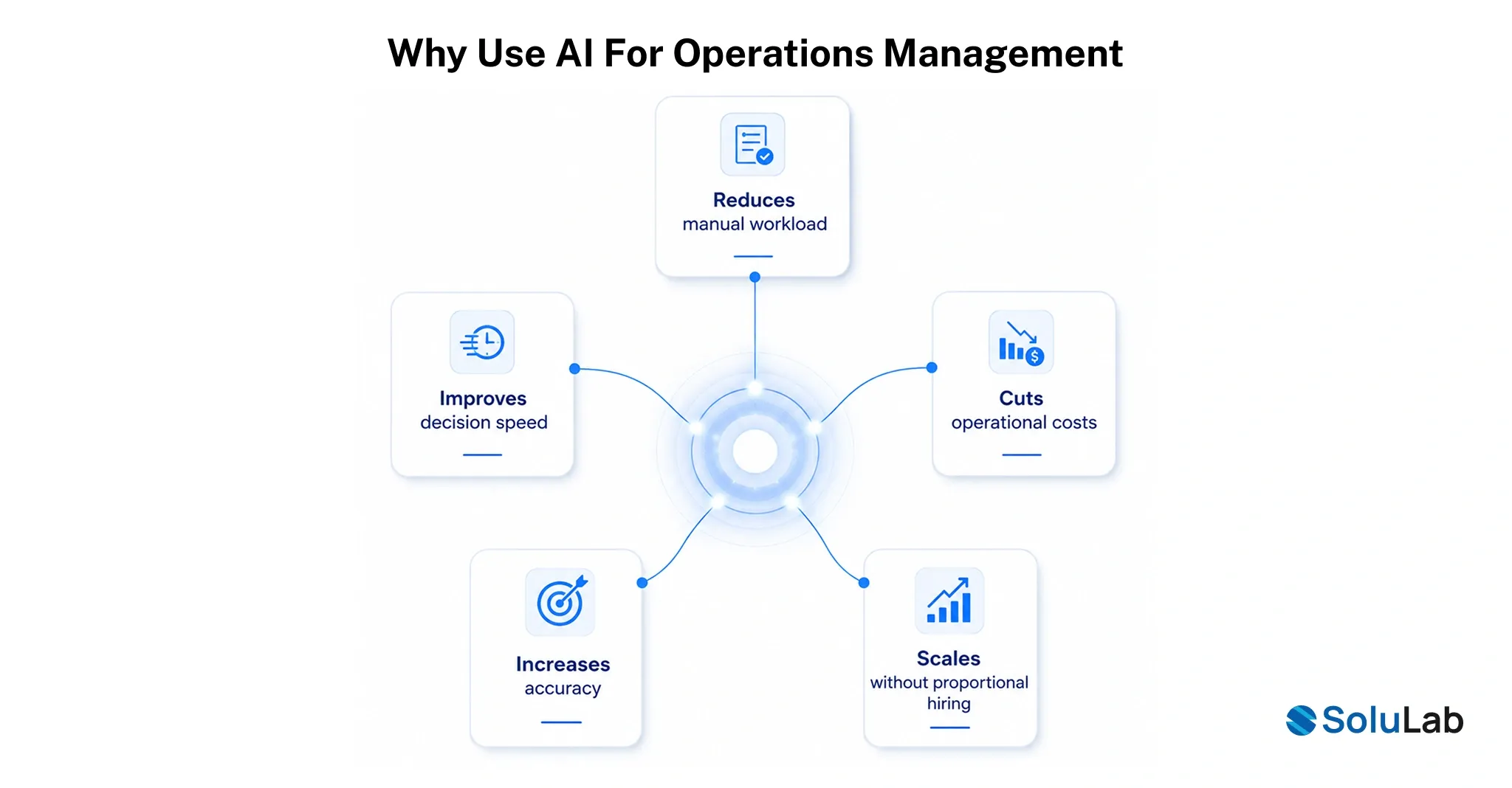
Operations teams have always been asked to do more with less, and that pressure isn’t easing up anytime soon, which is exactly why this shift is happening now.
- Reduces manual workload: Repetitive tasks like data entry, approvals, and status updates get handled automatically, freeing staff for work that actually needs judgment.
- Improves decision speed: Agents can pull data from multiple systems instantly, giving teams the context they need to act without waiting on manual reports.
- Cuts operational costs: Automating routine processes reduces the headcount needed for repetitive tasks, without necessarily cutting the roles that require real expertise.
- Increases accuracy: Consistent, rules-based execution reduces the human errors that creep into repetitive processes over long shifts or high workloads.
- Scales without proportional hiring: As transaction volume grows, agents can absorb more work without the business needing to add headcount at the same rate.
7 Ways AI Can Enhance Operations Management
Artificial intelligence touches far more of daily operations than most teams initially expect, often showing up in places that used to require several people working in sequence.
- Automated task routing: Agents assign incoming requests, tickets, or approvals to the right team or person based on content, urgency, and current workload.
- Real-time process monitoring: AI continuously tracks workflow status across systems, flagging delays or bottlenecks before they turn into bigger problems.
- Predictive resource planning: Machine learning forecasts staffing, inventory, or capacity needs based on historical patterns and current demand signals.
- Automated exception handling: Agents resolve common exceptions, like mismatched orders or missing data, without escalating every single case to a human.
- Cross-system data synchronization: AI keeps data consistent across ERP, CRM, and other platforms, removing the manual reconciliation work teams used to handle.
- Intelligent document processing: Agents extract, validate, and route information from invoices, contracts, and forms far faster than manual review.
- Continuous workflow optimization: Over time, agents identify recurring inefficiencies and suggest or apply process adjustments based on actual performance data.
How to Implement AI Agents for Operations?
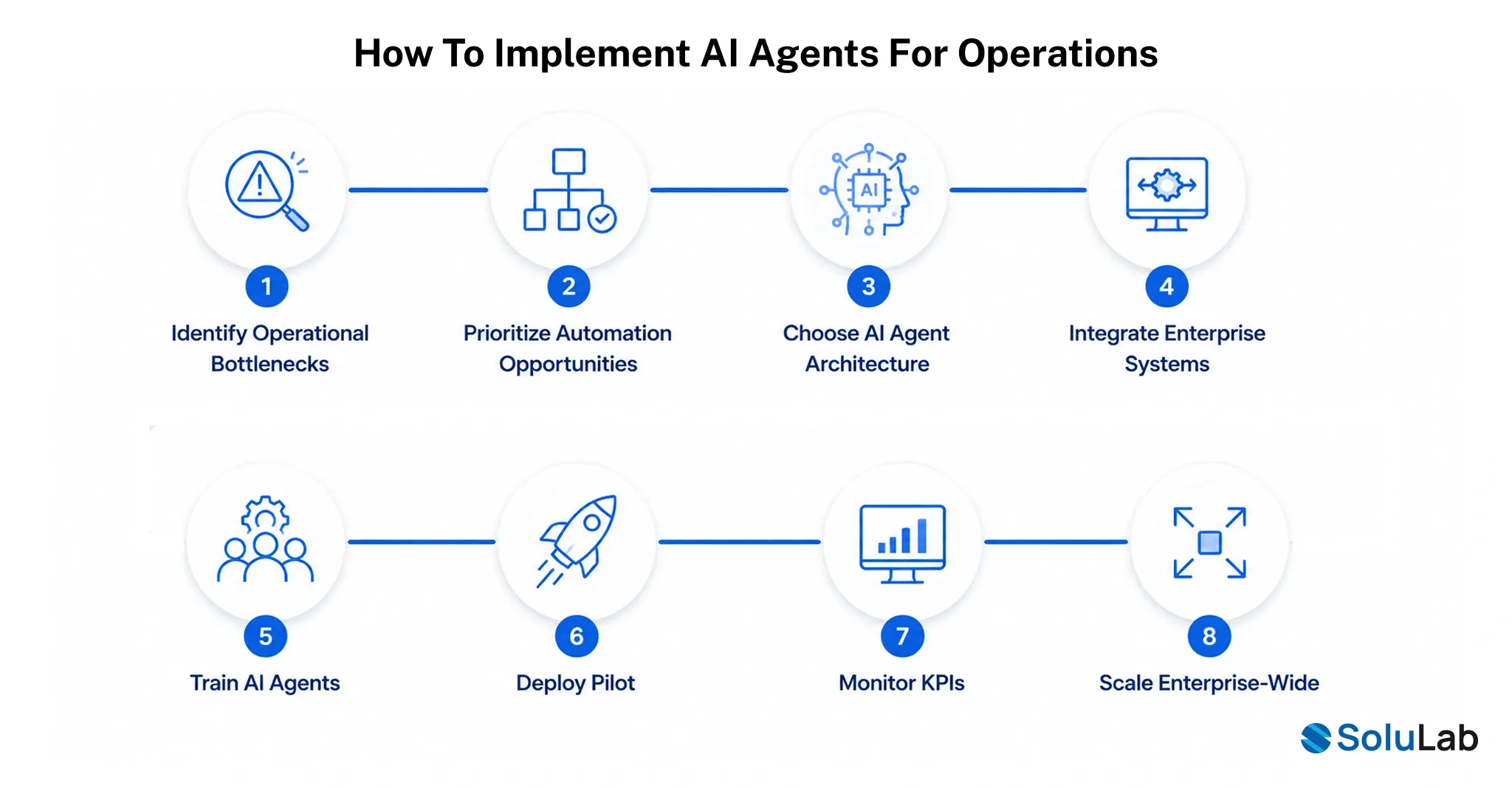
Rolling out AI agents for internal operations works best as a structured, phased process rather than a single big-bang deployment across the whole business.
1. Identify Operational Bottlenecks
Start by pinpointing where processes actually slow down or break most often.
- Map current workflow steps
- Flag recurring delays or errors
- Interview teams are doing the work
2. Prioritize Automation Opportunities
Not every bottleneck is worth automating first, so rank them by impact and feasibility.
- Score by potential time saved
- Weigh implementation complexity honestly
- Pick a high-value starting point
3. Choose AI Agent Architecture
Match the agent’s design to the complexity of the task it needs to handle.
- Decide on single-agent versus multi-agent
- Choose supporting AI models
- Plan for future scalability
4. Integrate Enterprise Systems
Connect the agent to the data and tools it needs to actually do the work.
- Connect ERP and CRM systems
- Set up secure data access
- Test integration points thoroughly
5. Train AI Agents
Give the agent the context and examples it needs to perform reliably.
- Feed relevant historical data
- Define clear task boundaries
- Set escalation rules clearly
6. Deploy Pilot
Test the agent on a small, controlled scope before expanding further.
- Limit scope to one team
- Monitor performance closely daily
- Collect structured user feedback
7. Monitor KPIs
Track real performance metrics to confirm the agent is delivering value.
- Track speed and accuracy
- Compare against baseline metrics
- Adjust based on results
8. Scale Enterprise-Wide
Once the pilot proves itself, expand the rollout in stages.
- Extend to additional teams
- Standardize deployment playbooks
- Keep monitoring after scaling
Real-World AI Agent Use Cases by Industry
Different industries are applying AI agents for enterprise operations in ways shaped by their own regulatory pressures, data types, and operational priorities.
1. Healthcare
Hospitals and clinics use agents to handle administrative work that used to pull staff away from patient care.
- Automated appointment scheduling and reminders
- AI-driven insurance claims processing
- Clinical documentation support for staff
2. Manufacturing
Factories rely on agents to keep production running smoothly and catch problems before they cause downtime.
- Predictive maintenance scheduling for equipment
- Automated quality inspection workflows
- Supply chain and inventory coordination
3. Retail
AI agents in retail manage the operational side of both physical stores and online channels.
- Dynamic inventory and restocking decisions
- Automated customer support resolution
- Demand forecasting across sales channels
4. Banking
Financial institutions apply agents to processes where speed and accuracy both carry real regulatory weight.
- Fraud detection and case triage
- Automated loan application processing
- Compliance monitoring and reporting
5. Insurance
Insurers use agents to speed up processes that traditionally required extensive manual review.
- Automated claims intake and routing
- Policy underwriting support workflows
- Customer inquiry resolution at scale
6. Logistics
Logistics companies deploy agents to coordinate the constant movement of goods and information.
- Route optimization and dispatch coordination
- Automated shipment tracking updates
- Exception handling for delayed deliveries
Read more: Autonomous AI shopping agents

Best Practices for Building Enterprise AI Agents
Deploying agentic AI for IT operations and management successfully depends on a handful of practices that separate reliable systems from risky ones.
- Governance: Establish clear ownership and decision rights for what agents can do, updated regularly as their scope expands.
- Human-in-the-loop: Keep human in the loop for reviewing high-stakes decisions, especially early in deployment when trust in the system is still being built.
- Continuous monitoring: Track agent performance constantly, not just at launch, since behavior can shift as data and conditions change.
- Model evaluation: Regularly test agent outputs against known benchmarks to catch drift before it affects real operations.
- Security: Treat every data connection and permission as a potential risk, applying the same scrutiny you’d give any critical system.
- Access controls: Limit what each agent can see and do based strictly on what its specific task actually requires.
- Prompt management: Version and document the instructions guiding agent behavior, so changes are traceable and reversible.
- Observability: Built-in logging and dashboards that let teams see exactly what an agent did and why.
- Testing: Run agents through edge cases and failure scenarios before trusting them with production workloads.
- Performance optimization: Continuously refine agent workflows based on real usage data, not just initial assumptions.
Future Trends in AI Operations
The direction this is heading is worth watching closely, since several trends are already reshaping how operations teams plan their AI investments.
1. Agentic AI
Systems are moving from answering questions to independently completing multi-step tasks across entire workflows.
2. Multi-Agent Systems
Multiple specialized agents coordinate with each other, splitting complex work rather than relying on one generalist agent.
3. AI Workforce
Businesses are starting to treat agents as a distinct category of digital labor, with defined roles and performance metrics.
4. Autonomous Enterprises
Some organizations are experimenting with end-to-end automated operations, where human involvement shifts toward oversight rather than execution.
5. AI Process Mining
AI analyzes actual workflow data to uncover inefficiencies humans often miss, guiding where automation should go next.
6. AI Orchestration
Platforms are emerging specifically to coordinate multiple agents, tools, and systems working together on shared objectives.
7. Digital Employees
Agents assigned to specific functional roles, complete with defined responsibilities, are becoming a more common operational model.
8. AI Governance
As adoption grows, formal governance frameworks are becoming a requirement rather than an afterthought for most enterprises.
Why Choose SoluLab for an AI Agent for Operations?
SoluLab, an AI native company deploying AI agents that actually hold up in production, takes more than picking a model off the shelf. SoluLab works with enterprises to design, build, and govern AI agents tailored to how their operations actually run.
- Custom AI agent development for operations
- Enterprise system integration and architecture
- Multi-agent workflow design
- Security, governance, and access control setup
- Pilot deployment and performance monitoring
- Enterprise-wide scaling support
Here are the AI agent examples for operations SoluLab has worked on:
For example, SoluLab built UpdateIA, a multi-agent AI platform for a French startup, enabling 14+ autonomous agents coordinated by Jarvis. It unified enterprise workflows, reduced manual effort, ensured compliance, and improved real-time decision-making across HR, CRM, Finance, and Legal systems.

Conclusion
AI agents are no longer a future concept for operations teams. They’re already handling scheduling, claims, fraud detection, and supply chain coordination across industries that can’t afford to get these processes wrong.
The businesses seeing real results aren’t the ones that moved fastest. They’re the ones that started with a clear bottleneck, built in proper governance, and scaled deliberately once the pilot proved itself.
SoluLab, an AI development company, can help your business identify the right starting point and build AI agents for operations that actually fit how your teams work.
FAQs
Neha is a curious content writer with a knack for breaking down complex technologies into meaningful, reader-friendly insights. With experience in blockchain, digital assets, and enterprise tech, she focuses on creating content that informs, connects, and supports strategic decision-making.