Key Takeaways
- AI agents are becoming core infrastructure, not experiments powering personalization, content operations, gaming, and fan engagement at enterprise scale.
- Fandom is a measurable growth lever: fans spend 51 more minutes daily with media than nonfans, and 55% engage with franchises across multiple platforms (Deloitte, 2026).
- Labeled AI content is gaining acceptance nearly 40% of fans say they’d embrace clearly labeled AI-created content across streaming, social, music, and gaming.
- Gartner’s 2026 outlook places multi-agent systems, domain-specific language models, digital provenance, and AI security platforms at the center of enterprise AI execution.
- The highest-value opportunity isn’t generic chatbots it’s custom, secure, workflow-connected agents built around first-party data, IP governance, and revenue goals.
- Governance must scale with capability provenance, labeling, and security are now business requirements, not afterthoughts.
Entertainment is becoming increasingly personalized, interactive, and AI-driven. From content recommendations and virtual influencers to automated video production and intelligent gaming experiences, AI agents are transforming how media companies create, distribute, and monetize content.
Unlike traditional AI tools that perform single tasks, AI agents can analyze audience behavior, make decisions, automate workflows, and execute actions across multiple systems with minimal human intervention. This capability is helping streaming platforms, gaming companies, studios, and content creators improve engagement, reduce production costs, and deliver more tailored experiences at scale.
As consumer expectations continue to rise, businesses across the entertainment industry are exploring AI agent development to enhance creativity, optimize operations, and unlock new revenue opportunities. In this guide, we’ll explore what AI agents in entertainment are, how they work, their key use cases, benefits, challenges, and the trends shaping the industry in 2026.
What Are AI Agents in Entertainment?
AI Agents in Entertainment are autonomous or semi-autonomous software systems that understand context, reason over objectives, use tools and data, and take action across media workflows. Unlike a one-time prompt-and-response tool, an agent can monitor signals, generate options, orchestrate workflows, personalize experiences, and continuously improve outcomes.
The Orchestration Difference
The real distinction in the AI agents for the entertainment industry category is orchestration. A traditional recommendation engine surfaces the next title to watch. An agentic system combines behavioral data, content metadata, fandom signals, business rules, and campaign priorities to decide what to recommend, when to engage, what offer to surface, and which downstream workflow to trigger next.
This is why AI in entertainment is shifting from isolated point solutions to enterprise-grade systems. Deloitte notes AI is becoming embedded across operations, audience analytics, production pipelines, and creative workflows, while Gartner names multi-agent systems a defining 2026 technology trend for complex automation.
How Do AI Agents Work Across the Entertainment Industry?
AI agents for media companies typically operate in a continuous loop: ingest signals → interpret context → decide the next best action → execute → learn from the result.
Inputs commonly include content libraries, viewing data, creator assets, ad performance data, CRM records, community activity, subscription behavior, merchandising events, and governance policies.
A Practical Agent Stack for Media & Entertainment
| Layer | Function |
| Perception Layer | Ingests first-party data, metadata, transcripts, engagement logs, and social signals |
| Reasoning Layer | Uses LLMs or domain-specific language models to classify, summarize, plan, and decide next steps |
| Tool Layer | Connects to CMS, DAM, ad systems, OTT platforms, help desks, moderation tools, and analytics |
| Governance Layer | Manages permissions, IP boundaries, labeling, digital provenance, and security controls |
| Feedback Layer | Measures CTR, watch time, churn risk, retention, conversion, and operational efficiency |
In mature deployments, agents rarely work alone. Gartner identifies multi-agent systems as a top 2026 trend precisely because modular agents can collaborate exactly what’s needed when personalization, rights management, production, fan engagement, and support workflows intersect.
How Are AI Agents Different From Traditional Entertainment Technologies?
Traditional entertainment technology is rules-based and single-purpose. AI Agents in Entertainment are goal-driven and adaptive; they reason through changing conditions, coordinate multiple systems, and make context-aware decisions within business guardrails.
This distinction has commercial weight: Deloitte argues that discovery, audience intelligence, and AI-enabled efficiency are now major differentiators in media. The systems that win are the ones acting across fragmented touchpoints, not those confined to a single dashboard or algorithm.
What Technologies Power AI Agents in Entertainment?
The strongest entertainment AI solutions combine models, data infrastructure, workflow orchestration, and trust architecture. Gartner’s 2026 trends highlight the key enablers: multi-agent systems, domain-specific language models, digital provenance, AI security platforms, confidential computing, and AI-native development platforms.
Core Building Blocks
- LLMs and domain-specific models for planning, summarization, dialogue, tagging, and reasoning
- Recommendation and ranking systems for discovery, retention, and monetization
- Retrieval and knowledge layers grounded in catalogs, scripts, policy libraries, brand guidelines, and fan data
- Generative media tooling for captions, recaps, highlights, translations, localization, and fan-facing creative assets
- Digital provenance and content labeling to verify origin and integrity of AI-generated outputs
- Security, privacy, and governance frameworks to protect sensitive IP, audience data, and enterprise workflows
The hidden differentiator? Data. Deloitte emphasizes44 that media companies need stronger investment in data infrastructure, metadata, analytics, governance, and partnerships to build the unified audience intelligence that modern personalization and monetization require.
Major Use Cases of AI Agents in Entertainment Industry
AI Agents for Streaming Platforms
AI agents for streaming platforms unify discovery, personalization, support, and retention. Deloitte notes that fragmented services frustrate consumers, and fans often discover content on social platforms before moving elsewhere to watch, a visibility gap agentic orchestration can help close.
High-impact streaming use cases:
- Personalized homepages, bundles, and cross-promotions based on fandom, viewing habits, churn risk, and off-platform signals
- Automated recap generation, highlight reels, summaries, subtitles, translation, and metadata enrichment
- Conversational discovery via voice or chat interfaces for titles, creators, and clips
- Subscriber support agents resolving billing, recommendations, and plan questions across channels
- Ad yield optimization through more complete fan profiles and better targeting logic
AI Agents for Content Creation
AI agents for content creation support ideation, story development, shot planning, asset organization, localization, post-production, compliance checks, and distribution packaging. Deloitte notes generative AI can accelerate the full content pipeline from ideation through post-production with localization, subtitling, and captioning delivering the fastest early value.
Example workflows:
- Script analysis agents identifying themes, audience segments, rating risks, and derivative content opportunities
- Production agents generating shot references, schedule suggestions, and editorial prep
- Post-production agents are creating trailers, short clips, platform variants, and accessibility assets faster
- Rights-aware publishing agents checking brand, legal, and IP guardrails before distribution
AI-Powered Fan Engagement
Fan engagement is becoming a frontline growth lever. Deloitte’s 2026 Digital Media Trends found 55% of fans engage with favorite franchises across multiple platforms, roughly half discover content through social media, and many want fandom experiences aggregated in one place.
Agents can now:
- Build unified fan profiles across streaming, social, commerce, events, and communities
- Deliver personalized digests, highlights, lore explainers, and community prompts
- Power virtual personalities, branded companions, and interactive fandom assistants
- Support governed co-creation experiences (alternate endings, fan clips, art)
- Trigger contextual commerce merchandise, memberships, premium bundles, and event upsells
AI Agents in Gaming
AI agents in gaming extend far beyond NPC scripting, powering adaptive worlds, live-ops intelligence, player support, toxicity moderation, content generation assistance, and real-time retention interventions.
Deloitte’s research shows fans are more likely than non-fans to be gamers and to pay for AI gaming services, while nearly 40% would accept clearly labeled AI-created game content, making gaming one of the most commercially ready environments for entertainment AI.
Benefits for Media Companies, Studios, and Entertainment Brands
The biggest benefit is measurable business leverage. AI Agents in Entertainment increase engagement, improve retention, accelerate content operations, and unlock new monetization paths, helping organizations compete in a fragmented, attention-constrained market.
For media executives, the strategic takeaway is simple: AI in entertainment is no longer just about content generation it’s about building systems that improve the full economic model around attention, discovery, fandom, and operational efficiency.
How AI Agents Are Reshaping Gaming and Interactive Entertainment?
AI agents are turning static gaming experiences into responsive ecosystems. Instead of relying solely on fixed branching logic, studios can adapt quests, dialogue, economy events, coaching, and support interactions based on real player behavior and live-service data.
Gaming sits at the intersection of narrative, community, progression, and monetization and Deloitte’s fandom data shows strong overlap between fans and gaming engagement, meaning agents support not just gameplay but creator ecosystems, virtual events, esports communities, and cross-franchise IP experiences.
Key Opportunities in Gaming
- AI game masters / live event directors that personalize challenges and in-world storytelling
- Real-time moderation and player safety agents for chat, voice, and community spaces
- Support agents that solve account issues, recommend modes, and reduce churn
- UGC enablement agents that help players create governed mods, levels, and branded content
- Economy and monetization agents that tune offers, bundles, and engagement loops intelligently
How Should Companies Deploy AI Agents in Media and Entertainment?
The right approach starts with business outcomes, not tools. Deloitte recommends tying AI efforts to practical AI use cases and clear business value; SoluLab’s methodology emphasizes strategic evaluation, custom design, integration, testing, and continuous optimization.
A Pragmatic Deployment Roadmap
- Identify the target — churn reduction, faster localization, improved ad yield, or fan monetization
- Prioritize one or two high-value use cases with accessible data and measurable KPIs
- Prepare the data foundation — metadata quality, permissions, rights boundaries, integrations
- Design the architecture — model choice, retrieval layer, action tools, human review points, audit logging
- Pilot in a governed environment, measure adoption and outcome quality, refine before scale
- Expand to multi-agent orchestration only after the core use case is stable and secure
Example: A streaming service might begin with a recap-generation agent and personalized content digests, then expand into fan segmentation, proactive support, and contextual commerce once governance and data are proven.
What Challenges, Ethics, and Best Practices Matter Most?
AI Agents in Entertainment create value only when governance scales with capability. As AI-generated content, personalization, and orchestration become more pervasive, trust, transparency, provenance, privacy, and security grow more important.
Top Risks to Manage
- IP misuse or unclear rights boundaries when generating or remixing branded content
- Hallucinations or low-quality outputs in customer-facing or editorial workflows
- Biased or opaque personalization logic that erodes trust
- Fragmented data and weak governance are undermining audience intelligence
- Security and compliance gaps across models, plugins, APIs, and third-party tools
Best Practices for Secure, Scalable Deployment
- Enforce provenance and labeling for AI-generated assets and experiences
- Use domain-specific grounding and human review for high-risk creative or rights-sensitive actions
- Implement role-based access, audit trails, and policy controls across all agent actions
- Build against a formal AI Security Checklist and align teams around AI Security Best Practices
- Treat AI as governed infrastructure, not an isolated experiment
What Is the Future of AI Agents in Entertainment for 2026 and Beyond?
The future is always-on, multi-agent, and deeply integrated with fandom economics. Deloitte’s 2026 outlook anticipates AI-generated content flooding platforms, discovery becoming a stronger differentiator, and audience trust plus data transparency mattering more as AI-driven experiences scale.
Shifts Likely to Define the Next Phase
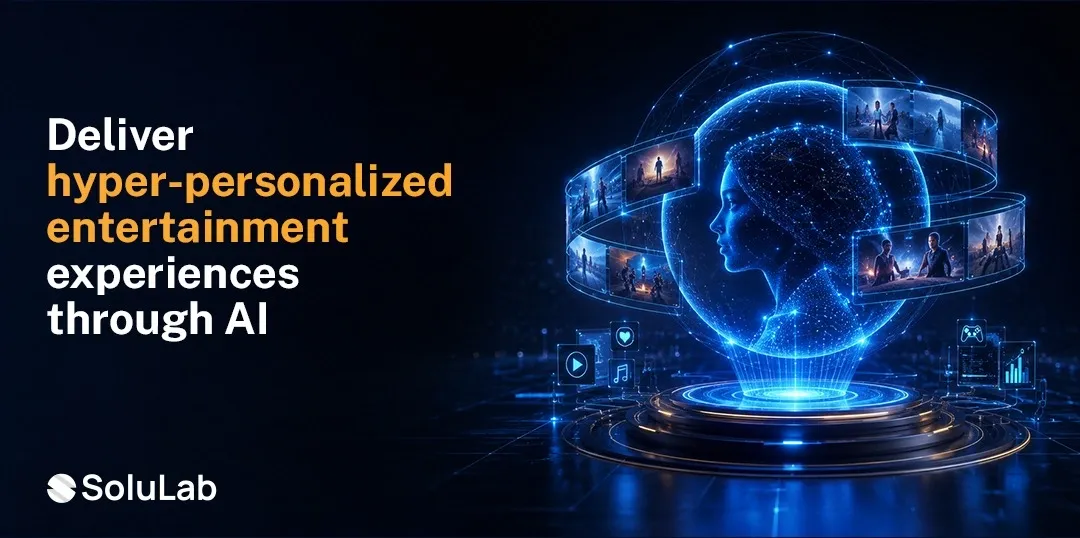
- Hyper-personalized entertainment journeys become standard, alongside efforts to preserve shared cultural moments
- Fan experiences become more aggregated, interactive, and commerce-enabled
- Custom domain models and multi-agent orchestration outperform generic AI layers
- AI-assisted co-creation becomes a monetizable part of franchise strategy
- Provenance, AI security platforms, and policy orchestration become mandatory enterprise capabilities
For brands investing now, the competitive advantage comes from execution discipline — the strongest data foundations, clearest use-case prioritization, best governance, and fastest path from pilot to production.
Why SoluLab for AI Agents in Entertainment?
The best AI Agent Development company combines strategy, custom engineering, media workflow understanding, enterprise integration, and strong governance into a production-ready delivery model. SoluLab is well-positioned here; its approach covers strategic planning, custom agent design, integration, optimization, and ongoing support rather than one-off prototype work.
Why Choose Professional AI Development Services?
Professional AI Development Services reduce the risk of fragile pilots that never reach production. Entertainment stakes are especially high audience data is sensitive, IP is valuable, workflows are complex, and brand trust can erode quickly from poor outputs or weak controls.
How Custom AI Agent Development Transforms Your Business?
Custom AI Agent Development aligns AI behavior with proprietary catalogs, fan segments, monetization goals, and operating workflows.
Examples of transformation:
- A streamer reducing churn through personalized recaps, recommendations, and lifecycle nudges
- A studio accelerating localization and post-production across global releases
- A gaming company using live-ops agents to personalize events and community engagement
- An entertainment brand growing merchandise and membership revenue through AI-powered fan journeys
Do You Need Enterprise AI Solutions and AI Consulting Services?
Yes, if your organization has multiple content systems, customer touchpoints, data silos, compliance obligations, or global workflows. Enterprise AI Solutions and Consulting are most valuable when AI must work across departments, vendors, channels, and governance boundaries.
The right sequence:
- Strategy and opportunity mapping
- Governance and security design
- Prioritized pilots
- Integration into production systems
- Scale-out through reusable agent frameworks
Should You Hire AI Developers or Partner With an AI Software Development Company?
Most entertainment companies should partner first, then build selectively in-house. Internal hiring of AI developers suits long-term platform ownership, but partner-led execution accelerates architecture, deployment, and governance in the early transformation phases.
A partner model helps you:
- Launch faster than an internal hiring cycle allows
- Access cross-functional expertise in data, LLMs, MLOps, integrations, and security
- Avoid costly early architectural mistakes
- Build proofs of value before expanding internal teams
Benefits of AI Integration Services and AI Automation Solutions
AI Integration and Automation deliver value by connecting intelligence to the systems where work and revenue already happen.
Main benefits:
- Faster time to value because agents can trigger real actions
- Better data quality through connected workflows and feedback loops
- Lower manual workload in tagging, recaps, localization, and support routing
- More consistent experiences across streaming, social, commerce, and community
- Stronger ROI reporting through measurable operational and engagement KPIs
Why Work With a Trusted AI Solution Provider and Technology Partner?
A trusted partner reduces execution risk while increasing long-term strategic value, balancing innovation with rights protection, customer trust, security, and experience quality.
The right partner provides:
- Business-first use-case prioritization
- Strong integration capability across legacy and modern stacks
- Security-minded delivery frameworks and governance planning
- Post-launch optimization, not just initial deployment
- Clear pathways from pilot to enterprise scale
This positions SoluLab not just as a vendor, but as an AI Technology Partner for media and entertainment organizations that need both speed and strategic depth.
Conclusion
AI Agents in Entertainment are redefining how content is created, distributed, personalized, monetized, and experienced. In 2026, the most important shift isn’t that AI can generate media, it’s that agentic systems can connect audience intelligence, operational workflows, fandom engagement, and business outcomes across the full media and gaming value chain.
For streamers, studios, game publishers, and entertainment brands, this creates a major strategic opening: reduced production friction, improved discovery, stronger AI-powered fan engagement, better retention, and new revenue streams across commerce, memberships, advertising, and interactive experiences.
SoluLab is well-suited to lead this transformation as an AI Agent Development Company, Agentic AI Development Partner, and AI Technology Partner for the entertainment sector, because the market now demands more than experimentation.
FAQs
Shipra Garg is a tech-focused content strategist and copywriter specializing in Web3, blockchain, and artificial intelligence. She has worked with startups and enterprise teams to craft high-conversion content that bridges deep tech with business impact. Her work translates complex innovations into clear, credible, and engaging narratives that drive growth and build trust in emerging tech markets.