Key Takeaways
- The problem: Generic LLMs sound smart but struggle with real business use cases. They miss context, produce inaccurate outputs, and can’t handle domain-specific complexity like legal, healthcare, or financial workflows.
- The solution: Domain-specific LLMs are trained on focused data, enabling accurate, context-aware outputs. With fine-tuning and the right architecture, businesses get reliable AI tailored to their exact needs.
- How SoluLab helps: SoluLab is an AI-native company, meaning we use AI in our own workflows to build faster and reduce costs. We help you design, train, and deploy domain-specific LLMs that actually work in production.
Generic LLMs appear intelligent but often overlook domain-specific context, resulting in inaccurate outputs, hallucinations, and poor business decisions. For industries like healthcare, finance, or legal, this lack of precision can create real risks and inefficiencies.
Relying on AI that misunderstands key terms or gives vague answers when accuracy actually matters. It slows teams down, increases review effort, and reduces trust in AI systems across your organization.
Domain-specific LLM development fixes this by training models on your own data, workflows, and terminology. With the right base model, fine-tuning approach, and validation, you get an AI system that understands your business deeply and delivers accurate, reliable, and production-ready outcomes.
What is a Domain-Specific LLM?
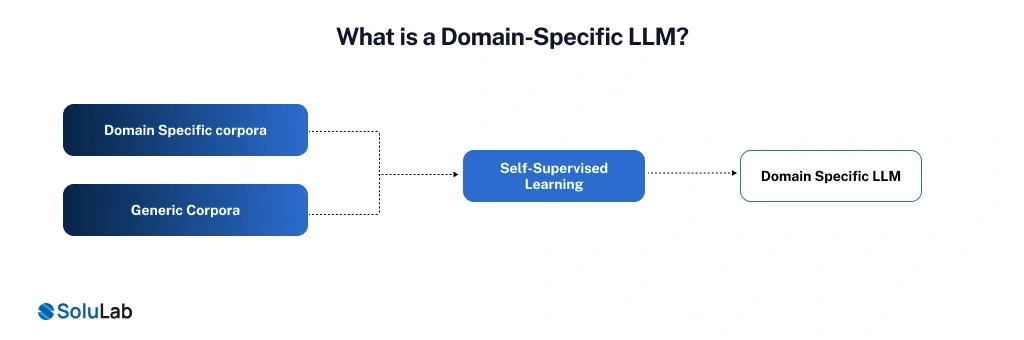
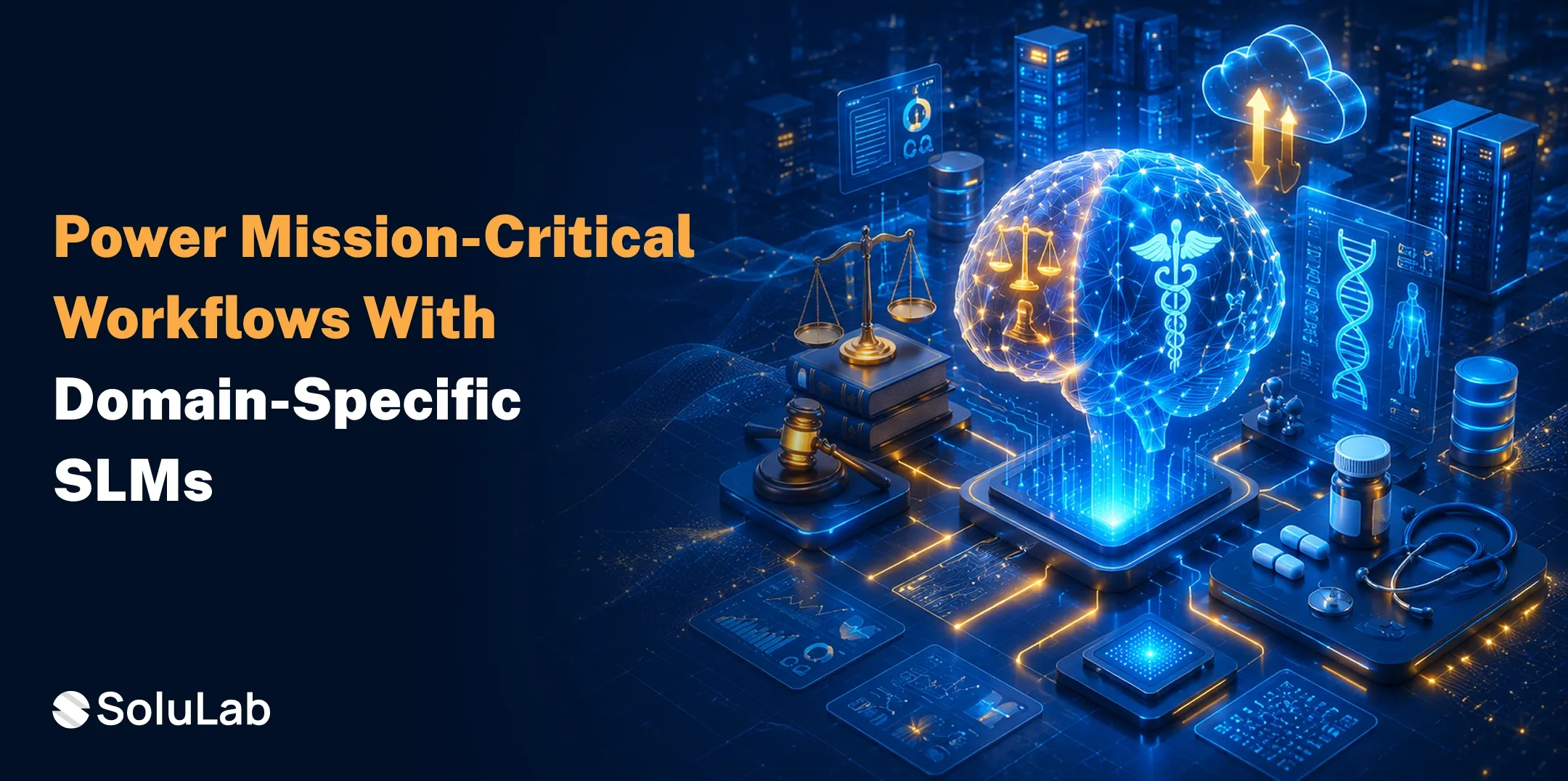
A domain-specific LLM is an AI language model trained or fine-tuned to understand and work within a particular field like healthcare, finance, or law. Instead of knowing a little about everything, it focuses deeply on one area, making it more accurate and reliable.
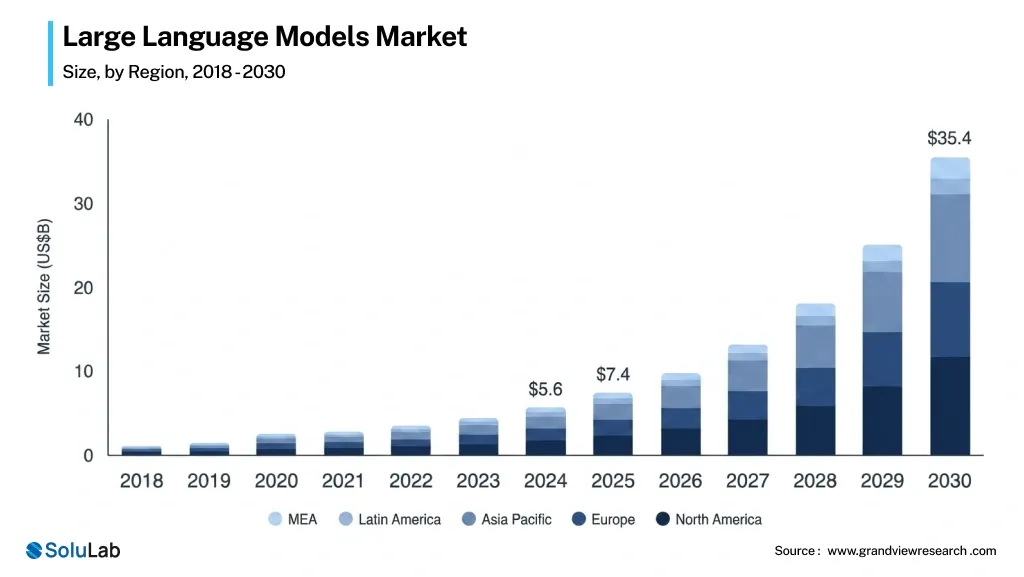
Think of it like a specialist doctor instead of a general one. It understands industry terms, context, and tasks much better than a general-purpose AI model. The global large language models market size was estimated to reach USD 35,434.4 million by 2030.
Why Build a Domain-Specific LLM?
General AI models often struggle with accuracy, context, and reliability in specialized tasks, which is why businesses are shifting toward domain-specific LLMs to achieve better performance and more relevant outcomes.
- Limited domain understanding: Generic LLMs lack in-depth knowledge of industry-specific terminology and workflows, resulting in vague or incorrect outputs when handling specialized tasks in fields such as healthcare, finance, or law.
- Higher risk of inaccuracies: Without domain training, models may generate misleading or fabricated information, which can create serious risks in sensitive industries where precision and correctness are critical.
- Inefficient decision-making: General models struggle with context-heavy queries, slowing down processes that require fast, accurate insights tailored to specific business environments.
- Poor contextual relevance: Outputs from generic models often miss subtle nuances of a domain, making them less useful for complex tasks that demand expert-level understanding.
- Scalability challenges: Businesses relying on generic models face limitations when trying to scale specialized use cases, as these models are not optimized for industry-specific requirements.
- Compliance and regulatory gaps: Generic LLMs may not align with industry regulations or standards, increasing the risk of non-compliance in sectors like healthcare, banking, and insurance.

How to Fine-Tune an LLM?
The fine-tuning phase customizes a broadly trained base model to excel in specialized tasks. It ensures the model retains its general linguistic capabilities while enhancing its performance in domain-specific contexts. Depending on the application, various techniques can be employed to fine-tune the model effectively:
| Technique | Description | Example |
| Task-Specific Fine-Tuning | Updating all parameters of the pre-trained model using a dataset tailored to a specific task. | Fine-tuning BERT for sentiment analysis on movie reviews. |
| Feature-Based Approach | Keeping the pre-trained model’s parameters fixed and adding task-specific layers. | Adding a classifier layer to a pre-trained BERT model for text classification. |
| Transfer Learning Techniques | Adopting a two-step process: intermediate task fine-tuning before final task-specific training. | Fine-tuning on a general news dataset before a smaller domain-specific news corpus. |
| Domain-Adaptive Pre-Training | Additional pre-training on domain-specific unlabeled data before task-specific fine-tuning. | Pre-training BERT with medical texts before fine-tuning for medical entity recognition tasks. |
| Adversarial Training | Training the model with adversarial examples to improve robustness and generalization. | Fine-tuning with perturbed inputs to increase resilience against input variations. |
| Multi-Task Learning | Training on multiple tasks simultaneously, sharing parameters across tasks for improved results. | Combining training for text classification and named entity recognition (NER). |
| Meta-Learning | Teaching the model to adapt quickly to new tasks with limited data. | Using MAML for rapid fine-tuning with a small number of training examples. |
| Distillation and Pruning | Compressing a larger model into a smaller one and removing redundant weights to enhance efficiency. | Using DistilBERT as a distilled version of BERT for faster and smaller-scale deployments. |
| Parameter-Efficient Fine-Tuning | Adding small, trainable modules or using low-rank matrices to optimize training processes. | Inserting adapters in BERT or using LoRA for domain adaptation. |
| Prompt-Based Fine-Tuning | Incorporating task-specific prompts in the input text to guide fine-tuning. | Adding prompts like “Question: [text]” for question-answering tasks. |
| Self-Supervised Fine-Tuning | Using self-supervised objectives alongside task-specific ones. | Using masked language modeling or next sentence prediction during task fine-tuning. |
Validation and Testing
To ensure the accuracy and reliability of domain-specific LLMs for practical applications, comprehensive validation and testing of custom-trained language models are essential:
- Performance Validation
Validate the model’s outputs using benchmarks specific to the domain, ensuring they meet the necessary standards of accuracy and reliability.
- Continuous Feedback and Iteration
Gather real-world feedback and update the model regularly to improve its effectiveness and accuracy over time. This iterative process ensures the model remains relevant to AI for domain-specific tasks.
Use Cases for Domain-Specific LLMs
Domain-specific large language models (LLMs) are transforming industries by offering tailored solutions that general-purpose models struggle to provide. These models are designed to excel in tasks requiring specialized knowledge, making them indispensable in several fields. Here are some prominent LLMs use cases:
1. Healthcare and Medicine
Domain-specific LLMs like Med-PaLM 2 are revolutionizing medical practice. They assist healthcare professionals by accurately interpreting medical records, answering complex medical queries, and even supporting diagnostic decision-making. These models are also being used in telemedicine to provide reliable and precise consultations, reducing the workload on practitioners.
2. Finance and Banking
In the financial sector, models like BloombergGPT and FinGPT streamline data analysis, sentiment detection, and market forecasting. Financial institutions are leveraging these LLMs to enhance customer service, automate compliance checks, and analyze market trends more efficiently, providing a competitive edge in decision-making.
3. Legal Services
Legal professionals benefit from domain-specific models such as ChatLAW, which are trained on vast legal corpora to assist in drafting contracts, summarizing case laws, and identifying potential legal risks. These models also help in regulatory compliance by cross-referencing laws and regulations specific to a jurisdiction.
4. Environmental Studies
Climate-focused models like ClimateBERT empower researchers and organizations to analyze climate data, verify facts, and generate reports on environmental issues. By minimizing errors in climate-related tasks, these models enable more accurate decision-making for sustainability initiatives and policy development.
5. Customer Support and Chatbots
Custom models like KAI-GPT are transforming customer support in industries such as banking, retail, and telecommunications. These LLMs deliver industry-specific conversational AI solutions that understand domain-specific terminology, ensuring accurate responses and a better customer experience.
6. Research and Academia
Researchers across domains use tailored LLMs to extract insights from vast datasets, automate literature reviews, and assist in drafting research papers. These models accelerate the research process while maintaining high levels of precision in domain-specific outputs.
7. Content Creation and Marketing
Companies are utilizing domain-specific LLMs to generate targeted content that resonates with specific audiences. For example, an LLM trained in fashion or technology can create blog posts, social media content, or product descriptions that align with the industry’s language and trends.
By focusing on the unique needs of specific fields, domain-specific LLMs are driving innovation and enabling organizations to solve complex problems with unparalleled accuracy and efficiency.
Benefits of Domain-Specific LLMs
Domain-specific large language models (LLMs) are redefining how industries tackle specialized tasks. By tailoring language models to specific fields, businesses, and professionals gain significant advantages over using general-purpose models. Here are the key benefits:
1. Improved Accuracy and Relevance
Domain-specific LLMs are trained on curated datasets unique to their respective industries. This specialization enables them to provide highly accurate and contextually relevant outputs, reducing the risk of errors that general models might produce in specialized tasks, such as medical diagnostics or legal document analysis.
2. Enhanced Efficiency
Tailored models streamline complex workflows by automating repetitive and knowledge-intensive tasks. Whether summarizing financial reports, extracting legal clauses, or analyzing climate data, these models save time and resources, allowing experts to focus on strategic decision-making.
3. Better Decision Support
By delivering outputs that align with domain-specific requirements, these LLMs support better decision-making. For instance, financial LLMs can provide precise market insights, while healthcare models can aid in diagnosis and treatment planning, offering valuable assistance to professionals.
4. Reduced Hallucinations
Unlike general-purpose models that often generate irrelevant or fabricated information, domain-specific LLMs are less prone to hallucinations. With focused training data and domain-specific safeguards, they deliver more reliable results, especially in critical applications such as law, finance, or healthcare.
5. Customization for Unique Needs
Domain-specific LLMs allow organizations to tailor models to their exact requirements. Customization enables businesses to address niche challenges, ensuring the model aligns with their operational goals and industry standards.
6. Increased User Trust and Adoption
When outputs are accurate and relevant, users develop greater trust in the technology. This trust fosters higher adoption rates of domain-specific solutions, as users feel confident in relying on the model for critical tasks and insights.
7. Cost-Effective Solutions for Specialized Tasks
By focusing only on relevant datasets and use cases, domain-specific LLMs reduce computational costs compared to deploying overly generalized models. This makes them a cost-effective choice for businesses seeking specialized AI-driven solutions.
Domain-specific LLMs not only address the limitations of generic models but also open up new possibilities for industry-specific innovation, making them indispensable in fields where precision and expertise are paramount.
Domain-Specific vs General-Purpose LLMs
Here’s a complete difference between domain-specific and general-purpose LLMs:
| Aspect | Domain-Specific LLMs | General-Purpose LLMs |
| Training Data | Curated datasets like PubMed for medicine | Vast corpora like Common Crawl |
| Strengths | Deep expertise (e.g., BioBERT for biology) | Versatility (e.g., GPT-4 across topics) |
| Limitations | Narrow scope (e.g., LegalBERT ignores casual chat) | Hallucinations in niches (e.g., faulty drug facts) |
| Use Cases | Healthcare (Med-PaLM), finance (FinGPT), law | Chatbots (ChatGPT), content gen |
| Resource Needs | Moderate for fine-tuning (e.g., LoRA on Llama) | Massive for pre-training |
How to Build a Domain-Specific Large Language Model?
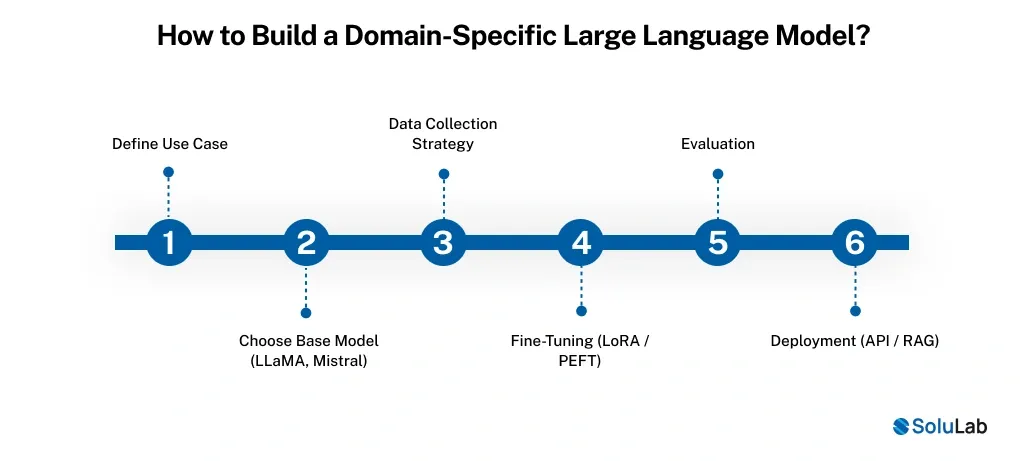
Building a domain-specific LLM is about turning a general AI model into a focused expert that understands your business, data, and real-world use cases with higher accuracy and reliability.
Step 1: Define Use Case
Start by clearly identifying the problem your LLM will solve. A focused AI use case ensures better model performance and avoids unnecessary complexity during development.
- Clear problem and goal
- Define target users
- Identify key workflows
- Set measurable success metrics
Step 2: Choose Base Model (LLaMA, Mistral)
Select a strong foundational model based on performance, cost, and flexibility. The right base model directly impacts accuracy, scalability, and fine-tuning efficiency.
- Compare model performance benchmarks
- Evaluate cost vs scalability
- Check open-source flexibility
- Align with use case needs
Step 3: Data Collection Strategy
Gather high-quality, domain-specific data to train your model. Clean, relevant datasets are the backbone of any successful domain-specific LLM.
- Collect domain-specific datasets
- Clean and preprocess data
- Ensure data diversity coverage
- Remove noise and duplicates
Step 4: Fine-Tuning (LoRA / PEFT)
Customize the base model using efficient techniques like LoRA or PEFT. This step helps the model understand domain-specific language without high compute costs.
- Use parameter-efficient techniques
- Train on curated datasets
- Optimize the usage of training resources
- Reduce cost and time
Step 5: Evaluation
Test the model against domain-specific benchmarks to ensure accuracy and reliability. Continuous evaluation helps refine performance before AI deployment.
- Use domain-specific benchmarks
- Measure accuracy and relevance
- Conduct human evaluation checks
- Identify performance gaps early
Step 6: Deployment (API / RAG)
Deploy the model using APIs or integrate with RAG systems for real-time applications. Ensure scalability, monitoring, and security for production environments.
- Deploy via APIs or RAG
- Ensure scalability and latency
- Monitor model performance continuously
- Implement security and guardrails
How to Add Domain-Specific Knowledge to an LLM Based on Your Data?
Adding domain-specific knowledge to an LLM helps it understand your business data better, improving accuracy, relevance, and performance while making AI outputs more aligned with real-world use cases.
- Retrieval Augmented Generation: Instead of retraining the model, RAG connects your LLM to external data sources, fetching relevant information in real time to generate accurate, context-aware responses.
- Knowledge Distillation: This method transfers knowledge from a large, complex model into a smaller one, helping retain domain expertise while improving speed, efficiency, and reducing infrastructure costs.
- PEFT (Parameter-Efficient Fine-Tuning): PEFT fine-tunes only specific parts of a model using techniques like LoRA, making it cost-effective while still adapting the LLM to domain-specific data and tasks.
Examples of Domain-Specific LLMs
Recognizing the limitations of general-purpose language models, industry leaders took the initiative to develop domain-specific language models customized to their respective fields. Here are some notable examples of domain-specific LLMs:
- BloombergGPT
BloombergGPT is a causal language model built using a decoder-only architecture. With 50 billion parameters, it was trained from the ground up using decades of financial data. This AI for domain-specific tasks excels in financial applications, outperforming other models significantly on financial-specific tasks while matching or exceeding their performance on general language tasks.
- Med-PaLM 2
Med-PaLM 2 is a specialized model developed by Google and trained on meticulously curated medical datasets. This domain-specific LLMs example demonstrates exceptional accuracy in answering medical questions, sometimes performing at the level of medical professionals. On the MedQA dataset, which includes questions from the US Medical Licensing Examination, Med-PaLM 2 achieved an impressive score of 86.5%.
- ClimateBERT
ClimateBERT is a transformer-based model trained on millions of climate-related datasets. Through fine-tuning, it empowers organizations to perform fact-checking and other language tasks with greater precision on environmental data. Compared to general-purpose models, ClimateBERT reduces errors in climate-related tasks by up to 35.7%.
- KAI-GPT
KAI-GPT, developed by Kasisto, is a large language model designed to deliver conversational AI solutions in the banking sector. It ensures safe, transparent, and accurate applications of generative AI in customer service, making it a reliable option for financial institutions seeking domain-specific language models.
- ChatLAW
ChatLAW is an open-source language model trained specifically with datasets from the Chinese legal domain. The model features several enhancements, including a unique method to reduce hallucinations and improve inference accuracy, making it highly effective for legal applications in China.
- FinGPT
FinGPT is a lightweight model pre-trained with financial datasets, offering a cost-effective alternative to BloombergGPT. This model incorporates reinforcement learning from human feedback, allowing for further personalization. It performs exceptionally well on financial sentiment analysis datasets, solidifying its position as one of the top examples of domain-specific LLMs in the financial sector.
These domain-specific LLMs examples demonstrate how tailored models are pushing the boundaries of AI for domain-specific tasks, enabling precise and effective solutions across industries.
How to Build a Domain-Specific Large Language Model?
Training and fine-tuning large language models (LLMs) is a complex process that involves addressing both ethical and technical challenges. Teams must manage computational costs, leverage domain expertise, and ensure the model achieves the desired accuracy. Mistakes made during the training process can propagate throughout the entire pipeline, impacting the final application. These best practices will help guide your efforts when training a domain-specific LLM or custom LLMs for specialized applications.
- Start Small
Avoid being overly ambitious when developing a model. Instead of targeting multiple use cases, focus on training the LLM for a specific task. For example, train a custom LLM to enhance customer service as a product-aware chatbot. Deploy the tailored model and only scale further if it proves successful in its initial application.
- Understand Scaling Laws
Scaling laws in deep learning examine the relationship between compute power, dataset size, and the number of parameters in a language model. OpenAI initiated this research in 2020 to predict a model’s performance before training, recognizing that building a large LLM, such as GPT, requires substantial time and cost.
Key insights from scaling laws include:
- Larger models outperform smaller ones when trained on the same dataset and reach desired performance levels faster.
- Expanding a model’s architecture has a greater impact on performance than simply increasing the dataset size, provided sufficient compute resources are available.
However, DeepMind’s 2022 research challenged these findings, showing that both model size and dataset size are equally important in enhancing the performance of AI for domain-specific tasks.
- Prioritize Data Quality
High-quality, domain-specific training data is essential for creating an effective domain-specific LLM. Training data must represent the diversity of real-world scenarios to prevent bias and ensure generalizability. For instance, financial institutions should train credit scoring models with datasets that reflect the demographics of their customer base to avoid deploying biased systems that may misjudge credit applications.
Whether building a model from scratch or fine-tuning an existing one, ML teams should ensure datasets are free of noise, inconsistencies, and duplicates. Proper data preparation is critical to achieving fairness and accuracy in the model’s predictions.
- Enforce Data Security and Privacy
The massive datasets used to train or fine-tune custom LLMs present significant privacy risks. Threats to the machine learning pipeline, such as data breaches, could harm an organization’s reputation and compromise user privacy.
Organizations must adopt stringent data security measures, such as encrypting sensitive data during storage and transmission. These practices are also essential for compliance with industry regulations like HIPAA and PCI-DSS.
- Monitor and Evaluate Model Performance
Once an LLM is deployed, ongoing monitoring is essential to ensure it meets real-world expectations and adheres to established benchmarks. If the model underperforms or exhibits issues such as bias or underfitting, it should be refined with additional training data, adjusted hyperparameters, or updated training processes.
Continuous evaluation allows AI for domain-specific tasks to remain effective and relevant in dynamic environments, ensuring it adapts to changing requirements and real-world circumstances.
By following these best practices, teams can successfully train and fine-tune domain-specific LLMs, ensuring their models are accurate, reliable, and aligned with the unique needs of their application.

Conclusion
Building a domain-specific large language model is not just about fine-tuning data; it’s about aligning AI with real business context, workflows, and decision-making needs.
When done right, it improves accuracy, reduces errors, and delivers meaningful outcomes where generic models fall short. From selecting the right base model to continuous optimization, every step plays a critical role in performance and scalability.
As industries move toward more intelligent systems, domain-focused LLMs will become a competitive necessity rather than an option. SoluLab, an AI development company, can help your business design, train, and deploy custom models tailored to your specific needs.
FAQs
Shipra Garg is a tech-focused content strategist and copywriter specializing in Web3, blockchain, and artificial intelligence. She has worked with startups and enterprise teams to craft high-conversion content that bridges deep tech with business impact. Her work translates complex innovations into clear, credible, and engaging narratives that drive growth and build trust in emerging tech markets.