Key Takeaways
- An AI agent in blockchain is a model that holds a wallet and acts. The reasoning layer is off-chain, the consequences are on-chain, and the gap between those two is where every design decision matters.
- The spend policy is the product. An agent without hard caps, allowlists and approval gates is an unbounded signing key attached to a probabilistic system.
- Identity is the unsolved half. Proving that a transaction came from an authorised agent, acting within a mandate, on behalf of a named principal, is harder than making the agent work.
- Autonomy and finality do not mix comfortably. A wrong on-chain action cannot be recalled, so the engineering effort goes into what the agent is prevented from doing.
- Most production value today is narrow. Payments, settlement triggers, monitoring and data verification pay back; autonomous treasury management mostly does not yet.
Agents that can hold a wallet and sign transactions are a genuinely new category, and the market is arriving faster than the controls around it. Gartner expects task-specific AI agents to appear in 40% of enterprise applications during 2026, up from under 5% in 2025.
That is an eightfold shift in a single year, and it lands on blockchain infrastructure where every action is final and publicly visible. The interesting engineering question is no longer whether an agent can execute an on-chain transaction, because it plainly can. It is what stops the agent from executing the wrong one.
This guide covers how AI agents in blockchain actually work step by step, eight use cases with real deployments behind them, the security and identity problems nobody has fully solved yet, the governance questions that still have no clean answer, and what a build realistically costs.

What Are AI Agents in Blockchain?
An AI agent in blockchain is an autonomous software agent that uses a language or decision model to pursue a goal, holds its own wallet or delegated signing authority, and executes transactions against smart contracts without a human approving each one. The model reasons off-chain; the actions and their consequences are recorded on-chain and are irreversible.
1. Read-Only Agents
The agent monitors on-chain state, interprets it and reports or alerts. No signing authority, no funds at risk. This is where most enterprise deployments sensibly start.
2. Gated Execution Agents
The agent proposes a transaction and a human or multisig approves it. Slower, and the pattern that production systems handling meaningful value overwhelmingly use.
3. Fully Autonomous Agents
The agent signs and executes within pre-set policy limits, with no human in the loop per action. Appropriate for high-frequency low-value operations, and genuinely dangerous without hard caps.
4. Why This Differs From Ordinary AI Automation
A normal agent that makes a mistake writes a wrong row to a database, and you correct it. An on-chain agent that makes a mistake has moved value irreversibly to a counterparty with no obligation to return it. The reasoning layer is probabilistic and the settlement layer is absolute, which is an uncomfortable pairing and the reason this discipline exists. For the broader convergence picture, see our guide to decentralized AI.
How Do AI Agents in Blockchain Work?
Tracing one agent action end to end shows where the engineering effort actually goes.
1. The Agent Receives a Goal and a Mandate
Not just an instruction, but a bounded mandate: what it may spend, which contracts it may call, which tokens it may touch, over what period. The mandate is configuration, and it is the single most consequential thing in the system.
2. It Gathers On-Chain and Off-Chain Context
Current balances, pool states, pending positions, plus whatever external data the decision needs. Oracle staleness matters here exactly as it does in any DeFi contract: an agent reasoning over a stale price reasons confidently and wrongly.
3. The Model Plans a Sequence of Calls
The reasoning step produces a plan, usually several transactions with dependencies. This is where language models are strongest and least predictable, which is why the plan is proposed rather than trusted.
4. Policy Enforcement Gates the Signature
Before anything is signed, a policy layer checks the plan against the mandate: spend caps, contract allowlists, rate limits, slippage bounds. Rejections happen here. This layer is deterministic code, deliberately not a model.
5. The Transaction Is Signed and Submitted
Through a smart contract account with programmable rules rather than a raw private key wherever possible, so limits are enforced on-chain and not only in your backend.
6. The Contract Executes and Settles
Standard on-chain execution applies, which our breakdown of smart contract development covers in detail. Once the block is final there is no recall path.
7. The Result Feeds Back and Is Logged
Outcome, gas cost, state change and the full reasoning trace are recorded. Without that trace you cannot audit why an agent did something, which is both an operational and a compliance problem.
Top 8 Blockchain-Based AI Agent Use Cases
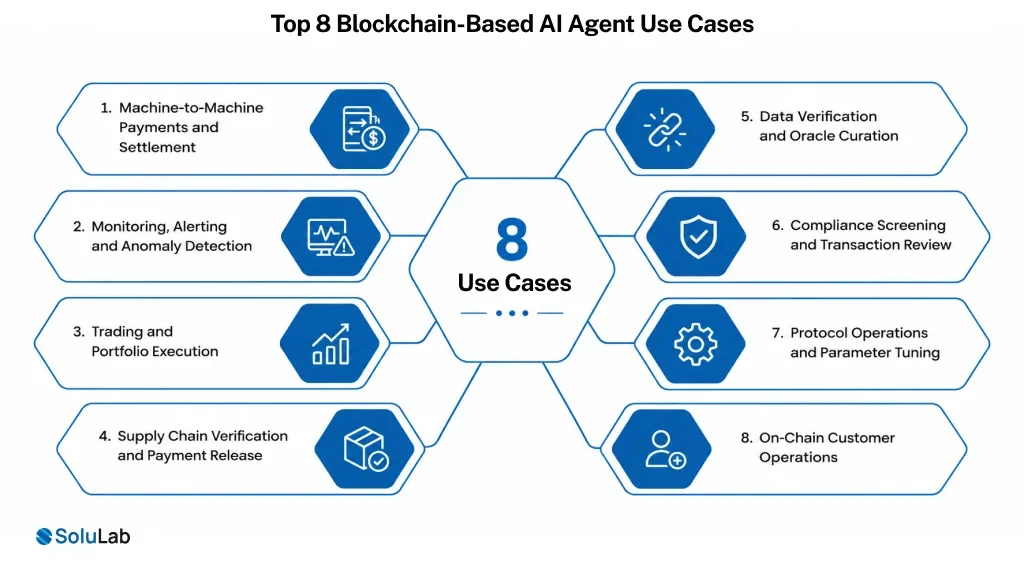
Here are top 8 use cases you should know:
1. Machine-to-Machine Payments and Settlement
Agents paying other agents or services for compute, data or API calls, settled in stablecoins with per-transaction caps. The clearest near-term application because the amounts are small, the logic is simple, and the counterparty risk is bounded.
2. Monitoring, Alerting and Anomaly Detection
Agents watching protocol state for parameter drift, unusual flows or liquidation risk, and escalating to humans. Read-only, zero signing risk, immediate value.
3. Trading and Portfolio Execution
The loudest category, and the one with real history behind it. We cover this specifically in AI agents in crypto trading, since execution strategy deserves its own treatment rather than a paragraph here.
4. Supply Chain Verification and Payment Release
Agents reconcile delivery evidence against contract milestones and releasing escrowed payment when conditions are verified. The pattern pairs naturally with blockchain in supply chain deployments where the trigger data already exists on-chain.
5. Data Verification and Oracle Curation
Agents cross-check data sources, flagging disagreement between feeds and curating what reaches a contract. Useful precisely because oracle failure is a leading cause of protocol loss.
6. Compliance Screening and Transaction Review
Agents screening counterparty addresses, flagging sanctioned or high-risk wallets and generating audit documentation before a transaction proceeds. Gated execution is mandatory here.
7. Protocol Operations and Parameter Tuning
Agents proposing collateral factor or rate curve adjustments based on observed conditions, with governance approving. Proposal, not execution, is the realistic scope.
8. On-Chain Customer Operations
Agents handling refunds, subscription renewals and dispute resolution against escrow contracts, within tight spend limits. For the wider catalogue beyond blockchain, see our AI agent use cases overview.
Key Benefits of AI Agents in Blockchain Technology
Here are few benefits of AI agents in blockchain:
1. Continuous Operation Against a Market That Never Closes
On-chain markets run constantly. An agent monitoring and acting around the clock removes the structural disadvantage of a human operating hours.
2. Verifiable Action History by Default
Every agent action is a public transaction with a timestamp. You get an audit trail without building one, which is a genuine advantage over off-chain automation.
3. Deterministic Enforcement of Limits
Spend caps enforced by a smart contract account cannot be talked around by a model, prompt-injected or misconfigured in a backend. The constraint lives where the funds live.
4. Reduced Settlement Friction Between Machines
Agents transacting with agents need no invoicing, no account setup and no payment terms. AI agents smart contracts automation removes the coordination overhead rather than just speeding it up.
5. Composability With Existing Protocols
An agent that can call a contract can use any protocol that contract integrates with, which means capability grows without new integration work on your side.
6. Narrower Trust Assumptions Than Custodial Automation
An agent operating through a policy-constrained smart contract account requires trusting less than handing an API key to a centralised service with full account access.
Multi-Agent Systems and On-Chain Coordination
1. Why Multiple Specialised Agents Beat One Generalist
A monitoring agent, an execution agent and a compliance agent with distinct mandates and separate keys contain failure better than one agent holding every permission. Separation of duties is an old control and it applies here directly.
2. How Agents Coordinate Without Trusting Each Other
Shared on-chain state is the coordination substrate. Agents read the same contract rather than messaging each other, which removes a trust assumption and a failure mode at once.
3. Cross-Chain Agent Operation
Agents operating across chains inherit every cross-chain risk, and configuration errors here are among the most damaging failure categories in the sector. Our explainer on blockchain interoperability covers the mechanics worth understanding first.
4. Orchestration and Escalation Design
Something has to decide which agent handles what, and what happens when one fails mid-sequence. The patterns are the same ones we describe in AI agent development for enterprise systems, with finality added as a constraint.
5. The Coordination Failure Nobody Plans For
Two agents acting on the same state in the same block produce outcomes neither predicted. Multi-agent systems blockchain designs need explicit sequencing or locking, and most early deployments discover this the expensive way.
AI Agent Blockchain Security and Identity Verification
1. Prompt Injection Becomes a Financial Exploit
An agent that reads untrusted on-chain data, token metadata or memo fields can be instructed by it. On a normal agent this produces a wrong answer; here it produces a signed transaction. Input isolation is a funds-protection control, not a quality one.
2. Key Management Is the Whole Problem
The agent needs signing capability, which means a key exists somewhere a compromise can reach. Smart contract accounts with on-chain limits, session keys with short expiry and hardware-backed custody for the parent key are the mitigations that actually hold.
3. Spend Policy Enforced On-Chain, Not in Your Backend
A limit checked in application code is a limit an attacker bypasses by reaching the key directly. Enforce it at the account contract level. Our blockchain security best practices guide covers the surrounding controls.
4. Agent Identity and Mandate Attestation
AI agent blockchain identity verification is the genuinely unsolved part. A counterparty needs to establish that a transaction came from an authorised agent, acting inside a stated mandate, on behalf of an identifiable principal. Decentralised identifiers and verifiable credentials are the direction of travel, and the tooling described in blockchain identity management is where most implementations currently start.
5. Audit the Account Contract Like Any Other
The smart contract account enforcing your limits is itself a contract holding funds, so it needs the same independent review as any protocol. That work sits with our smart contract audit company practice.
6. Reasoning Traces as Forensic Evidence
When an agent does something unexpected, the only way to understand it is a stored trace of inputs, retrieved context, the plan and the policy decision. Log it from the first deployment.
AI Agents in Blockchain Governance
1. What Agents Can Usefully Do in Governance
Summarising proposals, modelling their effect on protocol parameters, flagging conflicts with existing rules and drafting analysis for voters. All of this is informational and uncontroversial.
2. Delegated Voting Is Where It Gets Contested
An agent voting a delegated stake according to a published policy is technically straightforward and politically fraught. Who is accountable for a vote nobody made?
3. Why Full Autonomy in Treasury Decisions Stays Rare
AI agents blockchain governance proposals routinely suggest autonomous treasury management. Very few DAOs have adopted it, because the failure mode is irreversible and the accountability question has no clean answer. Structuring guidance sits on our DAO development company page.
4. The Practical Middle Ground
Agents prepare, humans decide, and the agent’s analysis is published on-chain alongside the vote so the reasoning is auditable. This is where credible deployments have landed.
How to Build AI Agents on Blockchain?
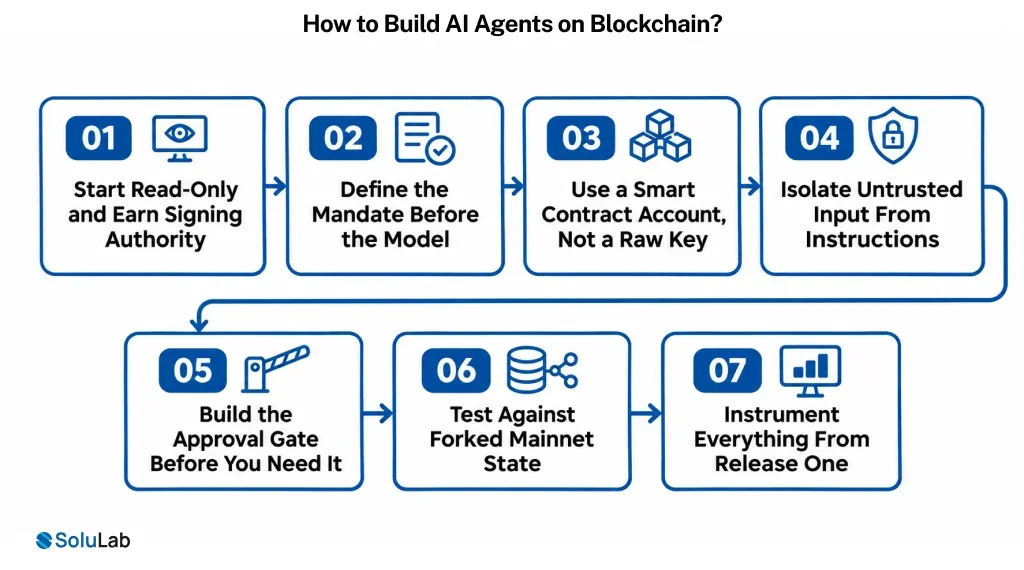
Here’s a complete step-by-step guide on how to build AI agent on blockchain:
1. Start Read-Only and Earn Signing Authority
Deploy the agent in monitoring mode against live state first. Compare its proposed actions to what you would have done. Grant execution only once that comparison is boring.
2. Define the Mandate Before the Model
Spend caps, contract allowlists, token allowlists, rate limits and time bounds, written down and reviewed. Model selection is a later and smaller decision.
3. Use a Smart Contract Account, Not a Raw Key
Programmable accounts let you enforce limits on-chain, rotate session keys and revoke authority without moving funds. This is the single highest-leverage architectural choice available.
4. Isolate Untrusted Input From Instructions
Treat all on-chain data, metadata and memo content as hostile. Structured parsing with instruction isolation, never raw concatenation into a prompt.
5. Build the Approval Gate Before You Need It
A human or multisig approval path for anything above a threshold, tested under time pressure rather than assumed to work.
6. Test Against Forked Mainnet State
Simulated environments hide integration failures. Fork tests against real state and real protocol behaviour are where agents meet reality.
7. Instrument Everything From Release One
Reasoning traces, policy decisions, gas costs, rejection rates. Rising rejection rates usually mean the mandate and the model disagree, which is useful to know early.
AI Agent Blockchain Development Cost
Cost tracks autonomy level, contract surface and compliance load far more than model choice.
| Engagement | Typical range | What it covers | Timeline |
| Architecture and mandate design | $6,000 to $14,000 | Use case framing, policy model, account architecture, risk assessment, build estimate | 2 to 3 weeks |
| Read-only monitoring agent | $18,000 to $45,000 | Data pipelines, reasoning layer, alerting, dashboards, no signing authority | 5 to 8 weeks |
| Gated execution agent | $45,000 to $110,000 | Smart contract account, policy enforcement, approval workflow, audit preparation | 10 to 16 weeks |
| Autonomous agent with on-chain limits | $80,000 | Full policy enforcement on-chain, session keys, monitoring, independent audit cycle | 14 to 22 weeks |
| Multi-agent system | $80,000+ | Orchestration, separated mandates, sequencing controls, cross-agent audit trail | 18 weeks+ |
| Monitoring and incident retainer | Monthly, scoped to value at risk | Policy review, model updates, trace analysis, response support | Rolling |
How SoluLab Can Help
We build AI agents and on-chain systems, and we have been engineering both since 2014.
1. Mandate and Architecture Design
We define what the agent may do before deciding what it will be built with, because the policy model determines the rest of the system.
2. Agent Builds From Read-Only to Autonomous
Monitoring agents, gated execution agents and policy-constrained autonomous agents, with smart contract accounts and reasoning traces as standard deliverables.
3. Security and Audit Coordination
Account contract review, prompt injection testing, key custody design and independent audit management as part of the build rather than after it.
4. Enterprise Integration
Connecting agents to the systems you already run, so on-chain action reflects off-chain reality. Our AI agent development company page covers the non-blockchain side of this work.
If you want custom ai agent blockchain solutions or need to build ai agents on blockchain for a defined workflow, start with an architecture call. We will tell you plainly when a read-only agent delivers most of the value at a fraction of the risk, because frequently it does.

Conclusion
AI agents in blockchain have moved past the question of whether they work. They do, and the market is adopting them quickly. What has not caught up is the control layer: the mandates, the on-chain spend limits, the identity attestation, and the approval gates that decide whether an autonomous system handling irreversible transactions is an asset or a liability.
The pattern across credible deployments is consistent and slightly boring. Start read-only. Enforce limits where the funds live rather than in application code. Treat every external input as hostile.
If you are deciding where an agent fits in your product, or how to architect one that cannot do more damage than it is worth, SoluLab, an AI agent development company, can help your business scope it properly. Book an architecture call, and we will work through the mandate with you.
FAQs
Neha is a curious content writer with a knack for breaking down complex technologies into meaningful, reader-friendly insights. With experience in blockchain, digital assets, and enterprise tech, she focuses on creating content that informs, connects, and supports strategic decision-making.