Key Takeaways
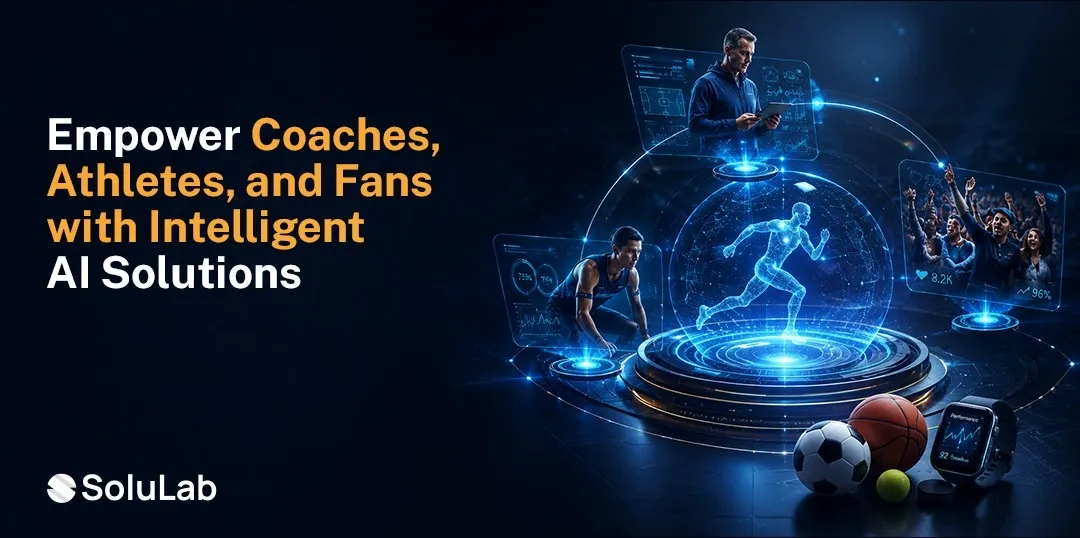
- AI agents are transforming sports by automating decision-making, analyzing real-time data, and supporting coaches, athletes, and front-office teams.
- Professional teams are using AI agents for player performance analysis, injury prevention, tactical planning, scouting, fan engagement, and operational efficiency.
- Agentic AI improves both on-field and off-field performance, from optimizing game strategies to personalizing fan experiences and streamlining business operations.
- Organizations adopting AI agents gain a competitive advantage through faster insights, data-driven decisions, and more efficient workflows.
- A successful AI implementation starts with the right use case, high-quality data, and a well-defined proof of concept before scaling across the organization.
By 2026, AI will no longer be a side project for sports organizations; it’s becoming the operating backbone of the industry. According to Deloitte’s 2026 Global Sports Industry Outlook, teams and leagues are shifting from experimentation to enterprise-wide adoption, using AI to reshape how they operate, make decisions, engage fans, and protect athletes. At the same time, Gartner projects that 40% of enterprise applications will embed task-specific AI agent developemnt by the end of 2026, up from under 5% just a year earlier.
AI agents in sports are the connective tissue behind this shift to autonomous systems that don’t just analyze data but act on it, running end-to-end workflows across analytics, operations, and fan experience. This post breaks down what’s driving the market, where AI agents for sports are already delivering results, and how organizations are working with an AI agent development company to build their own.
The State of AI in the Sports Industry: 2026 Market Data
The numbers back up what’s happening on the ground. The global AI in sports market was valued at roughly $10.61 billion in 2025 and is projected to reach $12.69 billion in 2026, growing at a compound annual rate of 21.6% through 2033 when it’s expected to hit nearly $49.92 billion, according to Grand View Research. Esports is the fastest-growing segment, expanding at a projected 24.5% CAGR over the same period, while North America currently holds the largest regional share of the market.
That growth tracks with the broader picture Gartner has laid out for enterprise AI: worldwide AI spending is forecast to total $2.52 trillion in 2026, a 44% year-over-year increase. Sports organizations are a visible part of that curve. Deloitte’s 2026 outlook specifically calls out AI agents that can handle ticketing and microtransactions automatically, model crowd patterns across entire stadium districts, and even let teams game-plan against digital-twin opponents during practice. The report is direct about where most organizations stand today: not there yet, but past the point where AI in professional sports can be treated as optional. Deloitte recommends teams focus now on consolidating data, building internal AI capabilities, and establishing clear governance and security guardrails, a theme that shows up again later in this post.
PwC’s own analysis of AI agents in sports echoes the same trajectory: adoption is moving from isolated pilots toward governed, production-grade deployments across front offices, medical staff, and fan-facing teams alike.

What AI Agents for Sports Analytics Actually Do?
“AI in sports” used to mean dashboards and post-game reports. AI agents for sports analytics go further; they observe, reason, and recommend in real time, and increasingly take action without waiting for a human to run the query.
- Real-Time Decision Support and Tactical Analysis
The most advanced systems now monitor live match data and generate tactical suggestions for coaching staff as the game unfolds, rather than after film review. Some organizations are experimenting with agent-based tactical simulation testing strategies against virtual opponents before matchday, while conversational AI layers let non-technical staff ask plain-language questions about defensive transitions or key possessions instead of digging through raw data themselves.
- AI-Powered Athlete Performance and Injury Prevention
Predictive modeling is one of the most operationally valuable applications of AI-powered athlete performance tools. By correlating workload intensity, biomechanical data, recovery metrics, and injury history, AI agents can flag elevated injury risk before it becomes a problem, giving medical and performance staff a head start that traditional monitoring can’t match.
- Player Evaluation and Recruitment
AI agents for sports analytics are also changing how teams evaluate talent, moving beyond box-score stats to measure specific role impact, such as how much a defender’s positioning lowers an opponent’s scoring probability, for example, or how a midfielder’s off-ball movement changes team structure. That level of granularity is reshaping scouting and recruitment pipelines across professional sports.
AI Agents for Sports Teams and Organizations: Beyond the Field
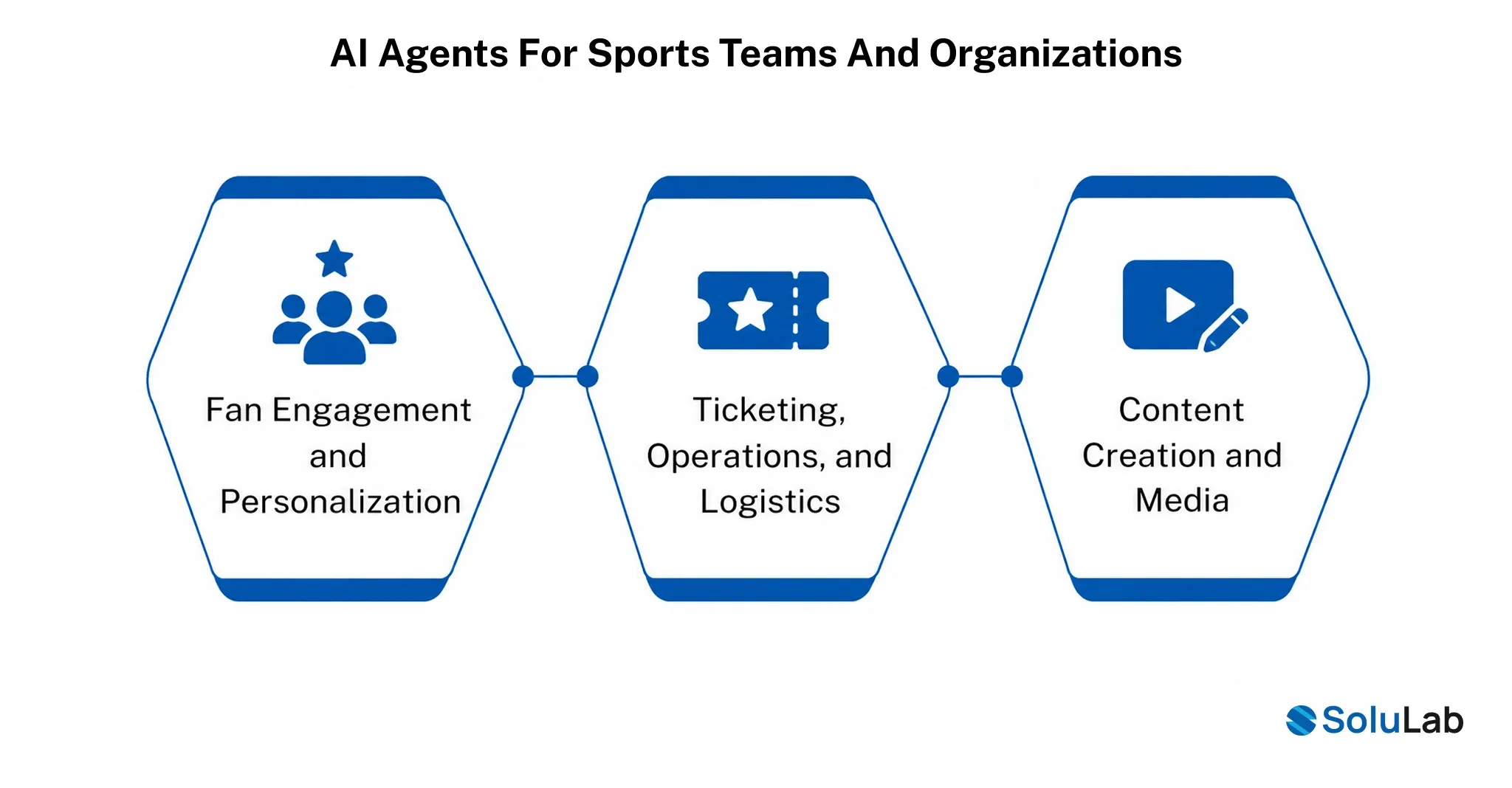
Analytics gets the headlines, but AI agents for sports teams and organizations are having just as much impact off the field.
- Fan Engagement and Personalization
Front offices are already putting this into practice. The Cleveland Cavaliers use AI agents to send personalized emails tailored to individual fan behavior and preferences, and the Indiana Fever use AI to segment audiences and trigger dynamic, in-the-moment offers. These are early, concrete examples of AI-powered solutions moving fan engagement from broad campaigns to one-to-one personalization at scale.
- Ticketing, Operations, and Logistics
As per Deloitte’s 2026 outlook, more sports organizations are expected to deploy AI agents for end-to-end operational workflows, ticketing and microtransaction handling, game-film logistics, and stadium-district crowd modeling, among them. This is AI agents for sports management in its most literal sense: agents running the operational plumbing so staff can focus on higher-value decisions.
- Content Creation and Media
Sports teams are also using AI agents to generate match summaries, respond to fan questions, and support content production, pulling from multiple internal systems automatically instead of requiring staff to manually assemble reports. This is one of the clearer examples of AI sports technology reducing operational overhead without reducing output quality.

Why Sports Organizations Are Turning to an AI Agent Development Company?
Most sports organizations don’t have in-house teams built to design, secure, and maintain autonomous agent systems, which is why so many are choosing to hire AI developers and partner with an outside AI agent development company rather than build from scratch.
A capable AI Agent Development partner brings a few things internal teams typically lack: production experience deploying agents that integrate with existing enterprise systems, a track record with the underlying data pipelines analytics agents depend on, and the security architecture needed to run agents safely at scale. This is where AI Development Services firms add the most value ot just writing code, but designing agent architecture around a specific organization’s workflows, data, and risk tolerance. Most also bring broader Artificial Intelligence Solutions to the table, such as machine learning, computer vision, and NLP, which matters once a sports agent needs to draw on video, biometric, or unstructured fan data rather than clean tabular stats alone.
For sports organizations specifically, that often means combining a few types of engagements:
- Custom AI agent development for sport-specific use cases, tactical analysis agents, injury-risk models, or fan personalization engines that off-the-shelf tools can’t replicate.
- Enterprise AI Solutions that connect agents to ticketing systems, CRM platforms, and broadcast infrastructure without disrupting day-to-day operations.
- AI Consulting Services to assess AI readiness, prioritize the highest-impact use cases, and build a realistic rollout roadmap rather than chasing every possible application at once.
- AI integration services and AI implementation services to get agents talking to the systems a team already runs, instead of forcing a rip-and-replace.
- AI agent development services and AI automation solutions to keep agents monitored, retrained, and reliable well after launch not just working on day one.
Many of the same firms offering AI agent development services also operate as a full AI software development company, which matters once an agent needs to plug into custom-built ticketing platforms, proprietary analytics tools, or legacy stadium systems that off-the-shelf integrations don’t cover.
Choosing the right AI Development companies matters as much as the technology itself. A sports AI development company that understands both agentic AI and the operational realities of a front office ticketing cycles, broadcast windows, in-season constraints will build systems that fit how the organization actually works, not just a generic AI application development template. Whether the goal is to build AI agents for sports analytics, fan engagement, or operations, the right AI solution provider treats each use case as a distinct engineering problem rather than a one-size-fits-all deployment.
Security and Governance: The Non-Negotiable Foundation
None of this works without security built in from the start a point Deloitte’s 2026 outlook raises directly when it calls out data governance, security, and trust guardrails as fundamentals sports organizations need before scaling AI further.
The risk is not hypothetical. Industry data cited in SoluLab’s AI Security Checklist shows that 63% of organizations either lack formal AI governance policies or are still developing them a significant gap given how much sensitive data (athlete health records, financial systems, fan personal data) now flows through AI agents. Following AI Security Best Practices means encrypting sensitive data in storage and transit, enforcing role-based access controls, and logging agent activity to catch unusual behavior before it becomes a breach.
Agent autonomy raises the stakes further. Secure AI Agent Development requires treating agents like privileged digital identities with least-privilege access, human-in-the-loop approval for high-risk actions like financial transactions, kill switches, and continuous monitoring rather than a “set it and forget it” deployment. For any organization deploying agents against athlete health data, ticketing revenue, or fan personal information, this isn’t optional infrastructure it’s the difference between a system that scales safely and one that becomes a liability.
Getting Started with AI Agents for Sports
The organizations pulling ahead in 2026 are the ones treating AI as infrastructure, not experiments. A practical starting point looks like this:
- Audit and consolidate data – Agents are only as good as the data they can access, and Deloitte’s research points to fragmented data as one of the biggest blockers to scaling AI in sports.
- Pick one high-impact use case – Injury-risk prediction, fan personalization, or ticketing automation are all proven starting points with measurable ROI.
- Build governance before scale – Access controls, human approval workflows, and monitoring should exist before an agent goes into production, not after.
- Bring in outside expertise where it’s needed – An experienced AI agent development company can shortcut months of trial and error, particularly around agent architecture and security.

Final Thoughts
AI agents in sports have moved past the buzzword phase. Between Deloitte’s 2026 outlook naming AI as the sports industry’s operating backbone and Gartner’s projection that 40% of enterprise applications will run task-specific agents by year’s end, the direction is clear — the organizations that build strong data foundations and secure agent architecture now will be the ones setting the pace over the next several seasons.
Whether the goal is smarter analytics, deeper fan engagement, or leaner operations, the right development partner can turn that roadmap into a production system. If you’re ready to build AI agents for your organization, SoluLab’s AI agent development team can help you scope, build, and secure the right solution.
FAQs
Shipra Garg is a tech-focused content strategist and copywriter specializing in Web3, blockchain, and artificial intelligence. She has worked with startups and enterprise teams to craft high-conversion content that bridges deep tech with business impact. Her work translates complex innovations into clear, credible, and engaging narratives that drive growth and build trust in emerging tech markets.