Document review time can drop by as much as 70%. Think about what that frees up: the hours your people currently burn on page-turning go back into the decisions that actually matter. And reading documents is only half of it. AI also picks up patterns and oddities buried in financial data, the kind that hint at fraud or at something quietly broken in the books. Machines chew through enormous datasets quickly and without getting bored, which is exactly why they catch the small discrepancy that turns out to be the first sign of a much bigger problem.
Accenture found that 70% of professionals believe generative AI will boost M&A results. Planning and executing those transactions gets more reliable, more efficient and faster, say 84% of them. And 82% of firms treat generative AI as a tool for reinvention, not just a cost line.
The tooling keeps getting sharper. The next wave of systems will flag hazards, read complicated market movements and help work through contract terms, rather than just summarising what a human already found. That shifts due diligence from backward-looking to predictive. Spot the problem before it lands on the deal table, and you buy yourself a level of accuracy and insight the old checklist approach never offered.
So this article walks through where AI agents actually get used in due diligence, what they are good at, what they cost you in setup, and how to put them to work. If you understand the shift now, you are not scrambling later when AI-driven insight becomes the baseline everyone expects from your team.
What is Due Diligence?
Due diligence is the homework you do before a decision you cannot easily undo. Someone is about to put money in, buy a business, or sign a contract, so they stop and look properly first. Gather the information. Check what you were told against what is true. Weigh the risk. Then decide.
Detective work, basically. An investor runs due diligence to find out whether the idea will earn anything. A company runs it before a partnership, because nobody wants to discover the mismatch six months in. Lawyers comb contracts for the clause that bites later. Banks want to know if the borrower can actually repay. Regulators do their own version, checking that everyone is playing by the rules.
Strip away the jargon and it comes down to being careful on purpose. Look before you commit, and the expensive mistakes mostly stop happening. That is as true for a large acquirer as it is for someone buying their first small business.
Why is GenAI Critical in Due Diligence?
Before the contract gets signed or the cheque gets written, somebody has to take the target apart and look inside. That inquiry is due diligence. It exists so no operational, legal or financial detail goes unexamined.
Partner vetting, investment analysis, mergers and acquisitions: the same exercise sits underneath all of them. And it usually means reading an unreasonable volume of material. Slow, dull, and precisely the conditions under which humans start missing things.
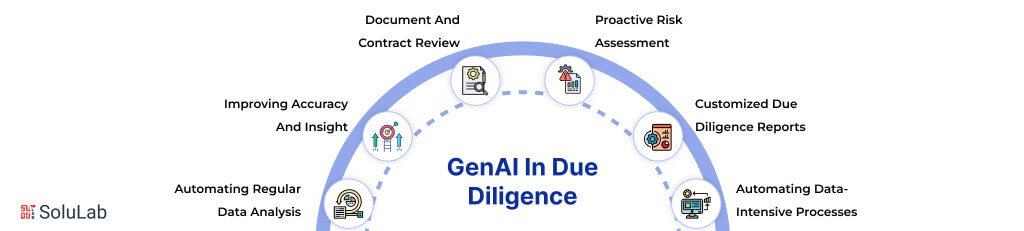
Generative AI rearranges that work in a few concrete ways:
1. Automating Regular Data Analysis: The collect-and-sort phase eats the calendar. Hand it to AI agents for data analysis and the team gets those hours back for the judgment calls that need a person.
2. Improving Accuracy and Insight: Fewer slips. GenAI builds detailed profiles and reports from the material already on hand, and in doing so surfaces risks and openings that a tired reviewer at 11pm would have skated past.
3. Enhancing Document and Contract Review: Natural language processing lets the model work through dense contracts and legal filings quickly, pulling out the terms that a proper review depends on rather than leaving you to hunt for them.
4. Proactive Risk Assessment: Run the operational and compliance data through generative models and patterns start showing up in credit risk models with machine learning including the abnormalities a human analyst would reasonably have missed.
5. Customized Due Diligence Reports: Once the first pass is done, the report writes itself against that analysis, with whatever the team adds folded in. Review cycles that used to drag on compress hard.
6. By Automating Data-Intensive Processes: Sharper analysis, faster decisions, better-informed ones: Generative AI is changing both how far due diligence can reach and how well it works. Regulatory and operational demands are not getting simpler. For most organisations, adopting GenAI here has stopped being a nice advantage and started looking like the price of staying in the game.
Potential Use Cases of AI Agents with Due Diligence Process Automation
Where does generative AI earn its keep in due diligence? The tables below lay out the AI agent use cases of AI agents handling due diligence process automation, broken out by function.
1. Regulatory Monitoring
| Use Case | Description |
| Automated Tracking | Watches for changes to laws and regulations across every jurisdiction in scope, so your diligence work reflects the rules as they stand today. |
| Alert Generation | Pings the diligence team the moment a relevant rule shifts, while there is still time to react to what it breaks. |
| Trend Analysis | Reads historical regulatory data to show where the rules are drifting, which helps firms get ahead of changes likely to hit their operations. |
| Compliance Documentation | Refreshes compliance records against new regulations as they land, so the paperwork never falls behind the law. |
2. Document Management
| Use Case | Description |
| Sorting and categorization | Files diligence documents by type, relevance or whatever criteria you set, which makes them findable instead of theoretically present. |
| Document retrieval | Lets you ask for a document in plain English and get it, cutting the time lost digging through oversized data rooms. |
| Version control | Tracks every version in play so nobody builds an argument on a draft that was superseded two weeks ago. |
| Access control | Locks documents down to the people cleared to see them, which keeps you on the right side of privacy rules. |
3. Risk Assessment
| Use Case | What It Does |
| Automated Analysis | Works through the data to weigh financial, legal and operational exposure rather than sampling and hoping. |
| Risk Scoring | Attaches a score to each piece of the findings, so attention goes where it is needed. |
| Trend Detection | Flags the patterns and outliers that tend to precede a risk becoming real. |

4. Contract Review
| Use Case | Description |
| Clause Extraction | Finds and pulls the specific clauses you care about, which speeds up assessment without making it sloppier. |
| Summarization | Turns a hundred-page contract into a short brief that leads with the points a reviewer has to see. |
| Compliance Checks | Tests terms and clauses against the regulations currently in force, and says where a contract falls short. |
| Risk Mitigation Recommendations | Reads a contract for exposure and proposes edits or actions to close the gap, which protects the company’s position rather than merely documenting it. |
5. Data Extraction
| Use Case | Description |
| Key Data Identification | Pulls the data points that matter out of messy, sprawling datasets, so nothing material slips past the analysis. |
| Data Normalization | Puts formats from different sources into one shape, which makes the numbers comparable instead of merely adjacent. |
| Metadata Tagging | Tags what it extracts so that sorting, tracing and pulling it back for a future audit takes minutes. |
6. Data Analysis
| Use Case | Description |
| Key Data Identification | Pulls the data points that matter out of messy, sprawling datasets, so nothing material slips past the analysis. |
| Data Normalization | Puts formats from different sources into one shape, which makes the numbers comparable instead of merely adjacent. |
| Metadata Tagging | Tags what it extracts so that sorting, tracing and pulling it back for a future audit takes minutes. |
7. Insight Generation
| Use Case | Description |
| Actionable Recommendations | Turns the analysis into advice someone can act on, which is what shapes both strategy and the final diligence call. |
| Benchmarking | Sets company performance against industry norms and named competitors, and shows where the gaps sit. |
| Scenario Planning | Runs the current data through different futures, so you can see how a strategy behaves before committing to it. |
| Data Correlation Analysis | Reads the relationships between separate datasets and explains what they imply, which is usually where the non-obvious findings live. |
Benefits of AI Agent for Due Diligence
What do teams actually get out of it? A few things stand out:
- Improved Productivity: An AI agent behaves like an extra pair of hands on the team. It gathers data and verifies it quickly, which pushes the heavier, more interesting work back to the people who should be doing it. Same headcount, more finished.
- Better Accuracy: Language and patterns in data are what these systems are built for. They do not lose focus on page 400 the way a person does. What comes back is dependable, and decisions made on top of it hold up better.
- Cost Savings: Paying a room full of people to do repetitive review work is expensive and nobody enjoys it. AI agents can carry that load instead, and the budget goes somewhere it matters more.
- Faster Decisions: Need an answer today, not next Thursday? Reports and insight come back in a few clicks. When a fresh opportunity or an awkward problem shows up, you can move on it while it is still live.
- Continuous Monitoring: It never stops watching the data. A new risk appears, something needs updating, a figure moves: the agent sees it and analyses it rather than waiting for the next scheduled review.
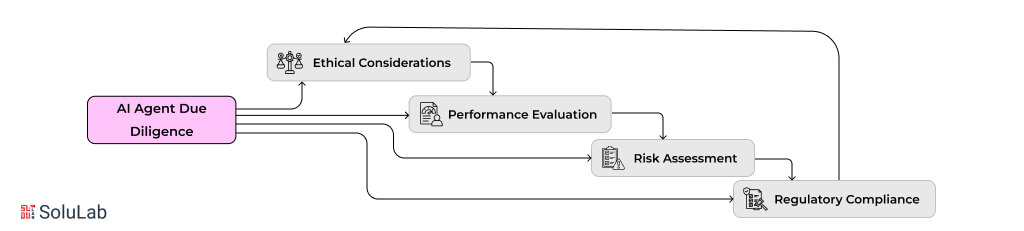
Considerations of AI Agents for Due Diligence
Automating diligence with AI agents is not a plug-and-play exercise. A handful of decisions up front determine whether it works. Here they are, one at a time:
1. Define Clear Objectives
Answer one question first: what is this agent supposed to do for us? Cut turnaround time? Reduce the errors that creep in when someone checks the same detail for the ninetieth time? Pick the goal, because without it there is no honest way to say whether the thing is working. In practice this is where most projects quietly go wrong.
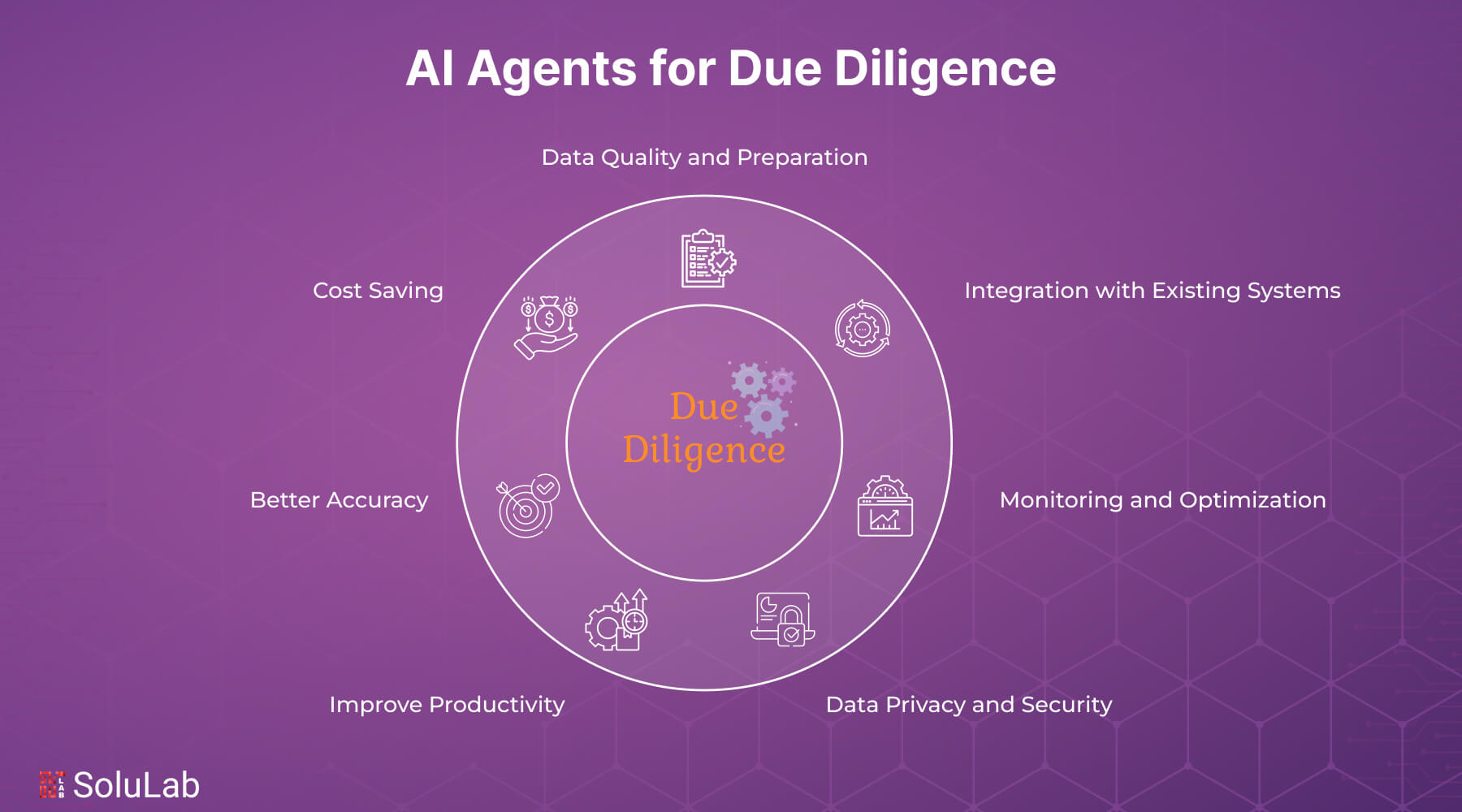
2. Data Quality and Preparation
Bad inputs, bad outputs. Put the wrong fuel in a car and it will not run, and an AI agent behaves the same way. Financial records, legal documents, market data: it all needs to be clean and machine-readable before the model sees it. That prep work is unglamorous and it is the part teams underestimate.
3. Integration with Existing Systems
A tool that does not talk to your existing stack becomes another window nobody opens. The agent has to plug into CRMs (where the customer records live) and into the document platforms your deals already run through. That connection is what makes the AI.
4. Monitoring and Optimization
Launch day is the start, not the finish. Check on it. Is the output holding up? Where is it weakest? The people using it every day will tell you what to fix, and their feedback is what turns a passable agent into a genuinely useful one.
5. Data Privacy and Security
This is sensitive material by definition, so protecting it is not optional. Deal documents leaking is a career-ending sort of problem. Firm access rules and real technical controls are what keep private information private and keep you compliant with the laws that govern it.
Get those five right and an AI agent slots into diligence work rather than sitting beside it. AI agents for Security Token Offerings‘ due diligence are assembled from distinct parts, each with a job to do. Worth looking at them one by one.
Components of AI Agents for Due Diligence
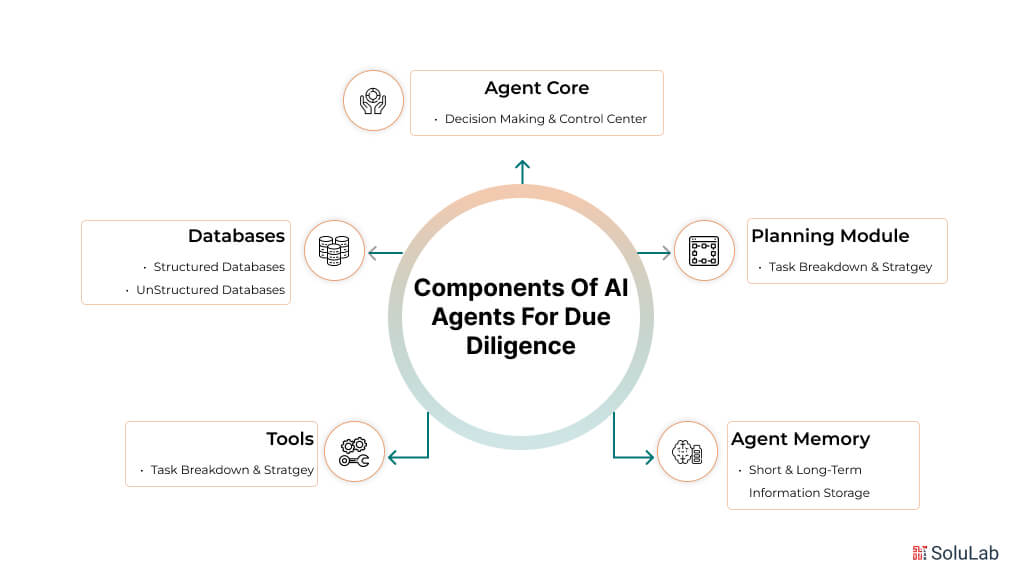
Here is what sits inside an AI agent built for due diligence:
1. Agent Core
Call the core the brain. It makes the calls, directs the other parts and keeps the whole thing coherent.
What it does:
- Big Goals: It sets the priorities, the way a lead partner would: is this company financially sound, where is the risk hiding, does any of this break a rule.
- Tools to Get the Job Done: A working toolbox sits behind it, from data analysers to document checkers.
- Planning Smarts: It picks the right approach for the job, whether that means re-running the financials or hunting for risk.
- Memory Magic: It holds on to what it found earlier, the way a detective keeps notes for the follow-up.
- Role-Playing: It can take on a specialist posture, zeroing in on regulatory compliance or on the fine detail of the accounts.
2. Planning Module
The planning module draws the route. Hand it something big and tangled, and it works out the order of operations.
How it Works:
a). Breaking Tasks into Pieces: Say the brief is to establish whether Company X is financially stable. The agent splits that into smaller jobs:
- Read the most recent financial statements.
- See whether revenue or spending swung sharply.
- Work out whether the company can comfortably cover what it owes.
b). Thinking Deeper: It applies structured reasoning methods, brainstorming among them, to check that it is solving the actual problem and not a convenient version of it.
3. Agent Memory (RAG)
Memory is what stops the agent answering from thin air. It keeps information for later use, and that is where the Retrieval-Augmented Generation (RAG) comes in.
Memory Types:
- Short-Term Memory (STM): Holds the current thread, so responses stay sensible while the agent is mid-task.
- Long-Term Memory (LTM): More like a running journal. It carries what happened across weeks and months, so a counterparty the agent dealt with before is recognised.
- Hybrid Memory: Blends the two, which keeps the agent quick.
4. Tools
The kit the agent reaches for. Field gear, essentially.
Some tools:
- Financial Statement Analyzer: Reads the accounts for patterns and for the numbers that do not add up.
- Risk Checker: Surfaces exposure, from market swings to rule-breaking.
- Compliance Checker: Confirms the company is actually following the rules it claims to follow.
- Document Reviewer: Reads contracts and pulls out what matters.
- Market Analyzer: Works out whether the company is gaining ground or quietly losing it.
- Background Check API: Digs through the history of the people involved and flags anything ugly.
- Data Visualizer: Turns a wall of numbers into charts someone will actually look at.
- Web Scraper: Collects what is publicly available online and worth knowing.
5. Databases
Everything the agent knows has to live somewhere. That somewhere is the database layer.
Types of Databases:
- Structured Databases: Tidy rows and columns. Financial records, filings, reports.
- Unstructured Databases: The messy half, and often the more revealing one: documents, email threads, contracts.
Put those pieces together and you have an agent that can genuinely carry diligence work: judging whether a company is healthy, catching the problems early, and confirming that the rules are being met.
Future of AI Agents for Due Diligence
The models keep improving, and that changes what these agents can be trusted with. Better natural language processing means they read difficult legal and financial documents properly, not approximately. Work that used to need a second human pass starts finishing in one.
Here is the interesting part. More of the processing moves onto local devices, with nothing shipped off to a distant server. Faster, and safer for anything confidential. Add the flood of connected devices around us, everything from smartwatches to building sensors, and agents get live signals to reason over rather than last quarter’s snapshot.
Then there is quantum. Machines that compute at a scale today’s hardware cannot approach. Once they are genuinely ready, AI agents for customer service can handle mountains of data at lightning speed.
The bigger shift is one of role. An agent that only waits for instructions is a tool. An agent that works out what the business needs next, adapts when conditions move, raises the problem before you ask and points at an opportunity you had not seen: that is closer to a colleague.
Conclusion
AI-backed due diligence is already reshaping how the big calls get made: acquisitions, mergers, where the investment money goes. Large volumes of data get read quickly, risks come to the surface, and growth signals stop hiding in the appendices. Faster and more accurate, both at once.
But the technology is not the point. The decision quality is. Markets keep moving, and firms that can read a difficult situation with confidence hold an advantage over firms still waiting on a manual review. Finance, healthcare, manufacturing, law: the pattern repeats in each of them, because better information and lower risk are what every one of those industries is buying.
SoluLab helped AI-Build, a construction tech company, use generative AI and machine learning for advanced product development in the CAD space. They wanted design work automated, output up and accuracy improved. The hard part was building something that could generate optimised designs, strip out manual effort and still scale. SoluLab’s an AI agent development company expertise enabled AI integration, improving efficiency and performance. Got a diligence problem of your own that keeps eating your team’s week? Our specialists are here, so get in touch.
FAQs
1. How does AI improve the due diligence process?
It reads large volumes of data fast, makes sense of complicated documents, and hands back findings a team can act on. Less time burned, fewer people tied up.
2. What role does NLP play in AI for due diligence?
Natural Language Processing (NLP) is what lets an agent read legal, financial and technical documents and understand what they say, which is the difference between real analysis and keyword matching.
3. How do AI agents ensure data privacy?
Through approaches like federated learning and edge computing, the processing happens locally, so sensitive material does not need to travel to an outside server in the first place.
4. What is the impact of quantum computing on AI for due diligence?
It could push AI capability up considerably, letting agents work through enormous datasets and run heavy calculations at speeds no current machine matches.
5. Will AI agents replace human professionals in due diligence?
No. They are built to support people, not stand in for them. The agent absorbs the repetitive work so the professionals can spend their time on the strategic judgment calls.
Shipra Garg is a tech-focused content strategist and copywriter specializing in Web3, blockchain, and artificial intelligence. She has worked with startups and enterprise teams to craft high-conversion content that bridges deep tech with business impact. Her work translates complex innovations into clear, credible, and engaging narratives that drive growth and build trust in emerging tech markets.