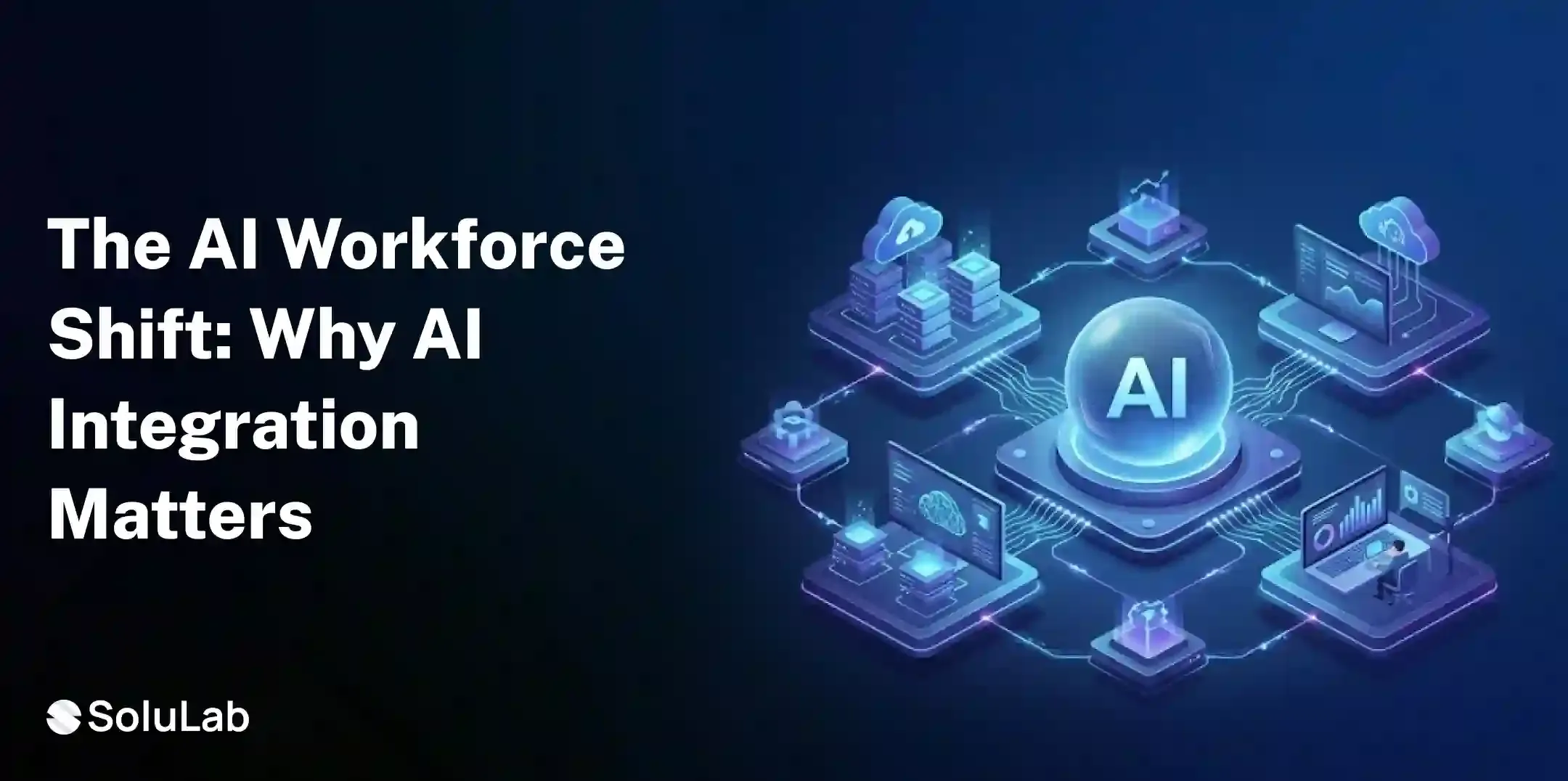
Many US enterprises want to reduce operational costs and stay competitive as artificial intelligence is changing how work gets done. Traditional systems and manual workflows often slow down innovation, making it difficult for organizations to scale efficiently. T
The answer lies in strategic AI integration that connects systems with existing business processes. By adopting AI-driven solutions, companies can enable AI workplace automation, decision-making, and build an AI-powered workforce that works alongside technologies.
However, Mckinesy studies show that AI tools can increase employee productivity, with estimates suggesting up to $4.4 trillion in annual productivity potential.
Continue reading this blog to know why AI integration services have become essential for US enterprises, and how they help businesses adapt to the evolving workforce landscape. Moreover, organizations must consider when implementing AI to remain competitive in an increasingly AI-driven business environment.
Key Takeaways
- The Issue: Multiple US companies are testing AI, yet fail to adopt it as a fundamental part of their business organizations. Incongruent tools, old infrastructure, and the absence of a strategy cannot enable organizations to create a scalable AI-driven workforce that can indeed enhance productivity.
- The Solution: In the US, businesses require organized AI Integration Services that can help bridge AI models to the current enterprise system, automated workflows, and utilization of data to make decisions. Strategic integration assists organizations in the transition to an efficient AI-powered workforce.
- How SoluLab Can Assist: SoluLab assists the US Businesses with the AI Integration by conducting infrastructure assessment, developing AI architecture, and offering enterprise AI integration services in the USA that could connect AI with enterprise platforms in a way that would influence operational change in a measurable way.
The AI Shift Is Already Happening in US Enterprises
In the US enterprises, AI is not an experiment of the future. Generative AI is quickly entering the realm of real business processes, prompting leaders to reconsider workforce strategy, productivity models, and competitive positioning.
- Generative AI Leaving Experimentation to Production: Pilot projects and proof-of-concept projects are becoming production deployments. Businesses are incorporating generative AI into customer service, software development, analytics, and internal processes to increase speed, efficiency, and decision-making.
- Why Workforce Transformation Is Becoming a Board Level Discussion: The use of AI is transforming work descriptions, skills required,d and expected productivity. The reskilling strategy, AI governance, and ways human talents could cooperate successfully with intelligent systems are actively debated by executive leadership and boards.
- Competitive Pressure as a Motivation to Adopt AI: The increasing adoption is compelling companies to adopt AI to optimize their operations and customer experiences more rapidly than their competitors. Companies that do not adopt AI quickly will lose their efficiency, market share, and other benefits of innovation.
Why AI Integration Services Matter in 2026 ?
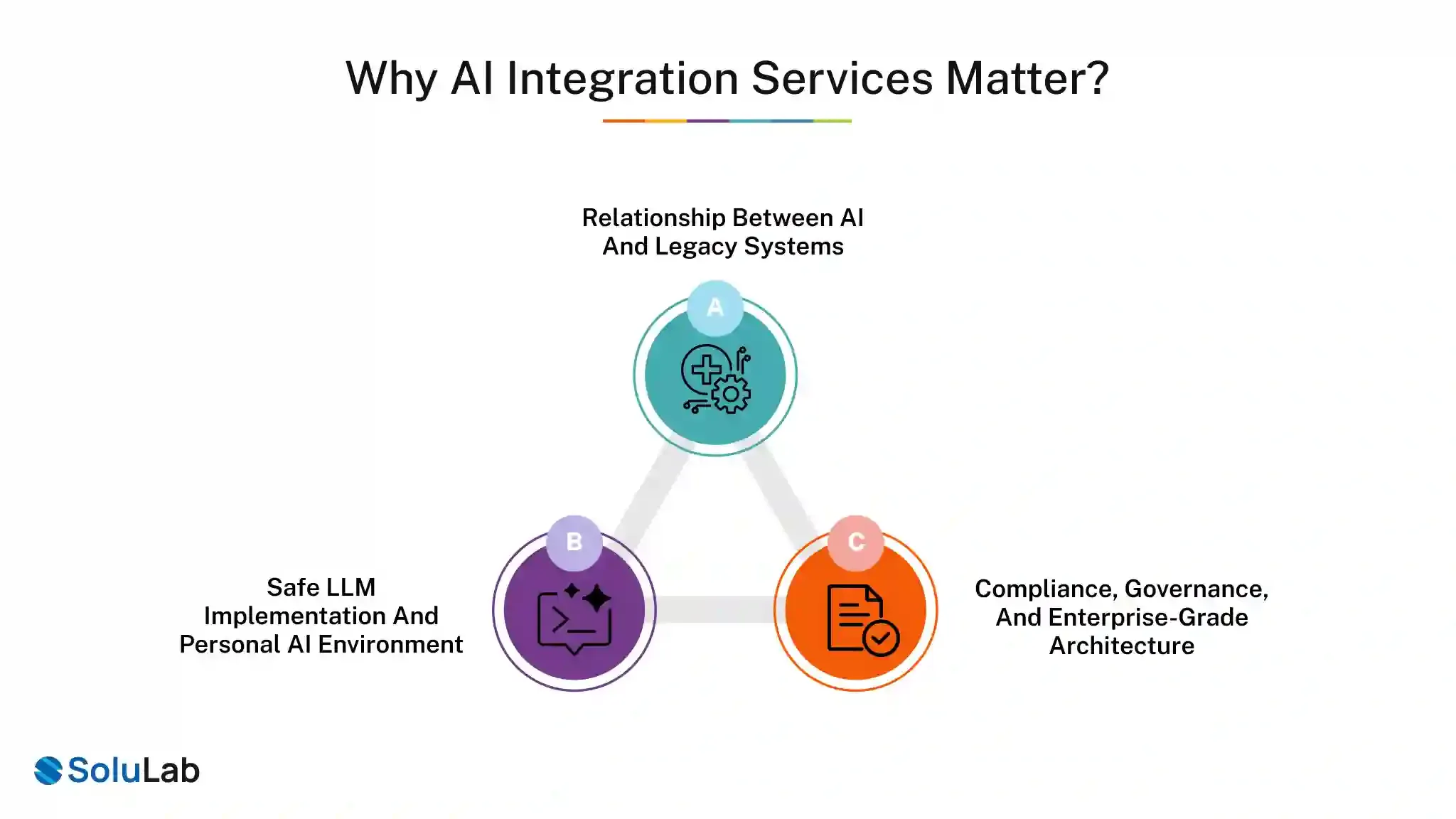
With organizations transitioning beyond AI experimentation to actual implementation, the need to integrate AI with the current business systems is creating a requirement for scalable automation, secure operation, and long-term digital transformation.
- Relationship between AI and Legacy Systems: It is possible to integrate AI with current systems, as intelligent models can be related to existing systems such as ERP, CRM, and HRMS. This allows workflows to be automated, provides data insights across the enterprise,e and scales enterprise AI solutions without modifying the existing infrastructure.
- Safe LLM Implementation and Personal AI Environment: Enterprises are focusing on their own AI environments to ensure confidential information when utilizing the capabilities of LLM. The current AI deployment services provide safe implementation, in-house access to models, and regulated interdepartmental pipelines.
- Compliance, Governance, and Enterprise-Grade Architecture: Governance and regulatory compliance are important issues as AI adoption is increasing. Sound architecture platforms can ensure responsible use of AI, auditing, and workforce preparedness, and facilitate workforce transformation of AI over the long term in the processes of the enterprise.

90% Optimism — What the TCS Study Really Signals for Business Leaders
The future of AI in the workplace is developing quickly, yet it is becoming more apparent that in the future, humans will be working alongside intelligent systems. Recent TCS studies indicate that optimism is present in terms of productivity, changing roles,s and AI-enabled organization change.
1. Entry-Level Positions Are Not Dying, They are Changing.
Approximately 90 percent of futurists assume that entry-level jobs will be changed considerably, but only ten percent anticipate that they will cease to exist. The novel functions will focus on AI oversight, data analysis, human decision-making, and automation.
2. Organizational Structures are Being Remodeled by AI
Organizations are also considering AI colleagues and robots as part of teams. Approximately 60 percent predict enterprises to possess enterprise AI systems, and 40 percent ppredictthe development of the Bring Your Own AI (BYOAI) models.
3. Employment Will Change in Three Phases: Assist, Augment
The research proposes a progressive change where AI will initially support workers, followed by a boost in their abilities, and finally alter work processes, making decisions smarter and innovation accelerated within individual departments.
4. AI Will Enhance work experience and growth of business.
Some of the benefits predicted by futurists include shorter workweeks, flexible careers, and employee well-being. Also, 75 percent of them think that the use of AI will enable small businesses to enter new markets and attract a wider audience.
From Assist to Transform — The 3-Stage AI Maturity Model for Enterprises
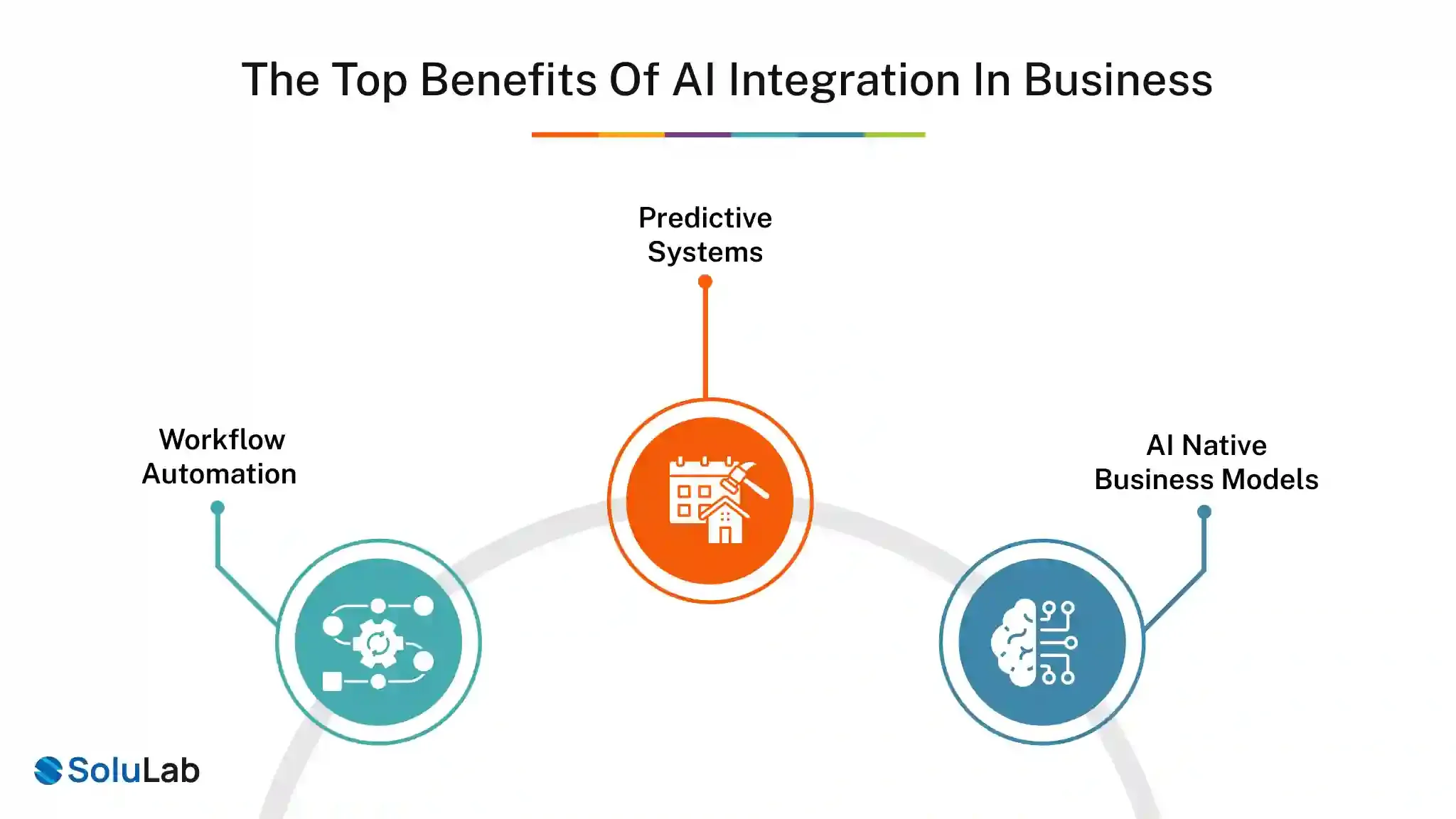
The implementation of artificial intelligence in business is changing at a rapid pace. Organizations are slowly shifting towards basic-assistance tools to smart decision systems and ultimately business models entirely powered by AI that transform operations, productivity, and revenue.
1. Assist: Workflow Automation, AI Copilots, and Internal Chatbots
In stage one, businesses implement AI systems to help workers in their daily chores. AI copilots, automated workflows, and internal chatbots assist teams in decreasing repetitive work, accelerating the workflow, and enhancing operational efficiency without significant modifications to the system.
2. Augment: Decision Intelligence and Predictive Systems
At the augmentation phase, the AI begins to improve human decision-making. Predictive analytics, intelligent sales, operations, HR, and sales intelligence dashboards, and AIs as copilots are examples of tools used by organizations to predict trends, maximize strategies, and workforce productivity through AI transformation.
3. Transform: AI-Native Business Models and New Revenue Streams
The last phase is when the AI is made into the business model itself. The AI Integration Services in the US make companies develop AI-enabled products, automated decision platforms, and intelligent services, which allow an even deeper AI Integration of US Businesses, and open up completely new revenue opportunities.
How SoluLab Helps US Businesses Implement AI Integration Services?
The use of AI in businesses in the United States is rapidly gaining popularity to enhance decision-making and workflow automation, as well as scaling business operations. The appropriate AI consulting partner assists companies in shifting between trial and actual business contribution.
- Evaluating Business Readiness to AI Integration: Consider the current infrastructure, working processes, and data preparedness to identify areas where AI can become an actual value. This is a systematic method that enables organizations to embrace AI Integration Services in the US settings without interfering with the already established systems.
- Developing AI Solutions to be efficient in operations: The team discovers areas of automation in the departments and develops an AI-driven workforce to manage monotonous tasks by enhancing productivity and allowing the employees to perform more strategic work.
- The Experimentation of AI and Existing Enterprise Systems: We use AI models together with CRMs, ERPs, analytics, and internal platforms. These applications contribute to the integration of AI in US Businesses by making AI work harmoniously in the current enterprise technology implementations.
- Creating Scalable Enterprise AI Infrastructure: With strong architecture and safe data pipelines, SoluLab assists corporations in implementing enterprise AI integration services in the USA, with the ability of AI systems to expand with increasing datasets, consumers, and the complexity of operations.
- Creating an AI-powered workforce in the future: In addition to deployment, assists in training, governance system, and ongoing optimization. This strategy can make organizations create an AI-driven workforce where human knowledge and AI systems can work together to make businesses grow over time.
Conclusion
The transition to the AI-based economy is already being initiated, and early adopters of US businesses will shape the next level of digital leadership. By investing in AI integration services, organizations can integrate intelligent systems into current processes and open up data-driven insights and operational efficiency at scale.
With the improvement of the competitive nature of industries and emphasis on technology, the enterprises that focus on AI integration today will be in a better place to dominate the business world of tomorrow, which will be much more intelligent and productivity-driven.
SoluLab, an AI development company in the US, can help you integrate AI in your business workflows to reduce manual tasks and focus on what’s important. Book a free discovery call today!
FAQs
Neha is a curious content writer with a knack for breaking down complex technologies into meaningful, reader-friendly insights. With experience in blockchain, digital assets, and enterprise tech, she focuses on creating content that informs, connects, and supports strategic decision-making.