There was a time when leveraging AI in business felt like something only large corporations could afford. Implementing AI meant hiring costly consultants, building complex systems, and dedicating months to training teams. Small businesses simply didn’t have the resources.
Today, that’s no longer the case. With AI development solutions, even small businesses can automate tasks, analyze data, and boost productivity in hours instead of weeks. Yet many business owners still struggle to unlock its full potential.
In this guide, you’ll discover practical use cases of AI for small businesses, strategies to increase ROI, and a step-by-step approach to implementing AI effectively—without needing a technical team.
Let’s get started.
Key Takeaways
- The Problem: Small businesses are experiencing redundancy, rising operational costs, a lack of marketing penetration, and an inability to make data-driven decisions. These challenges reduce productivity, revenue, and growth potential.
- The Solution: AI automates processes, enhances customer interactions, streamlines marketing and sales, offers predictive intelligence, and generates smarter and faster decisions. Small teams can be as efficient and ROI-effective as enterprises.
- The SoluLab Solutions: SoluLab offers AI development and integration to your business requirements. Our AI strategies are scalable and ROI-driven to create growth and operational efficiency in the form of automation and analytics, and AI-powered customer solutions.
Why Small Businesses Must Adopt AI in 2026?
Artificial intelligence is no longer optional; it has become a competitive requirement for small businesses. Those companies that are embracing AI are becoming efficient, cost-effective, and are providing a smarter customer experience like never before.
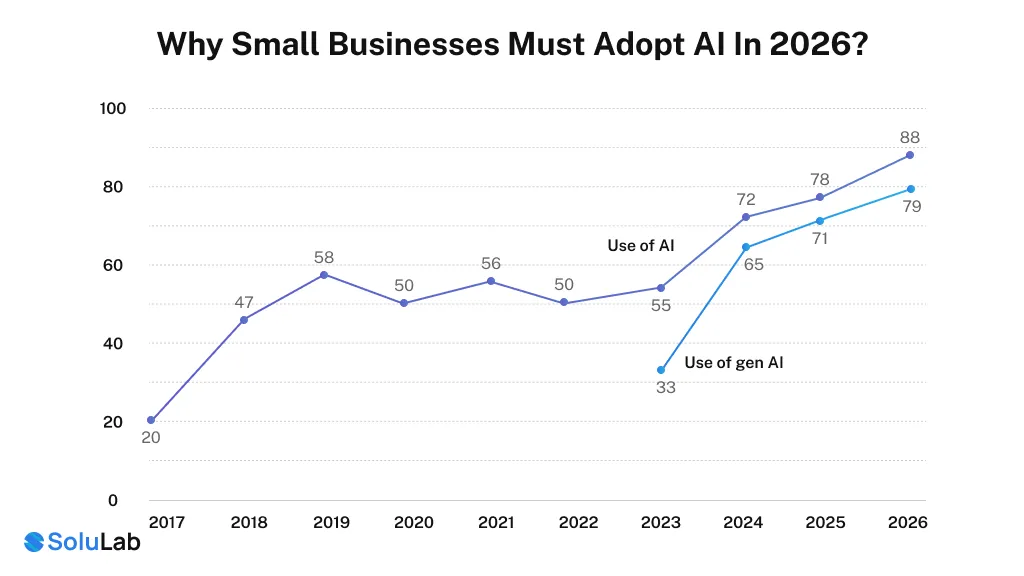
- Competitive Pressure: The use of AI is gaining rapid pace in all industries, and any business that is slow in its uptake can find itself losing to its competitors. McKinsey and Company (2023) also state that 55% of organizations use AI in at least one of their functions. Early adopters enjoy quicker processes, they get better insights and customer targeting, and this helps in developing a sustainable competitive advantage.
- Increased Operational Cost: There is an increasing cost in labor, supply chain, and marketing costs across the world. Artificially intelligent automation lowers operational inefficiencies and manual repetitive work. PwC projects that AI may add up to $15.7 trillion to the world economy by 2030, mostly by improving productivity and reducing costs, and that it would allow small companies to safeguard the bottom line.
- Customer Demands of Personalization: Contemporary customers are demanding rapid and customized interactions over channels. According to Salesforce research, 73 percent of customers desire companies to know their needs and are unique. AI allows customised recommendations, support, and predictive communication, elevating engagement, loyalty, and lifetime customer value.
- Data-Driven Decision Making: Small businesses produce valuable data, but they do not have the means to analyze and use it efficiently. AI-driven analytics convert raw data into actionable data. Gartner suggests that organizations that apply AI to decision intelligence make faster and better strategic decisions and, consequently, less risky and with higher ROI in the long term.
Benefits of AI for small businesses
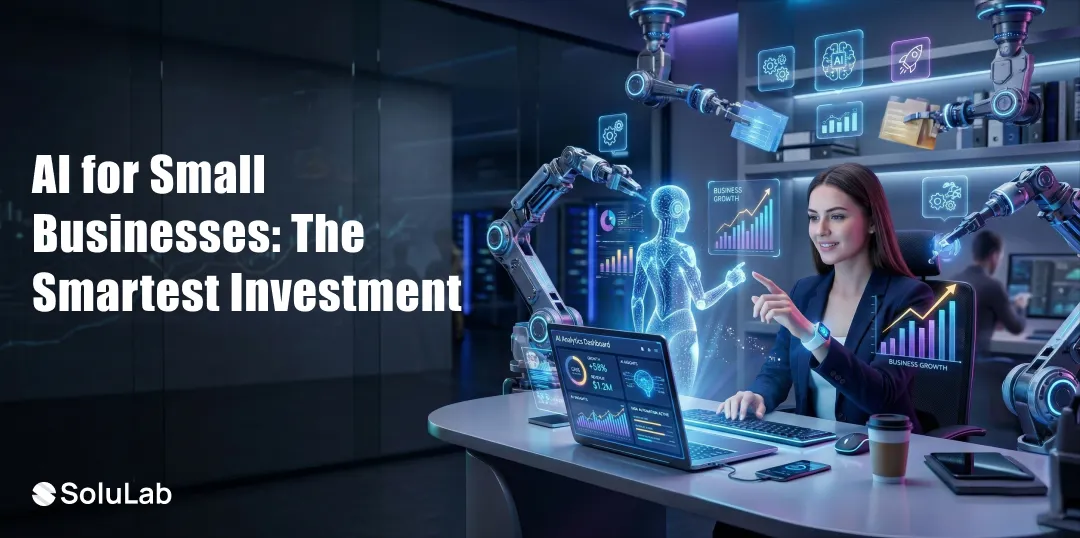
AI is having an impact on small businesses by automating processes, enhancing efficiency, and decision-making. Using AI, small businesses will be able to maximize the ROI, boost productivity, and provide better experiences to customers.
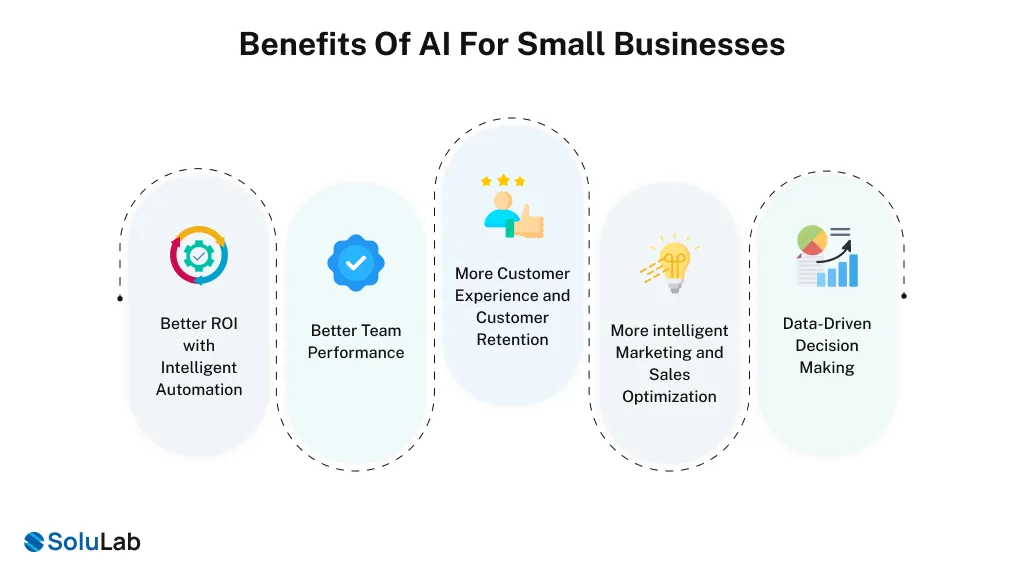
1. Better ROI with Intelligent Automation: AI is used to handle repetitive work such as invoicing, scheduling, and inventory management, which reduces the cost of operations and minimizes the level of human error. The average ROI growth is reported in 30% in businesses that employ automation with AI.
2. Better Team Performance: Artificial intelligence devices simplify operations, organize timeframes, and perform data processing. Work teams will have a faster completion rate, enhanced collaboration, and be able to concentrate on strategic projects, leading to high output without the need to raise manpower.
3. More Customer Experience and Customer Retention: AI-based chatbots, personalized suggestions, and predictive customer support guarantee 24/7 customer-facing communication. A business can enhance customer satisfaction and enhance long-term loyalty by making sure that customer needs are anticipated and addressed in real-time.
4. More intelligent Marketing and Sales Optimization: AI processes customer information, forecasts trends, and uses these to optimize campaigns. Small businesses will have the ability to draw in the correct audience from targeted advertisements and automatically create content and assign lead scores, turning more people into customers.
5. Data-Driven Decision Making: AI uses big data to offer viable information, predict future trends, and pinpoint risks. It is possible to streamline operations, minimize mistakes, and grow more rapidly with data-driven decisions, helping small businesses with their operations.
Practical AI Use Cases for Small Businesses
Small businesses are changing the way they operate due to artificial intelligence that saves time, reduces costs, and brings new earnings. There are many opportunities that are unlocked through the application of AI in Small Businesses in the fields of marketing, operations, HR, and customer engagement.
1. Prospecting and Lead Generation
The use of AI can scan through the mass data and determine who is a prospective customer, give priority to leads, and forecast purchase trends. Automation of the scoring of leads helps the sales team to concentrate on high-potential targets, enhancing the rate of conversion and revenue.
Example Tool: HubSpot CRM with AI-powered Sales Hub- Automates lead scoring and predicts which lead is most likely to convert, and saves time on sales teams.
2. Content Creation
The AI is utilized to create blog posts and social media updates, as well as marketing copy, which allows businesses to stay on track with their messages and saves them hours of going through their work. This increases brand awareness and minimizes the cost of production.
Example Tool: Jasper AI – Generates quality content at an optimized level, allowing it to be used with small businesses that have small marketing teams.
3. Recruiting and HR
AI also automates the process of screening candidates, resume analytics, and predicting employee performance by enabling small businesses to attract the best talent in less time and decreasing the level of bias.
Example Tool: HireVue – It is an AI-powered software that analyzes video-recorded interviews and ranks candidates by their skills; it provides an HR team with considerable amount of time savings.
4. Customer Analysis
AI examines the behavior of customers, recognizes trends, and forecasts purchasing trends. This revelation helps companies to customize products, enhance retention and boost satisfaction.
Example Tool: Zoho Analytics, The small business tool gives AI-powered dashboards to track customers, segment audiences, and make decisions on the basis of the data.
5. Email Marketing
AI will enable email campaigns to optimize the timing of sending emails, personalized content, and audience segmentation. This boosts the open rates, engagement, and ROI.
Example Tool: Mailchimp with AI intelligence – Suggests subject lines, content, and best time to send emails depending on customer behavior.
6. Data Security
AI scans systems and identifies anomalies as well as cyberattacks. Small companies are able to protect sensitive information without having to employ huge IT departments.
Example Tool: Darktrace – This uses artificial intelligence to identify suspicious traffic on networks and preclude cyber threats in real-time.
7. Market Research
AI has the potential to conduct competition, market trends, and demand forecasting. This enables small businesses to make wise decisions and keep up with the competition.
Sample Tip: Crayon – Tracks the actions of competitors and trends in the marketplace with the help of artificial intelligence to give strategic advice to the business.
How to Implement AI in Your Small Business (Step-by-Step Guide)
It does not need to be very complicated to implement AI in your small business. With a systematically implemented strategy, tasks can be automated, productivity can be increased, and the ROI can be assessed and achieved with very little risk.
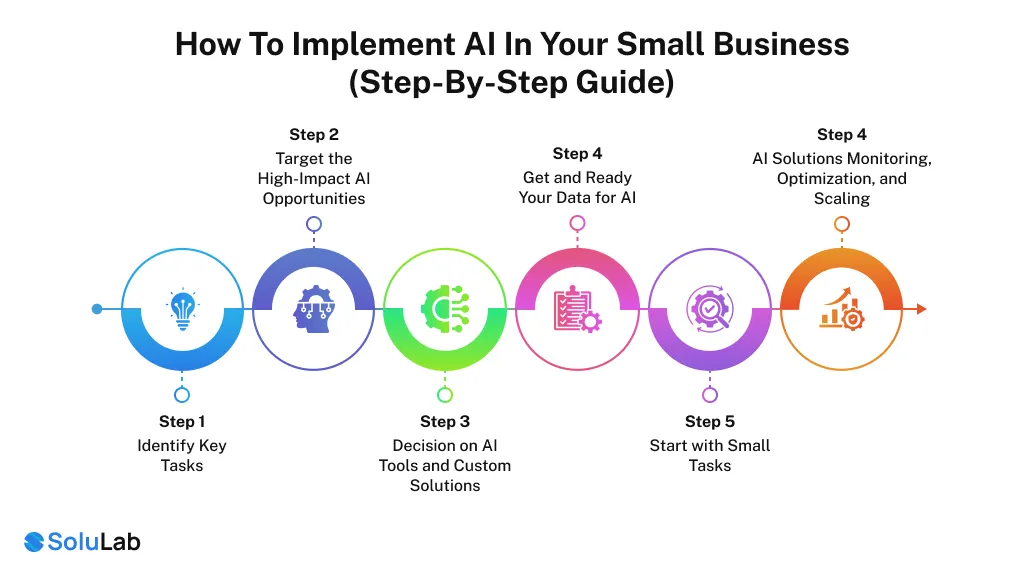
Step 1: Identify Key Tasks: These are analyzed to identify repetitive tasks, time-consuming tasks, or high-cost tasks in your business. They are perfect in automation with AI and can assist you in quick wins and quantifiable ROI, and leave your personnel to strategic tasks.
Step 2: Target the High-Impact AI Opportunities: Not every AI project is equivalent in its value. Concentrate on activities that directly impact income, customer experience, or operation. The high-impact areas should be prioritized to obtain quicker results and share easier justifications of investment.
Step 3: Decision on AI Tools and Custom Solutions: Consider the need to have an off-the-shelf AI software or a tailored AI solution. Internally developed AI may be combined with proprietary processes, deal with specific data, and create a competitive edge.
Step 4: Get and Ready Your Data for AI: The effectiveness of AI is based on quality data. Collect pertinent data, cleanse it, and transform the data into AI models. True predictions, smarter decisions, and improved automation results are guaranteed when accurate and structured data is used.
Step 5: Start with Small Tasks: Begin with a pilot project or one department in order to reduce risk. Measurement, collect feedback, and implement changes. Stepwise application assists teams with getting accustomed to it and gives evidence of the value of AI prior to pursuing a significant scale.
Step 6: AI Solutions Monitoring, Optimization, and Scaling: Monitor AI performance constantly and optimize models to keep them accurate and profitable. After the effectiveness is established, gradually apply AI to other departmental or operational areas to fully exploit productivity, increase business revenue, and long-term business efficiency.
Conclusion
By 2026, AI will be a growth engine for small businesses. AI can help small businesses become more productive and cost-effective, as well as maximize their returns on investment, by automating routine job functions, improving customer experiences, and making data-driven decisions.
Small businesses can remain competitive in a rapidly becoming digital market by beginning with high-impact use cases and scaling to custom AI solutions. Being an AI adopter now will make your company smarter, more efficient, and successful in the long run.
To get the potential of AI, the trick is to act, take action strategically and keep on measuring the outcomes. SoluLab, a top AI development company can help you automate your business by integrating AI in repetitive tasks. Book a free discovery call today!
FAQs
Deepika is a content writer who blends storytelling with strategic thinking. She explores topics across digital innovation, emerging tech, and the evolving blockchain industry. She enjoys breaking down complex ideas into simple, engaging narratives in the growing global markets.