Aptos (APT) is a Layer 1 blockchain built to be fast, secure, and scalable. It runs on the Move programming language and a parallel execution engine, two choices that let it handle far more transactions at lower cost than most chains that came before it. Since launch, Aptos has pulled in developers and users across DeFi, NFTs, gaming, and Web3 apps in a way that few new chains manage.
The numbers back that up. Aptos hit a record $1.29 billion in total value locked, and that figure didn’t arrive by accident. The architecture is designed so it doesn’t have to trade decentralization for throughput, which is exactly what serious builders want to see.
As of February 28, 2025, APT was trading at $5.87, touching $6.27 at the daily high and $5.64 at the low. Total value locked on the network had crossed $1 billion by that point. That’s not just a price stat; it’s a signal that capital is moving in and staying there.
This guide covers what Aptos actually is, how it works under the hood, what you can do with it, and why it’s attracting this much attention. If you invest in crypto or build on blockchains, or if you’re just trying to understand where this chain fits, read on.
What is Aptos (APT)?
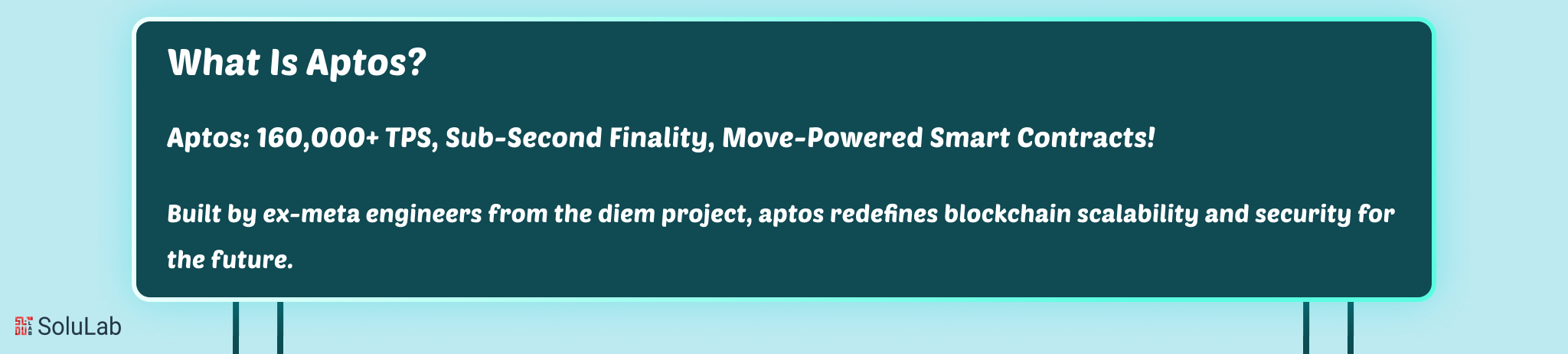
Aptos is a Layer 1 blockchain focused on security, scalability, and long-term upgradeability. Over 350 engineers contributed to building it. The network’s native token, APT, is what you use to interact with it.
The team came out of Meta’s Diem project. When Meta shelved Diem, the developers didn’t walk away from the technology they’d been building. They took the best parts of that work and rebuilt it independently as Aptos. The core goal hasn’t changed: make blockchain fast enough and cheap enough that ordinary users can actually use it without thinking about the infrastructure underneath.
How Does Aptos Work?
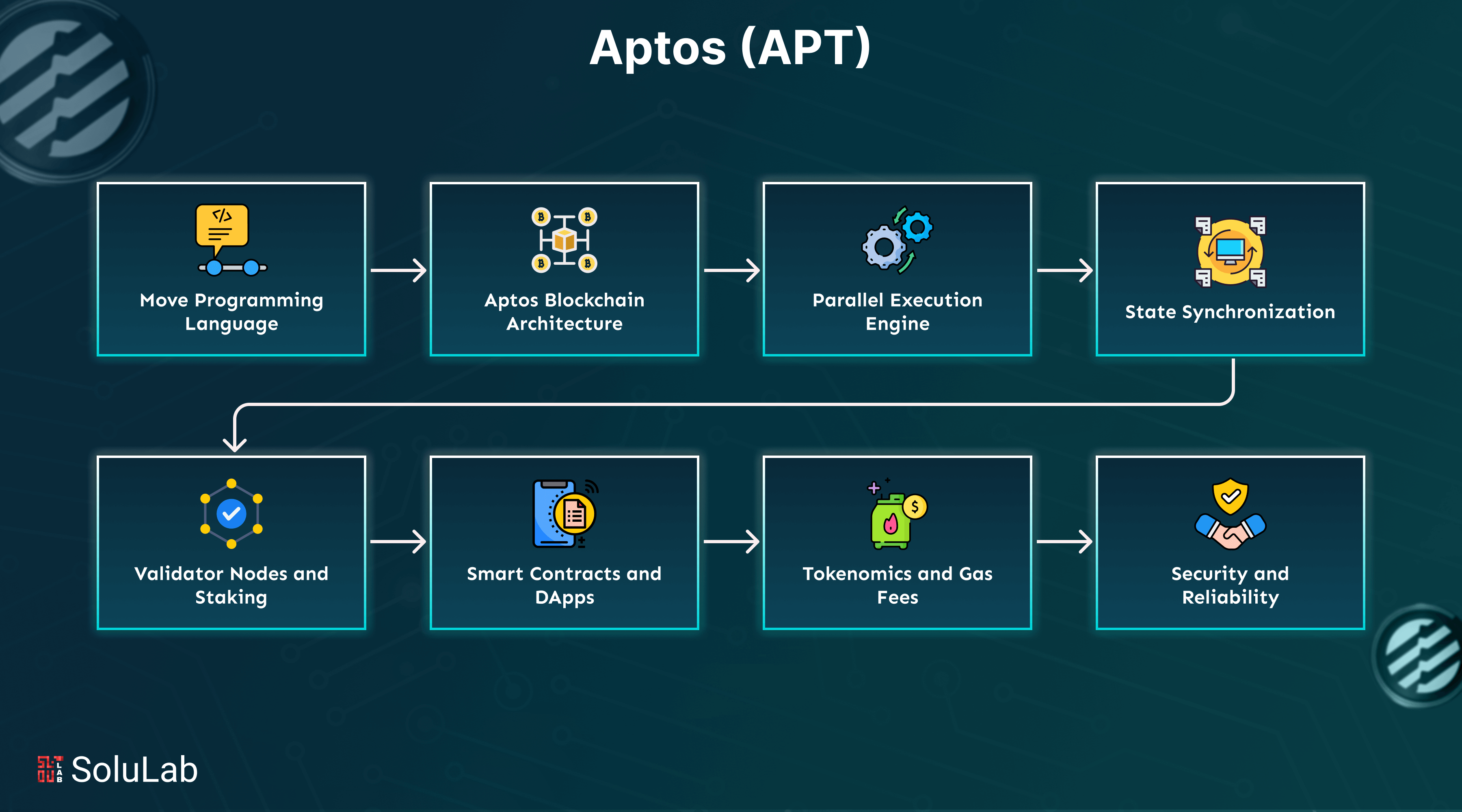
Aptos is a Layer 1 blockchain built for high scalability, security, and reliability. It pairs a purpose-built programming language with a consensus mechanism designed for speed. Here’s how each piece fits together:
1. Move Programming Language
Aptos runs on Move, a Rust-based language built specifically for smart contracts and blockchain transactions. Move’s big selling point is resource-oriented programming: assets can’t be accidentally duplicated or deleted. That’s not just a nice-to-have. In financial applications, that kind of guarantee is what separates a production-ready chain from a liability.
2. Aptos Blockchain Architecture
The network runs on a modular architecture that separates execution, consensus, and storage into distinct layers. Each one can be optimized independently. The key layers:
- Execution Layer: Handles transaction processing via a parallel execution engine. Multiple transactions run at the same time, which pushes throughput significantly higher than sequential models.
- Consensus Layer: Uses Proof-of-Stake (PoS) combined with Byzantine Fault Tolerance (BFT) to validate transactions quickly and with strong security guarantees.
- Storage Layer: A versioned database model keeps data integrity intact and allows fast retrieval and updates of on-chain state.
3. Parallel Execution Engine
This is the part people talk about most. Traditional blockchains like Ethereum run transactions one after another. Aptos runs them in parallel. That design choice is how the network gets to over 160,000 transactions per second. It’s not a marketing claim built on ideal conditions; it’s a direct consequence of the architecture.
4. State Synchronization
Instead of waiting on slow block confirmations, Aptos syncs state changes across the network using a streaming model. Transactions finalize faster. In practice, this is where users notice the difference most, because waiting for confirmations is the part that makes blockchains feel slow to non-technical users.
5. Validator Nodes and Staking
Validator nodes propose and confirm new blocks. To become a validator, you stake APT tokens. If you don’t want to run a node yourself, you can delegate your stake to an existing validator and earn rewards that way. The Proof-of-Stake model keeps the network secure and gives token holders a direct reason to participate.
6. Smart Contracts and DApps
Developers can build decentralized applications (dApps) and deploy smart contracts on Aptos using Move. The chain supports custom modules and composability, so teams can build complex, interoperable applications without hitting the walls that other platforms run into. Low-latency transaction finality makes it well-suited for finance, gaming, and NFT infrastructure.
7. Tokenomics and Gas Fees
APT, the network’s native token, covers three main functions:
(a). Paying transaction fees
(b). Staking and participating in consensus
(c). Governance voting. Aptos uses a dynamic gas fee model that adjusts fees based on network demand, so costs stay reasonable even when activity spikes.
8. Security and Reliability
Move’s type-safety features close off a lot of the attack vectors that have cost other chains badly. Add BFT consensus, which keeps the network running even if some nodes fail or act dishonestly, and you get a chain that was built to stay online. The modular design also means individual components can be patched or upgraded without touching everything else.
Use Cases of Aptos
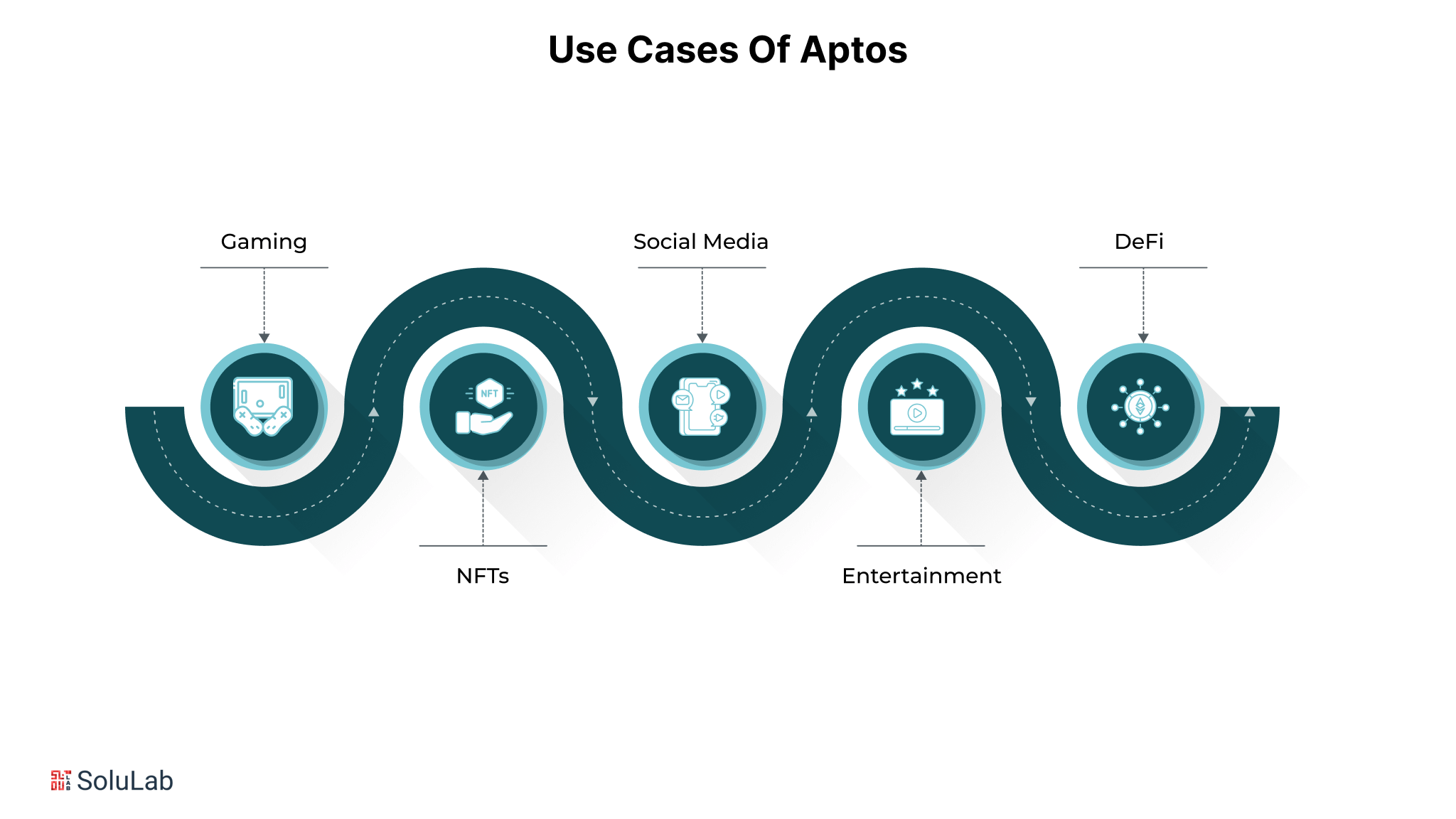
Aptos (APT) is built for high-speed, secure, scalable applications. It supports decentralized finance (DeFi), NFT marketplaces, and gaming platforms. Smart contract support makes it a practical choice for enterprises and developers who need decentralized apps that can actually handle production loads.
1. Gaming
Speed matters in games. So does true asset ownership. Aptos gives developers the throughput to build fast, responsive gameplay, plus the infrastructure for players to own and carry their in-game assets across contexts.
Creators can build free-to-play models, design worlds where players have real ownership of what they earn, and open up GameFi opportunities in ways that slower chains can’t support at scale.
2. NFTs
Ownership on Aptos is provable and permanent. Whether you’re minting art or any other type of content, the blockchain record is clear about who owns what.
Collections like MAVRIK, Bruh Bears, and Overmind have already built on Aptos. These aren’t just tokens. They represent a creator community that chose this chain because of what it makes possible, not as a fallback from something more established.
3. Social Media
Web3 social built on Aptos gives users something traditional platforms don’t: actual control over their data. You manage what you share, who sees it, and how you monetize across channels. That’s a meaningful shift from the current model, where the platform owns everything.
4. Entertainment
The fan-creator relationship changes when the infrastructure changes. Aptos makes that possible in concrete ways.
KYD Labs uses it for event ticketing, including festivals like WonderBus. Tickets are bought and sold quickly, securely, and on-chain. Prizes, digital artifacts, and shared event souvenirs are part of the same infrastructure. The experience is tighter than anything traditional ticketing platforms offer.
5. DeFi
Whether you’re sending money to family, lending to a peer, or making a purchase, the goal is the same: the money gets where it’s supposed to go, without friction or opacity.
Aptos and Web3 are making transactions faster, cheaper, and easier to verify. Mastercard Crypto Credential, an on-chain identity and verification solution built on Aptos, covers tickets, payments, and other financial flows. That’s a real-world institution choosing this chain for real-world use.
Read Blog: How to Develop Aptos Smart Contract Using Move Language?
What Are Aptos Tokens Used For?
APT serves four core functions on the network. Here’s what each one actually means:
1. Transaction Fees: Every transaction on Aptos requires APT to be validated and recorded. That’s true across all activity on the chain, from simple transfers to complex smart contract calls.
2. Staking: APT holders can lock their tokens to help secure the network. In exchange, they earn APT rewards. This keeps the incentives aligned: the people most invested in the network’s health are also the ones responsible for running it.
3. Governance: Holding APT gives you a vote on protocol changes. That means proposed upgrades and modifications go through the community before they’re implemented, not through a central authority making unilateral decisions.
4. Developer Incentives: Developers who build apps and services on Aptos are rewarded with APT. That’s a direct way to grow the ecosystem by making it worth people’s time to build on it.
How to Buy Aptos?
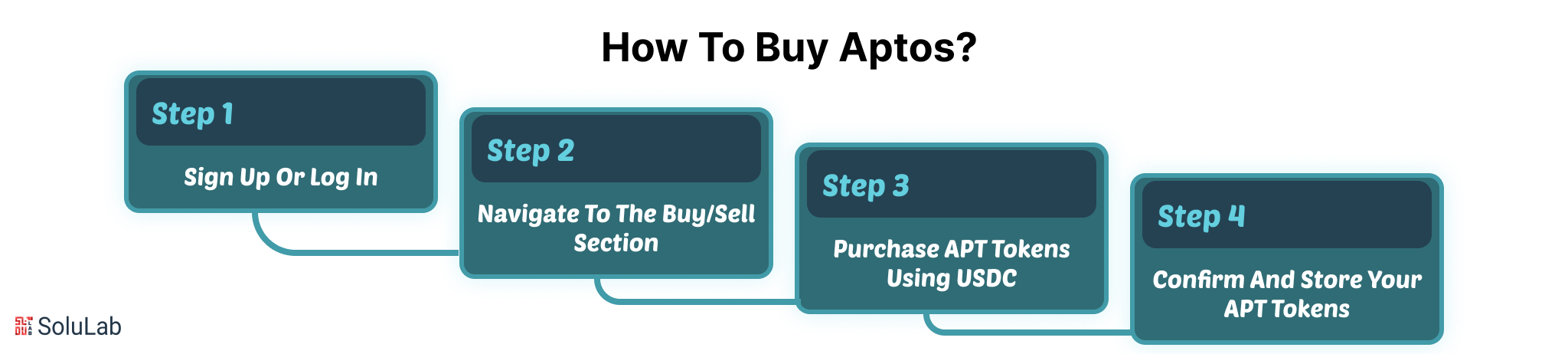
Buying APT is straightforward. Here’s the process from start to finish:
Step 1: Sign Up or Log In
Open your decentralized exchange and either create a new account or log in to your existing one. Complete any required identity verification before you proceed. Most platforms require this before they’ll let you buy.
Step 2: Navigate to the Buy/Sell Section
Once you’re in, go to the buy/sell section and select Aptos (APT) as the asset you want. Enter the amount you want to invest and check that your payment method is available. It’s worth checking the current APT price before you confirm.
Step 3: Purchase APT Tokens Using USDC
APT can be purchased directly with USDC (USD Coin). If you don’t have USDC in your wallet yet, you can buy it within the platform first, then use it to complete the APT purchase.
Step 4: Confirm and Store Your APT Tokens
After the transaction goes through, your APT will show up in your portfolio once verified. From there, you can hold, trade, or transfer it whenever you want.
Features of Aptos
Aptos is a high-throughput chain that processes thousands of transactions per second while keeping fees low. Move adds security and developer efficiency. Strong partnerships and a scalable base make it a serious candidate for production-grade decentralized applications. Here’s what sets it apart:
1. Development Background: Aptos came directly out of Meta’s Diem project. When Meta shut Diem down, the engineering team kept going. The blockchain you’re reading about is what happened when those developers stopped working for a corporation and started building for themselves.
2. Features of Blockchain: Aptos uses a Proof-of-Stake consensus system and Move, a programming language written specifically for smart contracts. The goal is to give decentralized applications (dApps) a network that is scalable, secure, dependable, and built to be upgraded over time without breaking what’s already running on it.
Read Also: Build an AI-Integrated Crypto Wallet on Aptos from Scratch
Pros of Aptos
Aptos (APT) handles thousands of transactions per second at low cost. Beyond the technical specs, backing from credible investors and strategic partnerships gives it staying power that newer chains often lack.
1. Scalability
Parallel transaction processing cuts latency and multiplies throughput. The network handles a high volume of transactions without slowing down, which is exactly what you need once real user activity starts hitting it.
2. Innovative Technology
Move gives Aptos a real technical edge. It’s not just a different syntax for doing the same thing. The language was designed around the specific security and performance needs of financial applications, and that design choice shows up in what developers can build on top of it.
3. Strategic Partnerships
Aptos has built relationships with major companies across tech and finance. These aren’t honorary partnerships. They’re integrations that put Aptos technology into real products and expand its reach beyond the core crypto audience.
4. High Liquidity
The platform has handled $6.69 billion in total value and hit $1.31 billion in total value locked. Those numbers indicate a healthy financial environment where capital can move in and out without friction.
5. User Adoption
About 700,000 daily active wallets as a baseline, 1.2 million daily active users, and 9 million monthly active users. Those are not small numbers. The chain is being used, and the usage is growing.
6. DeFi and TradFi Integration
Franklin Templeton and BlackRock have both used Aptos for tokenization work. When institutions at that level are running experiments on a chain, it tells you something about how seriously they’re taking its infrastructure. The platform also supports a variety of DeFi protocols, which is what makes the DeFi side of the network function.
7. Advanced Cryptographic Capabilities
Through Move, Aptos exposes type-safe APIs, keeps gas costs down, and lets developers write custom cryptographic primitives when they need to. That last part matters for teams building applications that require security properties beyond what a standard blockchain provides out of the box.
Aptos Tokenomics
1. APT Token: APT covers transaction fees and network costs on the Aptos blockchain. It also functions as the governance token, giving holders a direct vote on proposed protocol upgrades.
2. Circulating Supply: Total supply is 1 billion APT, with a portion currently in circulation. The circulating supply is set to increase gradually over time as vesting schedules play out.
Conclusion
Aptos has attracted serious attention from the crypto community and from investors who have seen a lot of blockchains come and go. The technology holds up under scrutiny. Whether it displaces its competitors is still an open question, as it is for any chain at this stage. If you’re thinking about buying APT or working with an Aptos Blockchain Development Company, do the due diligence, and go in with a clear plan for different outcomes.
But the advantages are real. Over 160,000 transactions per second. A programming language purpose-built for security. Strong institutional backing and a developer community that has been growing steadily. Aptos hasn’t won the whole market yet. What it has done is build something worth watching closely.
SoluLab helped NovaPay Nexus improve cryptocurrency payments by integrating blockchain protocols. The work included a fortified security framework to protect private keys and user funds, intuitive UI/UX design to lower the barrier to adoption, custom self-hosting solutions for flexibility, and ongoing technical support to keep things running smoothly. If your business has a problem in this space, SoluLab, a Blockchain development company, has the team to help. Contact us today to talk through it.
FAQs
Shipra Garg is a tech-focused content strategist and copywriter specializing in Web3, blockchain, and artificial intelligence. She has worked with startups and enterprise teams to craft high-conversion content that bridges deep tech with business impact. Her work translates complex innovations into clear, credible, and engaging narratives that drive growth and build trust in emerging tech markets.