
Key Takeaways
- A prediction market share pays $1 if an event happens and $0 if it does not, so its price reads as the crowd’s probability.
- Prices form through an order book or an automated market maker. Order books win at volume, and AMMs win on new or niche markets.
- Resolution is the hard part. Data feeds settle objective outcomes, optimistic oracles handle contested ones, and regulated exchanges resolve internally.
- Liquid markets have a strong forecasting record, beating 964 polls 74% of the time in the longest-running study. Thin markets are close to noise.
- Kalshi, Polymarket and Polymarket US traded a combined $45.33 billion in August 2026, about as much as the two companies traded in all of 2025.
A prediction market is a trading venue where people buy and sell shares tied to the outcome of a real-world event, such as an election, an interest-rate decision or a championship game. Each share pays a fixed amount if the outcome happens and nothing if it does not, so the live price works as a crowd-sourced probability. This guide explains how the mechanics work and how the main platforms compare in 2026.
What is a prediction market?
A prediction market is a marketplace where participants trade shares whose value depends on whether a specific, verifiable future event happens. A share typically pays $1 if the event occurs and $0 if it does not, so its trading price behaves like a live probability estimate. A share trading at $0.63 means the market is pricing that outcome at roughly 63%.
Nobody at the platform decides that 63% figure. It is simply the price at which buyers and sellers currently agree to trade. If new information makes the outcome look more likely, buyers bid the price up. If it looks less likely, holders sell and the price falls. That constant repricing is why economists study these markets as forecasting tools and not only as a way to speculate.
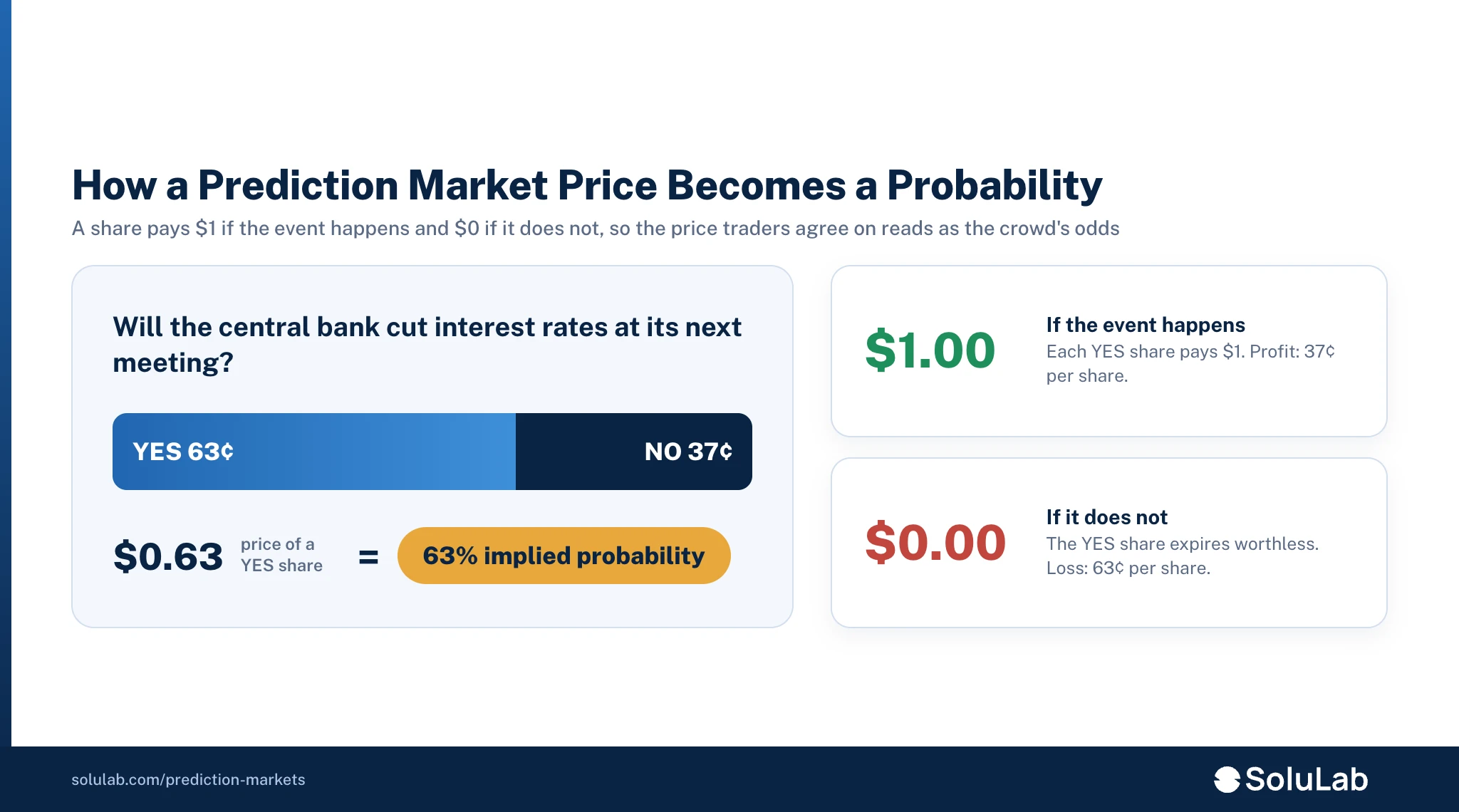
One caveat matters if you plan to quote these numbers. A price is close to, but not exactly, the average belief of traders. Wolfers and Zitzewitz showed that across a broad class of models, prices are usually close to the mean beliefs of traders, while Charles Manski’s earlier critique showed the price only bounds that average within an interval. Treat 63 cents as “about 63%,” not as a precise measurement.
Key terms
- Event contract: the regulated-exchange name for a prediction market share. It is a contract whose payout depends on the outcome of a defined event.
- Outcome share (or outcome token): the tradeable unit for one possible result. A binary market has a YES share and a NO share, and one YES plus one NO always redeems for $1 in total.
- Resolution: the process of determining which outcome occurred and paying the holders of the winning share.
- Oracle: the mechanism that reports the real-world outcome to the exchange or smart contract so resolution can happen.
- Market maker: whoever supplies the standing buy and sell prices that let others trade, either a trading firm posting orders or an algorithm (an automated market maker, or AMM).
- Liquidity: how much you can buy or sell without moving the price. Thin liquidity is the most common reason a prediction market price is unreliable.
How is a prediction market different from a sportsbook or a poll?
A prediction market lets traders set the price among themselves, while a sportsbook sets its own odds and a poll only records stated opinions. The market operator earns a fee on each trade and takes no side. A sportsbook builds its margin into the odds and is the counterparty to every bet, and poll respondents risk nothing when they are wrong.
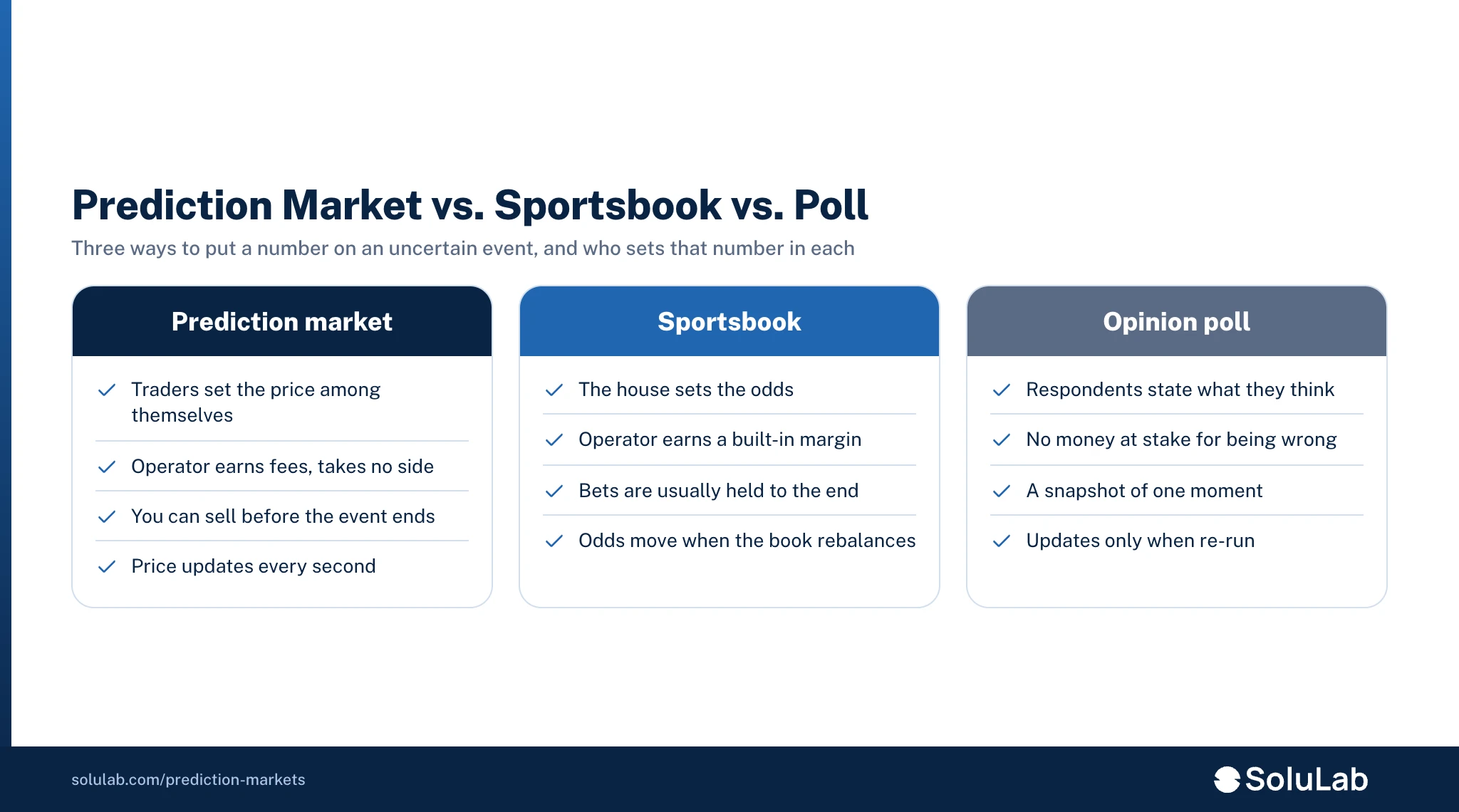
Two practical differences follow from that structure. First, a position in a prediction market can be sold at any time before the event ends, so a trader who bought at 40 cents can exit at 70 cents without waiting for the result. Second, the price updates continuously as orders arrive, which makes it useful as a running signal. A poll is a snapshot that goes stale until someone pays to run it again.
The line between the categories is not always clean. Sports event contracts look a lot like sports bets to many observers, and how they should be classified is being argued in US courts during 2026. The mechanics above describe how the products work. They are not a statement about how any regulator classifies them.
How do prediction markets work?
Every prediction market runs through the same five stages. Someone writes a question with a deadline and a resolution source, trading opens and a price forms, the real-world event happens, an oracle reports the outcome, and winning shares are paid out at $1 while losing shares expire at $0. The design choices sit inside stages two and four.
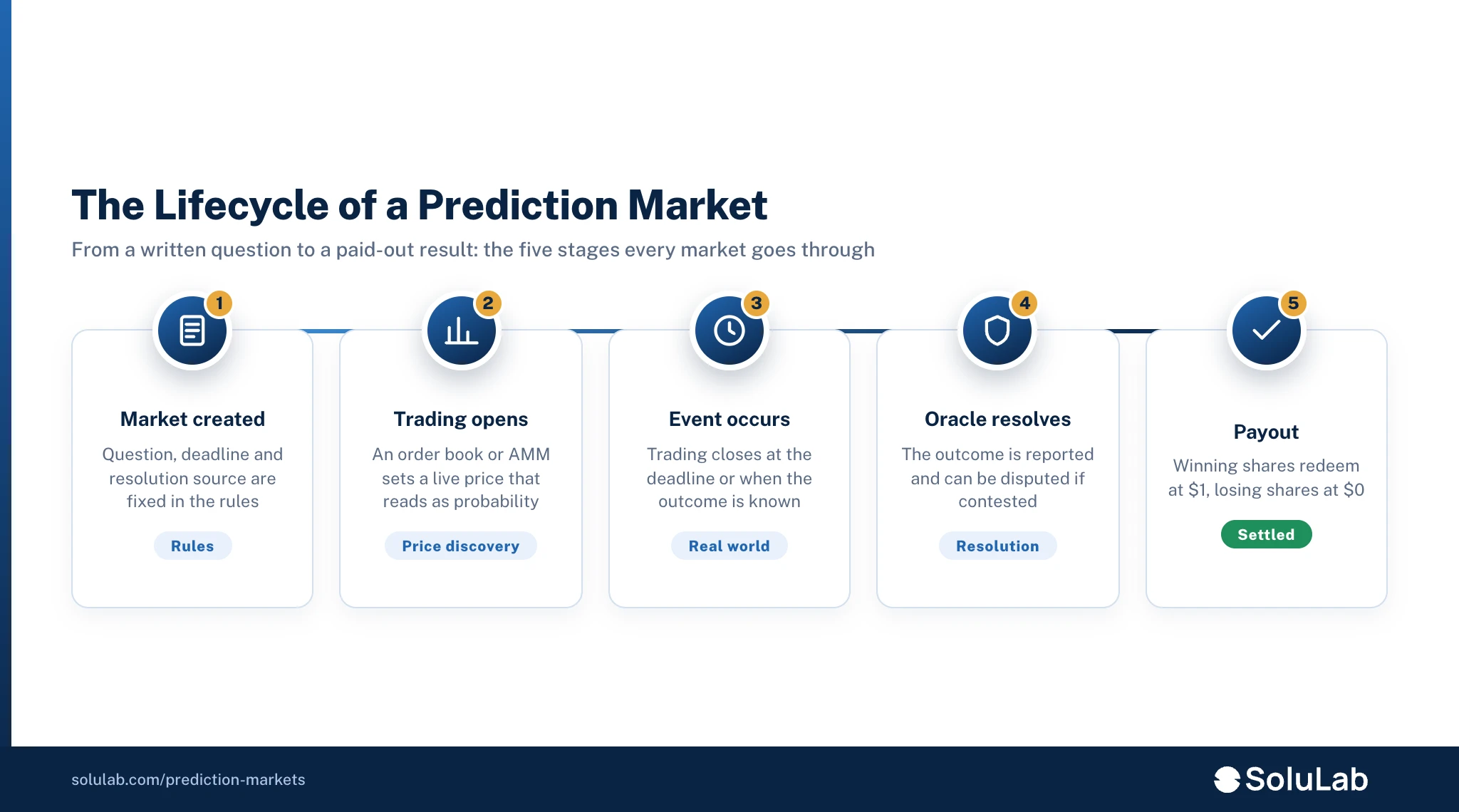
- Market creation. The question has to be unambiguous. “Will the central bank cut rates at its September meeting?” needs a named source (the bank’s own statement), a cut-off time and a rule for edge cases such as a postponed meeting. Many resolution disputes trace back to a loosely written question.
- Trading. Users deposit collateral (dollars on a regulated exchange, a stablecoin such as USDC on a crypto-native platform) and buy YES or NO shares. The trading engine is either an order book or an AMM, covered in the next section.
- The event. Trading usually halts at a set time or when the outcome becomes known.
- Resolution. An oracle reports what happened. On a regulated exchange this is an internal process against the source named in the contract rules. On-chain platforms use a decentralized oracle with a dispute window.
- Payout. The exchange or smart contract redeems winning shares for $1 each. Because every YES and NO pair was funded with $1 of collateral when it was created, the market is always fully collateralized and the platform itself carries no outcome risk.
AMM vs. order book: how do prediction markets set prices?
Prediction markets set prices in one of two ways. A central limit order book (CLOB) matches individual buy and sell orders, so the price is whatever traders quote. An automated market maker (AMM) prices shares with a formula against a pooled reserve, so a trade is always possible. Order books win at volume, and AMMs win on new or niche markets.
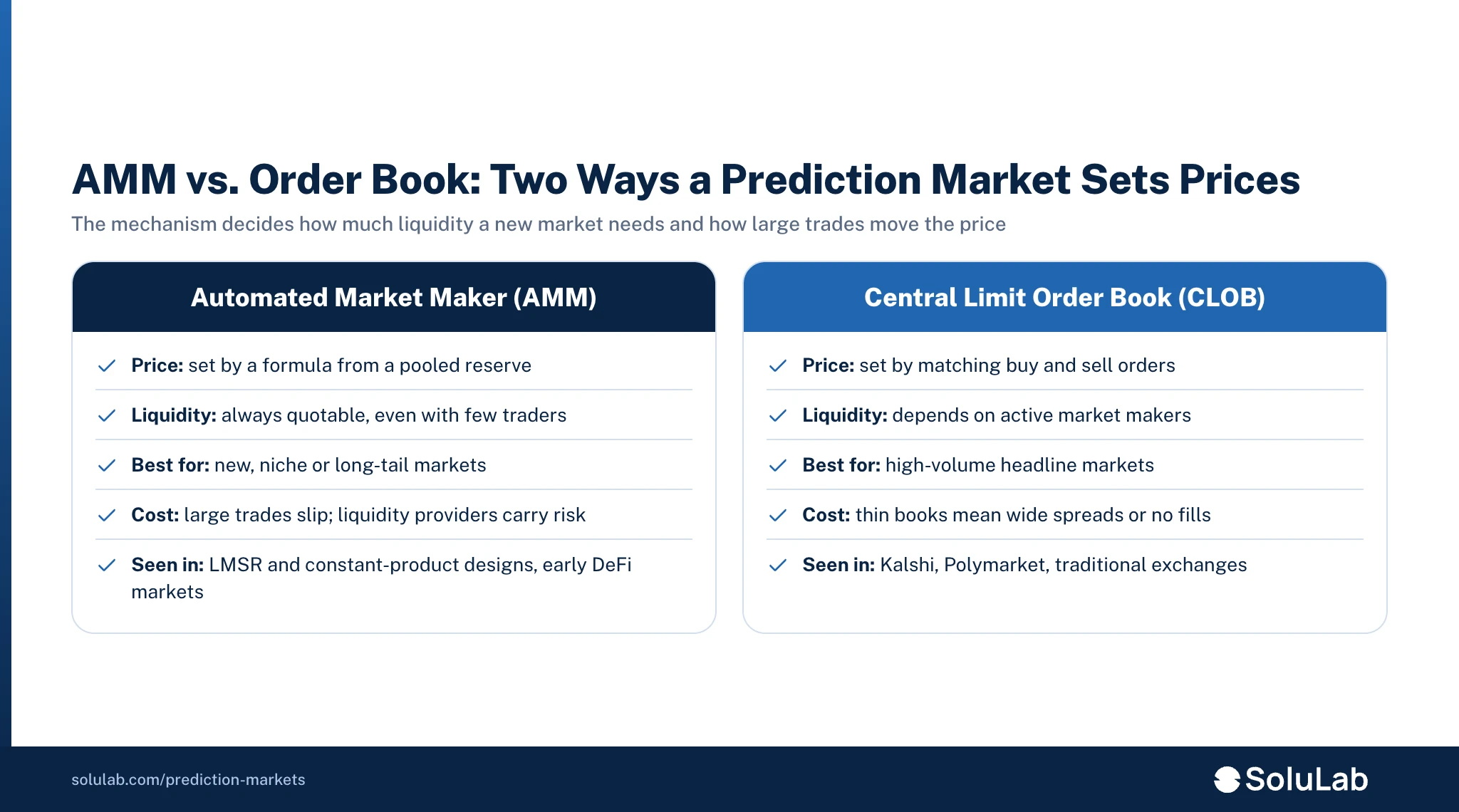
| Automated market maker (AMM) | Central limit order book (CLOB) | |
| How the price is set | By a formula, from the balance of a liquidity pool | By matching the best bid with the best offer |
| Liquidity needed at launch | Low. The pool quotes a price from the first minute | High. Someone has to post orders on both sides |
| Behavior on large trades | Price slips along the curve, which gets expensive fast | Fills against resting orders, tight when the book is deep |
| Who carries the risk | Liquidity providers, who can lose to better-informed traders | Market makers, who adjust or pull their quotes |
| Where you see it | LMSR and constant-product designs, early on-chain markets, long-tail markets | Kalshi, Polymarket, and every traditional exchange |
The best-known AMM design for prediction markets is Robin Hanson’s logarithmic market scoring rule (LMSR). It always quotes a price from a logarithmic cost function, so even a market with three traders has liquidity, and the sponsor’s worst-case loss is capped by a single liquidity parameter. Constant-product pools of the kind used by decentralized exchanges do a similar job with a simpler formula.
Polymarket is the clearest example of how the choice evolves. Its early markets ran on automated market makers. Today its documentation describes a central limit order book with off-chain matching and on-chain settlement on Polygon, with positions collateralized in pUSD, a USDC-backed token. Kalshi runs an order book, like the traditional derivatives exchanges it is modeled on.
The common pattern is to start with an AMM, because it solves the cold-start problem, and move to an order book once volume arrives. Many builds end up hybrid: an order book for headline markets, with an AMM or a contracted market maker backstopping the long tail. If you are scoping a platform, this is the first architecture decision, because it sets your liquidity budget, your smart-contract design and your fee model.
How do prediction market oracles work?
A prediction market oracle is the mechanism that tells the exchange or smart contract what happened in the real world, so it can pay the right side. Objective results come from data feeds. Subjective or contested results use an optimistic oracle, where a proposed answer stands unless someone stakes money to dispute it. Regulated exchanges resolve internally under their published contract rules.
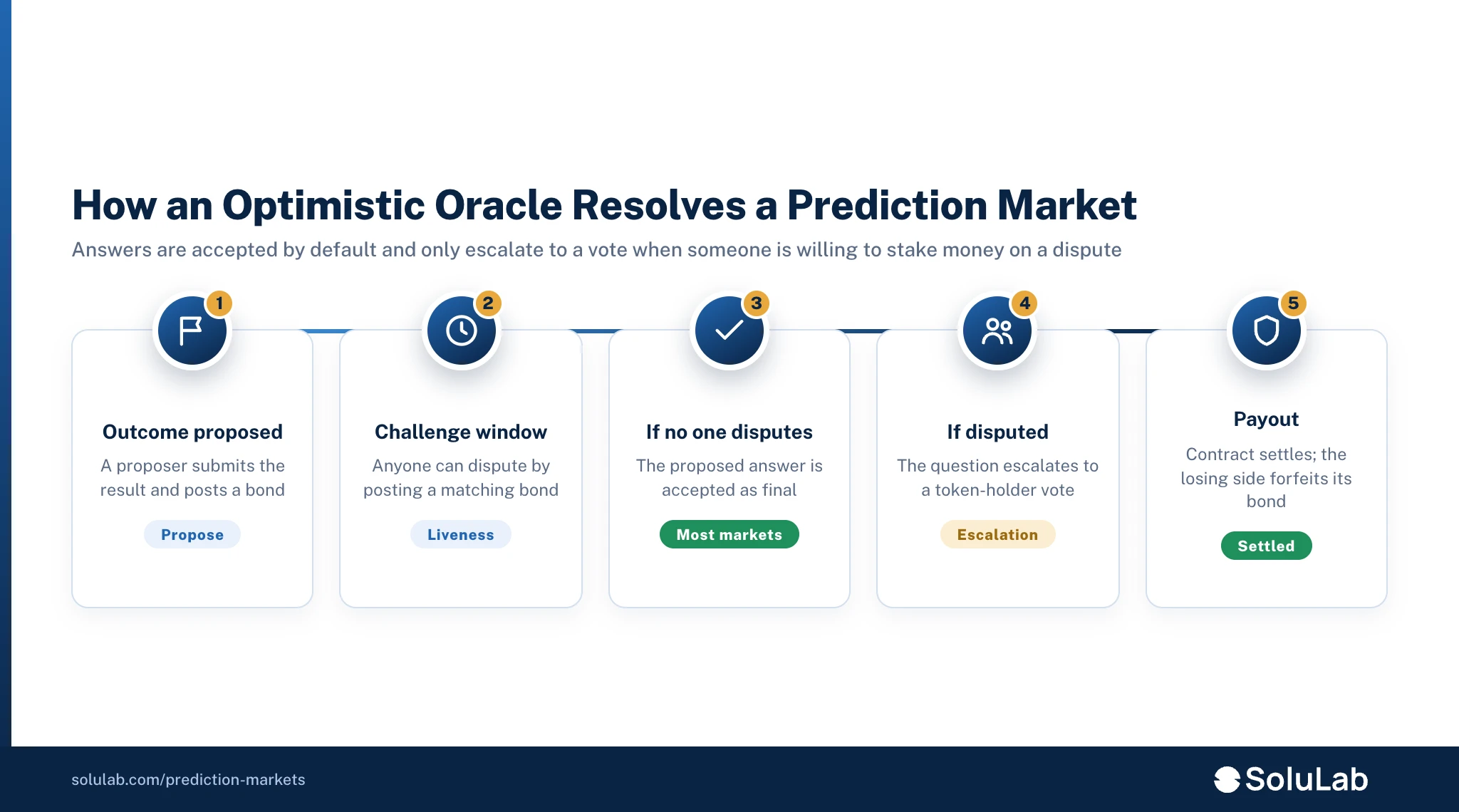
There are three patterns in production today.
1. Data-feed oracles for objective outcomes
When the question is “did Bitcoin close above a given price,” a signed data feed can settle it with no human involved. In September 2025 Polymarket partnered with Chainlink to resolve asset-pricing markets this way, using Chainlink Data Streams for timestamped price reports and Chainlink Automation to trigger settlement on-chain. This is the fastest and cheapest form of resolution, but it only works where a trusted machine-readable source exists.
2. Optimistic oracles for everything else
Most real-world questions are not machine-readable. Polymarket resolves these through UMA’s Optimistic Oracle. According to Polymarket’s resolution documentation, anyone can propose an outcome by posting a bond (usually $750), which opens a two-hour challenge period. If nobody disputes, the answer is final in about two hours. A dispute requires a matching bond, and a contested market escalates to UMA token holders, who vote over a 24-hour commit and 24-hour reveal period. A disputed market typically takes four to six days to settle, and the losing side forfeits its bond.
The design is “optimistic” because it assumes proposals are honest and only pays for a vote when someone has money at stake in saying otherwise. Its known weakness is that the final vote is weighted by token holdings, so the security of a large market depends on the cost of acquiring voting power.
3. Internal resolution on regulated exchanges
Kalshi does not use an on-chain oracle. Each contract’s rules name an outcome verification source, and a market settles when the official outcome is confirmed and Kalshi’s markets team finalizes the result. The check on that process is the exchange’s rulebook and its regulator, not a token vote. It is faster and simpler, and it asks users to trust the operator.
Augur, the first decentralized prediction market protocol, took the opposite extreme: holders of its REP token report outcomes, disputes escalate with larger and larger bonds, and a dispute that never settles forks the whole protocol into parallel versions. That mechanism was used for the first time in 2026.
Oracle design is where most prediction market failures happen. A contract can be flawlessly coded and still pay the wrong side if the question was ambiguous or the dispute process can be captured by a large token holder. The practical safeguards are dull but effective: name one primary resolution source per market, write the edge cases into the rules before trading opens, size dispute bonds so that frivolous challenges cost money, and keep a documented escalation path for the rare market that genuinely cannot be resolved.
What types of prediction markets are there?
Prediction markets are usually grouped by contract structure and by venue. By structure there are binary markets (yes or no), categorical markets (one winner from several options) and scalar markets (a number within a range). By venue there are regulated exchanges, crypto-native on-chain platforms, and play-money or internal corporate markets used purely for forecasting.
- Binary: “Will X happen by date Y?” One YES share and one NO share. This is the large majority of volume on every major platform.
- Categorical (multi-outcome): “Who will win the election?” One share per candidate, and the prices across all candidates should sum to roughly $1.
- Scalar (range): “What will inflation print at?” Payout scales with where the number lands inside a preset range. Useful, but harder to explain to retail users, so it is less common.
- Regulated exchanges: venues such as Kalshi and ForecastEx that list event contracts under a derivatives license, take dollars, and resolve markets internally.
- Crypto-native platforms: venues such as Polymarket’s global exchange, where collateral is a stablecoin, settlement happens on a blockchain and resolution runs through a decentralized oracle.
- Play-money and internal markets: forecasting tools run inside companies or research communities, where the goal is a better estimate of a launch date or sales figure and no real money changes hands.
Are prediction markets accurate?
Prediction markets have a strong record on events with deep liquidity and clear outcomes. In the longest-running study, covering five US presidential elections, the Iowa Electronic Markets were closer to the final result than 964 polls 74% of the time. Accuracy drops in thin markets, on low-probability outcomes and when public information is poor.
The evidence base is older than most people assume. Faculty at the University of Iowa’s Tippie College of Business have run the Iowa Electronic Markets since 1988 as a small-stakes research market. Berg, Nelson and Rietz compared its prices with 964 polls across the 1988 to 2004 elections and found the market was closer to the eventual vote share 74% of the time, and that it beat the polls in every election when forecasting more than 100 days out. In their review for the Journal of Economic Perspectives, Wolfers and Zitzewitz reported an average error of about 1.5 percentage points for the market in the final week, against 2.1 points for the final Gallup poll over the same elections.
The same paper is clear about the limits. Markets are “unlikely to perform well when there is little useful intelligence to aggregate or when public information is selective, inaccurate or misleading,” and they tend to misprice small probabilities. Two recent studies on today’s platforms sharpen that picture:
- Long shots are overpriced. A University College Dublin analysis of more than 300,000 prices from 46,282 Kalshi contracts found that buyers of contracts priced under 10 cents lost over 60% of their money, while contracts priced above 50 cents earned a small positive return. This is the favorite-longshot bias long documented in betting markets.
- A small group does the forecasting. A 2026 working paper by Gómez-Cram, Guo, Jensen and Kung found that around 3% of accounts generate the bulk of price discovery on a large platform, which Yale Insights identifies as Polymarket. In the authors’ words, accuracy reflects “the wisdom of an informed minority, not the wisdom of the crowd.”
The fair summary is that a liquid prediction market is one of the best public probability signals available, and a thin one is close to noise. Before quoting a price, check how much money is actually behind it.
How big are prediction markets in 2026?
Prediction markets traded about $45 billion in August 2026 across Kalshi, Polymarket and Polymarket US, according to The Block, with Kalshi alone accounting for $37.17 billion. For scale, Kalshi and Polymarket together generated a little over $44 billion in all of 2025. The sector now trades in a month what it traded in a year.
- August 2026: combined monthly volume of $45.33 billion, down 14.5% from July. Kalshi did $37.17 billion and Polymarket plus Polymarket US did $8.16 billion.
- The growth curve: Pew Research Center, using The Block’s data, shows combined monthly volume rising from under $5 billion in September 2025 to about $24 billion in April 2026.
- Full-year 2025: Kalshi and Polymarket generated more than $44 billion in trading volume.
- Forecasts: in April 2026, Bernstein analysts projected roughly $240 billion for 2026 and roughly $1 trillion by 2030. July and August 2026 alone added about $98 billion, so the 2026 figure already looks conservative.
Volume is not revenue, and monthly totals move around (August was down 14.5% on July). It is still the clearest sign that event trading has moved from a research curiosity to a mainstream retail product in under two years.
Top prediction market platforms compared
The table below compares the platforms most people mean when they talk about prediction markets. Facts were checked against each operator’s own documentation and regulator releases on September 21, 2026. Regulatory status is reported as a matter of public record only. Availability differs by state and by contract type, and the rules are being litigated this year, so check each platform’s own availability page and the CFTC’s overview of prediction markets and event contracts before relying on it. Nothing here is legal or investment advice.
| Platform | What it is | Trading mechanism | How markets resolve | Trading fees | US status (public record) |
| Kalshi | Regulated event-contract exchange | Order book | Internally, against the outcome verification source named in each contract’s rules | Fee schedule filed with the CFTC: 0.07 × contracts × price × (1 − price), rounded up to the cent. Resting orders can carry a maker fee | KalshiEX LLC was designated a contract market by the CFTC in November 2020 |
| Polymarket (global) | Crypto-native on-chain exchange | Order book with off-chain matching and on-chain settlement on Polygon, collateral in pUSD | UMA Optimistic Oracle with a two-hour challenge period. Chainlink data feeds for asset-price markets | Taker fee of shares × rate × price × (1 − price), with a rate of 0.04 to 0.07 by category. Geopolitics and world-events markets are fee-free. Makers pay nothing | Closed to US users since a January 2022 CFTC order |
| Polymarket US | Separate US exchange and app | Intermediated exchange, accessed through its own app | Under the exchange’s contract rules | Taker fee of 0.0695 × contracts × price × (1 − price), with a maker rebate, effective September 17, 2026 | CFTC Amended Order of Designation in November 2025. App rolled out from December 2025 and the waitlist was removed in May 2026 |
| Robinhood | Brokerage front end, not an exchange | Routes orders to partner exchanges: Kalshi, ForecastEx, Rothera and OG.com | By the exchange that lists the contract | Vary by contract and routing exchange | Offered by Robinhood Derivatives, LLC. Hub launched March 17, 2025 |
| Augur | Decentralized protocol on Ethereum | No active market product as of September 2026 | REP-holder reporting with escalating dispute bonds and, as a last resort, a protocol fork | Not applicable | Permissionless protocol, live since July 2018, now being rebuilt after its first fork |
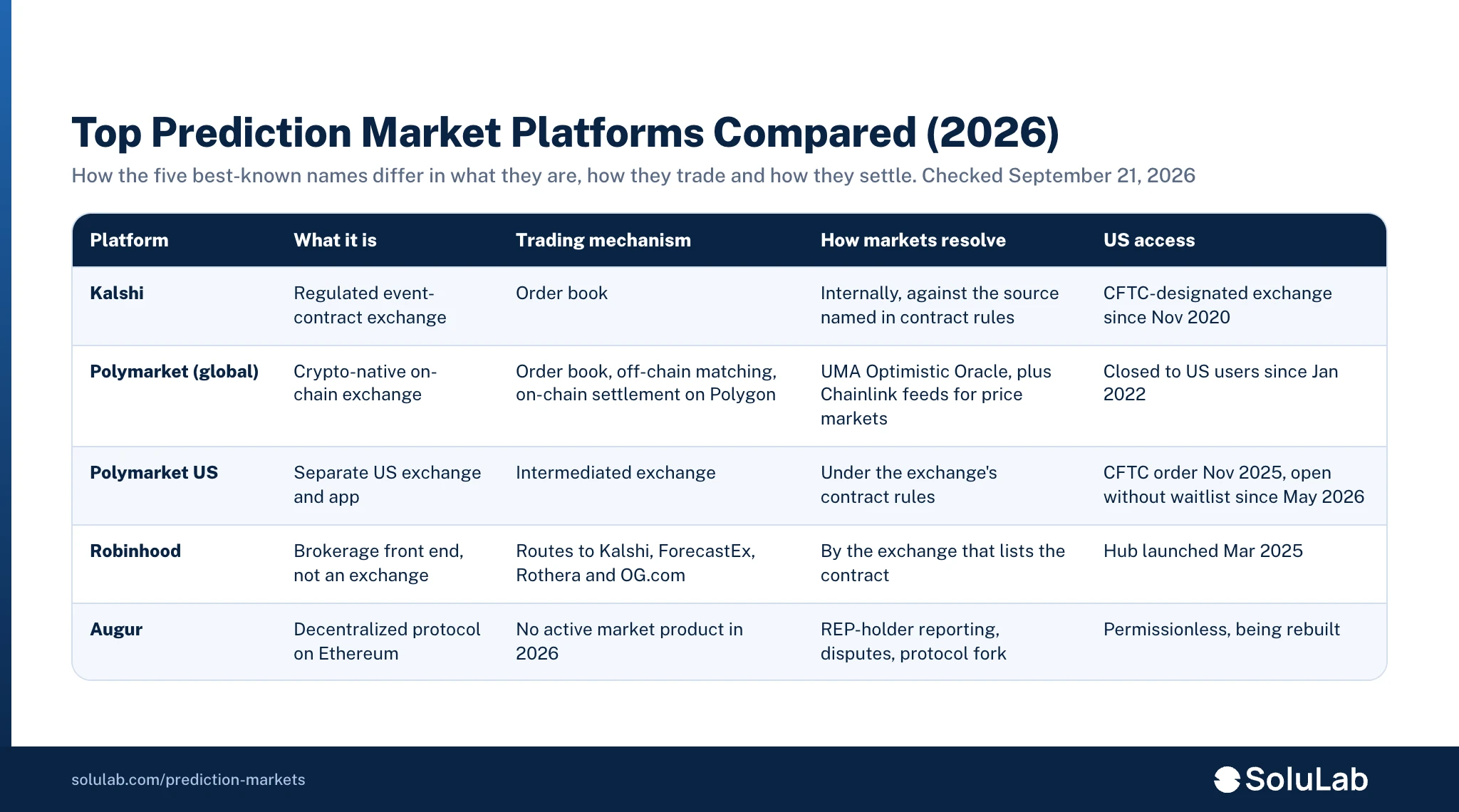
Three things in that table surprise people who last looked at this space in 2024.
- Polymarket is now two products. The global on-chain exchange is still closed to US users. After buying the CFTC-licensed exchange QCEX for $112 million in July 2025, Polymarket launched a separate US exchange and app. Fees, collateral and market lists differ between the two.
- Robinhood is a router, not a venue. Its hub launched on Kalshi’s exchange. Since then Robinhood and Susquehanna have acquired their own exchange, and as of September 2026 Robinhood spreads contracts across Kalshi, ForecastEx, its Rothera joint venture and OG.com.
- Augur is history being rewritten. The protocol that started the category in 2018 has no active trading product today. Its first-ever fork ran during 2026 and a new version is in development.
Other regulated US venues worth knowing: ForecastEx, Interactive Brokers’ event-contract exchange, which launched in August 2024, and FanDuel Predicts, built with CME Group and launched in December 2025.
Kalshi vs. Polymarket: what is the actual difference?
The core difference between Kalshi and Polymarket is architecture. Kalshi is a centralized, CFTC-designated exchange that holds customer dollars and resolves markets itself. Polymarket’s global exchange is on-chain, with self-custodied collateral and resolution by a decentralized oracle. Since late 2025 Polymarket also runs a separate regulated US exchange, so the gap has narrowed.
- Custody and funding. Kalshi holds funds like a traditional exchange and takes cards, bank transfers, wires, PayPal, Venmo and crypto deposits. On Polymarket’s global exchange you trade from a crypto wallet, with positions collateralized in pUSD on Polygon.
- Resolution. Kalshi’s markets team settles each contract against the source named in its rules. Polymarket’s global markets go through UMA’s Optimistic Oracle, where any participant can dispute a proposed result by posting a bond.
- Fees. Both now charge takers on the same curve, a rate multiplied by price × (1 − price), which peaks at 50 cents and shrinks toward the extremes. Kalshi’s filed rate is 0.07. Polymarket’s global rate runs from 0.04 to 0.07 by category, with some categories free, and Polymarket US charges 0.0695.
- Size. In August 2026 Kalshi traded $37.17 billion against $8.16 billion for Polymarket and Polymarket US combined, per The Block.
- Transparency. Every Polymarket global trade settles on a public blockchain, which is why independent researchers can study it account by account. Kalshi’s data is available through its API and regulatory filings.
For a builder, the comparison is a menu. Kalshi shows what a fully centralized, license-first design looks like. Polymarket’s global exchange shows the on-chain version, and its US arm shows that a single brand can run both.
How do prediction markets compare with traditional financial markets?
Prediction markets borrow the machinery of financial markets, such as order books, market makers and clearing, but trade a different thing. A stock is an open-ended claim on a company’s future cash flows. An event contract is a short-lived claim on one fact, with a known maximum payout, a fixed end date and no value after it resolves.
| Prediction market | Stock market | Options and futures | |
| What you trade | A claim on the outcome of one event | Ownership in a company | A contract on the future price of an asset |
| Payout | Fixed: $1 or $0 per share | Open-ended, plus dividends | Varies with the underlying price |
| Maximum loss | The price paid for the share | The price paid for the stock | Premium for buyers, potentially large for sellers |
| Lifespan | Ends when the event resolves | Indefinite | Ends at expiry |
| What the price tells you | An implied probability | A valuation | An expected price and its volatility |
| What settles it | An oracle or exchange ruling on a real-world fact | Nothing. It trades until sold | A reference market price |
| Typical leverage | None. Positions are fully collateralized | Optional margin | Built in |
The row that matters most for anyone building in this space is settlement. A futures contract settles against a market price that nobody seriously disputes. An event contract settles against a fact in the world, and someone has to be trusted to report it. That is why oracle and dispute design takes up so much of this guide.
What does it take to build a prediction market platform?
Building a prediction market platform comes down to four decisions: the trading mechanism (order book, AMM or hybrid), the oracle and dispute design, custody and collateral handling, and which market categories and jurisdictions you serve. A single-chain build with one resolution mechanism typically takes 10 to 16 weeks including an independent smart contract audit.
Everything above describes platforms that already exist. If you are weighing a new one, for a niche vertical, an internal forecasting tool or a market category the incumbents serve badly, the mechanism and oracle trade-offs in this guide are the same ones a build starts with. Category choice deserves equal weight, and it is the one decision that should be made with derivatives counsel in the room.
SoluLab’s blockchain team builds the infrastructure these platforms run on: non-custodial trading systems with on-chain settlement, AMM and order-book engines, and Chainlink oracle integrations. That includes an institutional decentralized exchange that has processed $5.2 billion in cumulative trading volume. We are ISO 9001 and SOC 2 certified and appraised at CMMI Level 3.

Start with our blockchain development and smart contract development teams, or see how we approach DeFi trading infrastructure.
FAQs
Rajat is a blockchain specialist and technophile who has led enterprise engineering teams at Citrix and InfoStretch before co-founding SoluLab.