ChatGPT and Google Gemini will happily draft your emails, boil a meeting down to five bullets, or talk a frustrated customer through a refund. Useful. But a tool built to do a bit of everything for everyone hits a ceiling fast. At some point the work gets specific, and so does the help you need.
General-purpose AI (people call it horizontal AI) is often where businesses start and rarely where they finish. A restaurant and a clothing store don’t have the same headaches. Why would they want the same assistant? They want something that already knows how their day actually runs. Money is following that idea. The global vertical AI market is projected to reach around USD 115.4 billion. That means going from USD 12.9 billion in 2024 to USD 34 billion by 2034, a CAGR of 24.5% between 2025 and 2034.
That gap is exactly where Vertical AI lives. It’s built for one line of work: restaurants, retail shops, construction sites. You’ve seen the pattern already in regular software. Shopify is for stores. Procure is for builders. Nobody asks them to do payroll for a hospital, and that narrowness is the whole point.
Below, we’ll cover what vertical AI actually is, the features that set it apart, where it’s being used right now, and where it’s heading.
What Are Vertical AI Agents?
Think of Vertical AI as a AI agent that takes a narrow set of tasks and just does them. On its own. Those systems are what we call Vertical AI agents: software that finishes work without a person nudging every step. Honestly, they could reshape how companies operate more than the move to cloud software did years ago.
Remember what cloud did. It let AI agents and Customer Service companies run programs without buying racks of hardware and wiring them up. Big shift. Vertical AI agents go a step past that, though. They don’t sit there waiting to be used like a normal app. They take on jobs people used to do, or they work next to those people so the job gets done sooner.
Here’s the part most people skip over. Companies spend far more on salaries than on software. For decades, growing revenue meant growing headcount, full stop. Now a Vertical AI agent can cover work that once needed an entire team. So the savings land in two places: the software bill, and payroll, which is usually the single biggest line on the budget.
Why Vertical AI Agents Are Unique?
Regular software gives you tools. Vertical AI agents behave more like a specialist you’ve hired for one job, and they’re judged on doing that one job very well. A few examples:
- MCH: Picture a tireless tester that clicks through your apps and websites so your QA people aren’t stuck doing it by hand.
- Gig.ml: Fields a flood of customer questions every single day for companies like Zepto.
- Sweet Spot: Reads through government contracts, the kind of slog that used to eat whole afternoons.
The result is less waiting and less grind. And, frankly, a company that gets more done without adding bodies.
1. Startups, Not Giants, Lead the Charge
Size doesn’t buy depth. Google never went after payroll tools like Gusto, and there’s a reason: payroll is fiddly, regulated, and full of edge cases you only learn by living in them. Small companies that obsess over one problem tend to win those corners.
That’s the opening for startups. A founder who spots a task that is dull and happens a thousand times a week has found a product. Build an agent for it. And move early, because every past tech wave has rewarded the people who showed up first. There’s no sign this one is different.
2. Disrupting the Workforce
The effect on jobs is real. The old playbook said more revenue needs more hires. These AI tools break that link, so a company can scale up sharply while its team stays roughly the same size.
Take Rippling. It pulls every HR tool under one roof, so there are fewer systems to juggle. Or Salient, which handles phone calls for jobs like collecting payments. No call center required. The AI just makes the calls.
3. What Founders Should Focus On
If you’re starting something, hunt for work that is slow, tedious, and begging to be sped up. A couple of places to look:
- Medical billing: Dentists lose hours to billing paperwork. An agent can take that off their plate.
- Job hiring tests: Screening candidates by actually checking their skills, so the right people rise to the top.
Neither sounds glamorous. That’s fine. Fixing unglamorous work is where the payoff tends to be biggest. These specialised tools combine automation (the work runs by itself) with real domain knowledge, which is why they save businesses both time and money. They look a lot like SaaS (software-as-a-service). My bet is they end up bigger.
As the category matures, the winners will be the teams that pick the most painful problems and solve them properly. This isn’t a small upgrade. It changes what we expect software to do in the first place.
Why Vertical AI Agents Could Be 10 Times Bigger Than SaaS?
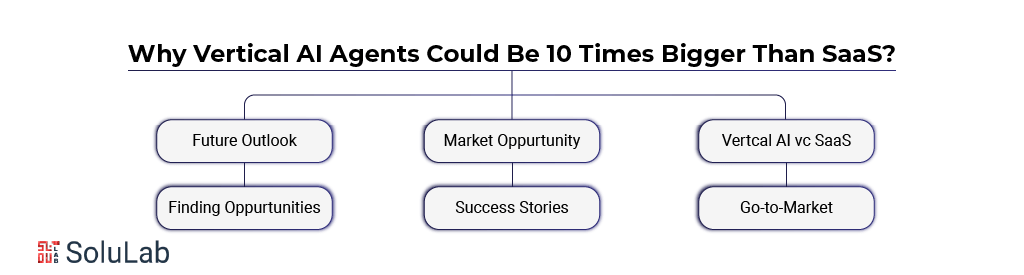
So why the “10x bigger than SaaS” talk? Six reasons.
1. Market Opportunity
The comparison people keep reaching for is the SaaS (software as a service) boom of the 2000s. Except this could run larger. Imagine every major SaaS company getting an AI counterpart built for the same niche. Those vertical AI agents could, in aggregate, produce companies worth more than $300 billion.
For a while OpenAI had the field mostly to itself. Not anymore. Rival models show up and get better month after month, and all that competition keeps widening the set of things founders can build on.
2. Vertical AI > SaaS
SaaS replaced software. Vertical AI also eats into hiring. Look at any company’s spend and the people line dwarfs tools like SaaS AI agents. With agents doing the heavy lifting, a small company can run lean and still punch above its size. And the models underneath keep improving roughly every three months.
Some vertical agents already cover the output of a full team and finish large pieces of work end to end. That’s a different kind of product.
3. Go-to-Market
Here’s the awkward bit. Try selling automation to the very team it might replace and you’ll hit a wall; people push back when they feel threatened. In practice, the smarter route is to go straight to the decision-makers, the CEO or the owner, who see the upside and don’t have their own job on the line.
4. Finding Opportunities
Start with the chores nobody wants. Repetitive, mind-numbing, done every day: that’s where the openings are. One founder got his idea watching his mom, a dentist, sink hour after hour into processing insurance claims. He figured an agent could do it. That’s usually how these ideas start, from something you’ve watched eat someone’s week.
People call these “butter-passing jobs”: small, thankless, necessary. Perfect for AI. Plenty of them are still sitting there untouched.
5. Success Stories
- MTIC: Runs software testing automatically, taking the repetitive checking off human hands.
- Cap.AI: Built a very capable chatbot for developers, so companies don’t need a huge support desk.
- Salient: Places AI calls to customers about auto loans and already counts big banks as clients.
6. Future Outlook
Managers can already oversee bigger teams because AI digests the information that used to bury them. Push that further and the old ceiling on how large a company can get starts to look soft.
SaaS stayed specialised, and there’s every reason to expect vertical AI agents to do the same. Which makes the future of AI both exciting and pretty well defined.
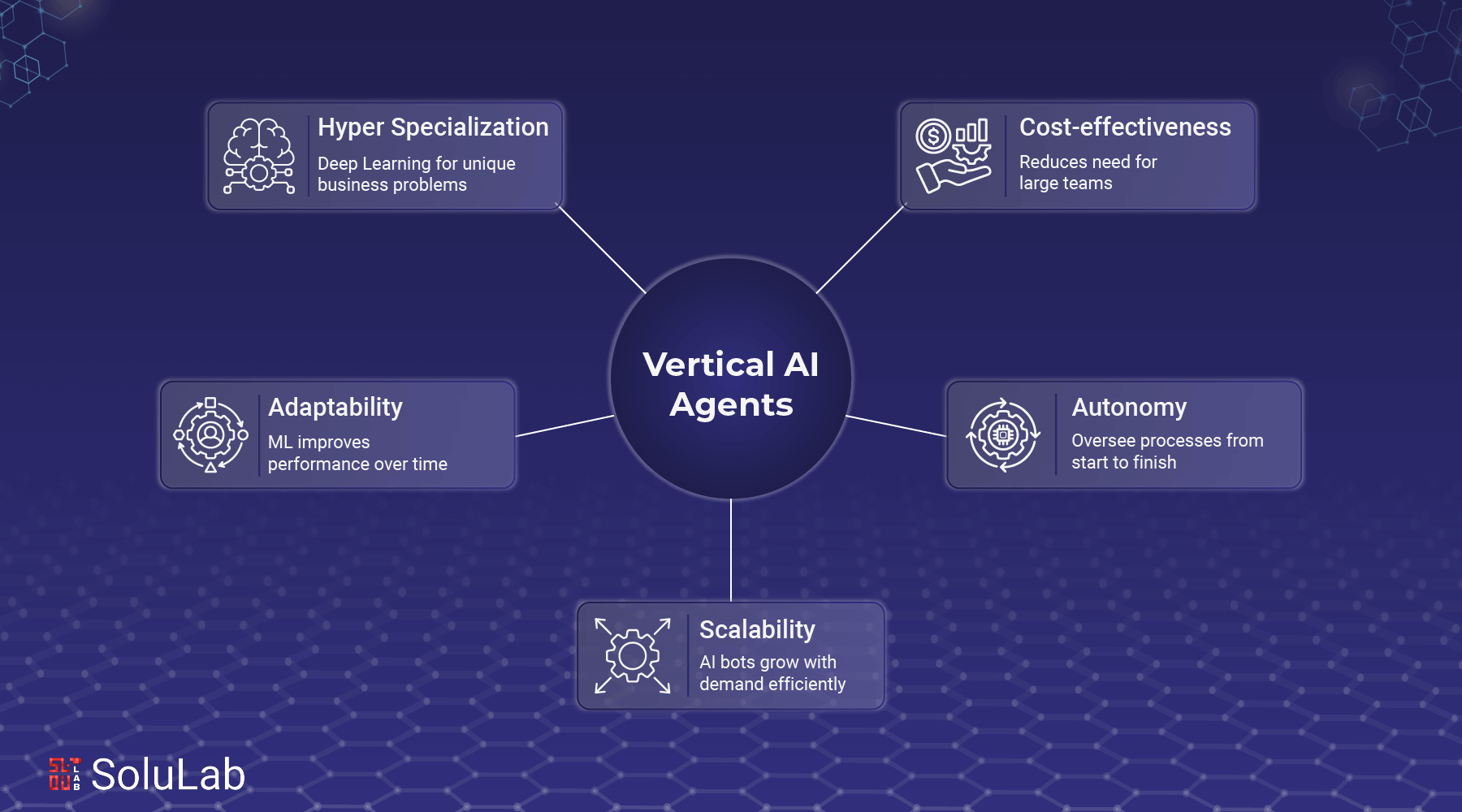
Features of Vertical AI Agents
What actually separates a vertical agent from a general chatbot? These traits:
- Hyper-Specialization: Bring in deep learning to crack the hard, business-specific problems a general model tends to get only roughly right.
- Autonomy: It can own an entire process, from the first step to the last.
- Adaptability: Machine learning keeps it getting better the longer it runs.
- Cost-effectiveness: Less need for large teams, so payroll drops noticeably.
- Scalability: It gets easier, because AI bots stretch to meet demand without a matching jump in hiring. A small startup team can carry a lot of growth.
- Increase competitiveness: Custom, advanced tooling gives a business sharper decisions and tighter operations, and that’s a real edge over rivals still doing things by hand.

Real-World Use Cases of Vertical AI Agents
Theory is cheap. Here’s where AI agents are already changing how different industries work, taking on hard tasks and getting through them faster than people can.
1. Healthcare
Doctors get a second set of eyes. Vertical AI systems can scan X-rays or MRIs and flag problems a clinician might miss on a busy day. Faster diagnosis, and a better shot at picking the right treatment.
These AI agents in Healthcare tools also chat with patients online, offer first-pass advice, and book appointments. All of that hands time back to doctors for the work that needs them, and patients get seen sooner.
2. Finance
Fraud is a pattern game, and machines are quick at patterns. An agent watches transactions around the clock and flags anything that looks off, often well before a human analyst would notice.
It also helps with loan decisions by working through piles of data such as credit histories. AI in finance can read long, tedious contracts too, catching errors or risky clauses so the business stays compliant.
3. Manufacturing
On a factory floor, an AI Agent for Manufacturing acts like a mechanic who never clocks out. It tracks how each machine is performing and calls out trouble before something snaps. Less downtime. Lower repair bills.
It can also build production schedules so every line has what it needs when it needs it. And it speeds up the supply chain, which means goods reach people faster.
4. Retail
Retail gets sharper. AI can trigger restocks, read what shoppers are likely to want, and recommend products based on what you’ve bought before.
On top of that, AI agents in Retail and E-commerce can run customer service chats, answer questions, and block fraud both in store and online. Think of a shop assistant who doesn’t take lunch.
5. Software Development
For programmers, AI catches bugs and proposes fixes. Sometimes it writes chunks of the code outright.
It can run the test suite as well, checking that everything behaves. So developers spend their hours building new features, not chasing the same bug for an afternoon.
6. Agriculture
Out in the fields, AI checks plant health, forecasts weather, and waters crops by the right amount. It pitches in on planting, harvesting, and pest control. It even tracks yield and tells farmers how best to manage their crops and supplies. Not bad for something that never gets a sunburn.
Opportunities and Challenges for Vertical AI Founders
The upside is obvious. Vertical agents automate tricky work humans normally do, so businesses save money and can grow without a hiring spree. There’s also a timing advantage. New technology tends to reward whoever adopts it first, and vertical AI looks no different. Plenty of industries have barely touched it. A founder who finds a boring, repetitive job and builds an agent for it has a head start most competitors don’t.
Challenges of Starting a Vertical AI Company
But it’s hard. You can’t build a good vertical agent without knowing the industry cold. You need high-quality data to train it, and that’s often where teams get stuck. You’ll almost certainly need partners who’ve spent years inside the sector. Then there’s fairness in how the AI decides things, and privacy for the people whose data it touches. Neither is optional.
Still, the opportunity outweighs the friction. Large companies often stumble in small, specialised markets because they don’t have the niche expertise. Smaller, faster startups can walk right into that gap and end up owning it.
Future Trends in Vertical AI Agents
Expect fast growth. Vertical AI agents are a form of artificial intelligence aimed at particular industries, healthcare, finance, and manufacturing among them, and they apply that intelligence to each sector’s own problems. They automate tasks. They support decisions. They produce solutions shaped for one industry at a time. Lots of businesses have already adopted AI simply because it makes the work quicker and less painful, and these agents also help with customer management and day-to-day operations, which lifts productivity.
- Increased Personalisation: Agents keep getting better at fitting each business’s specific needs, which helps a company work smarter and stand out in a crowded market.
- Integration with IoT: Vertical AI now plugs into the Internet of Things (IoT). So businesses pull live data from smart devices and act on it faster, with better decisions to show for it.
- Advancements in Natural Language Processing: With Natural Language Processing, vertical AI understands human language far better than it used to. Talking with customers gets easier, and their experience improves a lot.
- Multi-model Capabilities: Now picture a system that takes in what you say, what you show it, and what you type, all at once. That’s what multimodal models AI does: it folds words, images, and sound into a single system. In a hospital, for instance, it could read patient files (text), look at X-rays (visual), and listen to how a patient describes symptoms (audio). Doctors get a fuller picture, faster.
That capability travels well across industries. As more businesses need tools that handle every kind of data at once, these systems only get more valuable.
- Integration Ecosystem
Picture every gadget you own actually talking to the others. Vertical AI needs the same thing. It only does its best work when it connects cleanly with the apps, tools, and platforms an industry already runs on. That web of connections is what people mean by an integration ecosystem.
In banking, say, the AI hooks into compliance checkers and customer management systems. Work moves quicker and gets simpler. Once the pieces fit together, a business can make real use of its data and get a lot more out of its AI.
- Automation and Cost Efficiency
What if the dull chores just went away and people got to spend their days on creative work? That’s the pitch for vertical AI. Some experts expect that by 2030 it will be handling many of the tasks people do today, faster and for less money [SOURCE NEEDED].
Businesses would save a lot. Staff could put their energy into hard problems and into looking after customers. The repetitive stuff? The agent has it.
Expert Insights and Predictions
Jose E. Puente, CEO of Reality Border, puts it this way: “In the next five to ten years, Vertical AI agents will be super important for many industries. They will quickly adapt to solve tough problems.” His advice to businesses is to keep learning as things shift, so they get the full benefit of AI.

Conclusion
Calling vertical AI agents “new software” undersells them. They change what software is for. SaaS (Software-as-a-Service) let companies use programs without buying and installing them; agents go further, helping people with certain tasks or taking those tasks over entirely.
As adoption spreads, whole industries will work differently. The old ways get better, and the bar moves up. The founders who lead will be the ones who pick one specific, painful problem and solve it better than anyone else.
One example from our own work: SoluLab helped AI-Build, a construction tech company, apply generative AI and machine learning to advanced product development in the CAD space. They wanted design processes automated, productivity up, and accuracy tighter. The hard part was a system that could generate optimized designs, cut manual work, and still scale. SoluLab’s AI Development Company expertise made the AI integration work, with clear gains in efficiency and performance. Got a problem like that? SoluLab’s team is ready, contact us today!
FAQs
Shipra Garg is a tech-focused content strategist and copywriter specializing in Web3, blockchain, and artificial intelligence. She has worked with startups and enterprise teams to craft high-conversion content that bridges deep tech with business impact. Her work translates complex innovations into clear, credible, and engaging narratives that drive growth and build trust in emerging tech markets.