Key Takeaways
- The US CLARITY Act aims to establish clearer jurisdiction between the SEC and CFTC, reducing long-standing regulatory uncertainty for digital assets.
- The legislation could provide a stronger foundation for institutional adoption of Tokenized Real World Assets, stablecoins, and digital asset infrastructure.
- Stablecoin yield restrictions remain one of the most closely watched areas of Senate negotiations due to their potential impact on exchanges, fintech companies, and payment providers.
- Enterprises that prepare early with custody, compliance, identity verification, and settlement infrastructure may gain a significant first-mover advantage. Luxury Hotels in the Maldives at an institutional level.
The US Clarity Act, officially known as the Digital Asset Market Clarity Act, is quickly becoming one of the most closely watched legislative developments in the digital asset industry.
After passing the U.S. House of Representatives on July 17, 2025, with a strong bipartisan vote of 294-134, the bill entered Senate review. Where discussions are now intensifying around market structure, stablecoin regulations, investor protections, and digital asset oversight.
While many discussions focus on cryptocurrencies and exchanges, the larger opportunity actually sits within tokenized Real World Assets, tokenized securities, stablecoins, and institutional finance.
For enterprises exploring asset tokenization solutions and compliant digital asset infrastructure, the CLARITY Act crypto framework could create long-awaited regulatory certainty. Therefore, businesses that begin preparing now may benefit significantly while competitors continue waiting for perfect clarity.
What Is the US Clarity Act and Why Does It Matter?
The Digital Asset Market Clarity Act aims to establish a comprehensive crypto regulatory framework in the United States by clearly defining digital assets and assigning regulatory responsibilities between federal agencies.
For years, one of the industry’s biggest challenges has been determining whether a digital asset should be regulated by the SEC or the CFTC. Different interpretations have resulted in lawsuits, compliance uncertainty, and delayed innovation.
Mike Novogratz, CEO of Galaxy Digital, recently described June 2026 as a critical month for crypto legislation, emphasizing that Senate scheduling could determine whether the bill advances this year or faces further delays. He posted on X: “It’s literally now or never.”
Meanwhile, comment periods related to the GENIUS Act stablecoin framework closed on June 2, 2026, with the Senate expected to resume discussions shortly afterward.
The US crypto regulation landscape has often been described as fragmented. The new legislation attempts to address that challenge by providing practical classifications for digital assets and creating a more predictable path for businesses.
1. Key Objectives of the Digital Asset Market Clarity Act
The legislation seeks to:
- Define digital assets under federal law
- Clarify SEC and CFTC jurisdictions
- Protect self-custody rights
- Establish registration pathways for digital asset businesses
- Support compliant DeFi activities
- Reduce regulatory overlap
- Strengthen anti-fraud and anti-manipulation protections
For enterprises investing in Blockchain-based Real World Assets, these provisions could significantly reduce uncertainty when developing new products and services.
2. Why the Industry Is Calling It a “WAGMI” Moment
Crypto communities often use the phrase “WAGMI” (We’re All Gonna Make It) to describe positive industry developments.
While enterprises rarely use meme language in boardrooms, the sentiment reflects growing optimism around regulatory clarity.
The legislation potentially offers:
- Better institutional confidence
- Easier compliance planning
- Improved access to banking relationships
- More predictable investment environments
- Increased participation from traditional finance
These benefits are particularly important for organizations developing Enterprise tokenization platforms and institutional digital asset products.
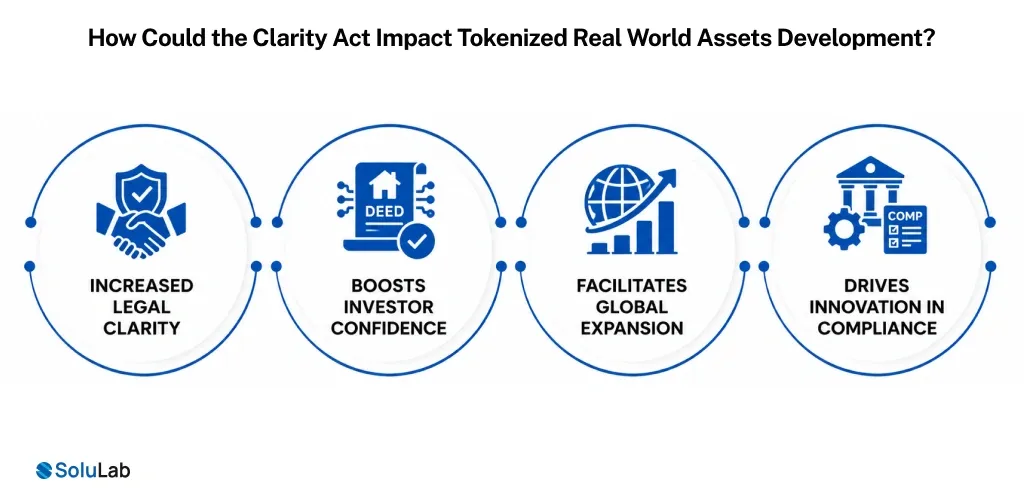
How Could the Clarity Act Impact Tokenized Real World Assets Development?
The most significant opportunity may not involve speculative trading at all.
Instead, the Clarity Act on tokenized RWAs could provide a stronger foundation for organizations bringing traditional assets onto blockchain infrastructure.
1. Understanding RWA Crypto Opportunities
RWA crypto refers to the tokenization of real-world assets, such as:
- Real estate
- Government bonds
- Treasury products
- Infrastructure assets
- Commodities
- Private credit
- Corporate debt
Using Blockchain asset tokenization, ownership rights can be represented digitally while maintaining compliance requirements and investor protections.
2. Why Enterprises Are Focusing on Tokenized Securities
Traditional financial markets often involve multiple intermediaries, lengthy settlement cycles, and operational inefficiencies.
Tokenized securities can potentially offer:
- Faster settlement
- Enhanced transparency
- Fractional ownership
- Lower administrative costs
- Improved accessibility
- Better liquidity opportunities
As a result, demand for Real World Asset tokenization services continues to grow among financial institutions and asset managers.
3. The Growing Market for Tokenized Assets
Several industry reports estimate that the market for tokenized assets could reach trillions of dollars over the next decade.
According to a recent report by Citigroup, the value of tokenized securities and other tokenized real-world assets could reach $5 trillion to $6 trillion by 2030.
The report also estimates that as much as $1 trillion in trade finance volumes could move onto blockchain infrastructure over the coming years.
Popular categories attracting institutional interest include:
- Tokenized treasury assets
- Tokenized government bonds
- Real estate investments
- Private equity funds
- Commodity tokenization
- Alternative investment products
- Infrastructure financing
- Asset-backed securities
Meanwhile, firms such as BlackRock, Franklin Templeton, and JPMorgan Chase have already launched or explored tokenization initiatives, highlighting growing confidence among traditional financial institutions.
The Clarity Act on tokenized RWAs could provide the regulatory certainty many institutions have been seeking before scaling investments.
For enterprises building RWA tokenization platforms, clearer rules could accelerate adoption while reducing compliance uncertainty.
Why Should Enterprises Prepare Before the Bill Is Fully Implemented?
A common mistake organizations make is waiting for regulations to become final before beginning preparations.
However, market leaders generally build infrastructure before regulations become fully operational.
1. Early Movers Often Capture the Biggest Advantages
Organizations developing an RWA tokenization platform today can position themselves to launch faster once regulations become clearer.
Benefits may include:
- Faster market entry
- Stronger institutional partnerships
- Better investor confidence
- Increased market share
- Improved product readiness
Meanwhile, competitors may still be evaluating regulatory developments.
2. Enterprise Readiness Starts Now
Companies exploring Asset tokenization consulting should already be assessing:
- Digital asset strategies
- Token issuance infrastructure
- Compliance frameworks
- Custody solutions
- Smart contract governance
- Identity verification procedures
- Reporting systems
Preparing early does not mean taking regulatory risks.
Instead, it means building capabilities that can adapt as regulations mature.
3. “GM” for Enterprise Builders
In crypto communities, “GM” simply means “Good Morning.”
For enterprises, this may be the perfect “GM” moment to begin evaluating long-term digital asset opportunities rather than waiting for competitors to establish market leadership.
What Are the Stablecoin Yield Debates and Why Do They Matter?
One of the most heavily discussed aspects of Senate negotiations involves stablecoin yields.
1. The Current Debate
The Senate has been reviewing provisions that would restrict regulated payment stablecoins from offering interest-like returns simply for holding the asset.
Negotiations involving:
- Senator Thom Tillis (R-NC)
- Senator Angela Alsobrooks (D-MD)
have explored compromise approaches that distinguish payment utility from deposit-like products.
The SEC, CFTC, and Treasury would likely play significant roles in defining final implementation standards.
2. Why Stablecoins Matter to Enterprises
Stablecoin development is increasingly becoming critical infrastructure for:
- Cross-border payments
- Treasury management
- Digital settlements
- Institutional transfers
- Tokenized asset transactions
For organizations building Digital asset solutions, stablecoins often function as the settlement layer connecting traditional finance and blockchain networks.
3. Potential Challenges
Restrictions on stablecoin yields may affect:
- Exchange revenue models
- Treasury products
- Institutional liquidity strategies
- Customer incentive programs
However, activity-based rewards and payment-related incentives may still be permitted under certain circumstances.
4. Enterprise Response
Businesses should focus on:
- Settlement efficiency
- Operational utility
- Compliance readiness
- Transaction automation
- Payment infrastructure
rather than relying solely on yield-driven stablecoin models.
The “HODL” culture may work for retail communities, yet enterprise finance teams require practical business outcomes and regulatory certainty.
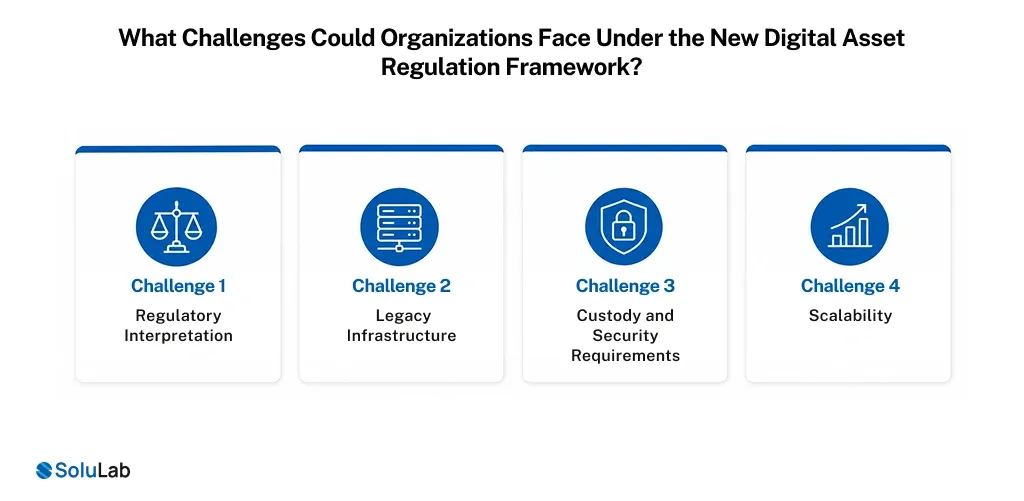
What Challenges Could Organizations Face Under the New Digital Asset Regulation Framework?
Although the legislation provides greater clarity, enterprises will still face implementation challenges.
Challenge 1: Regulatory Interpretation
Even with clearer definitions, agencies must still develop detailed implementation guidance.
Solution
Work closely with legal advisors and providers offering Security token development services to ensure compliance is built into product architecture from day one.
Challenge 2: Legacy Infrastructure
Many banks and financial institutions continue operating on systems designed decades ago.
Solution
Adopt modular Blockchain development services that integrate with existing infrastructure rather than requiring complete replacement.
This approach reduces operational disruption while improving adoption rates.
Challenge 3: Custody and Security Requirements
Institutional investors demand strong custody controls and risk management processes.
Solution
Organizations should implement:
- Multi-signature wallets
- Institutional custody frameworks
- Smart contract audits
- Risk monitoring tools
- Compliance reporting systems
These capabilities are essential for any serious Tokenized asset management platform.
Challenge 4: Scalability
As adoption increases, transaction volumes may grow significantly.
Solution
Develop scalable Enterprise asset tokenization solutions capable of supporting:
- High transaction throughput
- Institutional user bases
- Regulatory reporting requirements
- Multi-asset portfolios
Scalability planning should begin long before widespread adoption occurs.
Which Industries Could Benefit Most From the CLARITY Act?
Several sectors stand to gain from clearer Digital asset regulation.
1. Real Estate
A compliant Real estate tokenization platform can improve liquidity, expand investor access, and simplify ownership structures.
Real estate remains one of the most attractive categories within Real World Asset tokenization.
2. Asset Management
Fund managers can create:
- Tokenized treasury assets
- Tokenized bond portfolios
- Tokenized investment funds
- Digital ownership structures
Many organizations are already evaluating Tokenized fund platform opportunities.
3. Banking and Financial Services
Banks may participate through:
- Custody services
- Asset servicing
- Settlement infrastructure
- Compliance support
As regulations become clearer, participation from traditional finance is expected to increase.
4. Insurance
Insurance providers may eventually leverage Asset-backed token development for reserves, structured products, and investment portfolios.
5. Alternative Investments
Private equity, infrastructure funds, and private credit markets can benefit from improved accessibility through Tokenized Real World Assets.
How Can Businesses Prepare for the Future of Blockchain-Based Real World Assets?
Organizations interested in long-term growth should begin developing a practical roadmap today.
1. Strategic Priorities for Enterprise Teams
Focus on:
- Compliance readiness
- Asset selection frameworks
- Stablecoin integration strategies
- Custody planning
- Governance procedures
- Investor onboarding systems
- Reporting automation
2. Technology Investments Worth Evaluating
Enterprises should assess:
Rather than focusing only on tokenization software, enterprises should evaluate the core infrastructure needed to support regulated digital assets at scale.
- Identity verification and KYC/AML systems
- Smart contract security and audit frameworks
- Digital asset custody and wallet infrastructure
- Stablecoin payment and settlement capabilities
- Asset servicing and compliance reporting tools
- Multi-chain interoperability solutions
- AI-powered risk monitoring and fraud detection
These investments help organizations build secure, compliant, and scalable foundations for Real World Asset tokenization and institutional digital asset operations.
Building foundational capabilities now can significantly reduce implementation delays later.
3. The Role of AI and Tokenization
Many organizations are also exploring AI Tokenization Asset Ownership models to support:
- Asset verification
- Compliance monitoring
- Risk assessment
- Portfolio management
- Reporting automation
Meanwhile, guidance frameworks such as the SEC Playbook for RWA Tokenization Development continue influencing enterprise planning and compliance strategies.
Conclusion
As regulatory clarity gradually improves, enterprises that invest early in real-world asset tokenization, tokenized securities, and digital asset infrastructure are likely to gain a significant competitive advantage.
At SoluLab, a top tokenization platform development company, we help businesses launch compliant tokenization solutions, including
- real estate tokenization platforms,
- tokenized fund platforms,
- stablecoin integrations,
- smart contract development,
- custody frameworks, and
- enterprise-grade blockchain systems.
Our team works with startups, financial institutions, and large enterprises to reduce operational overhead, accelerate settlement cycles, and improve transparency.
Through this, you can reduce administrative and reconciliation costs by 30-50% while enabling near real-time settlement and broader investor access.
Whether you’re exploring a new RWA opportunity or scaling an existing digital asset initiative, connect with SoluLab to evaluate your tokenization roadmap and compliance strategy. The organizations preparing today are often the ones leading tomorrow.
FAQs
Deepika is a content writer who blends storytelling with strategic thinking. She explores topics across digital innovation, emerging tech, and the evolving blockchain industry. She enjoys breaking down complex ideas into simple, engaging narratives in the growing global markets.