Key Takeaways
- Problem: Slow settlement delays cash access, weakens liquidity planning, and slows reinvestment after deals close.
- Solution: Businesses can implement tokenized agentic payment systems to unlock faster, rule-based payments after verified business events.
- How SoluLab Helps: SoluLab builds secure payment workflows with smart contracts, wallets, and automation to improve cash flow. It simplifies cross-border transactions, reduces friction, and improves customer and partner trust.
Revenue does not leak only through weak sales. It also leaks through slow settlement, failed transactions, manual approvals, chargeback exposure, fragmented payment data, and poor cross-border payment experiences. Businesses try to fix the problem by adding more human resources, tools, and reconciliation. That approach adds cost, but it does not fix the system. This is exactly why tokenization platform development is gaining attention across fintech, SaaS, marketplaces, logistics, trade finance, and enterprise commerce.
A tokenized agentic payment system gives enterprises a way to smartly fix the current limitations and introduce smarter approaches to move value. It brings automation and intelligent decision-making together to make payments quicker, secure, and simple. Businesses can use agentic payment systems to trigger actions automatically based on pre-approved conditions. This guide explores how tokenized agentic payment systems boost revenue for businesses.
What Is a Tokenized Agentic Payment System?
A Tokenized Agentic Payment System combines three ideas in one operating model.
First, it uses tokenization. The Bank for International Settlements defines tokenization as the process of generating and recording a digital representation of traditional assets on a programmable platform. That matters because a token can carry value, rules, data, and logic in the same system.
Second, it uses programmable payment rules. Instead of relying on static instructions, the enterprise sets conditions for when value should move. A payment can trigger when a delivery is confirmed, when a service milestone is approved, when usage reaches a threshold, or when a contract condition is met.
Third, it uses agentic intelligence. In this model, software agents monitor events, evaluate rules, and execute approved actions without waiting for human intervention at every step. The result is not uncontrolled automation. The result is policy-driven execution.
In this model, value moves through tokens rather than static payment instructions. Decision logic sits with intelligent software agents rather than manual back-office intervention. The result is a system that can act, adapt, and optimize.
A strong system usually includes:
- Token creation and asset representation
- Rule-based or AI-led payment triggers
- Smart contract logic
- Wallet and ledger integration
- Compliance checks
- Fraud controls
- Real-time reporting and reconciliation
The old stack versus the new revenue model:
| Revenue issue | Legacy payment stack | Tokenized Agentic Payment System |
| Settlement speed | Funds move on fixed cycles and often create delays | Funds can move on verified triggers with near real-time logic |
| Approval workflow | Teams rely on emails, spreadsheets, and manual checks | Agents act within policy and escalate only true exceptions |
| Payment visibility | Data sits across gateways, ERP, treasury, and partner systems | Unified logic improves tracking, reconciliation, and auditability |
| Commercial flexibility | Hard to support milestone, usage-based, or shared-revenue models | Programmable value supports flexible payment structures |
| Cross-border execution | High friction, weaker transparency, more intermediary dependency | Better routing logic and tokenized value can simplify global flows |
How Agentic Payments Work?
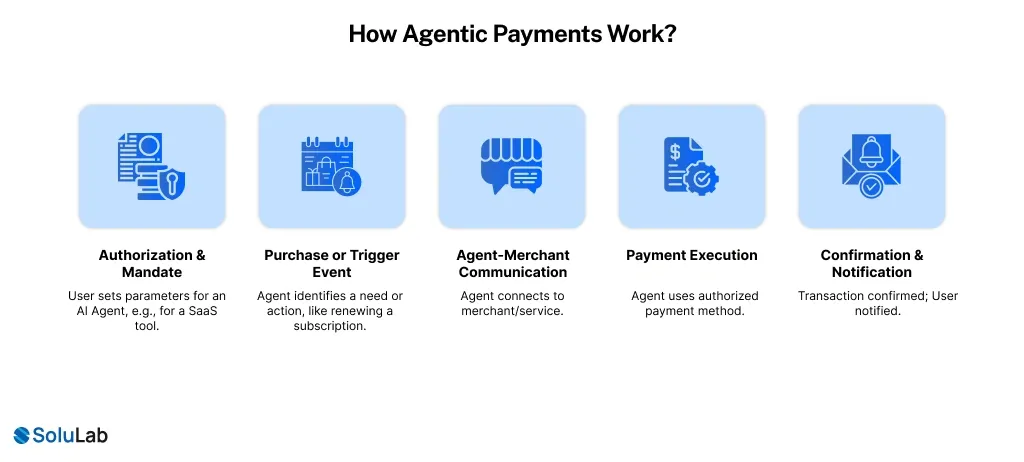
To understand the business impact, you need to understand how agentic payments work.
First, a business converts payment value, rights, or settlement units into digital tokens through blockchain-powered tokenization. These tokens can represent fiat-backed value, asset-backed value, credits, rewards, invoice claims, or usage-based payment units.
Next, businesses define rules for payment execution. An AI agent monitors events. It checks whether conditions are met. Then it initiates the right payment action automatically. This is where AI agents in payment processing add speed and operational precision.
For example:
- A marketplace agent releases seller funds when proof of delivery is verified
- A SaaS billing agent adjusts tokenized usage charges based on live consumption
- A trade finance agent settles partial payments when milestones are confirmed
- A treasury agent routes liquidity to the lowest-cost settlement path
That is the core promise of AI agent payment systems. They do not just move money. They make payment decisions within approved business logic.
When deployed well, these systems become a flexible Web3 payment system layer for enterprise operations, partner payouts, subscriptions, procurement, treasury, and embedded finance.

Why Legacy Payment Rails Limit Growth?
Most businesses still use payment stacks built for fixed workflows. Those stacks can process transactions, but they struggle to support dynamic revenue models.
Legacy systems create five growth problems.
1. Slow settlement blocks cash velocity
Delayed settlement slows reinvestment. It also weakens liquidity planning. A sales team may close a new business, but finance still waits days to access funds.
2. Manual intervention increases cost
Approval chains, exception handling, and fragmented reconciliation eat margin. Every manual step adds operational drag.
3. Limited monetization
With traditional systems, it becomes difficult to handle microtransactions, milestone payments, tokenized rewards, hybrid asset payments, or programmable B2B contracts.
4. Poor Visibility
Due to payment data being restricted across gateways, ERPs, wallets, and third-party tools, it becomes hard for businesses to see profit leakage in time and act to fix the issue.
5. Cross-border complexity reduces conversion
FX friction, intermediary fees, and settlement uncertainty often make international growth more expensive than it should be.
AI-powered payment infrastructure fixes all these issues as intelligent systems can learn, automate, and scale with the business model.
Read more – Natural Resource Tokenization Platform Development
The Direct Revenue Benefits of Tokenized Payment Solutions
The value of tokenized payment solutions shows up in revenue, margin, retention, and speed.
- Faster settlement improves working capital
Real-time tokenized payments reduce the time between transaction completion and usable capital. Faster access to capital helps businesses reinvest in growth, shorten billing cycles, and improve treasury efficiency.
- Lower transaction friction lifts conversion
When payment logic becomes programmable, businesses can simplify the checkout and payout experience. Less friction often leads to fewer drop-offs, better partner satisfaction, and stronger deal velocity.
- New business models become viable
A tokenized payment system for enterprises supports milestone billing, fractional settlement, automated usage-based billing, partner revenue sharing, tokenized loyalty, and machine-to-machine commerce. These are difficult to run on static infrastructure.
- Better automation protects margin
With secure tokenized payment infrastructure, businesses can automate approval, compliance, reconciliation, and fraud checks. That reduces overhead and protects revenue already won.
- Cross-border revenue becomes easier to capture
A tokenized system can reduce dependence on slow intermediaries and simplify global value transfer. This matters for enterprises expanding across regions, vendor networks, and digital ecosystems.
- Trust increases partner and customer retention
Programmable transparency changes business relationships. When vendors, distributors, and customers can verify payment logic and status in real time, disputes drop, and confidence rises.
These are the real benefits of tokenized payment systems. They do not sit only in the technology layer. They show up in financial outcomes.

Where Tokenization Unlocks the Business Revenue Growth?
The strongest growth stories usually come from tokenization use cases where payment speed, automation, and trust matter at the same time.
- B2B marketplaces
Marketplaces can automate escrow, commission distribution, returns logic, and milestone-based releases. That reduces disputes and makes supplier acquisition easier.
- SaaS and platform businesses
Usage billing, partner payouts, API monetization, and subscription adjustments become easier with tokenized digital payments linked to live usage data.
- Enterprise procurement
Procurement teams can automate vendor releases based on delivery, inspection, or contract performance. This lowers back-office pressure and improves supplier relationships.
- Logistics and supply chain
Carriers, brokers, and service partners can receive conditional payments tied to delivery confirmation, route compliance, or service milestones.
- Financial services and fintech
Treasury, lending, asset servicing, and cross-border settlement become more flexible when payment value is tokenized, and payment logic is agentic.
- Loyalty and ecosystem commerce
Businesses can issue tokenized incentives, credits, or rewards that work across products, partners, and marketplaces. That turns payments into retention infrastructure.
How to Strategically Roll Out Agentic Payment Infrastructure?
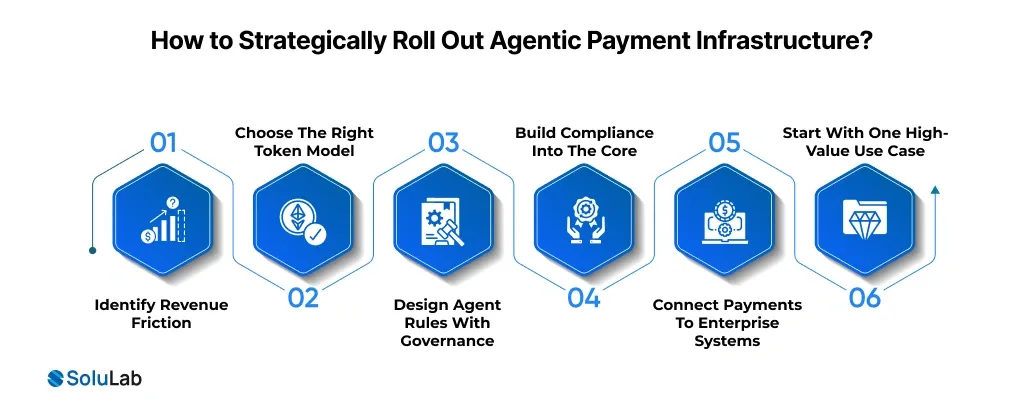
A strong rollout starts with payment architecture.
Identify revenue friction
Map where payment delays, failed transactions, reconciliation time, and payout complexity hurt revenue most.
Choose the right token model
Not every business needs the same token logic. Some need fiat-backed settlement tokens. Others need credits, utility tokens, or asset-linked structures.
Design agent rules with governance
Autonomy must stay aligned with policy. Define what agents can approve, route, escalate, or reject. Good governance makes agentic payment systems reliable at scale.
Build compliance into the core
A serious system must support auditability, identity checks, fraud monitoring, transaction controls, and reporting. Compliance cannot be an afterthought.
Connect payments to enterprise systems
Revenue impact grows when the payment layer connects with ERP, CRM, wallets, billing engines, inventory systems, and customer platforms.
Start with one high-value use case
Pilot one workflow with strong financial upside. Examples include vendor payouts, cross-border settlements, subscription billing, or milestone-based B2B invoicing.
To execute the process seamlessly, businesses require top RWA tokenization companies for deploying strong architecture, blockchain expertise, smart contract discipline, and business process design.
What a High-Performance Payment Stack Looks Like?
A revenue-focused payment stack should support:
- Programmable token issuance
- Smart contract settlement
- Wallet and custody integration
- Live policy enforcement
- AI-led routing and monitoring
- Fraud analytics
- Reconciliation dashboards
- Multi-chain or interoperable design where needed
Secure tokenized payment infrastructure supports these features and helps enterprises to move from fragmented payment operations to a unified system. It prepares the business for future commerce models. As digital ecosystems expand, payments will increasingly happen between platforms, machines, agents, suppliers, and users.
Conclusion
A tokenized agentic payment system does not replace strategy; it strengthens execution. It helps enterprises collect faster, pay smarter, reduce manual work, and create payment models that older rails cannot support. In business markets, that matters because buyers expect speed, vendors expect visibility, and finance teams expect tighter control. The companies that win will not only close more deals, but they will also settle faster, cut avoidable leakage, and turn payment operations into a source of trust and margin.
Thinking about the next move? SoluLab can help!
SoluLab helps enterprises design and build tokenized agentic payment systems that match their business goals. From tokenization strategy and smart contract architecture to wallet integration, compliance workflows, and AI-led payment automation, SoluLab supports businesses that want a practical path to faster settlement, lower friction, and stronger revenue control. For companies exploring a trusted RWA tokenization development company, SoluLab offers the kind of technical depth and business focus that complex payment transformation needs.
FAQs
Shipra Garg is a tech-focused content strategist and copywriter specializing in Web3, blockchain, and artificial intelligence. She has worked with startups and enterprise teams to craft high-conversion content that bridges deep tech with business impact. Her work translates complex innovations into clear, credible, and engaging narratives that drive growth and build trust in emerging tech markets.