Key Takeaways
- Stablecoin real estate transactions now enable property settlement within hours using atomic execution and on-chain escrow systems across regulated global markets.
- Regulatory frameworks like the GENIUS Act and MiCA ensure compliant, stablecoin real estate payments with real-time reserve verification and institutional-grade trust layers.
- Tokenization combined with stablecoins enables fractional ownership, unlocking liquidity and expanding access to global real estate investment opportunities.
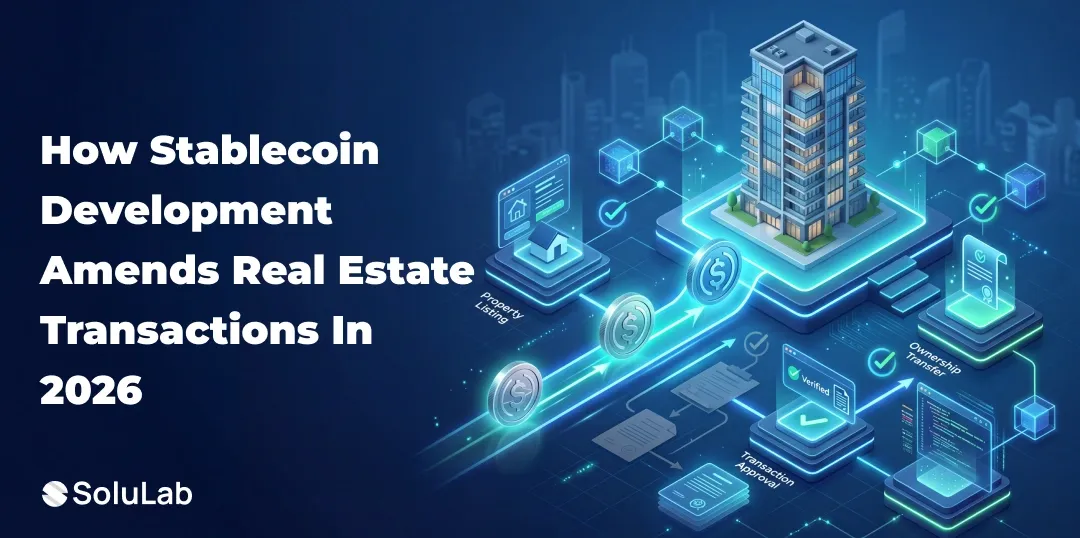
Real estate transactions are becoming faster, more structured, and globally accessible as digital infrastructure improves. Stablecoins are now part of this shift, acting as a reliable settlement layer for property deals. Unlike earlier adoption phases, 2026 reflects a more mature environment where regulation, institutional participation, and compliance standards are already in place.
- The global real estate tokenization market has reached $4.7 billion in 2026, with long-term projections pointing toward $24 billion by 2035.
- This is growing at an aggressive 21% CAGR.
- More importantly, stablecoins are now actively used in high-value property transactions, not just as an experimental payment method.
This shift is supported by, including regulatory alignment, security improvements, and institutional collaborations that are shaping how stablecoin property transactions are executed today.
Stablecoin Development: Powering the 2026 Real Estate Economy
By March 2026, the convergence of real estate tokenization and regulated stablecoin development has moved from experimental pilots into the core of global institutional infrastructure.
The total value locked (TVL) in tokenized Real-World Assets (RWAs) exceeded $26.4 billion as of early 2026. Stablecoins are also now the primary settlement layer for property deals.
1. Key Market Indicators (Q1 2026)
- $24 Billion+ TVL: Total value locked in tokenized real-world assets.
- 65% Adoption Rate: Percentage of RWA platforms utilizing the ERC-3643 (T-REX) standard for automated compliance.
- < 24 Hour Closings: Property settlement timelines have dropped from 30–60 days to under a single day in compliant jurisdictions.
The current year marks a definitive shift in how the industry views digital liquidity. Stablecoin development is no longer focused solely on “speed” but on the quality and auditability of the transactions.
What Defines This 2026 Infrastructure?
- Primary Settlement Layers: Stablecoins are now the default for cross-border real estate tokenization projects, bypassing the traditional 3-5 day bank wire delays.
- 24/7 Market Operations: Unlike legacy banking systems, stablecoin payments for property deposits or rental distributions run around the clock, independent of banking holidays.
- Fee Compression: Using blockchain-based settlement layers, transaction costs have been reduced to below 1%, compared to the 3-6% often seen in traditional international property acquisitions.
- Legal Parity: New federal frameworks, such as the GENIUS Act, have given stablecoin settlements the same legal standing as traditional wire transfers.
2. Solving Traditional Pain Points with Stablecoin Innovation
Conventional real estate is often stalled by “The Three Horsemen of Inefficiency”: Delay, Cost, and Opacity. Stablecoin solutions address these by replacing manual verification with automated code.
3. Eliminating Counterparty Risk via Atomic Settlement
In the traditional model, a buyer sends money and hopes the deed follows days later. In 2026, stablecoin development has popularized “Atomic Settlement.” This ensures that the digital deed and the stablecoin payments exchange hands simultaneously. If one part of the transaction fails, the entire deal reverts, ensuring neither party is left empty-handed.
4. Automated Compliance and Global Accessibility
One of the biggest hurdles in real estate tokenization was ensuring that global investors met local KYC/AML laws. By March 2026, platforms will have integrated compliance directly into the token.
- ERC-3643 (T-REX) Standard: This protocol automatically blocks the transfer of property tokens to any wallet that hasn’t been verified by a recognized identity provider.
- Fractional Liquidity: Stablecoins allow an investor in London to buy a $500 share of a commercial building in Tokyo instantly, with dividends paid out daily in a USD-pegged token.
5. The Trump Organization and Global Political Shifts Shaping Stablecoin Real Estate Transactions
The Maldives Tokenization Project (February 2026): In a landmark deal, WLFI, co-founded by the Trump family, partnered with Securitize (backed by BlackRock). This is to tokenize the Trump International Hotel & Resort in the Maldives.
The Saudi project, developed alongside Saudi Arabia’s Dar Global, allows accredited investors to buy tokens representing loan revenue interests. It marks a shift from traditional private equity to a model where global capital can fund luxury hospitality developments via the blockchain.
U.S. “Crypto Capital” Policy: Since January 2025, the administration has pushed an executive order to make the U.S. the “crypto capital of the world.” This has led to the “Project Crypto” initiative at the SEC, moving away from enforcement and toward a clear taxonomy for digital assets.
Benefits of Stablecoin Development Solutions in Real Estate Financial Transaction
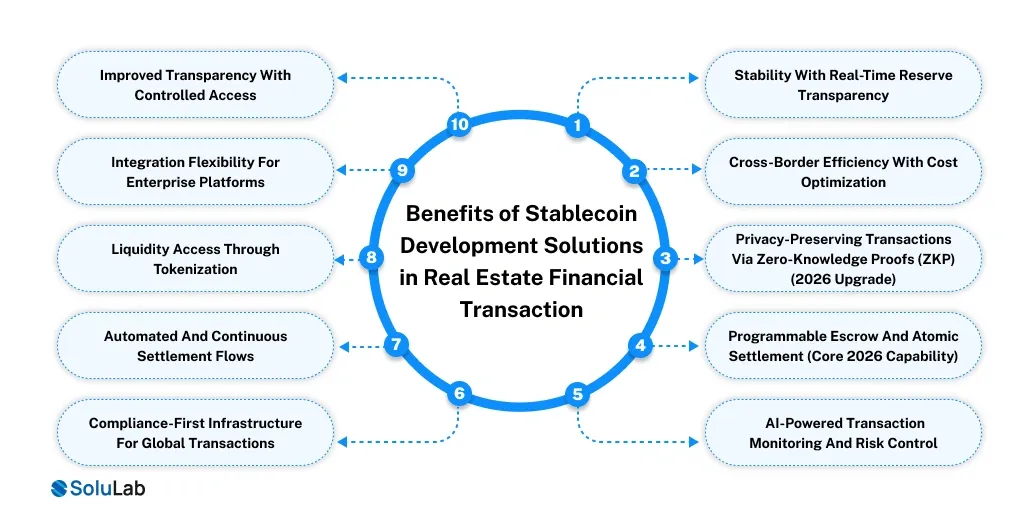
Stablecoin real estate transactions are no longer just about faster payments. In 2026, they are part of a structured system that combines compliance, automation, and intelligent transaction execution.
Stablecoin development solutions now integrate privacy layers, programmable settlement logic, and AI-driven validation, making blockchain real estate transactions more reliable for enterprises and institutional investors.
1. Stability with Real-Time Reserve Transparency
In stablecoin property transactions, price predictability remains critical. However, what changed in 2026 is how stability is verified.
- Stablecoins now provide real-time proof of reserves, not just periodic audits
- Enterprises prefer fully backed, regulated tokens for large property deals
- Buyers and sellers can lock in deal values without exposure to volatility
Where it matters:
- High-value residential deals
- Commercial property acquisitions
- Cross-border real estate payments using stablecoins
This makes stablecoin real estate settlement more dependable for long transaction cycles.
2. Cross-Border Efficiency with Cost Optimization
Traditional international property payments involve multiple intermediaries, delays, and high fees.
With blockchain-based property payments:
- Transactions settle within minutes or hours
- Fees are reduced to below 1% in most cases
- No dependency on SWIFT or banking windows
Typical cost comparison:
- Traditional cross-border transfer: 3%–6%
- Stablecoin real estate payments: ~0.2%–1%
This directly improves ROI for developers and investors handling global deals.
3. Privacy-Preserving Transactions via Zero-Knowledge Proofs (ZKP) (2026 Upgrade)
A key advancement in stablecoins in real estate is the use of Zero-Knowledge Proofs (ZKP).
- Buyers can prove they hold required funds (e.g., $2M USDC)
- No need to expose full wallet history
- Sensitive financial and identity data stays protected
Enterprise relevance:
- High-net-worth individuals
- Institutional investors
- Cross-border regulatory environments
This balances transparency with privacy in blockchain real estate transactions, which was a major limitation earlier.
4. Programmable Escrow and Atomic Settlement (Core 2026 Capability)
One of the most important upgrades in smart contracts in real estate is atomic settlement.
How it works:
- Property ownership transfer and payment occur simultaneously
- If one condition fails, the entire transaction is reversed
On-chain escrow for real estate:
- Funds are locked in smart contracts
- Released only when:
- Title verification is complete
- Legal checks are approved
- Conditions are digitally validated
Institutional usage:
Platforms like Securitize use this for automated settlements.
Cost insight:
- Traditional escrow services: $2,000–$10,000 per deal
- On-chain escrow: significantly lower, depending on network fees
This reduces dependency on intermediaries and improves trust in stablecoin property transactions.
5. AI-Powered Transaction Monitoring and Risk Control
Modern stablecoin development solutions now include AI-driven layers to improve transaction reliability.
Key capabilities:
- Fraud detection using behavioral analysis
- Real-time anomaly detection in payments
- Automated compliance checks (KYC/AML validation)
- Smart contract risk scoring before execution
Use cases in real estate payments using stablecoins:
- Identifying suspicious wallet activity
- Preventing unauthorized token transfers
- Monitoring large-value transactions
AI integration ensures blockchain-based property payments remain secure at scale.
6. Compliance-First Infrastructure for Global Transactions
Stablecoin compliance in property transactions is now built into the system itself.
What has changed:
- Wallet-level KYC enforcement
- Region-based transaction restrictions
- Integration with standards like ERC-3643 (T-REX)
Benefits:
- Prevents transfers to unverified participants
- Ensures legal ownership tracking
- Simplifies cross-border regulatory compliance
This makes stablecoin real estate transactions viable for regulated markets like the US and EU.
7. Automated and Continuous Settlement Flows
Stablecoin development enables continuous financial operations in real estate.
Examples:
- Instant property settlement after verification
- Automated rental income distribution
- Scheduled mortgage payments using stablecoins
Smart contract escrow ensures:
- No delays
- No manual approvals
- Transparent execution
This improves operational efficiency in blockchain-powered real estate systems.
8. Liquidity Access through Tokenization
Stablecoins play a key role in enabling fractional real estate investment.
How it works:
- Properties are tokenized into smaller units
- Investors can buy shares using stablecoins
- Returns are distributed automatically
Benefits:
- Unlocks liquidity in traditionally illiquid assets
- Allows smaller investors to participate
- Enables faster capital rotation for developers
This strengthens real-world asset (RWA) transactions and expands market participation.
9. Integration Flexibility for Enterprise Platforms
Stablecoin development solutions are designed to integrate with existing systems.
Key integrations:
- Payment gateways
- Property management systems
- Legal and compliance platforms
- Banking and custody solutions
Estimated implementation cost range:
- Basic integration: $20,000–$30,000
- Enterprise-grade platform: $30,000–$50,000+
This allows businesses to adopt blockchain infrastructure without rebuilding their entire system.
10. Improved Transparency with Controlled Access
Transparency remains a core advantage, but in 2026 it is more controlled.
- Transaction records are immutable
- Access is permissioned based on roles
- Regulators and stakeholders can verify data when needed
This builds trust while maintaining privacy in stablecoin real estate payments.
How Does Stablecoin Development Help Safeguard Real Estate Investments Against Inflation?
Stablecoins are a powerful tool for protecting real estate investments from inflationary pressures while maintaining flexibility and control over assets.
- Hedging Against Inflation: Stablecoins pegged to stable assets provide a reliable store of value during inflationary periods. By converting real estate profits into stablecoins, investors can protect their returns from local currency devaluation while maintaining the flexibility to reinvest quickly when opportunities arise.
- Preserving Value: The stable nature of these digital assets helps maintain the purchasing power of real estate investments. Unlike traditional fiat currencies that may lose value over time, properly backed stablecoins maintain their worth, providing a reliable medium for storing real estate value.
- Facilitating Quick Transactions: When market conditions change, stablecoins enable investors to move quickly. Whether it’s taking advantage of new opportunities or protecting assets during market downturns, the speed of stablecoin transactions gives investors unprecedented agility.
- Integration with Tokenized Real Estate: The combination of stablecoins and tokenized real estate creates new opportunities for portfolio diversification. Investors can easily rebalance their holdings and maintain optimal exposure to different property types and markets.
Top-Performing Stablecoin Tokens in the 2026 Market
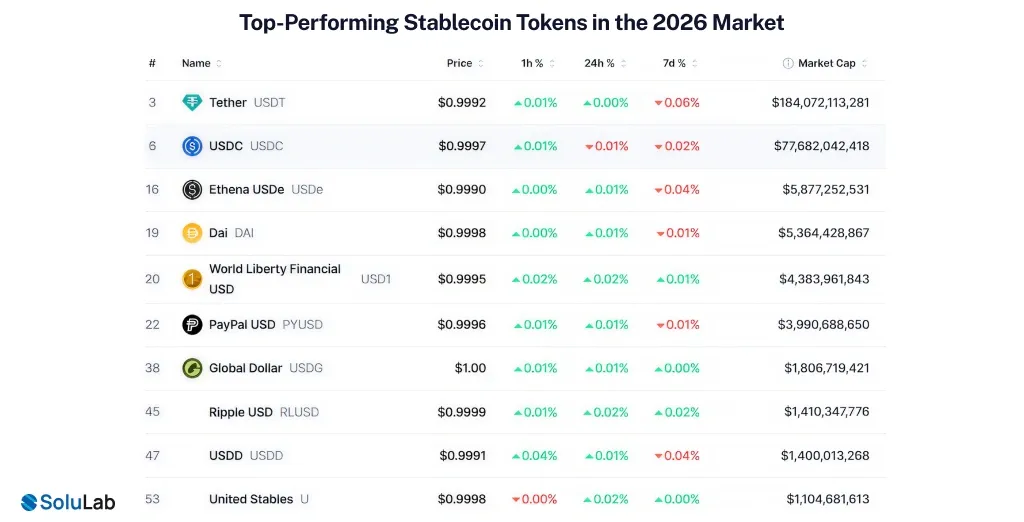
The real estate market has embraced several reliable stablecoin options, each offering unique advantages for property transactions and investment management.
- USDT (Tether): As the most used stablecoin, Tether offers high liquidity and broad market acceptance. Its extensive trading pairs make it particularly useful for international real estate transactions, though users should stay informed about its reserve backing. Additionally, the growing popularity of cryptocurrency coin options like Tether is shaping the future of cross-border transactions.
- USDC (USD Coin): Known for its strong regulatory compliance and transparent backing, USDC has gained significant trust in real estate circles. Its regular audits and institutional backing make it a preferred choice for large property transactions.
- DAI (Dai): This decentralized stablecoin offers unique advantages through its crypto-collateralized structure. Its stability mechanism makes it particularly attractive for smart contract-based real estate transactions.
- BSC-USD (Binance Peg): Operating on the Binance Smart Chain, this stablecoin offers low transaction fees and fast settlement times, making it popular for smaller real estate transactions and rental payments.y
- USDE (Ethena): A newer entrant to the market, USDE is gaining attention for its innovative stability mechanism and focus on institutional use cases in real estate.
Conclusion
The integration of stablecoins into real estate transactions is significant in property markets. These digital assets address many traditional pain points while showing new possibilities for investment and management. As technology improves and grows every day, we can expect stablecoins to become an integral part of real estate finance.
As more real estate professionals recognize the efficiency and security benefits of stablecoin solutions. While challenges remain, particularly around regulation and standardization, the advantages of stablecoins in real estate are too significant to ignore.
When Crypto Mining, an e-commerce platform for mining hardware, wanted to simplify global transactions and improve accessibility, SoluLab a Stablecoin development company helped them develop a blockchain-based marketplace powered by smart contracts, ensuring secure, transparent, and fast transactions. By automating processes and reducing intermediaries, we helped them create a user-friendly platform that connects miners worldwide with top-notch security and minimal costs.
FAQs
Shipra Garg is a tech-focused content strategist and copywriter specializing in Web3, blockchain, and artificial intelligence. She has worked with startups and enterprise teams to craft high-conversion content that bridges deep tech with business impact. Her work translates complex innovations into clear, credible, and engaging narratives that drive growth and build trust in emerging tech markets.