We all know that the global stablecoin market capitalization has crossed $300 billion and is expected to grow as banks, fintech platforms, and payment companies enter the space.
But here’s the shift.
Launching a stablecoin today is not just about smart contracts or blockchain selection. It is about where you launch it. Different countries now offer very different regulatory environments. Some enable fast innovation. Others create heavy compliance barriers.
For any business exploring stablecoin development for fintech companies or payment platforms, choosing the right jurisdiction can define success or failure.
Key Takeaways
- Stablecoin success today depends more on regulatory clarity than technology.
- Countries like EU, Singapore, and Hong Kong are leading with clear frameworks and licensing.
- Enterprise-grade stablecoin development requires a compliance-first architecture, and costs vary depending on regulatory and infrastructure complexity.
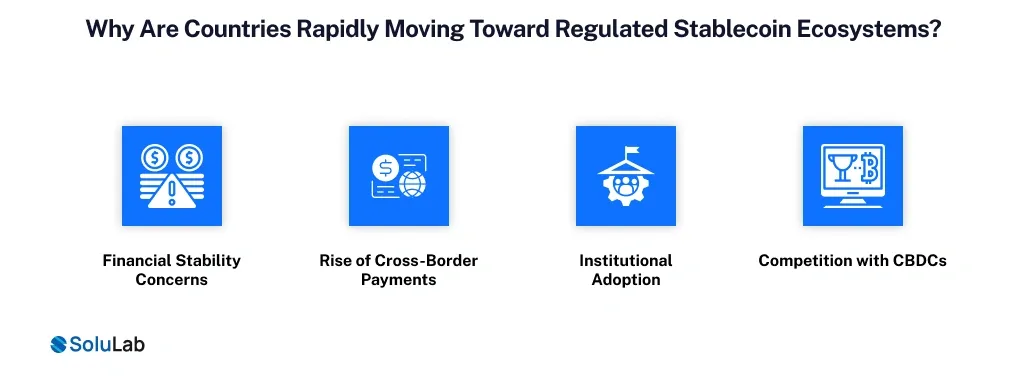
Why Are Countries Rapidly Moving Toward Regulated Stablecoin Ecosystems?
Governments have realized that stablecoins are not just crypto assets. They are digital money infrastructure.
This has pushed regulators to act quickly.
Key Drivers Behind Regulation
1. Financial Stability Concerns
Unregulated stablecoins can impact monetary systems. Governments want reserve transparency and risk control.
2. Rise of Cross-Border Payments
Stablecoins are being used for remittance platforms and global payments, reducing costs by up to 60–80% compared to traditional systems.
3. Institutional Adoption
Banks and enterprises are entering the space. They require legal clarity to operate at scale.
4. Competition with CBDCs
Countries are balancing private stablecoins alongside Central Bank Digital Currencies.
Read Also: How CBDC is Transforming Global Economies?
Market Insight
- The global stablecoin transaction volume crossed $10 trillion annually (2025)
- Over 70% of financial institutions are exploring stablecoin payment solutions
- Regulatory clarity is now the top factor influencing adoption

What Makes a Jurisdiction Ideal for Stablecoin Development and Compliance?
Not all countries are equal when it comes to launching a stablecoin legally. Before choosing a jurisdiction, businesses must evaluate key factors:
Key Evaluation Criteria
1. Licensing Clarity
Clear guidelines for stablecoin issuance, custody, and operations.
2. Reserve Requirements
Rules on asset backing, audits, and transparency.
3. Compliance Complexity
KYC, AML, and reporting requirements.
4. Time to Market
Some jurisdictions allow launches in 3–6 months, others take over a year.
5. Cross-Border Usability
Ability to support global payments and remittances.
Comparison Table: What Matters Most
| Factor | High-Value Jurisdictions | Low-Clarity Jurisdictions |
| Licensing | Clearly defined | Unclear or evolving |
| Time to Launch | 3–9 months | 9–18 months |
| Compliance Cost | Moderate | High due to uncertainty |
| Investor Confidence | High | Low |
| Scalability | Global-ready | Limited |
Which Top 5 Countries Are Emerging as Global Leaders in Stablecoin Regulation?
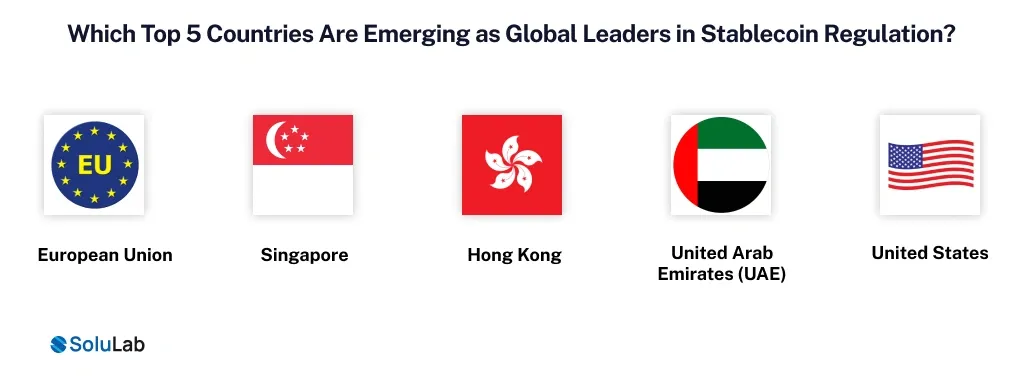
Here are the best countries to launch a stablecoin based on regulatory frameworks, business environment, and scalability.
1. European Union (MiCA Framework)
Why It Stands Out
The EU introduced MiCA (Markets in Crypto-Assets Regulation), one of the most comprehensive stablecoin regulatory frameworks globally, accelerating the adoption and development of MiCA-compliant stablecoin platforms.
Key Highlights
- Mandatory licensing for issuers
- Strict reserve backing rules
- Passporting across EU countries
Best For
Fintech companies targeting multi-country expansion
Challenge
Higher compliance costs and reporting requirements
2. Singapore
Why It Stands Out
Singapore is known for its balanced regulatory approach under the Monetary Authority of Singapore (MAS).
Key Highlights
- Clear stablecoin licensing structure
- Strong fintech ecosystem
- Fast approval timelines
Best For
Payment platforms and remittance solutions
Challenge
Strict compliance expectations
Read Also: MAS Tokenized Treasury Bills
3. Hong Kong
Why It Stands Out
Hong Kong stablecoin regulation is evolving rapidly with a focus on becoming a global crypto hub.
Key Highlights
- Stablecoin licensing regime under development
- Strong support for Web3 and fintech
- Access to Asian markets
Best For
Companies targeting Asia-Pacific expansion
4. United Arab Emirates (UAE)
Why It Stands Out
The UAE is rapidly shaping its crypto regulatory landscape through frameworks led by VARA and ADGM, fostering the growth of UAE-backed stablecoin (dirham-backed) ecosystems.
Key Highlights
- Business-friendly licensing
- Faster setup processes
- Strong support for digital asset innovation
Best For
Startups and enterprises looking for quick market entry
5. United States (Emerging Frameworks)
Why It Stands Out
Despite regulatory complexity, the US remains a major market.
Key Highlights
- Ongoing stablecoin bills
- High institutional demand
- Strong fintech infrastructure
Challenge
Fragmented regulatory environment across states
How to Choose the Right Country for Stablecoin Development and Launch?
The cost of stablecoin development for enterprises in 2026 has stabilized, as white-label infrastructure has emerged. While a full-scale global ecosystem remains a major investment, the entry point for a secure, regulated pilot is more manageable than your initial figures suggest.
Updated Enterprise Cost Breakdown (2026)
| Level | Estimated Cost | Scope |
| Enterprise Pilot (PoC) | $30K – $40K | Single-chain, limited whitelist, basic smart contract. |
| Standard Regulated Launch | $70K – $130K | Multi-chain, MiCA/UAE compliant, integrated KYC & Audit. |
| Full Global Ecosystem | $200K+ | Real-time reserve attestations, custom banking rails, 24/7 liquidity. |
1. The European Union (MiCA) – The “Gold Standard.”
With MiCA now fully implemented, the EU is the destination for enterprises seeking maximum scalability. Once licensed in one member state (like France or Luxembourg), you can “passport” your stablecoin across all 27 EU countries.
- Best for: Banks and large fintechs targeting the 450M+ European consumer market.
- Trade-off: High capital reserve requirements and strict “E-Money Token” (EMT) rules.
2. United Arab Emirates (VARA & ADGM) – The “Innovation Fast-Track.”
The UAE remains the most agile jurisdiction. Dubai’s VARA provides a “modular” licensing approach, allowing you to pay only for the specific activities you perform (e.g., just issuance, or issuance + custody).
- Best for: Global payment platforms and startups needing rapid time-to-market.
- Trade-off: Excellent for MENA and Asia, but may face “offshore” scrutiny in the US/EU.
3. Singapore (MAS) – The “Trusted Bridge.”
Singapore’s MAS framework is notoriously selective, focusing on “High-Standard” stablecoins. It is the preferred hub for connecting Western capital with Asian liquidity.
- Best for: Cross-border B2B settlement and Treasury management.
- Trade-off: Intense scrutiny on AML/CFT and technical “white-box” audits.
Making the Decision
If your primary goal is long-term institutional trust, the EU or Singapore is your best bet despite the higher initial “paperwork” burden. If your priority is operational flexibility and lower tax friction, the UAE is the 2026 market leader.

Conclusion
It is no longer about who builds first. It is about who builds right.
Regulatory frameworks are shaping the future of digital payments, remittance platforms, and financial infrastructure.
Businesses that align with the right jurisdiction early will gain:
- Faster approvals
- Higher trust
- Better scalability
Launching a stablecoin development solution today requires more than technical execution. It requires a compliance-first strategy backed by the right development partner. Contact SoluLab for the latest stablecoin development solutions.
FAQs
Deepika is a content writer who blends storytelling with strategic thinking. She explores topics across digital innovation, emerging tech, and the evolving blockchain industry. She enjoys breaking down complex ideas into simple, engaging narratives in the growing global markets.