Key Takeaways
- Energy-backed stablecoins connect digital liquidity with real renewable infrastructure and measurable ESG value.
- Enterprises can reduce settlement costs while improving treasury efficiency and sustainability reporting.
- Renewable energy RWAs create yield opportunities through green bonds, energy receivables, and carbon-linked reserves.
- AI, smart contracts, and IoT make green stablecoin platforms more transparent, scalable, and audit-ready.
Instead of relying only on fiat reserves, the stablecoin platforms link digital tokens to tangible energy-linked assets such as
- solar production contracts,
- renewable energy credits,
- tokenized green bonds, carbon offsets, and
- power purchase agreements.
This creates a stronger connection between digital finance and real-world utility. A modern green stablecoin platform does more than issue tokens. It helps enterprises:
- unlock liquidity from renewable infrastructure,
- improve cross-border settlements,
- create transparent ESG reporting,
- generate yield from real-world assets,
- attract institutional investors seeking sustainable exposure.
Projects like Tether, Circle, MakerDAO, and KlimaDAO have already shown how asset-backed digital instruments can reshape finance. The next wave is moving toward sustainable collateral models.
For enterprises entering this space, the opportunity is not just innovation. It is operational efficiency, ESG positioning, and long-term financial resilience.
What Makes an Energy-Backed Stablecoin Different From Traditional Stablecoins?
Traditional stablecoin development is usually backed by:
- fiat reserves,
- treasury bills,
- overcollateralized crypto assets.
An energy-backed stablecoin introduces real-world sustainability-linked collateral. This matters because institutional confidence in asset-backed digital finance is growing fast.
According to recent market estimates, the global stablecoin supply crossed $220 billion in early 2026, and DefiLlama’s tracker puts USD-pegged supply near $313 billion by late September 2026, with enterprise usage increasingly shifting toward transparent reserve models and real-world asset-backed structures.
1. Renewable energy production receivables
These are future revenues generated from:
- solar farms,
- wind plants,
- battery storage systems.
Enterprises can tokenize predictable cash flows from electricity sales.
2. Renewable Energy Certificates (RECs)
RECs represent proof that power came from clean sources.
Benefits:
- tradable ESG value,
- measurable sustainability metrics,
- transparent reserve validation.
3. Carbon credits and offsets
A carbon-backed stablecoin may use:
- verified carbon credits,
- emissions reduction certificates.
This helps businesses build green treasury products.
4. Green bonds and infrastructure debt
Tokenized green bonds provide:
- yield generation,
- predictable returns,
- institutional confidence.
In short, what was once a passive reserve instrument is now becoming a strategic treasury tool. The enterprises that adopt energy-linked stablecoins early can improve liquidity management, lower operational friction, and position themselves as leaders in sustainable digital finance.
How Can a Green Stablecoin Platform Support Enterprise Sustainable Finance Goals?
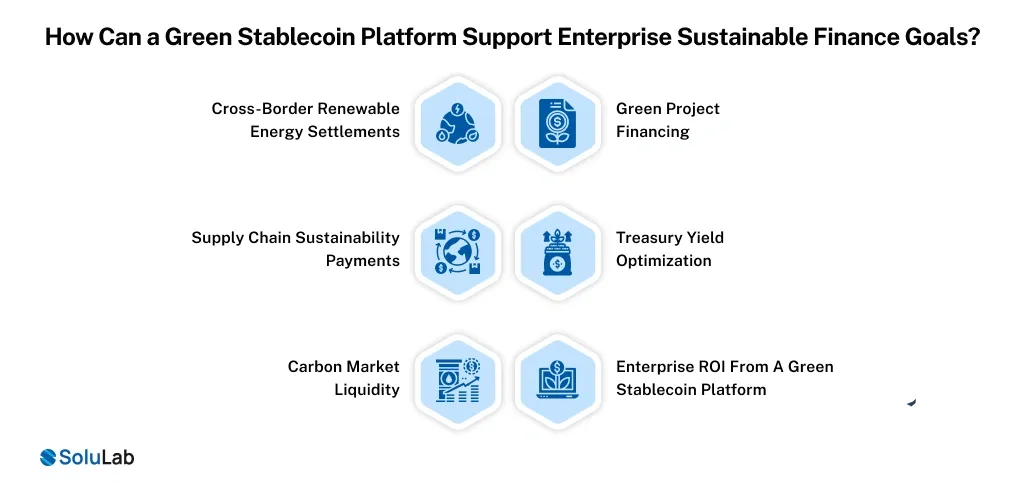
A robust green stablecoin platform should be built to support real enterprise finance operations, not just token transfers. In 2026, businesses need systems that improve cash flow, simplify compliance, and create measurable ESG value across treasury, supply chain, and capital markets.
1. Cross-Border Renewable Energy Settlements
Energy companies operating across regions often deal with slow settlement cycles, multiple intermediaries, and foreign exchange risks. A green stablecoin development enables near-instant transfers and faster financial reconciliation.
2. Supply Chain Sustainability Payments
Manufacturers and enterprise buyers can use smart contracts to release payments based on sustainability milestones, supplier performance, or delivery verification, reducing delays and improving trust.
3. Carbon Market Liquidity
Carbon credit markets remain fragmented across registries and jurisdictions. Stablecoins improve transaction speed, settlement certainty, and transparency for enterprises buying or trading offsets.
4. Green Project Financing
Enterprises can tokenize solar projects, battery systems, EV infrastructure, or clean energy receivables to raise capital faster and attract ESG-focused investors.
5. Treasury Yield Optimization
A yield-bearing green stablecoin allows treasury teams to earn returns on reserves while maintaining liquidity, reducing idle capital, and improving capital efficiency.
6. Enterprise ROI From a Green Stablecoin Platform
A well-designed platform creates measurable financial and operational benefits for enterprises.
| Business Area | Enterprise Impact | Typical 2026 ROI Outcome |
| Cross-border settlements | Faster payments and lower banking dependency | 30–50% lower transaction costs |
| Working capital | Reduced idle reserves and better cash flow cycles | 15–25% higher liquidity efficiency |
| ESG reporting | Real-time reserve and sustainability visibility | Faster audit and compliance readiness |
| Supply chain finance | Automated milestone-based supplier payouts | Reduced payment disputes and delays |
| Treasury yield | Returns from renewable-backed reserves | New passive income opportunities |
| Investor positioning | Stronger sustainable finance narrative | Better ESG investor confidence |
For CFOs, treasury teams, and sustainability leaders, this is more than a technology upgrade. A green stablecoin platform becomes a practical financial infrastructure layer that improves efficiency, supports ESG goals, and strengthens long-term capital strategy.

Why is an ESG stablecoin Becoming Important for Institutional Treasury and Compliance?
An ESG stablecoin is no longer a niche idea. It is becoming part of enterprise sustainability and treasury transformation.
1. ESG reporting pressure is increasing
Public companies now face:
- stricter sustainability disclosures,
- investor scrutiny,
- Scope 3 visibility expectations.
Blockchain-based ESG stablecoins improve:
- auditability,
- reporting transparency,
- reserve traceability.
2. Green capital is growing
Global sustainable finance markets continue expanding.
Institutional investors increasingly prefer:
- low-risk yield products,
- sustainable digital assets,
- real-world asset exposure.
3. Regulatory clarity is improving
In 2026, regulators are placing stronger emphasis on:
- reserve transparency,
- AML compliance,
- issuer accountability.
A compliant stablecoin platform should include:
- KYC/AML modules,
- reserve attestation,
- audit logs,
- jurisdiction controls.
4. Demand for sustainable DeFi products
Enterprises want:
- on-chain treasury tools,
- programmable liquidity,
- green yield opportunities.
This supports:
- RWA stablecoin yield
- green bond tokenization
- sustainable finance DeFi
5. AI + ESG intelligence
AI integration improves platform performance by:
- monitoring reserve health,
- forecasting redemption patterns,
- detecting fraud,
- tracking carbon metrics.
This creates smarter treasury management.
How Does a Renewable Energy RWA Token Model Work in Real-World Energy Markets?
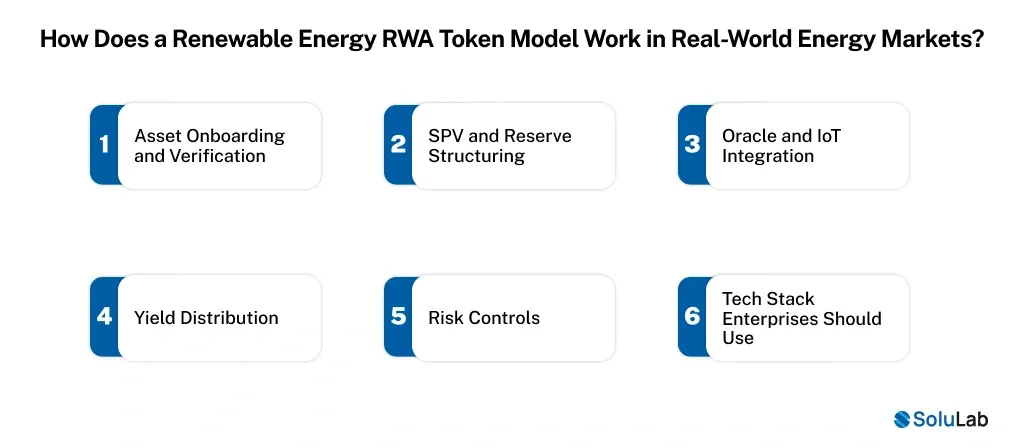
Building a renewable energy RWA token platform requires more than blockchain deployment. It demands structured legal ownership, live asset validation, risk controls, and enterprise-grade financial architecture. Also, stablecoin platform development cost depends on the features you integrate fr that you need a high-end, experienced partnership.
1. Asset Onboarding and Verification
The first step is identifying and validating eligible clean energy assets that can support the token’s reserve and long-term financial sustainability.
Enterprises typically assess:
- energy assets,
- generation contracts,
- ESG certificates.
Key requirements include:
- legal ownership verification,
- valuation,
- due diligence.
2. SPV and Reserve Structuring
A secure reserve structure is essential to separate token liabilities from business risk and ensure trust for investors, auditors, and regulators.
Assets are usually held through:
- SPVs,
- trustee structures,
- regulated custody layers.
This helps ensure:
- reserve segregation,
- investor confidence.
Smart Contract Issuance
The token issuance layer must support secure minting, redemptions, reserve controls, and compliance workflows without compromising transparency or scalability.
The platform creates:
- mint/redeem contracts,
- reserve ratio controls,
- oracle integrations.
3. Oracle and IoT Integration
Live energy data is critical to maintain reserve accuracy, support audits, and ensure token backing reflects real-world asset performance.
Green energy tokenization platforms need real-time data from:
- smart meters,
- grid APIs,
- IoT sensors.
This enables:
- production verification,
- reserve adjustments,
- ESG tracking.
4. Yield Distribution
A well-structured yield layer helps enterprises improve reserve efficiency while offering transparent returns linked to underlying renewable assets.
Enterprises can create:
- yield-sharing pools,
- treasury staking mechanisms,
- protocol incentives.
5. Risk Controls
Enterprise-grade security and governance controls are essential to protect reserves, manage volatility, and reduce financial or technical risks.
A secure architecture must include:
- reserve stress testing,
- redemption limits,
- smart contract audits,
- cyber monitoring.
6. Tech Stack Enterprises Should Use
The right technology stack determines platform performance, compliance readiness, operational scalability, and long-term ecosystem interoperability.
Recommended components:
- EVM chains for smart contracts,
- Layer 2 scaling,
- MPC wallet custody,
- tokenized reserve ledgers,
- AI fraud monitoring.
This is where experienced blockchain developers for hire become critical for successful deployment.

Conclusion
Building an energy-backed stablecoin platform in 2026 takes far more than launching a token. Enterprises need secure blockchain infrastructure, compliant reserve management, ESG reporting, AI-based monitoring, and seamless integrations with banking and treasury systems. That is why choosing the right development partner matters.
As a trusted stablecoin platform development company, SoluLab helps enterprises build future-ready stablecoin platforms with:
- secure smart contract and mint/burn architecture
- reserve and custody management systems
- ESG reporting and compliance workflows
- DeFi integrations and yield models
- AI-powered fraud and treasury monitoring
If you are planning to launch a sustainable stablecoin platform, now is the right time to build with experts. Connect with SoluLab to explore the latest solutions for secure, scalable, and enterprise-ready stablecoin development.
FAQs
Deepika is a content writer who blends storytelling with strategic thinking. She explores topics across digital innovation, emerging tech, and the evolving blockchain industry. She enjoys breaking down complex ideas into simple, engaging narratives in the growing global markets.