Key Takeaways
- The problem: Large language models are expensive to run, slow to answer, and hungry for infrastructure. For most enterprises that means AI rollouts drag, and scaling them in resource-constrained, real-world settings gets hard fast.
- The solution: Small Language Models are quicker, cheaper, and built for a specific job. They can run on the device itself, go live sooner, and give you tighter control over your data, performance, and scale.
- How SoluLab helps: SoluLab is AI-native, so AI already runs through how we work. We use that to help businesses build lean SLM and LLM solutions faster, spend less on development, and ship AI systems that scale and fit the job they were built for.
Small language models (SLMs) are quietly changing how businesses think about AI. They give you a leaner, more scalable alternative to large language models.
No giant server farm. No eye-watering compute bill. SLMs deliver targeted artificial intelligence for narrow jobs like chat, summarization, and classification, and they do those jobs well.
That makes them a natural fit for real-time apps, on-device processing, and anywhere privacy is non-negotiable. And as enterprises chase lower costs and shorter release cycles, SLMs have become the practical pick for AI-powered products.
Below, we cover what small language models actually are, why they pay off, which ones you can use today, and how enterprises are putting them to work in 2026 to run smarter, faster, leaner operations.
What Are Small Language Models (SLMs)?
Small Language Models (SLMs) are AI models that read and write human language, just like large language models (LLMs) do. The difference? They get there with far fewer parameters, less data, and a fraction of the compute. The global small language model market size is projected to reach USD 20,707.7 million by 2030.
Because they are smaller and trained on tighter, higher-quality data, small models can run faster and cheaper than large language models. Most teams point them at one job and one job only: answering customer questions about a single product, say, or summarizing sales calls, or drafting marketing emails.
So a few topic-specific small models dropped into your architecture can lift accuracy and cut cost and effort at the same time.
Key Characteristics of SLMs:
- Fewer Parameters: Usually somewhere between a few million and a few billion parameters. That is tiny next to an LLM.
- Lower Compute Requirements: They run on edge hardware, think smartphones, laptops, or embedded systems, with no heavy infrastructure behind them.
- Faster Inference: Answers come back quicker, which is exactly what chatbots and assistants need.
- Task-Specific Optimization: Many are fine-tuned for one domain, like healthcare, finance, or customer support.
Cost Efficiency: Less training data, less infrastructure, and so a smaller bill for both development and deployment.
When Should You Use Small Language Models Instead of LLMs?
An SLM won’t replace a large model every time. But for plenty of real-world projects it is the faster, cheaper, more sensible route to targeted AI applications. Here is when to reach for one.
- When You Need On-Device Processing: If your app has to live on a smartphone, an IoT device, or an edge system, and can’t count on the cloud or a steady internet connection, an SLM is the obvious choice.
- When Cost Optimization Is Critical: Tight budget? SLMs need far less compute, storage, and infrastructure than a large language model does to deploy and keep running.
- When You Need Faster Response Times: Chatbots and assistants live or die on latency. Users expect an instant reply, and SLMs are built to give one.
- When Tasks Are Domain-Specific: When the app only has to understand one field, healthcare or finance for example, a smaller fine-tuned model often gets you accurate results without the overhead.
- When Data Availability Is Limited: SLMs do well on smaller, curated datasets. That matters when large-scale training data simply doesn’t exist for your problem, or privacy rules keep it locked away.
- When Privacy and Security Matter: Run the model locally and sensitive user data never leaves the device. Fewer trips to external servers or cloud AI means fewer chances for something to leak.
- When You Need Faster Development Cycles: Training and deployment are quicker, so your team can test an idea, throw it away, and try again without waiting months. AI features reach the market sooner.
Why are Small Language Models Required?
Large Language Models get most of the attention in AI, and fair enough. They generate text, translate languages, and produce creative writing remarkably well, and all of that is thoroughly documented. Small Language Models are a newer class of AI models, and they have been gaining ground with a lot less noise. Are they as powerful as the top models in each category? No. But they bring a specific set of advantages that make them useful across a huge range of applications. Here is why they matter:
1. Low-Resource Effectiveness
If you build private LLMs they turn into data hoarders. Training one eats enormous amounts of data and processing power. For a lot of companies and individuals, that alone puts them out of reach. This is where SLMs earn their keep. They are small and focused on core functionality, so they can learn from small llm datasets and run on modest hardware. The result is more cost-effective AI solutions, and a real shot at adding intelligent features even when resources are thin.
2. Faster Deployment and Training for Faster Development
Speed matters. Training an LLM can take weeks or even months, depending on how complex the model is, and that drags down release cycles for apps that should be moving much faster. That is the gap the best small language models fill. With a slimmer architecture and a focus on key features, they train much faster than LLM use cases. Developers get AI features running sooner. Time to market shrinks.
3. Taking Intelligence to New Heights
AI won’t live only in the cloud. It is moving out to the edge, into the devices you carry every day. LLMs are too big and too resource-hungry to sit comfortably on a wearable, or even a phone. Small language models are not. Their size and light resource needs make them a strong fit for on-device applications of artificial intelligence, and that opens up some genuinely interesting options. Picture a virtual assistant that answers your questions with no internet connection. Or a translator that works in real time, straight from your phone. Intelligence built into the device itself: that is the future SLMs are making possible.

Examples of Small Language Models
AI small large language models rank among the bigger breakthroughs in the field. Their footprint is small. Their range of applications is not. They manage to be capable and efficient at once, and a few names come up again and again:
- DistilBERT: A distilled take on BERT, one of the best-known large vs small language models, from Google AI. It keeps the characteristics that matter for jobs like text categorization and sentiment analysis while shrinking the size. The application developers can build those same strengths into specific applications without paying for the extra compute. Short on resources? DistilBERT is usually the pick, since it trains in less time than BERT. Put simply, it is a distilled version of BERT (Bidirectional Encoder Representations from Transformers) that keeps 95% of BERT’s performance while being 40% smaller and 60% faster. It has around 66 million parameters.
- Microsoft Phi-2: Phi-2 is a flexible small language model with a reputation for efficiency across several kinds of work. Text generation, summarization, some question answering: it handles all three. Microsoft built the project around low-resource language processing, which helps in applications with demanding linguistic requirements. In practice, Phi-2 may still perform well when trained on only a small slice of data in a given language.
- MobileBERT by Google AI: Another distilled BERT, but this one was built for phones and other devices with limited computing power. Mobile was the design target from day one. So developers can add question answering and text summaries to mobile applications without hurting the user experience. Smart features on the go, running efficiently. That is the whole point of MobileBERT.
- Gemma 2b: Google Gemma 2b is a very capable SLM from a family that also comes in 9B and 27B sizes. Against the open-source models out there, Gemma 2b delivers top-of-class performance, and Google designed it with safety enhancements in mind. Because these small language models run directly on the desktop or laptop you develop on, far more people can use them. With a context length of 8192 tokens, Gemma models suit resource-limited setups such as laptops, desktops, or cloud infrastructure.
How Small Language Models Work?
You know what is a small language model, so how does one actually get made? The process breaks down into five phases:
1. Data Collection
- It starts with text, and a lot of it. Teams gather a large dataset from sources like code repositories, online forums, books, and news articles.
- Then comes pre-processing, so the data is clean and consistent. Usually that means stripping out noise such as formatting codes or stray punctuation.
2. Architectural Model
- The backbone of an SLM is a deep learning architecture, normally a neural network. Data flows through layer after layer of interconnected artificial neurons.
- Fewer layers. Fewer parameters. That simplicity is why SLMs learn faster and more efficiently.
Read Blog: AI in Architecture: Transforming Design & Construction
3. Training the Model
- Training means feeding the prepared text into the SLM. As it goes, the model picks up the relationships and patterns hiding in that data.
- The method is often called “statistical language modeling.” Put plainly, the model guesses the next word in a sequence from the words that came before it.
- Every guess gets scored. The model uses that feedback to adjust its internal parameters, and its accuracy climbs over time.
4. Tuning (Optional)
- An SLM might first be trained for broad language skills. Later, you can fine-tune it for something much narrower.
- Fine-tuning means taking a model that is already trained and training it again on a domain-specific dataset, say data from health care or finance. With all its attention on that one area, the SLM gets a real chance to master it.
5. Using the model
- Once it is trained or calibrated, the SLM is ready for work. Users type something in: a question, a sentence to translate, a passage to summarize.
- It weighs that input against what it learned and sends back a fitting response.
Benefits of Small Language Models
Yes, small language models look tiny next to their bigger siblings. They still punch well above their weight. Here is why more and more AI teams are picking them:
1. Efficiency
Small Language Models use far less compute and memory than large models. They get by on modest processing power, storage, and energy, which is exactly why they suit resource-constrained devices like smartphones.
2. Speed
Small size, simple design. That is why small large language models finish tasks much faster than large language models do. For anything that needs a real-time reply, chatbots above all, the speed makes a noticeable difference.
3. Privacy
Small language models are easier to train than large vision models and easier to deploy locally on devices, so sensitive data rarely has to travel to a remote server. Users keep control of their data. And there is simply less exposure to unauthorized access or a breach.
4. Customization
These small models are easier to shape around a specific domain or use case than LLMs. Being small, they fine-tune quickly on your own data, so you can build a model tailored to one industry, or even one workflow.
How to Build a Small Language Model?
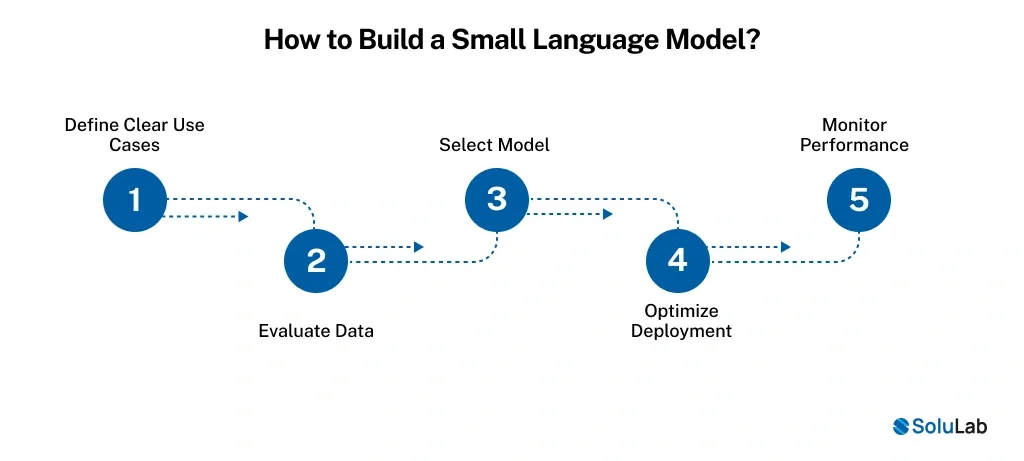
Building a small language model takes focus. You need a clear use case, disciplined data handling, and optimized AI deployment working together if you want an AI solution that scales without costing a fortune.
1. Identify Use Case
Pin down the exact problem first. Summarization? Chatbot replies? Sentiment analysis? Keep the scope narrow and tied to a business outcome. In practice, this is where most teams get stuck, because the scope keeps creeping.
2. Evaluate Data
Look hard at your dataset: how much you have, how good it is, how relevant it is. Clean, structured, domain-specific data lifts accuracy and cuts training time significantly.
3. Select Model
Pick a base model or architecture that fits the use case. You are trading off performance, size, and cost, whether you start from an open-source model or fine-tune a pre-trained one.
4. Optimize Deployment
Ship it through edge devices, APIs, or cloud infrastructure, whichever suits. Watch latency, scalability, and cost closely, because that is what decides how it behaves in the real world.
5. Monitor Performance
Launch is not the finish line. Keep tracking accuracy, response quality, and drift, and use feedback loops and analytics to keep the model reliable as time goes on.
Use Cases of Small Language Models
Where do these models actually show up? Here are some notable small language model use cases:
1. Mobile Apps
Models like MobileBert let developers build natural language processing features, text summarization and question answering among them, straight into mobile apps. Real-time interactions get faster, and the user experience doesn’t suffer for it.
2. ChatBot
SLM models sit behind many virtual assistants, answering user questions quickly and accurately. Being fast and light, they handle work like customer support well, and users stay engaged.
Check Out Our Blog: AI use cases and Applications in Key Industries
3. Code Generation
Small Language Models can turn a plain-English description into a working code snippet. Programmers prototype features faster, hand off the repetitive stuff, and get more done.
4. Sentiment Analysis
A small LLM model works well for sentiment analysis on social media monitoring customer feedback. It chews through text quickly to read how people feel, so businesses can act on what users actually think.
5. Customer Service Automation
Put small LLM models on automating customer service interactions and businesses can field inquiries and support requests with no human in the loop. Answers are accurate, they arrive faster, and customers notice.
Small Language Models vs Large Language Models (SLM vs LLM)
Small or large? It comes down to your use case, your budget, and how much performance you need. Once you see the differences side by side, designing an efficient, scalable AI solution with a clear purpose gets much easier.
| Parameter | SLM (Small Language Models) | LLM (Large Language Models) |
| Model Size | Smaller models with fewer parameters (millions to low billions) | Very large models with billions to trillions of parameters |
| Cost | Lower development, training, and deployment costs | High infrastructure and operational costs |
| Speed | Faster inference and real-time response capabilities | Slower compared to SLMs due to model complexity |
| Deployment | Can run on-device (mobile, edge, IoT systems) | Mostly cloud-based due to heavy compute requirements |
| Use Cases | Task-specific applications like chatbots, summarization | Complex tasks like reasoning, content generation, research |
| Data Requirement | Works with smaller, curated datasets | Requires massive datasets for training and fine-tuning |
Examples of Small Language Models
Small language models keep picking up users because they bring efficient AI to all kinds of devices. These four show how compact models run real-world applications quickly and cheaply.
1. Gemma 2B:
Google built Gemma 2B to be light but strong, with efficient text generation and reasoning. It does well in LLM development services focused on AI that scales without blowing the budget.
2. MobileBERT by Google AI:
MobileBERT is tuned for mobile and edge devices and handles question answering and summarization. You’ll find it widely used in AI model development for on-device intelligence with minimal latency and a light resource load.
3. Microsoft Phi-2:
Phi-2 is compact but capable. Trained on high-quality datasets, it holds up well on reasoning and language tasks, and it fits neatly in custom AI solutions requiring efficiency without giving up accuracy.
4. DistilBERT:
DistilBERT is BERT, distilled. It keeps most of the original’s performance while running smaller and faster, which is why production teams lean on it for NLP jobs like classification and sentiment analysis.
What’s the Future of Small Language Models?
Small language models are still changing fast. Demand for AI that is quicker, cheaper, and more private is pushing them forward, and that shapes how businesses roll out intelligent features across devices, apps, and everyday settings. Here is where things look headed.
- Rise of On-Device Intelligence: SLMs will drive On-device AI models, handling real-time processing on smartphones, wearables, and IoT devices with far less dependence on the cloud.
- Growth of Edge AI Platforms: Expect adoption of Edge AI language models to climb as businesses put low latency, offline use, and secure data processing near the user at the top of the list.
- Specialized Domain Models: Tomorrow’s SLMs will be tightly fine-tuned for industries such as healthcare, finance, and SaaS. The aim is sharper accuracy on specific use cases, not general-purpose chatter.
- Hybrid AI Architectures: Many companies will run both. Lightweight models take the real-time work, larger ones handle the heavy reasoning, and the split keeps performance up and cost down.
- Improved Efficiency and Performance: Better compression and training techniques will keep making SLMs more capable, without giving up their low resource use or quick responses.

Conclusion
Small language models make AI faster, cheaper to run, and usable on far more devices and in far more places. They power real-time apps. They keep deployments affordable. For an enterprise that wants to scale intelligent systems without buying a mountain of infrastructure, that is a practical way in.
The hard part isn’t picking small or large. It is knowing which tasks deserve which model, and getting that split right is what separates an AI project with measurable results from one that just burns budget.
SoluLab, an AI consulting company can help your business design, build, and deploy tailored AI solutions that match your goals and keep paying off long after launch.
FAQs
Shipra Garg is a tech-focused content strategist and copywriter specializing in Web3, blockchain, and artificial intelligence. She has worked with startups and enterprise teams to craft high-conversion content that bridges deep tech with business impact. Her work translates complex innovations into clear, credible, and engaging narratives that drive growth and build trust in emerging tech markets.