Key Takeaways
- A demo is not a product. Capability, product and operation are three layers. Most failed efforts have the first and neither of the others.
- Data is a first-class dependency, not a prerequisite you tick off. Poor data readiness stalls more builds than any modelling problem.
- Evaluation replaces the pass/fail test. Build a golden test set and set your ship threshold before you look at results.
- Start with a foundation model. Build custom only when a specific constraint forces it, because capable models now arrive by API.
- Prefer RAG over fine-tuning when the model simply lacks your facts. RAG connects the model to your knowledge at query time, and it stays cheaper to keep current.
- Design for the moments the model is wrong. Set expectations, show sources, make correction cheap, and always provide a fallback.
- Launch is the start of the work. Drift, cost per request and latency all need watching from the first release.
AI product development means turning a raw capability, such as a language model or a prediction, into something people can use, trust and pay for. The work spans discovery, data, model selection, AI-specific UX, evaluation, deployment and monitoring. Therefore it succeeds when the product solves a real job better than the alternative.
SoluLab designs, builds and operates AI products, so this guide reflects how shipping teams actually work rather than a course syllabus. If you want a partner to build with, start with our AI development company services, then use the process below to plan your own build.
On this page: what AI product development means, how it differs from ordinary software, the seven-stage lifecycle, build versus buy, designing UX for uncertainty, evaluation, deployment and monitoring, why projects fail, and what drives cost.
What Does AI Product Development Mean?
It means product work where the core value comes from a model instead of hand-written rules. You still do discovery, design and engineering. However, the intelligence is learned from data or generated by a foundation model, so behaviour is probabilistic rather than fixed.
A useful way to picture AI product development is three layers stacked on top of each other.
Capability. The model or method: a foundation model such as GPT, Claude, Gemini or Llama, a fine-tuned model, or a classic machine learning model.
Product. The interface, workflow and guardrails that make the capability usable for a specific job.
Operation. The evaluation, monitoring and cost controls that keep it working after launch.
Most failed AI efforts have a strong capability and no product or operation around it. After all, a demo that answers questions in a notebook is not a product. The product is everything that turns that answer into a reliable, repeatable outcome.
How Is Building an AI Product Different From Normal Software?
Regular software is deterministic. The same input returns the same output, and you can test every branch. AI products are probabilistic instead, so the same prompt can return different answers and quality shifts as data changes.
Four differences drive most of the extra work.
Data is a first-class dependency. Your product is only as good as the data behind it.
Uncertainty is normal. The model will sometimes be wrong, so you design for that with confidence signals, fallbacks and human review.
Evaluation replaces the pass/fail test. You measure quality on a scored test set, because no single assertion proves correctness.
The work does not end at launch. Models drift as the world changes, so monitoring and retraining belong to the product.
Plan for these from day one. Otherwise, teams that treat an AI feature like ordinary CRUD software discover the gap late, usually when accuracy complaints arrive.
What Is the AI Product Development Lifecycle?
The AI product development lifecycle runs from discovery to monitoring in seven stages. Each stage has an exit test, so you never move forward on hope.
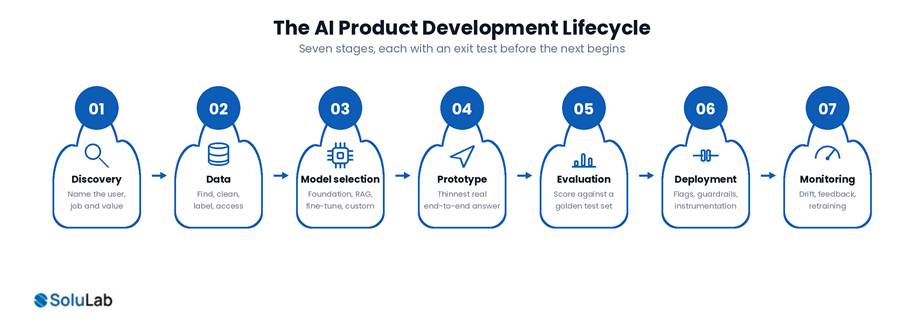
1. Discovery. Name the user, the job to be done and the decision the AI improves. Write the value in one sentence.
2. Data. Next, find, clean and label the data the model needs. Confirm you can access it legally and keep it fresh.
3. Model selection. Choose between a foundation model, a fine-tuned model or a custom model based on accuracy, cost, latency and control.
4. Prototype. Then build the thinnest end-to-end version that produces a real answer for a real user.
5. Evaluation. Score the prototype on a labelled test set. Decide the ship threshold before you look at results.
6. Deployment. Ship behind a flag, wire up guardrails, then instrument every call for cost, latency and quality.
7. Monitoring. Finally, watch for drift, track feedback, and retrain or re-prompt on a schedule.
The stages are not strictly linear. In practice you will loop between data, model and evaluation several times before deployment. What stays fixed is the exit test: no stage passes without evidence.
Should You Build a Custom Model or Use an Existing One?
For most teams in 2026, start with a foundation model and build custom only when a specific constraint forces it. Building your own model from scratch is rarely justified now that capable models arrive by API. SoluLab’s build versus buy AI guide walks through total cost of ownership before you decide.
| Option | Control | Relative cost | Time to first value | Best for |
| Foundation model via API | Low over internals, high over prompts | Low upfront, pay per use | Days to weeks | Most products; general reasoning and chat |
| RAG on a foundation model | Medium; you control the knowledge source | Low to medium | Weeks | Answers grounded in your private documents |
| Fine-tuned foundation model | Medium to high; tuned to your tasks | Medium | Weeks to months | Consistent tone, narrow tasks, repeated formats |
| Custom-trained model | Full | High; data, compute and ML talent | Months | Unique data, strict latency, or IP and compliance needs |
Two practical rules follow. First, prefer retrieval-augmented generation over fine-tuning when the problem is that the model does not know your facts, because RAG connects it to your knowledge at query time. Second, treat model choice as reversible, so abstract the model behind an interface and swap it later.
How Do You Design AI Product UX?
AI UX design makes a probabilistic system feel trustworthy and controllable. The core challenge is that the model is sometimes wrong. Consequently the interface has to set expectations, show its work, and give the user an easy way out.
Set expectations. First, tell users what the AI can and cannot do before they rely on it.
Show confidence and sources. Next, cite the source of an answer or signal how sure the system is, so users can calibrate.
Make correction cheap. Then let users edit, regenerate or reject an output in one step, treating every correction as a signal.
Provide a fallback. Finally, when the model is unsure, route to a human or a safe default rather than a wrong answer.
Above all, keep the human in control of consequential actions. For anything that spends money, sends a message or changes a record, put a confirmation step in front of the model’s suggestion.
How Do You Evaluate and Keep an AI Product Accurate?
You evaluate with a labelled test set, a defined quality bar and continuous checks in production. Evals are the AI equivalent of a test suite: a scored collection of inputs with expected outputs that you run on every change.
A golden test set. These are real examples with correct answers, covering common cases and known edge cases. Grow it whenever production surfaces a new failure.
Metrics that match the job. Accuracy, groundedness and helpfulness for generation; precision and recall for classification.
Guardrails at runtime. Input and output filters, retrieval checks, and rules that block unsafe responses before they reach a user.
Human-in-the-loop review. Sampled human grading of live outputs, plus a fast path for users to flag bad answers.
To reduce wrong answers, ground the model in your data with RAG, constrain the prompt, validate outputs against rules, and let the system say it does not know. The NIST AI Risk Management Framework Generative AI Profile recommends varying controls across foundation models, fine-tuned models and embedded tools (NIST).
How Do You Deploy and Monitor AI Products?
You deploy with MLOps practices: versioned models and prompts, staged rollouts behind flags, and full instrumentation of every model call. Monitoring then watches three things ordinary apps ignore.
Quality drift. Therefore sample outputs and score them over time. When accuracy falls, the data has moved.
Cost per request and per user. Because token and inference costs scale with usage, cap and alert rather than discovering it on the invoice.
Latency and reliability. Users abandon slow AI, so set targets, cache where you can, and keep a fast fallback path.
Feedback loop. Additionally, route thumbs-down and human flags straight back into the golden test set.
Ship behind a feature flag to a small group first, compare against a baseline, then expand. Indeed, the teams that operate AI well treat deployment as the start of the real work.
Why Do AI Products Fail?
AI products fail for predictable, mostly non-technical reasons. The model is rarely the problem.
Unclear value. This is a feature built because AI is exciting rather than because it solves a job.
Data not ready. Missing, dirty or inaccessible data stalls the build. Gartner ties much of the roughly 50% proof-of-concept abandonment to poor data readiness (Gartner).
No evaluation. Teams ship on a good demo, then cannot tell whether changes help or hurt.
Ignored operating cost and risk. Gartner predicts over 40% of agentic AI projects will be cancelled by the end of 2027 due to rising costs, unclear value or weak controls (Gartner).
No human fallback. A product that states wrong answers confidently, with no way to correct or escalate, loses trust after the first bad one.
Every one of these is avoidable with the lifecycle above. Therefore name the value, ready the data, build evals, and plan the operation before you scale.
What Drives AI Product Development Cost?
Cost depends on scope, data work, model choice, integrations and how much accuracy and compliance you need. The model itself is often the cheap part. Meanwhile, data preparation, integration, evaluation and ongoing operation drive the real spend.
Data work. This covers collection, cleaning, labelling and pipelines, and it is usually the largest line item.
Model approach. API usage versus fine-tuning versus custom training.
Integrations. Similarly, each system, channel and data source adds engineering.
Evaluation and guardrails. Building and maintaining the test set and safety layer.
Operation. Inference cost at scale, monitoring and retraining over time.
For a directional sense, SoluLab publishes indicative ranges in its AI MVP cost guide and AI agent development cost guide. Confirm any figure against a scoped estimate, since ranges move with data readiness and integration count.
How Do You Choose an AI Product Development Partner?
Choose a partner that has shipped and operated AI products, not one that only demos them. The difference shows in whether they talk about evaluation, monitoring and cost rather than model accuracy on a slide.
1. Shipped experience. Specifically, ask for AI products they built and still run in production.
2. Data honesty. Crucially, they assess your data readiness early and say when it is not ready.
3. Evaluation discipline. In addition, they define metrics and a test set before building.
4. Full lifecycle. They cover discovery through monitoring, including MLOps and cost control.
5. Model-agnostic. Equally, they pick the model for your constraints and keep it swappable.
6. Cross-domain depth. AI products rarely stand alone, so breadth matters as you expand.
Where Does SoluLab Fit?
SoluLab covers this range across generative AI development and enterprise AI development, and works across classical modelling through our machine learning development company practice.
We run the full path from discovery and data through evaluation, deployment and monitoring, because AI product development only pays off when the operation holds up after launch.
Frequently Asked Questions
Shipra Garg is a tech-focused content strategist and copywriter specializing in Web3, blockchain, and artificial intelligence. She has worked with startups and enterprise teams to craft high-conversion content that bridges deep tech with business impact. Her work translates complex innovations into clear, credible, and engaging narratives that drive growth and build trust in emerging tech markets.