Key Takeaways
- Consulting answers a different question from development. Consulting asks whether to build this and how. Development builds it. Most failed chatbot projects skip the first question entirely.
- The deliverable is a decision, not a prototype. A use-case matrix ranked by value and risk, a model recommendation, an integration plan and a guardrail specification.
- Model selection is a decision, not a default. If a firm cannot explain why it would pick one model over another for your case, that is a signal about the firm.
- Retrieval quality matters more than model size. For LLM and agentic bots, how well the system retrieves from your content decides answer quality more than which frontier model sits behind it.
- Grounding is the core lever against hallucination. Retrieval-augmented generation connects the model to your real content instead of letting it guess, and research supports it as the primary control.
- Containment without CSAT is a false win. A rising containment rate with falling satisfaction means the bot is trapping people, not helping them.
- Set your baseline before launch. Benchmark targets vary widely by industry and channel, so published figures are close to useless without your own starting point.
Chatbot consulting services are advisory-led engagements that scope your use cases, pick the right LLM and architecture, plan guardrails and integrations, and de-risk the build before any code ships. A consultant decides what to build and why. A development team then builds it. Good consulting saves you from shipping the wrong bot.
SoluLab runs chatbot consulting as the front end of delivery, pairing GenAI strategy with verifiable audit trails and cloud deployment. If you already know your scope, our AI chatbot development company team can move straight to the build.
On this page: what consulting covers, what a consultant actually produces, consulting versus development, how engagements are priced, which chatbot type fits your use case, how to choose a partner, the seven-stage lifecycle, hallucination control, and how ROI is measured.
What Are Chatbot Consulting Services?
Chatbot consulting services are the strategy and design work that happens before you build a bot. A consultant studies your goals, data and systems, then recommends what to automate, which model and architecture to use, and how to control risk.
Consulting is not the same as development. Consulting answers “should we build this, and how?” Development answers “let’s build it.” Most failed chatbot projects skip the first question. They pick a platform, script a few flows, and discover months later that the bot cannot answer from real company data or connect to the tools people actually use.
A typical consulting output includes a use-case matrix, a model recommendation, an integration plan and a guardrail specification. You leave with a decision and a roadmap, not a half-built prototype.
What Does a Chatbot Consultant Actually Do?
A chatbot consultant runs discovery, scores your use cases, selects the model and architecture, and hands you a plan you can build against. The work is structured, not a slide deck of buzzwords.
Use-case matrix. Every candidate use case ranked by value, feasibility and risk.
Model recommendation. Which model class fits: a GPT-class model, Claude, Gemini, or an open-source option you host yourself.
Architecture and RAG design. Whether the bot needs retrieval-augmented generation to answer from your documents, and how that retrieval is structured.
Guardrail specification. How the bot avoids hallucinations, handles unsafe requests, and escalates to a human when it is unsure.
Integration plan. Which systems the bot touches: CRM, helpdesk, knowledge base, internal APIs.
The point of this phase is to catch expensive mistakes on paper, where they cost a meeting instead of a rebuild.
Chatbot Consulting vs Chatbot Development: What Is the Difference?
Chatbot consulting decides what to build and why. Chatbot development builds and ships the bot. You often need both, in that order, but they are distinct engagements with different teams and outputs.
| Dimension | Chatbot consulting | Chatbot development |
| Primary goal | Decide what to build and why | Build and ship the bot |
| Typical output | Use-case matrix, model and architecture recommendation, roadmap | Working chatbot, integrations, tests |
| Best when | Scope is unclear or the project is high-risk | Requirements are already defined |
| Team focus | Strategists, solution architects | Engineers, ML and NLP developers |
| Relative duration | Shorter, scoped in weeks | Longer, scaling with integration count |
If your requirements are already firm, you can skip straight to build with an enterprise AI chatbot development company. If scope is fuzzy or the stakes are high, start with consulting.
How Much Do Chatbot Consulting Services Cost?
Chatbot consulting cost depends on scope, not a fixed price. A short use-case discovery costs far less than a full strategy engagement covering model selection, RAG design and a rollout plan across several departments.
Consultants usually bill under one of three models.
Hourly or time and materials. You pay for actual hours. Fits discovery, audits and evolving scope.
Fixed fee. A defined engagement with set deliverables, such as a use-case assessment or an architecture blueprint.
Retainer. Ongoing advisory across a multi-phase programme. Fits enterprises rolling out several bots over time.
Specific figures vary by region, seniority and scope, so treat any published number with caution and get a quote against your actual use case and channels.
Which Chatbot Type Fits Your Use Case?
The right chatbot type depends on how dynamic the answers must be and how much control you need over what the bot says. There are four broad classes, and consultants match the class to the use case rather than defaulting to the newest option.
Rule-based bots. Scripted decision trees. Cheap, predictable, and fine for a fixed FAQ or a simple form. They break the moment a user phrases something unexpectedly.
NLP or intent-based bots. Built on frameworks like Rasa, Google Dialogflow or Amazon Lex. They recognise intents and entities, which suits structured, controlled conversations.
LLM or generative bots. Powered by GPT-class models, Claude or Gemini, usually paired with retrieval so they answer from your content rather than from memory.
Agentic assistants. Bots that chain steps and call tools to complete tasks, not just answer questions. They can update a record or trigger a workflow.
For LLM and agentic bots, retrieval quality matters more than raw model size. If your bot needs autonomy and tool use, our work on AI agent development covers how agentic systems are designed and governed.
How Do You Choose a Chatbot Consulting Partner?
Choose on domain fit, model neutrality, integration depth, governance and post-launch support. A build-only vendor that sells one platform will steer you toward that platform whether it fits or not.
1. Domain experience. Have they shipped bots in your sector, with your compliance constraints?
2. Model neutrality. Do they recommend across GPT-class models, Claude, Gemini and open source, or push a single stack?
3. Integration depth. Can they connect the bot to your CRM, helpdesk and internal systems, not just a web widget?
4. Governance. Do they have a real answer for hallucination control, data privacy and auditability?
5. Post-launch support. Who owns monitoring, retraining and drift after go-live?
A consulting-led partner treats the model as a choice, not a default. If a firm cannot explain why it would pick one model over another for your case, that is a signal.
What Does a Chatbot Consulting Engagement Look Like?
An engagement moves through discovery, use-case scoring, model and RAG design, guardrail definition, a pilot, rollout and monitoring. Each phase has an exit check before the next begins.
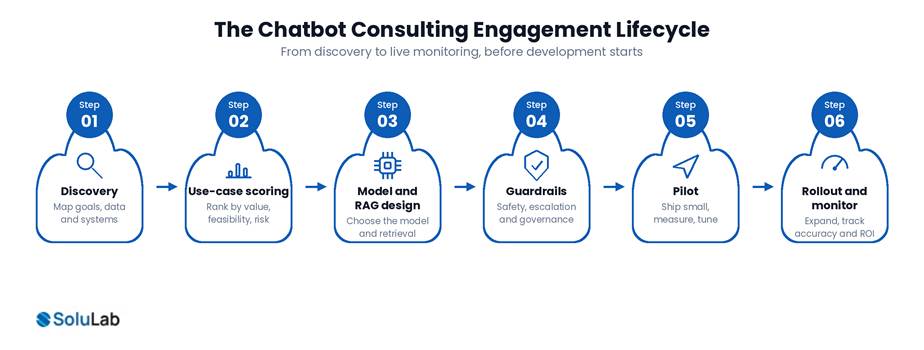
1. Discovery. Map goals, users, data sources and systems. Identify candidate use cases.
2. Use-case scoring. Rank candidates by value, feasibility and risk. Pick the first bot to build.
3. Model and RAG design. Choose the model class and, if needed, design retrieval over your documents.
4. Guardrails. Define how the bot handles uncertainty, unsafe input and escalation to a human.
5. Pilot. Ship to a small audience, measure against target metrics, and tune.
6. Rollout. Expand access, add channels, and connect remaining systems.
7. Monitoring. Track accuracy, containment and satisfaction, then retrain as content and usage shift.
The lifecycle is a loop, not a line. Monitoring feeds new use cases back into discovery.
How Do Consultants Control Hallucinations and Safety?
Consultants control hallucinations by grounding answers in your data with retrieval-augmented generation, filtering what the model retrieves, constraining prompts, validating outputs, and adding fallback handling so the bot escalates when unsure. Grounding is the core lever.
Retrieval-augmented generation connects the model to your real content instead of letting it guess. Research has found that grounding responses in reliable sources with RAG significantly reduces the hallucination rate of generative AI chatbots, and separate work shows RAG reduces hallucination in structured outputs while improving generalisation to new domains.
Grounding alone is not enough. A consultant also plans against a governance baseline. The NIST AI Risk Management Framework Generative AI Profile sets out actions organisations can take to manage generative AI risk across the lifecycle, and it is a sensible reference point for a chatbot governance plan.
How Do You Measure Chatbot ROI?
Measure against containment, satisfaction, cost per conversation, deflection and resolution time, then compare the total against what the bot costs to build and run. Pick the metrics before launch, not after.
Containment rate. The share of conversations the bot resolves without escalating to a human.
CSAT. Customer satisfaction on bot-handled conversations. A rising containment rate with falling CSAT means the bot is trapping people rather than helping them.
Deflection rate. Contacts that never reached a human queue.
Cost per conversation. Total run cost divided by handled conversations, compared against the agent cost it replaces.
Resolution time. How fast issues close, for the bot and for the humans it hands off to.
Benchmark targets vary widely by industry and channel, so set your own baseline first rather than importing someone else’s numbers.
Where Does SoluLab Fit?
SoluLab runs chatbot consulting as consulting-led GenAI work, then adds two things most consultancies do not offer together: verifiable audit trails and cloud deployment across AWS, Azure and GCP. That combination matters when a bot touches regulated data and you need a tamper-evident record of what it did.
Our solution architects treat model selection as a decision, not a default. They weigh accuracy, data privacy, latency and cost across GPT-class models, Claude, Gemini and open-source options, then design retrieval and guardrails around the choice. For teams that want strategy and build under one roof, we bridge consulting into delivery with the same architects who scoped the work.
For conversational strategy beyond a single bot, see our conversational AI consulting services, and for delivery see our chatbot development company page.
Frequently Asked Questions
Shipra Garg is a tech-focused content strategist and copywriter specializing in Web3, blockchain, and artificial intelligence. She has worked with startups and enterprise teams to craft high-conversion content that bridges deep tech with business impact. Her work translates complex innovations into clear, credible, and engaging narratives that drive growth and build trust in emerging tech markets.