Key Takeaways
- Retention, not launch, decides success. SaaS products earn recurring revenue only while customers stay, so the product is never finished.
- Validate before you build. In SaaS, the bigger risk is building the wrong specification, not failing to deliver it.
- Keep the MVP narrow. One user role, one workflow end-to-end, one integration, billing and enough analytics to see activation.
- Decide multi-tenancy and billing early. These are the architecture choices that are most expensive to reverse; the tech stack rarely is.
- Budget for the ongoing cost. Infrastructure, support and continuous development typically become the larger cost by year two.
What is a SaaS product?
A SaaS product is software that customers access over the internet and pay for on a subscription, with the vendor running the infrastructure, updates and security. The customer never installs or maintains it.
Two consequences follow, and they shape every technical decision. First, one codebase serves every customer, so multi-tenancy, configuration and data isolation are architecture problems from day one. Second, revenue depends on customers staying, so the product is never finished. For engagement models and team shapes, see our SaaS product development company page.
What is SaaS product development?
SaaS product development is the process of taking a problem worth solving, defining who it is for, building the smallest version that proves value, then improving it against usage data and retention metrics rather than a fixed specification.
The difference from traditional custom software development is where the risk sits. In traditional software projects, the risk is delivering the specification. In SaaS, the risk is that the specification was wrong, which is why validation and a real MVP matter more than the build plan.
Why build a SaaS product?
- Recurring revenue rather than one-off project income.
- One codebase, so improvements reach every customer at once.
- Usage data on every customer, which makes product decisions evidence-based.
- Valuation multiples on recurring revenue are higher than on services revenue, which is why service businesses try to productise.
The cost side is real: you carry infrastructure, security, support and continuous development forever. A SaaS product that stops being developed starts losing customers.
Types of SaaS products
| Type | Who buys | What decides success |
| Horizontal SaaS | Any industry, one function | Breadth, integrations, self-serve onboarding |
| Vertical SaaS | One industry, deeply | Domain fit, compliance, workflow match |
| Product led | End users, self-serve | Time to first value, in-product activation |
| Sales led | Buying committees | Security review readiness, admin controls, reporting |
| Platform or API first | Developers | Documentation, reliability, predictable pricing |
The five stages of SaaS product development
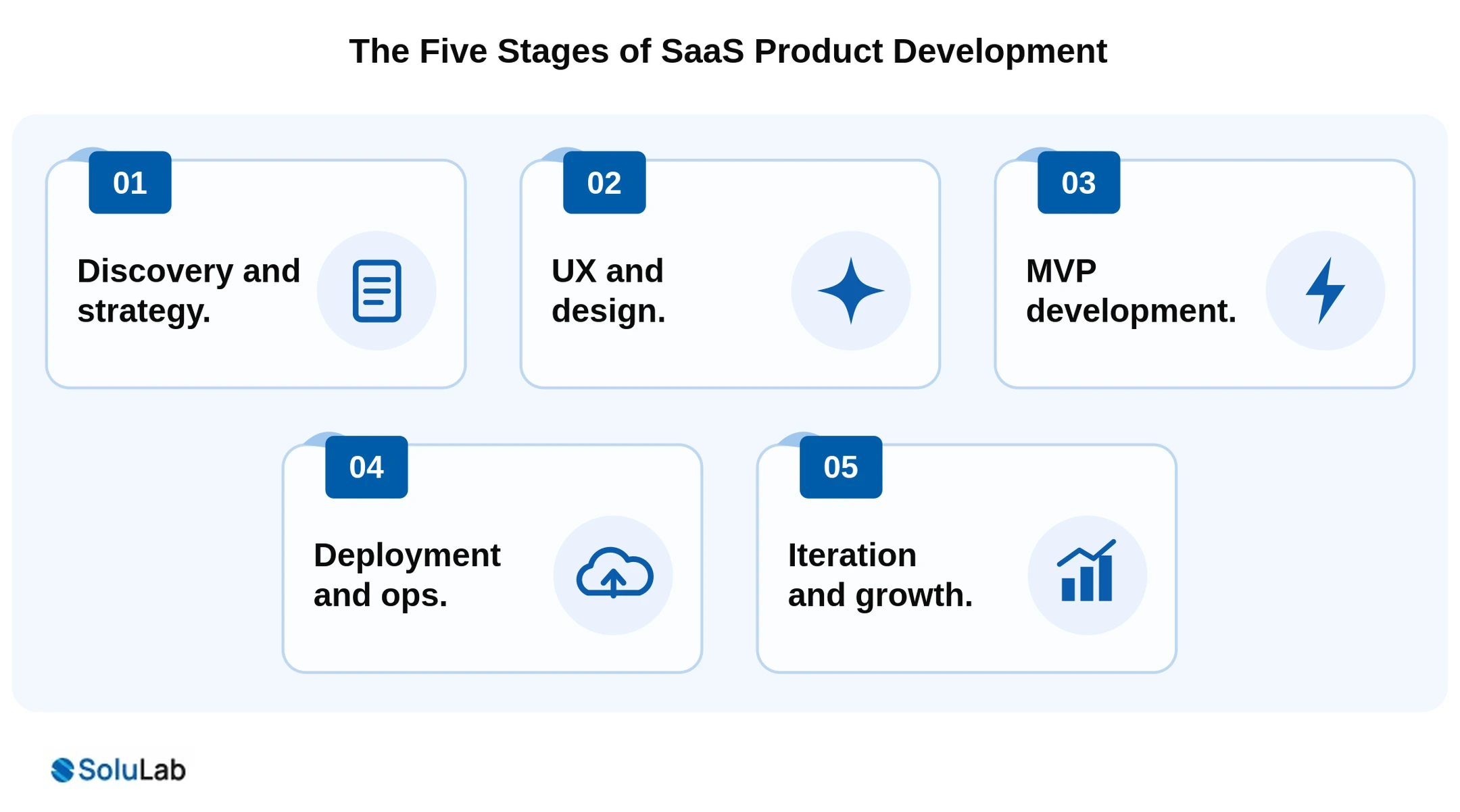
Stage 1: Discovery and product strategy. Find a pain rather than a feature. Define the ideal customer profile precisely enough to disqualify people. Set the product strategy and the business goals the product has to move, then decide what the first version will not do.
Stage 2: Design. User flows, then interface, then a design system. The user experience of onboarding matters more than any other screen, because a customer who does not reach first value does not renew.
Stage 3: Development. Build the MVP against the architecture decisions below. Ship to production early and keep it there.
Stage 4: Deployment. Environments, CI/CD, monitoring, backups and an incident process. For SaaS this is part of the product, not operations overhead.
Stage 5: Iteration. Instrument activation, engagement, churn rate and lifetime value. Change the product against what the data shows, and review pricing at least twice in the first year.
The architecture decisions that are expensive to reverse
| Decision | Why it is hard to change later |
| Multi tenancy model | Shared schema, schema-per-tenant or database-per-tenant changes every query and every migration |
| Identity and permissions | Roles, teams and delegated admin get woven through the whole product |
| Billing and metering | Usage-based pricing needs event capture from day one |
| Data residency | Moving customer data between regions later means downtime and legal review |
| Audit logging | Retrofitting an audit trail means touching every write path |
| Tech stack | Not the hardest to change, but the hardest to hire for if the choice is unusual |
A sensible default tech stack in 2026 is a managed relational database, a typed backend, a React-based front end and a cloud provider you already understand. The stack is rarely what kills a SaaS product. The multi-tenancy and billing decisions are.
Integration complexity, the cost nobody budgets for
Integrations are usually the largest source of unplanned work in SaaS product development. Three reasons: every integration has its own authentication and rate limits, customers expect field level mapping you did not design for, and each integration becomes a support surface forever.
Practical controls:
- Build the two integrations your ideal customer profile cannot work without, and refuse the rest until they are asked for by paying customers.
- Put integrations behind your own internal interface so a provider change does not reach the product.
- Price integration-heavy plans higher, because they cost more to run.
What goes in a SaaS MVP
The MVP is the smallest product that lets a real customer complete the job and lets you measure whether they come back. That usually means one user role, one workflow end-to-end, one integration, billing, and enough analytics to see activation.
What to leave out of a first version: admin configurability, more than one pricing tier, SSO, a mobile app, and reporting. Each of these is a real requirement later, and none of them tells you whether the product works. For AI-first products, see our AI MVP development services.
What does SaaS product development cost?
Cost is driven by the number of user roles, the depth of integrations, whether regulated data is involved and how much of the workflow is genuinely new. A focused SaaS MVP commonly lands between a few tens of thousands and low six figures, and the running cost of infrastructure, support and continuous development typically becomes the larger number by year two.
Estimate it in four parts rather than one: discovery and design, MVP build, launch and infrastructure, then a monthly figure for iteration and support. A single build number with no ongoing figure understates the real commitment. For a detailed SaaS product cost breakdown, see our cost guide.
Common pitfalls in SaaS product development
- Building for everyone. A product with no disqualifying customer profile has no roadmap.
- Launching without billing. Free pilots that never convert hide the only question that matters.
- Treating retention as a later problem. Net revenue retention is the metric investors underwrite, and it is designed into onboarding, not added by marketing.
- Too many integrations too early. They consume the roadmap and become a permanent support cost.
- Configurability instead of opinion. Every setting is a branch to test and a support question forever.
- No instrumentation. If activation is not measured, every product decision is an argument.
- Pricing set once. Most SaaS products underprice at launch and never revisit it.
How SoluLab builds SaaS products
Discovery that narrows scope, design that prioritises onboarding, an MVP in production with billing and analytics from the start, then iteration against activation and retention. Where AI features are part of an AI SaaS product, they are built by the same team and measured for accuracy and cost per use rather than demonstrated once.
See our SaaS product development company page for engagement models and team shapes, or the SaaS product cost breakdown for detailed pricing.
Get an MVP scope and fixed price estimate in 48 hours
Describe the customer, the workflow and the constraint that matters most. You will get a recommended MVP scope, what we suggest cutting, and an estimate.

Frequently Asked Questions
Shipra Garg is a tech-focused content strategist and copywriter specializing in Web3, blockchain, and artificial intelligence. She has worked with startups and enterprise teams to craft high-conversion content that bridges deep tech with business impact. Her work translates complex innovations into clear, credible, and engaging narratives that drive growth and build trust in emerging tech markets.