Key Takeaways
- An MVP (Minimum Viable Product) focuses on the core features needed to validate a product idea with real users.
- Start by defining the target audience, problem, value proposition, and essential user journey before deciding what to build.
- Prioritize must-have features and avoid unnecessary features that increase development time and cost.
- MVP development costs vary based on complexity, features, technology stack, integrations, design requirements, and development team location.
- Development can be handled by an in-house team, freelancers, a software development company, or a dedicated development team.
- A development partner can help with product discovery, UI/UX design, development, testing, deployment, and post-launch support.
- An MVP should be scalable enough for future improvements but not over-engineered at the initial stage.
MVP software development means building the smallest version of a product that delivers real value to early adopters and produces user feedback you can act on. In software, a minimum viable product is working software in production, not a mockup. Its purpose is to test the riskiest assumption before the full build is funded.

What is an MVP in software development?
An MVP, or minimum viable product, is a working version of a product with just enough functionality for early adopters to complete a real job. It ships to production, real users use it, and their behaviour answers a question you could not answer by discussion.
The word that carries the weight is viable. A minimum viable product MVP has to be genuinely usable for one workflow, whether it is delivered as web development, mobile or both. Software that demonstrates an idea without being usable is a prototype, and it produces opinions rather than user feedback.
What does MVP mean in software development?
It means the product is deliberately incomplete along every axis except one: the core job must work end to end. One user role, one workflow, real data, in production.
Most failed MVPs fail in one of two directions. They include so much that they take as long as the full product and test nothing early. Or they are cut so far that no user can finish the job, so the feedback measures the gaps rather than the idea.
Characteristics of a real MVP
- It is in production, with real users and real data.
- One workflow works completely, without manual help from your team.
- It is instrumented, so activation and repeat use are measurable.
- It has a stated hypothesis and a number that would falsify it.
- It can be thrown away without wrecking the codebase you keep.
Why build an MVP?
- Reduced development cost on the wrong product, which is the largest avoidable cost in software.
- Earlier user feedback, from behaviour rather than from interviews.
- A fundable artifact. Investors respond to usage, not to decks.
- Technical de-risking. Integrations and performance assumptions get tested against reality.
- Team alignment. A shipped MVP ends most internal arguments about scope.
MVP vs PoC vs Prototype
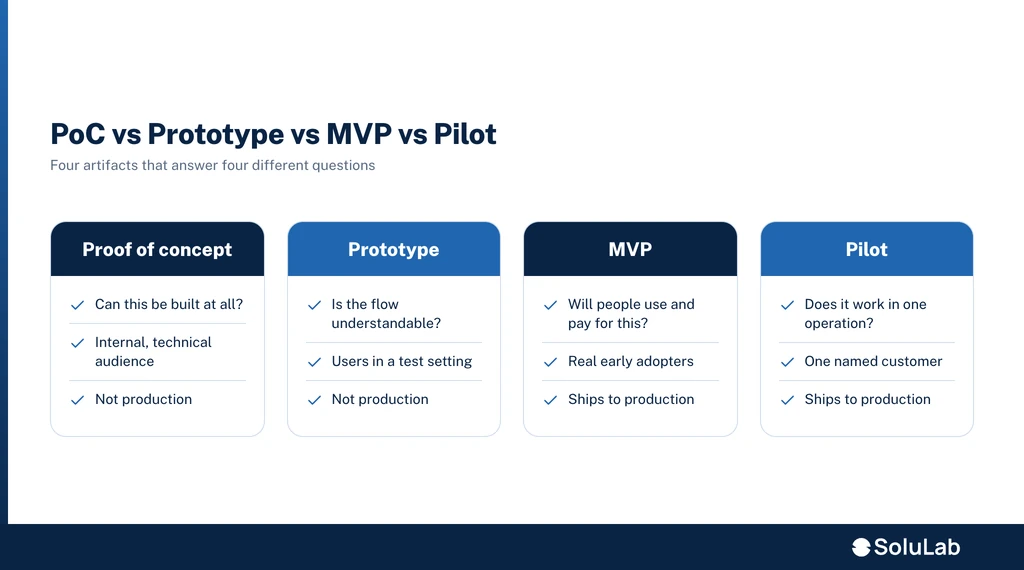
| Artifact | Question it answers | Audience | Production? |
|---|---|---|---|
| Proof of concept | Can this be built at all? | Internal, technical | No |
| Prototype | Is the flow understandable? | Users in a test setting | No |
| MVP | Will people use and pay for this? | Real early adopters | Yes |
| Pilot | Does it work inside one customer’s operation? | One named customer | Yes |
The common error is running a proof of concept and calling it an MVP, then concluding from it that users want the product. A PoC tests feasibility and tells you nothing about demand. For the full comparison:
Types of MVPs
| Type | What you build | Use when |
|---|---|---|
| Single feature MVP | One workflow, done properly | The core job is clear |
| Concierge MVP | The service delivered manually behind a simple interface | The workflow is not yet understood |
| Wizard of Oz MVP | Looks automated, is human operated behind the screen | Automation is the expensive unknown |
| Piecemeal MVP | Assembled from existing tools | Speed matters more than ownership |
| Landing page MVP | No product, measured demand | You are testing willingness, not usability |
For AI products the concierge and Wizard of Oz patterns are worth more than they used to be, because they let you measure whether the output is good enough before paying to automate it.
What features should an MVP include?
Include: the core workflow end to end, authentication, the minimum data model, one integration if the job cannot be completed without it, billing if you intend to test willingness to pay, and analytics.
Leave out: multiple user roles, admin configuration, reporting and dashboards, SSO, a mobile app alongside web, notifications beyond the essential one, and every second pricing tier.
The test for any feature: if it is removed, can a target audience user still finish the job and can you still measure whether they came back? If yes, it is not in the MVP.
Building an MVP, step by step
- State the hypothesis and the falsifying number. Building an MVP without a falsifying number produces a product MVP nobody can evaluate, so write both down before scoping.
- Define the early adopters. Precisely enough that most people are excluded.
- Map the one workflow. End to end, including the unglamorous steps.
- Cut to the core. Remove every feature that survives the test above.
- Choose the tech stack and the throwaway boundary. Decide now which parts are deliberately temporary.
- Build in short cycles with project management that surfaces scope creep weekly. Scope creep is the main failure mode, and it arrives as small reasonable requests.
- Instrument before launch. Activation, completion, repeat use.
- Launch to the early adopters, not to everyone.
- Measure against the falsifying number, then decide.
Sourcing models for MVP development
| Model | Speed to start | Cost | Control | Best when |
|---|---|---|---|---|
| In house team | Slowest, you hire first | Highest fixed cost | Full | The product is your core and you are already staffed |
| Outsourced MVP build | Fast, weeks | Fixed price possible | Vendor directs build | You want one team accountable for shipping |
| Staff augmentation | Fast | Per engineer monthly | You direct the work | You have a lead but not enough hands |
| Freelancers | Fast to start, slow to finish | Lowest headline, highest coordination | Fragmented | Very small, separable scope |
Most funded startups building a first version choose an outsourced MVP build with a fixed price, then move to staff augmentation once the roadmap is driven by usage.
How much should an MVP cost?
MVP software development for a focused product commonly lands between a few tens of thousands and low six figures. Four factors move it more than anything else: the number of user roles, integration depth, whether regulated data is involved, and whether you need mobile app development alongside web development.
What makes MVPs expensive is almost never the engineering rate. It is scope that grew after the estimate, and integrations that turned out to be mandatory.
For AI specific MVPs, model and evaluation cost changes the arithmetic.
Test and launch
Test the workflow with people who match the early adopter definition, not with your team. Watch them rather than asking them. Launch to a small group, keep support close, and expect the first week to produce more product decisions than the whole build.
What happens after an MVP launches: scale, pivot or kill
Decide against the number you wrote down, using three outcomes:
- Scale. The hypothesis held. Now harden what you deliberately built as throwaway, and add the second user role.
- Pivot. Users completed a different job than the one you designed for, or completed yours in an unexpected way. Keep the codebase, change the product.
- Kill. Nobody returned. This is a successful MVP, because it cost a fraction of the full build.
Teams that skip writing the falsifying number in advance almost always choose scale, because by launch there is organisational momentum behind the product.
MVP development with SoluLab
Fixed price MVP scoping in 48 hours, a build that ships to production rather than to a demo environment, instrumentation from day one, and a scope conversation that includes what we recommend cutting. Where the product is AI led, we build a measured evaluation into the MVP so the accuracy question is answered before scale.
Proof:
- Team Extension for building an eWallet. Product engineering alongside the client team.
- Instant loans app for small business lending. A regulated first version taken to production.
- Algorithmic stock trading system. Data intensive build with measurable output.
Get an MVP scope and fixed price estimate in 48 hours
Send the hypothesis and the constraint that binds, budget or date. You will get a recommended MVP scope, an explicit cut list, and an estimate.
FAQs
Shipra Garg is a tech-focused content strategist and copywriter specializing in Web3, blockchain, and artificial intelligence. She has worked with startups and enterprise teams to craft high-conversion content that bridges deep tech with business impact. Her work translates complex innovations into clear, credible, and engaging narratives that drive growth and build trust in emerging tech markets.