
Key Takeaways
- Robotic process automation in healthcare works best on high-volume, rule-based administrative work: eligibility checks, claims submission, prior authorization follow-up, and data entry between systems.
- Start with process selection, not tooling. The wrong first process is the most common reason a pilot stalls.
- RPA handles structured, repeatable steps. Anything requiring judgment or unstructured documents needs AI on top of the bot.
- HIPAA compliance is a design constraint from day one: scoped service accounts, encrypted credential vaults, and an audit trail on every bot action.
- Legacy systems without APIs are the norm in healthcare, which is exactly why screen-level automation still earns its place here.
- Bots break when screens change. Budget for maintenance or your automation quietly stops working.
Robotic process automation in healthcare uses software bots to carry out rule-based administrative tasks across systems that do not talk to each other: verifying insurance eligibility, submitting claims, moving data between an EHR and a billing platform, or chasing prior authorization status. Implementation follows five stages, from process discovery through to a governed production rollout.
The appetite is there. Deloitte’s 2026 Global Health Care Outlook found that 80% of healthcare executives expect agentic AI to deliver measurable business value, with administrative burden reduction named by 61% of them as a top value area. Automation ambition is not the bottleneck.
This guide covers process selection, the build sequence, compliance design, realistic cost and timeline ranges, and the failure patterns that kill most healthcare automation programs before they scale.

What is Robotic Process Automation in Healthcare?
Robotic process automation in healthcare is software that mimics the clicks, keystrokes, and data lookups a staff member performs across clinical and administrative systems. The bot logs into the same applications, follows the same rules, and leaves the same audit trail.
1. What a bot actually does
A bot opens the payer portal, enters a member ID, reads the eligibility response, and writes the result back into your practice management system. No integration project. No vendor API. It works through the interface that already exists, which matters enormously in a sector where a hospital may run software older than some of its staff.
2. Where RPA stops, and AI begins
Robotic process automation is deterministic. Given the same input, the bot does the same thing every time, and it fails loudly when it hits something unexpected. That is a feature in a regulated environment. What it cannot do is read a scanned referral letter, interpret a clinical note, or decide whether a denial is worth appealing.
Those tasks need a layer on top. Document understanding, classification, and reasoning come from AI-powered intelligent document processing and machine learning models, with the bot handling execution once a decision is made. Most production healthcare automation today is this hybrid, not pure RPA.
3. Why healthcare specifically
Three conditions make a process a good RPA candidate: high volume, stable rules, and multiple disconnected systems. Healthcare administration hits all three routinely. Revenue cycle work alone involves an EHR, a practice management system, a clearinghouse, several payer portals, and a general ledger, each with its own login and format.
Why are healthcare organizations investing in RPA now?
The healthcare sector is working with RPA development companies because administrative cost is the pressure point, and staffing is no longer a lever they can pull. Vacancy rates in billing and coding remain stubborn, claim volumes keep rising, and payer rules change faster than teams can retrain.
Gartner projected that half of U.S. healthcare providers would invest in robotic process automation within three years, up from around 5% at the time of the forecast.
1. The three pressures driving adoption
Regulatory timelines are tightening. New CMS rules shortened standard prior authorization decision windows, which pushes both payers and providers toward faster, automated exchange rather than fax and phone follow-up.
Margin pressure is constant. Administrative rework is expensive precisely because it is invisible on a P&L, buried in salaried hours rather than a line item.
And staff retention suffers. Nobody trained in clinical documentation wants to spend eleven hours a week re-keying eligibility data.
2. What RPA is not going to fix
It will not repair a broken process. Automating a bad workflow gets you a faster bad workflow with a licensing bill attached. If your denial rate is high because coding guidance is unclear, a bot submitting those claims faster just produces denials faster. Fix the rule first, then automate it.
That distinction sits at the heart of any serious digital transformation program. Automation amplifies whatever process it inherits.
Use Cases of RPA in Healthcare
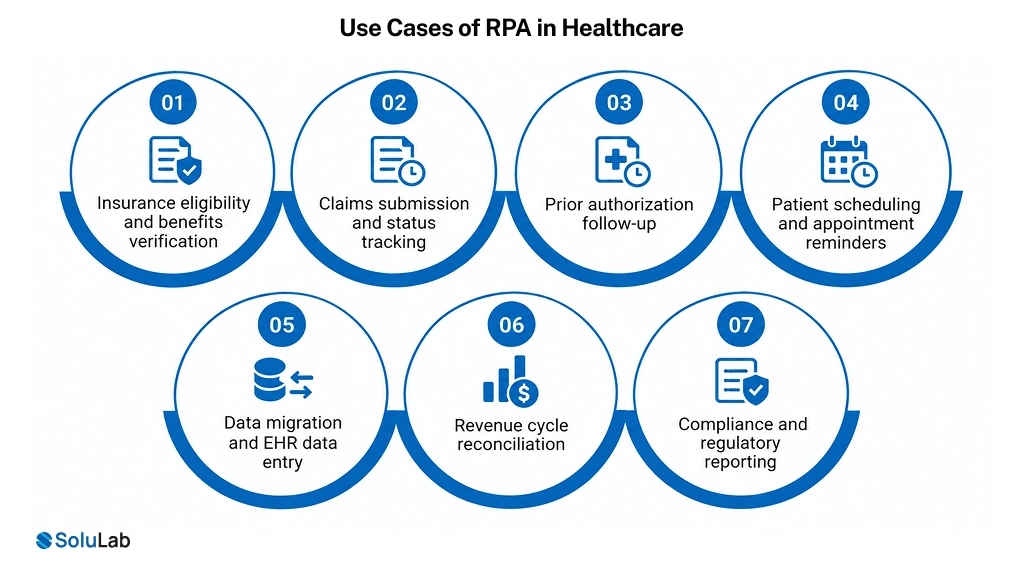
Automate high-volume, rule-based, multi-system processes with a measurable cost per transaction. Seven candidates account for most of the value in provider and payer organizations.
1. Insurance eligibility and benefits verification
The classic first automation. High volume, entirely rule-based, and painfully manual when it involves logging into six payer portals. Bots run verification in batch the night before appointments and flag only the exceptions.
2. Claims submission and status tracking
Bots assemble claim data from the EHR and practice management system, validate required fields against payer rules, submit through the clearinghouse, and poll for status. Robotic process automation for medical billing work usually delivers the fastest payback of anything on this list.
3. Prior authorization follow-up
Submission is increasingly electronic, but chasing status is still manual in most organizations. A bot can check portals on a schedule, update the ticket, and escalate anything approaching a clinical deadline.
4. Patient scheduling and appointment reminders
Rescheduling cascades when a clinician calls out. Bots can rebook against rules, send notifications, and update the calendar across systems in minutes rather than an afternoon of phone calls.
5. Data migration and EHR data entry
Moving patient records between systems, reconciling duplicates, and populating registries. Tedious, error-prone, and perfectly suited to deterministic automation.
6. Revenue cycle reconciliation
Matching remittance advice to submitted claims, posting payments, and flagging underpayments. Bots do the matching; humans handle the disputes.
7. Compliance and regulatory reporting
Pulling data from multiple systems into a required report format on a fixed schedule. Low glamour, high reliability payoff, and a natural fit alongside generative AI for compliance work where the reporting narrative also needs drafting.
Clinical-facing automation, along with most generative AI in the healthcare industry, is a different conversation entirely. That belongs with AI agents in healthcare, not with RPA, and it carries a much heavier validation burden.
RPA, AI, or intelligent automation: what should you actually build?
Choose RPA when the process is structured and stable, AI when inputs are unstructured or need judgment, and intelligent automation when a single workflow contains both. Most healthcare workflows contain both.
| Factor | RPA | AI / ML layer | Intelligent automation |
| Input type | Structured fields, fixed screens | Documents, images, free text | Mixed |
| Decision logic | Explicit rules only | Probabilistic, learned | Rules plus model output |
| Best healthcare fit | Eligibility, claims submission, reporting | Coding suggestions, denial triage, referral extraction | Full revenue cycle, prior authorization |
| Failure behavior | Stops and raises an exception | Returns a low-confidence answer | Routes to human review |
| Validation effort | Low to moderate | High, needs monitoring | High |
| Typical payback | Fast, weeks to months | Slower, depends on data | Moderate |
The honest position: if your target process is clean and rule-based, do not over-engineer it. A well-scoped bot delivers value in weeks. Adding a model where rules would do is a common and expensive mistake, and it multiplies your validation and monitoring load for no clinical or financial gain.
For workflows that genuinely need both, our guide to AI workflow automation covers how the orchestration layer decides what goes to a bot and what goes to a model.
How to implement RPA in the healthcare industry step by step?
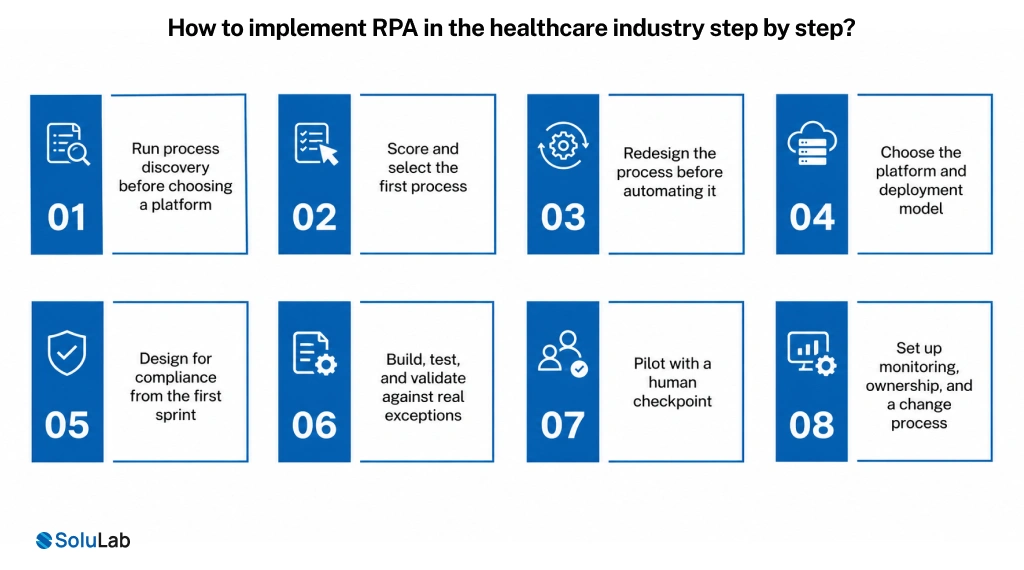
Eight steps, in sequence. Skipping straight to tooling is the single most common way these programs stall.
1. Run process discovery before choosing a platform
Sit with the billing and front-office teams and document what they actually do, not what the SOP says. Count transactions per month. You are building a shortlist of processes with high volume, low variation, and a clear cost per transaction.
2. Score and select the first process
Rank candidates on volume, rule stability, system count, and compliance sensitivity. Pick something with real volume but low clinical risk. Eligibility verification is the safe classic. Anything touching clinical decisions is a bad first choice, regardless of how appealing the ROI looks on paper.
3. Redesign the process before automating it
Remove the redundant approval, the duplicate data entry, the workaround someone invented in 2019. Automating the current-state process locks in its flaws. On most engagements, this step alone removes 15% to 25% of the steps before a single bot is built.
4. Choose the platform and deployment model
UiPath, Automation Anywhere, Blue Prism, and Power Automate all serve healthcare. Selection criteria that matter here: on-premises or private cloud deployment for PHI, credential vault support, audit logging depth, and how the vendor handles unattended bot licensing. Price per bot matters less than orchestration and governance features.
5. Design for compliance from the first sprint
Give each bot a scoped service account with the minimum permissions it needs. Store credentials in a vault, never in the script. Log every action with a timestamp and a bot identity. Define what happens to PHI in memory and in temporary files. Retrofitting this later means rebuilding.
6. Build, test, and validate against real exceptions
Build the happy path, then spend most of your testing time on exceptions: portal timeouts, changed screen layouts, missing fields, duplicate patient records. A bot that only handles clean inputs is not production-ready. Validation documentation should be assembled as you go, not written retrospectively for an audit.
7. Pilot with a human checkpoint
Run the bot in parallel with the existing manual process for two to four weeks. Compare outputs. Review every exception it raises. Only once accuracy holds and exception volume is understood should you retire the manual path.
8. Set up monitoring, ownership, and a change process
Assign an owner. Monitor success rate, exception rate, and processing time. Establish a path for the bot to be updated when a payer changes its portal, because it will. Programs without this decay within a year.
Teams that need delivery capacity rather than a full engagement can hire AI developers for defined build phases that already carry healthcare validation experience.
How do you keep healthcare RPA compliant and safe?
Treat every bot as a workforce member with system access. That framing gets the controls right: individual identity, least-privilege permissions, logged activity, periodic access review, and a documented offboarding path when the bot is retired.
1. HIPAA and PHI handling
Bots touching PHI fall under the same safeguards as staff. Encrypt data in transit and at rest, restrict where temporary files land, and confirm your platform vendor will sign a business associate agreement. Cloud orchestration that stores execution logs containing PHI outside your controlled environment is a real exposure, and it is easy to miss during procurement.
2. Audit trail and traceability
Every bot action needs to be reconstructable: what it did, when, with which credentials, on which record. Auditors will ask. So will your own team the first time a claim posts incorrectly and nobody can explain why.
3. Human oversight where it matters
Define which outcomes a bot can finalize and which require a human sign-off. Financial write-offs, clinical documentation changes, and anything affecting patient communication belong in the second category. This is also the point where AI consulting input pays for itself, because the boundary between automatable and reviewable is a governance decision, not a technical one.
4. Change management with staff
Tell people what the bot does and what it does not. Automation announced badly reads as a layoff notice, and the staff who understand the process best are exactly the ones you need cooperating during discovery. Frame it as removing the eleven hours of portal clicking, because that is usually what it actually does.
What does healthcare RPA cost and how long does it take?
A first production automation typically costs between $30,000 and $80,000 to design, build, and validate, and takes 8 to 16 weeks. Platform licensing sits on top of that, usually charged per bot per year. Costs scale with process complexity and the number of systems involved, not with transaction volume.
1. What drives the number
| Cost driver | Effect on budget | Why |
| Number of systems touched | High | Each application adds credentials, error handling, and test cycles |
| Process variation | High | Every exception path is separate development and testing work |
| Compliance scope | Moderate to high | PHI handling adds validation documentation and review cycles |
| Legacy interface stability | Moderate | Older screens break more often and need defensive design |
| Unstructured documents | High | Pushes the build from RPA into document AI territory |
| Ongoing maintenance | Recurring | Portal and EHR updates require bot changes, typically quarterly |
2. Where teams underestimate
Maintenance. Almost universally. A bot is not a one-time build; it is a small piece of software with external dependencies you do not control. Plan for a recurring maintenance allocation from the start, roughly in line with what you would budget for any integration you did not own the endpoints of.
The second underestimate is exception handling. Building the happy path is perhaps 30% of the work on a healthcare process. The rest is everything the payer portal does when it is having a bad day.
3. Building the business case
Calculate cost per transaction today: fully loaded staff hours divided by monthly volume. Multiply the difference by annual volume. Add avoided rework from error reduction, which in claims work is often larger than the labor saving itself. Present payback in months, not percentage efficiency gains, because finance teams discount efficiency claims, and they are right to.
Why do healthcare RPA projects fail, and how do you avoid it?
Most fail on process selection, maintenance neglect, and unmeasured ROI rather than on technology. Gartner has noted that while hyperautomation remains a staple discipline for around 90% of large enterprises, fewer than 20% of organizations have mastered measuring their hyperautomation initiatives.
Healthcare mirrors that gap. In Deloitte’s 2026 Global Health Care Outlook, 51% of health system leaders said they either had not measured returns on their AI investments or considered it too early to tell, while 31% reported moderate financial returns.
1. Automating an unstable process
If the rules change monthly, the bot breaks monthly. Stability matters more than volume when you are choosing the first target. Check how often the process changed in the past year before you commit.
2. No named owner after go-live
The project team disbands, the bot runs unattended, and six months later nobody notices it has been silently failing on 12% of transactions. Ownership is not a nice-to-have. It is the difference between an automation program and a pile of orphaned scripts.
3. Measuring bot count instead of outcomes
“We have 40 bots in production” tells you nothing. Straight-through processing rate, exception rate, cost per transaction, and hours returned to clinical staff tell you everything. Pick three and report them monthly from the pilot onward.
4. Underinvesting in exception design
The bot that stops cleanly and raises a ticket is far more valuable than the one that guesses. In healthcare, a wrong guess can mean a misposted payment or an incorrectly closed authorization. Design failure behavior deliberately.
5. What good execution produces
On an anonymized engagement for a healthcare provider network, our team built an autonomous revenue cycle platform combining agents with FHIR API and Epic integrations, OCR, and payer connections. The system verified insurance, suggested coding, validated claims, monitored reimbursements, and resolved denials.
Reported outcomes were 56% faster claims submission, 43% fewer claim denials, and a 37% improvement in the cash collection cycle. Those numbers arrived after a phased rollout across process areas, not at launch. The first eight weeks looked ordinary, which is normal and worth setting expectations around before you begin.
Providers extending automation toward patient-facing channels usually pair this with healthcare chatbots and, over a longer horizon, the shift described in the future of AI in healthcare.
Conclusion
Implementing robotic process automation in healthcare is mostly an operations discipline wearing a technology label. The organizations that succeed spend their first month watching how work actually happens, fix the process before they automate it, pick a boring high-volume target, and put a named owner behind every bot in production. The ones that struggle start with a platform demo.
If you are evaluating this, resist the urge to build a roadmap of twenty automations. Pick one process with real volume and low clinical risk, run it in parallel for a month, and let the exception data tell you what your second automation should be.
SoluLab, an AI development company, can help your business identify the right processes, build compliant automation, and connect it to the systems you already run.
FAQs
Neha is a curious content writer with a knack for breaking down complex technologies into meaningful, reader-friendly insights. With experience in blockchain, digital assets, and enterprise tech, she focuses on creating content that informs, connects, and supports strategic decision-making.