
Key Takeaways
- Modernization is not a hardware refresh. The point is to change how infrastructure is provisioned, scaled and operated, not to buy newer boxes.
- Most real programmes mix approaches. Rehost the systems facing a hard exit date, then refactor only the applications that justify it.
- Skipping assessment is the most common cause of overrun. Teams migrate systems that should have been retired.
- Lift-and-shift without right-sizing often costs more than the old data centre. Governance and continuous optimisation are what deliver the savings.
- You run old and new side by side during transition. That doubles the attack surface until the legacy system is decommissioned.
- Infrastructure as code ties the layers together. Terraform or CloudFormation makes environments versioned and repeatable instead of hand-built.
- AI stalls on three things legacy stacks lack. Elastic GPU compute, clean consolidated data and container-based MLOps platforms.
Infrastructure modernization is the work of upgrading legacy IT, meaning physical servers, fixed storage, static networks and monolithic applications, into cloud-native, automated and elastic systems. It covers compute, storage, network, data and applications, plus the security and governance around them. Therefore the goal is lower cost, faster delivery and readiness for data and AI workloads.
SoluLab plans and runs these programmes end to end, from assessment through migration and optimisation. If you are scoping a move off aging hardware, our cloud application development team builds and re-architects the applications that sit at the centre of most modernisation work.
On this page: what infrastructure modernization means, why companies do it, the four migration approaches compared, the six components of a programme, a four-phase roadmap, the biggest challenges, AI readiness and how to start.

What Is Infrastructure Modernization?
Infrastructure modernization is the process of replacing or upgrading legacy IT so it runs on modern, cloud-native, automated platforms. In practice that means moving off on-premises servers and manual processes toward containers, managed services and infrastructure as code.
The scope is wider than a single migration. A full programme touches five layers.
Compute. In practice, physical or virtual machines move to containers, Kubernetes or serverless functions.
Storage. Similarly, fixed disk arrays give way to object storage and managed database services.
Network. Static networks become software-defined, with segmentation and zero-trust controls.
Applications. Meanwhile, monoliths are rehosted, replatformed or broken into microservices.
Security and governance. Identity, logging and policy are automated instead of ticketed.
Modernization is not the same as buying newer hardware. Instead, the point is to change how infrastructure is provisioned, scaled and operated.
Why Do Companies Modernize Their Infrastructure?
Companies modernize to cut operating cost, ship software faster, tighten security and prepare for AI workloads that legacy systems cannot handle. The trigger is usually a mix of rising maintenance bills, slow release cycles and hardware nearing end of support.
Cost efficiency. Because pay-as-you-go compute and storage replace over-provisioned data centres, so you stop paying for idle capacity.
Scalability. Elastic infrastructure absorbs traffic spikes automatically, rather than forcing a capacity-planning project.
Reliability. Together, managed services, multi-zone deployment and automated failover raise uptime above what a single data centre offers.
Security. Modern platforms centralise identity, encryption and patching, and they make compliance evidence easier to produce.
AI and data readiness. Elastic GPU compute and clean pipelines let you run workloads legacy stacks cannot support.
Meanwhile, the cost of standing still is real. Aging systems accumulate technical debt, get harder to hire for, and widen the security gap as vendors drop support.
What Are the Main Infrastructure Modernization Approaches?
There are four primary approaches: rehost, replatform, refactor and replace. They trade effort and cost against long-term payoff. Consequently, most real programmes mix approaches across the portfolio.
These map onto the widely used migration frameworks. Amazon popularised the “6 Rs”, and both IBM and Microsoft’s Cloud Adoption Framework document the same set of strategies.
| Approach | What it means | Effort | Cost | Risk | Payoff |
| Rehost (lift and shift) | Move as-is to cloud VMs, no code changes | Low | Low | Low | Fast data-centre exit, limited cloud benefit |
| Replatform | Minor tweaks such as a managed database or container runtime | Medium | Medium | Medium | Scaling and cost wins without a rewrite |
| Refactor (re-architect) | Redesign into microservices or serverless | High | High | Medium to high | Full elasticity, resilience and speed |
| Replace / rebuild | Retire the app and adopt SaaS or build fresh | High | High | High | Removes technical debt, changes workflows |
Rehost is often the right first move when you face a hard data-centre exit date. After that, refactor selectively. Not every system deserves a rewrite.
What Are the Key Components of a Modernization Programme?
A programme spans six components: compute, storage, network, data, applications, and security and governance. You rarely modernize one in isolation, because a re-architected application usually forces changes in data, network and identity at the same time.
Compute. Containers and Kubernetes for portable workloads, serverless for event-driven work, right-sized VMs for the rest.
Storage. This covers object storage for unstructured data, managed databases, and tiering to control cost.
Network. Software-defined networking, private connectivity, segmentation and zero-trust access.
Data. Likewise, consolidated pipelines and a warehouse or lakehouse give analytics and AI clean inputs.
Applications. The monoliths, batch jobs and integrations that get rehosted, replatformed or rebuilt.
Security and governance. Finally, automated identity, secrets management, policy as code, logging and cost controls.
Infrastructure as code, using tools such as Terraform or CloudFormation, ties these together. As a result, environments become versioned and repeatable instead of hand-built.

What Does an Infrastructure Modernization Roadmap Look Like?
A practical roadmap runs in four phases: assess, plan and prioritise, migrate or refactor, then optimise and govern. Treating it as a continuous programme rather than a one-time cutover is what separates smooth modernizations from stalled ones.
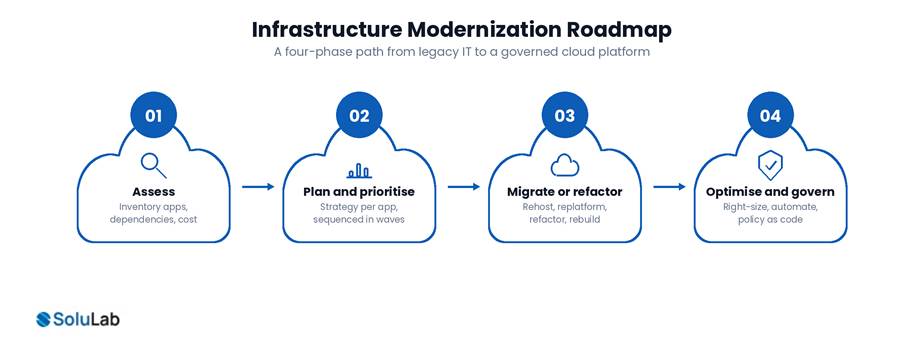
1. Assess. First, inventory every application, dependency and cost. Then score each system on business value, technical health and migration difficulty.
2. Plan and prioritise. Next, pick a strategy per application, sequence the work in waves, and agree the target architecture.
3. Migrate or refactor. Then execute in waves, starting with low-risk workloads to build the runbook before touching business-critical systems.
4. Optimise and govern. Finally, after cutover, right-size resources, automate scaling, enforce policy as code, and track cost continuously.
The order matters. Skipping assessment is the most common reason budgets overrun, because teams migrate systems that should have been retired.
What Are the Biggest Challenges?
The biggest challenges are technical debt, downtime risk during cutover, skills gaps, cost overruns and security exposure while systems are in transition. Most are manageable with planning. However, they derail programmes that jump straight to migration.
Technical debt. In reality, undocumented dependencies surface mid-migration, which is why assessment is non-negotiable.
Downtime risk. Cutovers break dependent systems. Therefore use wave-based migration, parallel running and tested rollback plans.
Skills gaps. Equally, teams fluent in legacy stacks may lack Kubernetes, cloud networking or infrastructure-as-code experience.
Cost overruns. Lift-and-shift without right-sizing often costs more than the old data centre.
Security exposure. During transition you run old and new side by side, doubling the attack surface until the legacy system is decommissioned.
Timelines and budgets vary widely by portfolio size and approach, so scope both against an assessment rather than a published range.
How Does Modernization Prepare Infrastructure for AI?
Modernization prepares infrastructure for AI by delivering elastic GPU compute, clean consolidated data pipelines, and platforms that scale training and inference on demand. Legacy stacks usually fail on all three, which is why AI projects stall before they start.
Elastic compute. Specifically, AI training needs bursts of GPU capacity that fixed on-premises hardware cannot supply cost-effectively.
Clean data. After all, models are only as good as their inputs, so consolidated pipelines replace scattered extracts.
MLOps-ready platforms. In addition, containers, orchestration and CI/CD let teams deploy and retrain models the way they ship software.
This is where cloud and AI expertise combine. SoluLab builds the modernized platform and the AI workloads on top of it, so the infrastructure is designed for the models it will run rather than retrofitted later.
How Do You Start an Infrastructure Modernization Project?
Start with an assessment and a prioritised backlog, not a migration. Inventory your systems, score them on value and difficulty, pick a strategy per application, then run a small low-risk workload first to prove the approach.
A realistic first 90 days looks like this. Run the assessment and dependency mapping in weeks one to four. Next, agree the target architecture and wave plan by week six. Finally, migrate a pilot workload and capture the runbook before scaling out.
Bring in a cloud partner if your team is stretched on Kubernetes, networking or infrastructure as code.
Where Does SoluLab Fit?
SoluLab supports each stage. Our cloud computing consulting team runs the assessment and target-architecture work. Meanwhile, our DevOps consulting services automate the pipelines, infrastructure as code and governance that keep a modernized platform reliable.
For the applications themselves, this overlaps with broader enterprise software development, since most infrastructure modernization work is ultimately about the applications running on top.
Frequently Asked Questions
Shipra Garg is a tech-focused content strategist and copywriter specializing in Web3, blockchain, and artificial intelligence. She has worked with startups and enterprise teams to craft high-conversion content that bridges deep tech with business impact. Her work translates complex innovations into clear, credible, and engaging narratives that drive growth and build trust in emerging tech markets.