Talk to an Expert
Get in Touch

HR Chatbots – Benefits and Use cases

HR Chatbots - Benefits and Use cases

The field of human resource management is being revolutionized by the incorporation of HR chatbots. These modern HR AI chatbots are revolutionizing HR operations by providing ways to improve employee experiences, expedite procedures, and create a more productive workplace. This blog delves into the revolutionary power of AI chatbots in HR, emphasizing their advantages, including enhanced query response, heightened efficiency, and economic viability. We’ll also look at popular HR chatbot use cases like hiring and employee engagement, emphasizing how important these digital assistants are to the changing nature of remote and hybrid work environments.

So, without any further ado, let’s get started!

Overview of HR Chatbots

Imagine working at a company where onboarding goes smoothly, HR questions are promptly resolved, and employee engagement is constantly high. Greetings from the age of HR chatbots, the new digital assistants that are making the field of human resources more responsive, dynamic, and effective.

HR chatbots are becoming more than just automated question-answer systems thanks to artificial intelligence (AI). They can now comprehend, communicate with, and instantly handle HR-related problems. These chatbots are creating better accessibility and user-friendliness in every HR function, from guiding new hires through their first week on the job to answering HR chatbot benefits questions for staff members and expediting the hiring process.

Chatbots in human resources are the link between effective HR administration and a better employee experience at a time when the workforce is becoming more distributed and digital. They’re not only tools; rather, they represent the intelligent, adaptable, and vitally efficient HR of the future.

What is a Chatbot for HR?

A sophisticated conversational AI designed to handle a range of HR-related activities and questions is known as a chatbot for HR. It’s an intelligent system with generative AI and natural language processing (NLP) capabilities, not merely a tool for basic question answering. It can comprehend and react to a wide range of HR inquiries, from leave regulations and employee benefits to more complicated matters like performance reviews, onboarding procedures, and training courses, thanks to these capabilities.

An HR AI chatbot’s primary goal is to automate and expedite time-consuming, repetitive HR operations. By doing this, HR personnel’s burden may be greatly decreased, greatly improving the employee experience, and freeing them up to focus on important and challenging problems. 

These HR industry chatbots are an essential component of the contemporary HR toolset since they are skilled at managing self-service portals, running employee surveys, and obtaining feedback.

Because of their versatility, HR chatbots may be implemented into a wide range of platforms, including messaging apps, intranets, corporate websites, and mobile applications. The existence of many platforms guarantees that workers may obtain HR assistance at any time and from any location, promoting a more cohesive and effective work environment.

Top HR Chatbot

Now that you are aware of what is an HR chatbot here is the list of top HR chatbots:

1. Leena AI

By automating all potential HR processes, and procedures and expediting employee requests, Leena.AI, enables chat and seeks to listen to the load of daily tasks of the HR team. Based on organizational needs, it enables businesses to customize staff workflows. This HR chatbot has natural language comprehension capabilities that enable it to automatically answer your employees’ questions and concerns, enabling them to submit tickets any time they require assistance and streamline HR procedures.

Features

  • Natural Language Comprehension for inquiries 
  • A ticketing system for staff assistance
  • Individualized work processes for employees
  • Simplifying HR procedures and activities
  • Efficient management of HR tasks, and workflow

2. Rezolve.AI

Rezolve.AI is a modern HR help that integrates with MS teams and provides workers with automated and customized HR assistance with the help of Generative AI HR chatbot sidekick. Employees can communicate with this HR chatbot any time they run into issues. By developing a customized solution, this interactive Help chatbot will promptly attract the employees’ questions and concerns. In addition to saving time, this will make the employee experience smooth and easy for HR assistance representatives.

Features

  • Real-time HR assistance via Gen AI sidekick Chabot
  • Knowledge management through conversation that delivers accurate information at any time and from any location
  • Live chat with a human in the loop for L2 support
  • A new tool for employee engagement service together in input.
  • A no-code automation solution to simplify intricate HR procedures and activities
  • Accessible chain management with MS teams

3. Paradox.AI

Olivia is an HR chatbot that Paradox provides. Its purpose is to make applying for jobs easier. It makes it easy for applicants to apply by text message on this smartphone. It may check applications for employment criteria and enable video discussions with them via a straightforward link. With direct integration and public API, Olivia may also independently arrange interviews and integrate with a variety of devices, apps, and systems.

Features 

  • Texting to apply for a job
  • Interviews on videos
  • Screening of candidates
  • Scheduling of interview interviews
  • Combinations

4. Ideal

Ideal provides a hiring chatbot that effectively evaluates applications, increases candidate engagement, and does away with the need for lengthy phone screening. It can implement chatbot questionnaires via emails and instant messages and expedite that pre-screening procedure around the clock. Around 70% of exchanges can be effectively automated by the chatbot.

Features

  • Increasing the involvement of candidates
  • Pre-screenings
  • Giving top prospects priority
  • Qualifications of candidates
  • Distributing questionnaires chatbots

5. Humanly

A program called Humanly may automate communication with applications via websites, text, email, and career sites. It ensures that applicant profiles are kept up-to-date and uses objective questioning to gain insight into the background and skill set of the candidate. Humanly seeks applicants who can enhance the culture of your company.

Features

  • Responding to inquiries about candidates
  • Scheduling and screening
  • Engagement of candidates
  • Evaluating the backgrounds and abilities of applicants
  • Keeping candidate profiles, currently maintained

What Benefits Can HR Chatbots Offer?

Benefits of HR Chatbots

The efficacy and efficiency of human resource departments across companies are being redefined by the incorporation of HR chatbots.

The following are the primary benefits of chatbot in HR:

  • Quicker Procedures

HR department workflow is being revolutionized by HR chatbots. They are particularly good at hiring, onboarding, and managing leaves. They also excel at automating and streamlining other time-consuming operations. For instance, a chatbot can now precisely classify applications in hours instead of the days it used to take. This acceleration improves the overall effectiveness of HR operations by streamlining HR activities and drastically cutting the hiring time.

The second acceleration layer stems from their capacity to promptly address regular staff queries. This instantaneity is essential in hectic work settings where staff morale and productivity can be directly impacted by the prompt availability of information.

  • Simple Problem-Solving

Chatbots are a game-changing option for an HR department overrun with repeated queries. With their sophisticated natural language processing (NLP) skills, they can comprehend and instantly address a variety of employee inquiries. It guarantees that whenever workers want information on HR rules, perks, and processes, they will always get consistent and correct information.

Furthermore, HR chatbots free up real HR specialists to concentrate on more important and difficult problems by answering these repetitive questions. It not only makes the best utilization of a human resource chatbot but also raises employee satisfaction by guaranteeing that their issues are handled effectively and on time.

  • Transparent Responses

Chatbots in HR give employee interactions a never-before-seen degree of openness. Because their replies are based on facts, the information they offer is accurate and consistent. It is particularly important in delicate areas where fairness and clarity are critical, such as policy explanations or grievance redressals.

Furthermore, the impartiality of chatbots promotes confidence among staff members. Employees feel free to voice concerns or ask questions because they know they will get frank, unbiased answers, which fosters an honest and open work environment.

  • Increased Productivity

chatbot for HR greatly increases productivity both inside the HR division and throughout the whole company. They provide HR professionals more time by automating repetitive operations, allowing them to focus on more important duties like talent development and strategic planning. The organizational HR function is elevated by this transition from transactional to strategic activity.

Chatbots provide employees with instant access to HR information and assistance, which minimizes downtime and increases job satisfaction. Overall organizational productivity rises as a result of employees spending more time on their primary duties and less time navigating HR procedures.

CTA1

  • Streamlined Referrals Procedures

The employee recommendation process is made easier, more engaging, and more efficient by HR industry chatbots. To expedite the recommendation submission process, they might proactively inform staff members about available openings and provide an invitation to recommend qualified people. It expedites the hiring process and makes greater use of the current staff by drawing from a larger pool of talent.

Furthermore, chatbots are capable of managing and tracking referrals, and giving staff members information on the progress of their recommendations. This openness promotes a culture of cooperation and teamwork and motivates participants in the referral program to continue participating.

  • Economical Fix

For businesses, implementing a chatbot for HR is an affordable solution. These virtual assistants take care of a wide range of duties that would normally need substantial human resources. Chatbots provide significant cost savings in terms of salary, training, and other associated expenditures by eliminating the need for a sizable HR personnel to handle regular questions and tasks.

Furthermore, because chatbots are scalable, expanding firms may easily use them as cost-effective solutions to handle growing workloads. Their capacity to update and adjust to evolving HR rules and regulations guarantees that businesses stay compliant without having to pay additional fees.

Related: How AI Agents Will Influence the HR Industry?

  • Remote Workforce

In the current world of remote and hybrid work patterns, chatbots for HR are essential for facilitating communication over physical distances. They provide remote workers with round-the-clock assistance, responding to their questions and issues instantly, no matter where they are. This continuous accessibility guarantees that distant workers stay connected and get assistance, improving their productivity and quality of work life.

Additionally, recruiting chatbots in the HR industry simplifies remote onboarding and training procedures by giving recruits quick access to the data and tools they need. Despite their physical distance, it makes it easier for them to integrate into the company and contributes to the development of a cohesive and knowledgeable remote workforce.

  • Simple Workflows With Instantaneous Analytics

HR chatbots use real-time analytics to not only automate procedures but also deliver insightful information. HR departments may gain valuable insights into employee requirements and trends by using them to log interactions and collect data on employee questions and complaints. Chatbots for HR services and policies may be continuously improved thanks to this data-driven approach.

Additionally, these insights are essential for making strategic decisions. HR teams may improve employee happiness and retention by better tailoring their programs and efforts to the requirements of the workforce by studying employee habits and preferences.

What are the Top Use Cases of Chatbots in the HR Industry?

Use Cases of Chatbots in HR Industry

The introduction of HR chatbots is revolutionizing the ever-changing field of human resources. In labor management, these AI-driven solutions are generating new paradigms. HR chatbots are showing themselves to be quite useful tools, from automating repetitive work to offering strategic insights. Let’s examine six crucial areas where chatbots for HR are having a big influence:

1. Using Knowledge Bot for Inquiries

Use a knowledge bot to assist staff in finding information on their own. Your co-workers may ask a range of simple questions that require prompt action. These inquiries relate to subjects. Three subjects that frequently prompt employees to ask questions, you can use knowledge, but instead of making some employees repeatedly answer the same question or having them go through the library of resources. Each time they need assistance.

The knowledge bot operates as follows:

  • Employees may access the knowledge board on their company chat platform if they have a query or concern.
  • The employee then chooses to enter the category issue and include any relevant information under the search term.
  • After the worker selects apply filters, the bot instantly looks through all of the information and all of your company’s knowledge bases.
  • The member can then access the article page by clicking on the links provided.

2. Welcome Bot for Easy Onboarding 

Upon joining your company, a new hire will probably require assistance in determining which channels to join inside the messaging platform. This is especially relevant if they work remotely. The messaging app can be their one-stop shop for finding important information about the profession and connecting with co-workers.

Informing the newcomers about their first day can relieve the burden on your hiring managers in the HR department. It shares channels relevant to their field of expertise, provides extra avenues for the new hire to be informed about various company facts, and provides. A welcome-bot Slack message is sent on a new hire’s first day to further assist with the onboarding of the new hire by sharing a message that reminds the new employee to give a brief introduction to the business and explains important contacts at the company to the new hire.

3. Sending Birthday Wishes 

You have few alternatives for your employee’s birthdays when they work remotely. However, you may still use a Birthday bot to acknowledge their special day and try to make it much better. The HR chatbot will notify you if a team member’s birthday is coming up, giving you time to compose a curated message or wish them well in advance.

All of the team’s greetings are collected by Birthday and sent straight to the employee on their birthday. A birthday bought Slack message, requesting that I send in a birthday greeting for a coworker.

4. Recruiter Bot for Hiring Process

Employees gain more than just advantages when they are permitted to recommend friends and co-workers. References from employees are more likely to perform better and remain with the company for a longer period.

You can use a bot to encourage staff members to provide referrals. By offering a model in the company communication platform that has all of the necessary recommendation fees from your applicant tracking system, the HR chatbot enables staff members to make referrals. After the candidate has completed and submitted the form, add them to your ATS.

5. Standup Bot for Great Teamwork

Use the standup bot to communicate with members of your team and learn about the project. It’s easy to feel cut off from your team members and their jobs, especially since many of them probably work remotely. By employing a stand-up bot, you can listen to this emotion and foster greater teamwork.

This is how it will function:

  • Every morning, the bot poses a predetermined series of questions to every team member: how are you feeling this morning and what are your top three priorities for today as well are there any obstacles or inquiries?

Stand-up bot shares your response in your team’s channel on your corporate communications platform after you submit them. This way, everyone in your team can see how you are doing and what you’re working on, and then they can react appropriately.

HR Chatbot Statistics

Conversational AI systems are undoubtedly transforming hiring and personal management procedures. They are more successful and efficient because of this technology. The following significant figures demonstrate the growing impact of using chatbots in HR: 

  • Virtual assistance and machine learning applications have already been implemented by 13% of the teams.
  • According to Gartner, AI-based conversational platforms or bots will handle 75% of the queries.
  • Around 92% of departments in HR, acknowledge the usefulness of boards in helping staff members find the information they require.
  • 73% of candidates were unable to discover whether they were speaking with a bot since the AI product’s user interface is so smooth.
  • A career website that uses the chatbot to interact with Job search reports, a notable increase in results, such as 40% of completed application applications, 95% more leads, and 13% greater clicking on job requests.

The Future of HR Chatbots

1. The trend of HR is increasing the concentrated or employee well-being in the future:

2. Organizations should expand HR benefits to include mental health, work, life, balance, and wellness programs.

3. Companies invest more in supporting settings that promote professional progress and well-being since the workforce is a crucial asset.

4. Chatbot integration will change HR. This text will improve HR productivity by improving recruitment.

5. Immersive learning with augmented reality and virtual reality can change training programs.

These trends indicate a change towards a more people-centric, technologically adept, and forward approach to HR chatbots.

CTA2

Concluding Remarks

In conclusion, the journey towards revolution of human resources (HR) chatbots requires a proactive and adaptive mindset. As we anticipate the future of HR, it is evident that the focus will remain steadfast on employee well-being and the seamless integration of emerging technologies. 

Companies like SoluLab stand at the forefront of transforming the HR industry. Through our AI development services, we empower organizations to harness the potential of artificial intelligence in reshaping HR processes. By leveraging renowned AI solutions, SoluLab enables companies to streamline recruitment, enhance employee engagement, and make data-driven decisions. SoluLab, an AI development company, emerges as a key partner in unlocking the transformative power of AI in the realm of Human Resources.

FAQs

1. What is an HR chatbot?

Artificial intelligence (AI) powered virtual assistants known as HR Chatbots assist with human resource duties. They can perform actions, automate repetitive operations, and respond to inquiries from candidates and employees. 

2. How are chatbots used in recruiting?

By automating first-contact interactions with candidates and responding to commonly asked questions regarding job openings and the organization, pre-screening candidates based on their skills, setting up interviews, and generally expediting the hiring process by offering convenient communication. 

3. Which is the chatbot for HR-related queries?

“Leena AI” is a comprehensive AI assistant that can handle a variety of HR tasks, including performance management, employee management, and information access via a conversational interface.

4. Why is there a growing emphasis on employee well-being in HR practices?

In today’s workplace, work-life balance, psychological wellness, and stress management are becoming more important because healthy and happy employees boost productivity, retention, engagement, and the company’s bottom line. 

5. How to build a recruitment chatbot?

For building a recruitment chatbot you will have to identify the type of chatbot that you need, then move ahead with designing a conversational job application, integrate management tools within the bot, add conditions, and lastly set automated schedules for interviews.

6. Are chatbots useful for human resource management?

Chatbots can automate repetitive tasks like responding to commonly asked questions about policies, benefits, and leave which freezes up HR professionals to work on more strategic projects. They can also improve staff members access to information and streamline processes like hiring and boarding.

7. What is the name of the digital HR chatbot?

EVA is a well-known digital HR chatbot developed by Leena AI. It is an AI-powered board that aims to improve the experience of employees by answering HR-related questions. 

Metaverse Use Cases and Benefits

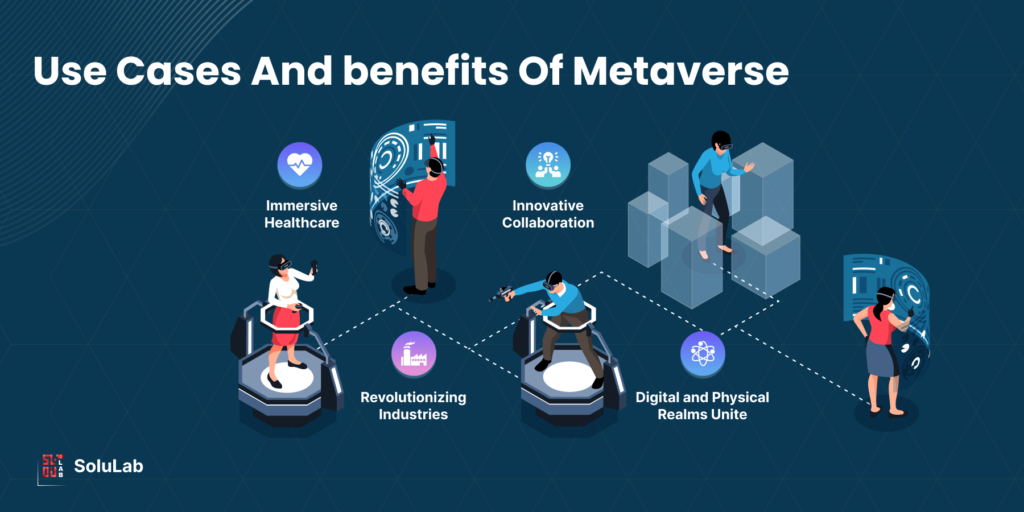
Use Cases and Benefits of Metaverse

The Metaverse, a convergence of physical and digital realities, has the potential to revolutionize many industries. This exploration will examine a variety of Metaverse use cases across industries, highlighting the ways in which virtual and physical realms can be mutually beneficial.

One of the most promising Metaverse use cases is in the healthcare industry. Virtual reality (VR) and augmented reality (AR) can be used to create immersive experiences that can help patients with a variety of conditions. For example, VR can be used to create realistic simulations of surgical procedures, which can help surgeons to practice and improve their skills. AR can be used to provide patients with real-time information about their condition, which can help them to better understand their treatment and make informed decisions.

The Metaverse can also be used to improve education. VR and AR can be used to create immersive learning experiences that can make it easier for students to understand complex concepts. For example, VR can be used to create simulations of historical events or natural disasters, which can help students to develop a better understanding of the world around them. AR can be used to provide students with real-time information about their surroundings, which can help them to learn more effectively.

The Metaverse has the potential to transform the way we work. VR and AR can be used to create collaborative workspaces that allow people to work together from anywhere in the world. This can improve productivity and reduce travel costs. VR can also be used to create simulations of real-world environments, which can help employees to learn new skills and improve their performance.

The Metaverse can also be used to create new forms of entertainment. VR and AR can be used to create immersive experiences that can transport users to new worlds. This can make for more engaging and immersive entertainment experiences.

The Metaverse is still in its early stages of development, but it has the potential to revolutionize many industries. By merging physical and digital realities, the Metaverse can create new opportunities for businesses and consumers alike.

Related: Guide on 7 Layers of the Metaverse

Understanding Metaverse Use Cases

In the expansive landscape of the Metaverse, use cases are manifold. From education and entertainment to commerce and beyond, the Metaverse offers a myriad of applications. Its versatility lies in its ability to bridge geographical gaps, foster collaboration, and create immersive experiences for users.

For example, in the education sector, the Metaverse can be used to create virtual classrooms that allow students from all over the world to learn together. This can be a great way to reduce barriers to education and provide students with access to a wider range of learning opportunities. Additionally, the Metaverse can be used to create interactive simulations and games that can help students learn in a more engaging way.

In the entertainment sector, the Metaverse can be used to create immersive virtual worlds where users can interact with each other and explore new environments. This can be a great way to escape from the real world and have fun with friends. Additionally, the Metaverse can be used to create new forms of entertainment, such as concerts and sporting events, that can be enjoyed by people all over the world.

In the commerce sector, the Metaverse can be used to create virtual stores where users can shop for products and services. This can be a great way for businesses to reach new customers and expand their reach. Additionally, the Metaverse can be used to create new forms of customer engagement, such as virtual product demos and customer service.

These are just a few examples of the many ways that the Metaverse can be used. As the technology continues to develop, we can expect to see even more innovative and creative applications for the Metaverse in the years to come.

Metaverse Development Services

Benefits of the Metaverse

The benefits of the Metaverse extend beyond virtual realms. Enhanced collaboration, connectivity, and economic opportunities define the Metaverse’s positive impact. Users experience a new dimension of interconnectedness, ushering in an era where physical and virtual realities converge seamlessly.

  • Enhanced collaboration: The Metaverse allows people from all over the world to collaborate in real time, regardless of their physical location. This can be a game-changer for businesses, as it allows teams to work together more efficiently and effectively. For example, a team of designers could collaborate on a new product design, or a team of engineers could collaborate on a new software development project.
  • Connectivity: The Metaverse also provides a new way for people to connect with each other. For example, people can attend virtual concerts, sporting events, or even parties. This can be a great way for people to stay connected with friends and family who live far away.
  • Economic opportunities: The Metaverse also creates new economic opportunities. For example, businesses can sell virtual goods and services, or they can charge users for access to their virtual worlds. This can be a lucrative business, as the Metaverse is expected to grow to a multi-trillion dollar market in the coming years.

The Metaverse is still in its early stages of development, but it has the potential to revolutionize the way we live, work, and play. By providing new ways for people to collaborate, connect, and create, the Metaverse has the potential to make the world a more interconnected and prosperous place.

Healthcare Metaverse Use Cases

Use Cases of Healthcare Metaverse

In healthcare, the Metaverse emerges as a catalyst for change. From Healthcare Metaverse Use Cases like virtual medical consultations to training simulations and therapeutic interventions, the Metaverse is redefining patient care. This section delves into the tangible impacts, offering insights into improved accessibility, skill development for medical professionals, and innovative mental health treatments within the virtual realm.

1. Virtual Medical Consultations

Virtual consultations redefine healthcare accessibility by providing patients with real-time interaction with healthcare providers, eliminating geographical constraints, and enhancing healthcare delivery. This can be especially beneficial for patients who live in rural areas or who have difficulty traveling to see a doctor. Virtual consultations can also be more convenient for patients who work full-time or have other commitments that make it difficult to schedule appointments.

In addition to improving accessibility, virtual consultations can also help to reduce costs for patients. By eliminating the need for travel, patients can save money on gas, parking, and other transportation costs. Additionally, virtual consultations can often be completed more quickly than in-person appointments, which can save patients time and money.

Virtual consultations can also provide a more comfortable and convenient experience for patients. Patients can feel more relaxed and at ease in their own homes, and they can access the care they need without having to leave their homes. This can be especially beneficial for patients who are feeling ill or who have mobility issues.

Overall, virtual consultations offer a number of benefits for patients, including improved accessibility, reduced costs, and a more comfortable and convenient experience. As virtual healthcare continues to evolve, it is likely that virtual consultations will become an increasingly common way for patients to access healthcare.

2. Medical Training Simulations

In the Metaverse, medical professionals can immerse themselves in realistic training simulations that not only enhance their skills, but also provide a risk-free environment for honing expertise. For example, a surgeon can practice a complex procedure on a virtual patient, without the risk of harming a real person. This can help to improve surgeons’ confidence and skills, and ultimately lead to better patient outcomes.

In addition to surgical training, the Metaverse can also be used for other types of medical training, such as practicing patient communication, diagnosing diseases, and prescribing medications. This can help to improve the overall quality of care that patients receive.

The Metaverse is still in its early stages of development, but it has the potential to revolutionize medical training. By providing a safe and realistic environment for practicing, the Metaverse can help to improve the skills of medical professionals and ultimately lead to better patient outcomes.

3. Therapeutic Interventions

Virtual reality Metaverse is becoming a powerful tool in mental health treatment. Immersive therapy sessions in the Metaverse offer therapeutic interventions, providing new avenues for mental health support.

Industrial Metaverse Use Cases

Industries are undergoing a profound transformation through Industrial Metaverse Use Cases. Virtual prototyping, remote maintenance, and training simulations for industrial workers reshape how industries operate and innovate. As we navigate through these applications, witness the Metaverse as a catalyst for efficiency, collaboration, and groundbreaking advancements in manufacturing and beyond.

1. Virtual Prototyping in Manufacturing

Manufacturers leverage the Metaverse for accelerated product development. Virtual prototyping becomes a cost-effective and efficient means of testing and refining products.

The Metaverse is a virtual world where people can interact with each other and with digital objects. It is still in its early stages of development, but it has the potential to revolutionize the way we design, manufacture, and sell products.

One of the most significant ways that the Metaverse can be used to accelerate product development is through virtual prototyping. Virtual prototyping allows manufacturers to create digital models of their products that can be used to test and refine designs before they are ever built. This can save manufacturers a significant amount of time and money, as it eliminates the need to create physical prototypes.

In addition to saving time and money, virtual prototyping can also help manufacturers to improve the quality of their products. By being able to test and refine designs in a virtual environment, manufacturers can identify and correct potential problems before they occur. This can lead to products that are safer, more reliable, and more efficient.

The Metaverse is still a new technology, but it has the potential to revolutionize the way we design, manufacture, and sell products. By leveraging the Metaverse, manufacturers can accelerate product development, improve product quality, and reduce costs.

Related: Generative AI in the Metaverse

2. Remote Maintenance and Repairs

Field technicians can benefit from virtual assistance in the Metaverse in a number of ways. For example, virtual assistants can provide real-time guidance and support to technicians who are working on complex or unfamiliar tasks. This can help to reduce the risk of errors and improve the efficiency of the maintenance and repair process. Additionally, virtual assistants can be used to monitor the performance of equipment and identify potential problems before they become serious. This can help to prevent downtime and keep operations running smoothly.

Here are some specific examples of how virtual assistance can be used to improve field maintenance and repairs:

  • A virtual assistant can provide step-by-step instructions to a technician who is working on a complex repair. The assistant can also provide real-time feedback to the technician, helping them to avoid mistakes.
  • A virtual assistant can monitor the performance of equipment and identify potential problems. The assistant can then alert the technician to the problem so that it can be addressed before it becomes serious.
  • A virtual assistant can provide remote support to technicians who are working in remote locations. This can help to reduce the need for technicians to travel to the site of the problem, which can save time and money.

Overall, virtual assistance can be a valuable tool for field technicians. It can help to improve safety, efficiency, and productivity.

3. Training Simulations for Industrial Workers

Industrial workers are increasingly using virtual environments to enhance their skills. Safety training and emergency response simulations are two common uses for virtual environments. These simulations can help workers prepare for real-world scenarios by providing them with a safe and controlled environment in which to practice their skills.

For example, a worker who is training for a job in a hazardous environment may use a virtual environment to practice responding to a hazardous materials spill. The worker can learn how to identify the hazardous materials, how to safely contain the spill, and how to evacuate the area. This type of training can help workers to stay safe in the event of a real-world hazardous materials spill.

Another common use for virtual environments is emergency response simulations. These simulations can help workers to prepare for a variety of emergencies, such as fires, floods, and earthquakes. Workers can learn how to respond to the emergency, how to evacuate the area, and how to provide first aid. This type of training can help workers to save lives in the event of a real-world emergency.

Virtual environments are a valuable tool for industrial workers. They can help workers to learn new skills, prepare for emergencies, and stay safe in the workplace.

Metaverse Use Cases in Healthcare

The intersection of the Metaverse and healthcare is a testament to innovation. Metaverse Use Cases in Healthcare redefine how patients access medical services, how professionals hone their skills, and how therapeutic interventions are conducted. Join us in uncovering a world where the Metaverse becomes a dynamic space for better health outcomes, bridging the gap between virtual and physical realities.

1. Digital Health Records in a Virtual Environment

The Metaverse hosts secure and accessible health records, streamlining healthcare systems and providing a comprehensive digital platform for managing patient data. This integration allows patients to access their health records from anywhere, at any time, and gives healthcare providers a single, centralized view of patient data. The Metaverse also offers a number of other benefits for the healthcare industry, including:

  • Improved patient care: By providing patients with access to their health records, the Metaverse can help to improve patient care by enabling patients to be more involved in their own care and to make informed decisions about their health.
  • Reduced costs: By streamlining healthcare systems, the Metaverse can help to reduce costs by eliminating the need for duplicate records and by making it easier for healthcare providers to communicate with each other.
  • Increased efficiency: By providing a single, centralized view of patient data, the Metaverse can help to improve efficiency by reducing the time that healthcare providers spend searching for patient information.

The Metaverse is still in its early stages of development, but it has the potential to revolutionize the healthcare industry. By providing secure and accessible health records, the Metaverse can help to improve patient care, reduce costs, and increase efficiency.

2. Patient Education and Engagement

Patients enter interactive learning platforms within the Metaverse. Health awareness campaigns gain momentum as patients engage in virtual spaces for education. These virtual spaces provide a safe and engaging environment for patients to learn about their conditions and treatments. They can also connect with other patients and share their experiences. This can help to reduce feelings of isolation and loneliness, and can also provide patients with a sense of community.

In addition to providing educational resources, virtual spaces can also be used to deliver healthcare services. For example, patients can meet with their doctors or therapists in a virtual setting. This can be helpful for patients who live in rural areas or who have difficulty traveling to a doctor’s office. Virtual spaces can also be used to conduct clinical trials and research. This can help to improve the quality of healthcare and make it more accessible to patients.

The Metaverse is still in its early stages of development, but it has the potential to revolutionize healthcare. By providing patients with a safe, engaging, and accessible environment for learning and healthcare, the Metaverse can help to improve the quality of life for patients around the world.

3. Global Collaborations in Medical Research

The Metaverse is a virtual world where people can interact with each other and with digital objects. It has the potential to revolutionize medical research by making it possible for researchers from all over the world to collaborate in real time. Virtual laboratories and shared research spaces can be created in the Metaverse, where researchers can access the same data and tools, regardless of their location. This can greatly accelerate the pace of medical research and lead to new breakthroughs in the treatment of diseases.

For example, a team of researchers from the United States, Europe, and Asia could collaborate on a new drug development project in the Metaverse. They could share data, access the same research tools, and hold virtual meetings to discuss their progress. This would be much more difficult to do in the real world, where travel and communication can be expensive and time-consuming.

The Metaverse also has the potential to make medical research more accessible to people in developing countries. With virtual laboratories and shared research spaces, researchers in these countries can access the same resources as their counterparts in developed countries. This could help to level the playing field and lead to better healthcare outcomes for everyone.

The Metaverse is still in its early stages of metaverse development, but it has the potential to revolutionize medical research. By making it possible for researchers from all over the world to collaborate in real time, the Metaverse can accelerate the pace of medical research and lead to new breakthroughs in the treatment of diseases.

Metaverse Use Cases in Manufacturing

Metaverse Use Cases in Manufacturing

Manufacturing sees a paradigm shift through Metaverse Use Cases in Manufacturing. From supply chain optimization to collaborative design and engineering, the Metaverse becomes a catalyst for efficiency and innovation. This section explores how manufacturers navigate the digital realm to streamline processes, reduce downtime, and unlock new possibilities in the manufacturing landscape.

1. Supply Chain Management in a Virtual World

Manufacturers are optimizing supply chain management within the Metaverse, a digital world where users can interact with each other and with virtual objects. Enhanced visibility and transparency are redefining how supply chains operate in the digital realm.

In the Metaverse, manufacturers can track their products in real time, from the point of origin to the point of sale. This level of visibility allows manufacturers to identify and address potential problems early on, which can help to improve efficiency and reduce costs.

Additionally, the Metaverse can be used to create virtual simulations of supply chains. These simulations can be used to test different scenarios and to identify potential risks. This information can then be used to make better decisions about how to manage the supply chain.

The Metaverse is still in its early stages of development, but it has the potential to revolutionize supply chain management. By providing enhanced visibility and transparency, the Metaverse can help manufacturers to improve efficiency, reduce costs, and mitigate risk.

2. Collaborative Design and Engineering

Global teams collaborate seamlessly in the Metaverse for design and engineering.

With the Metaverse, global teams can collaborate in real time on product development projects, regardless of their physical location. This allows for more efficient and innovative product development, as teams can work together more closely and share ideas more easily.

For example, a team of engineers in the United States could work with a team of designers in Europe to design a new product. Using the Metaverse, the engineers and designers can see each other’s work in real time and make changes as needed. This would not be possible if the teams were working in different physical locations, as it would take too long to send files back and forth and make changes.

The Metaverse also allows for more immersive collaboration. Teams can use virtual reality (VR) headsets to experience the product they are designing in a realistic way. This can help them to identify potential problems and make improvements to the design. Overall, the Metaverse has the potential to revolutionize product development by making it more efficient, innovative, and immersive.

Related: Top Metaverse Development Companies in 2024

3. The Future of the Metaverse

As technology advances, the Metaverse will evolve, shaping the future of virtual realities. Predictions suggest a profound impact on industries and society, marking an era where the boundaries between physical and digital fade away.

The Metaverse is a concept of a persistent, immersive, and shared virtual world that is accessible through different devices. It is often compared to the internet, but it is more than just a collection of websites. The Metaverse is a place where people can interact with each other, create content, and experience new things.

The Metaverse is still in its early stages of development, but it has the potential to revolutionize many industries. For example, the Metaverse could be used for education, healthcare, retail, and entertainment. In education, the Metaverse could provide students with a more immersive and interactive learning experience. In healthcare, the Metaverse could be used to provide patients with remote care and to train medical professionals. In retail, the Metaverse could be used to create virtual stores and to allow customers to try on clothes and furniture before they buy them. In entertainment, the Metaverse could be used to create new forms of gaming, social media, and entertainment.

The Metaverse will also have a profound impact on society. As the Metaverse becomes more popular, people will spend more time in virtual worlds. This could lead to a decline in face-to-face interaction and a rise in social isolation. However, the Metaverse could also be used to connect people from different cultures and backgrounds. It could also be used to promote social change and to educate people about important issues.

The Metaverse is still a new concept, but it has the potential to change the world in many ways. As the Metaverse evolves, it will be interesting to see how it impacts industries and society.

Hire Metaverse Developers

Conclusion

In concluding our exploration of Metaverse Use Cases, it’s evident that we stand at the threshold of a transformative era. The seamless integration of physical and virtual worlds has unlocked an array of applications across industries, bringing forth benefits that resonate globally.

The Benefits of Metaverse are far-reaching, extending from enhanced collaboration and immersive experiences to economic opportunities. The Metaverse serves as a conduit for connectivity, reshaping how individuals, industries, and technologies interact.

In the realm of Healthcare Metaverse Use Cases, the virtualization of medical consultations, training simulations, and therapeutic interventions has ushered in a new frontier. Patients experience improved accessibility, medical professionals refine their skills, and mental health treatments become more immersive.

Similarly, in Industrial Metaverse Use Cases, the applications are transformative. From virtual prototyping and remote maintenance to training simulations for industrial workers, the Metaverse is redefining how industries operate and innovate.

In the healthcare sector, the integration of digital health records, patient education platforms, and global collaborations in medical research within the Metaverse showcases the potential to revolutionize the healthcare landscape. Simultaneously, in manufacturing, supply chain optimization and collaborative design and engineering are paving the way for unprecedented efficiency.

As we look ahead, the Metaverse’s trajectory is marked by continuous evolution and technological advancements. The collaboration between industries, individuals, and technology is paramount, and here, SoluLab emerges as a key player in shaping this future. As a leading Metaverse Development Company, SoluLab is at the forefront of driving innovation within the Metaverse. Their expertise in blockchain and technology solutions positions them as pioneers, facilitating businesses and industries to navigate the dynamic landscape of the Metaverse with precision and foresight.

In conclusion, the Metaverse is not just a technological evolution; it’s a paradigm shift that holds the promise of reshaping our reality. The diverse use cases we’ve explored only scratch the surface of its potential. As we pioneer tomorrow with the Metaverse, embracing the collaboration between physical and virtual realities, we set the stage for a future where the possibilities are boundless, and SoluLab stands as a guide in this exciting journey of technological evolution.

FAQs

1. What exactly is the Metaverse, and how does it differ from virtual reality?

The Metaverse is a collective virtual shared space, merging augmented reality and virtual reality. It differs from virtual reality in that it encompasses interconnected virtual and physical realities, creating a more immersive and interactive experience.

2. How are industries leveraging the Metaverse, and what benefits does it offer in terms of collaboration and innovation?

Industries are leveraging the Metaverse for diverse applications, from collaborative design and training simulations to supply chain optimization. The benefits include enhanced collaboration, efficiency, and innovative solutions.

3. Can you elaborate on the healthcare Metaverse use cases and how they are transforming patient care?

Healthcare Metaverse use cases include virtual medical consultations, training simulations, and therapeutic interventions. These applications enhance accessibility, medical training, and mental health treatments, transforming patient care delivery.

4. How is the Metaverse contributing to the advancement of global medical research and collaboration?

The Metaverse facilitates global collaborations in medical research through virtual laboratories and shared research spaces. This accelerates knowledge exchange, collaboration, and advancements in medical research on a global scale.

5. In what ways is SoluLab involved in shaping the Metaverse, and how can businesses benefit from their expertise?

SoluLab is a key player in shaping the Metaverse, providing expertise in blockchain technology solutions. Businesses can benefit from their guidance to navigate the dynamic Metaverse landscape, fostering innovation and precision in their operations.

6. Are there specific challenges associated with Metaverse adoption in industries, and how can these challenges be addressed?

Challenges in Metaverse adoption include technological integration and potential security concerns. Addressing these challenges involves careful planning, robust cybersecurity measures, and ongoing collaboration between technology providers and industries.

7. What predictions can be made about the future of the Metaverse, especially in terms of technological advancements and societal impact?

The future of the Metaverse holds exciting possibilities with continuous technological advancements. Predictions include more immersive experiences, widespread adoption across industries, and a profound impact on how society interacts with digital and physical realities.


Significance of Asset Management in DeFi

Significance of DeFi Asset Management

The financial industry is undergoing a radical transformation with the advent of Decentralized Finance, commonly known as DeFi. This groundbreaking shift eliminates conventional intermediaries, ushering in an era of peer-to-peer transactions, lending, and trading. At the forefront of this revolution is DeFi Asset Management, a rapidly evolving field that plays a pivotal role in optimizing and securing assets within the decentralized finance space. This blog delves into the intricacies of DeFi Asset Management, exploring its growth, fundamental principles, challenges, and promising trends that are reshaping the financial landscape. Join us on a journey to unravel the dynamics of managing assets in the decentralized future of finance.

So, let’s get started!

What is Asset Management in DeFi?

Asset management in DeFi refers to the strategic oversight and optimization of digital assets within the decentralized ecosystem. In the world of DeFi, users can engage in various financial activities, such as lending, borrowing, and trading, without relying on traditional intermediaries like banks. Asset management in DeFi involves actively managing and allocating these digital assets to maximize returns while minimizing risks. Users leverage smart contracts and decentralized protocols to automate and execute investment strategies, ensuring transparency, security, and efficiency in the management process.

Decentralized finance platforms often provide users with tools like decentralized exchanges (DEXs), liquidity pools, and yield farming protocols, enabling them to optimize their asset allocation strategies. Asset managers in DeFi may employ algorithms and automated strategies to rebalance portfolios based on market conditions and opportunities. 

This dynamic and automated approach distinguishes DeFi asset management from traditional finance, offering users greater control over their assets and financial strategies in a permissionless and trustless environment. As the DeFi space continues to evolve, asset management plays a crucial role in empowering users to navigate the decentralized financial landscape and unlock the full potential of their digital assets.

DeFi Development Company

The Evolution of DeFi and Its Impact on Asset Management

The allure of DeFi captured the interest of asset management professionals and investors as early as 2019. The DeFi landscape introduced novel elements such as protocols, derivatives, composability, decentralized exchanges, and Security Tokens, creating a fertile ground for innovative solutions in asset management.

These components, when amalgamated, laid the groundwork for the adoption of DeFi asset management. Traditional finance predominantly revolves around life goals, risk profiles, and income considerations for investment decisions. This often results in a manual and burdensome process, lacking standardization and leading to diverse investment portfolios among similar clients.

In recent years, the financial sector witnessed the rise of automated advisors like Betterment, Personal Capital, and Wealthfront, along with self-investing platforms such as Robinhood. This shift empowered investors, moving towards dominance by index funds and algorithms in the investment and asset management landscape. The convergence of these trends, coupled with the advantages presented by DeFi, spurred the growth of asset management within decentralized finance.

Before DeFi’s emergence, crypto trading was heralded as the next alternative to conventional financial systems. With the increasing usage of Ethereum and the advent of ERC20 tokens, decentralized exchanges emerged as a response to the drawbacks associated with centralized counterparts.

Beyond decentralized exchanges, the demand for hedging, margin trading, borrowing, and lending became pronounced. Users also sought incentive mechanisms tied to staking and liquidity. Consequently, DeFi evolved into a highly competitive space, offering a diverse range of financial instruments and setting the stage for the integration of asset management into the decentralized realm.

Importance of Asset Management in DeFi

Importance of Asset Management in DeFi

The importance of managing assets in the realm of decentralized finance (DeFi) cannot be overstated. In DeFi, efficient asset management is a pivotal aspect that empowers users to navigate the decentralized financial landscape with precision and purpose. Unlike traditional finance, where centralized entities often dictate financial strategies, DeFi places the control firmly in the hands of users. Asset management in DeFi ensures that digital assets are strategically allocated and actively optimized, maximizing returns while mitigating risks. This dynamic approach is facilitated by the use of smart contracts and decentralized protocols, providing users with transparency, security, and unprecedented autonomy over their financial assets. As the DeFi ecosystem continues to evolve, the role of asset management becomes increasingly crucial, enabling users to unlock the full potential of their digital assets in a trustless and permissionless environment.

A. Risk Management and Diversification

In the dynamic landscape of decentralized finance (DeFi), risk management stands out as a paramount consideration. Asset management in DeFi allows users to strategically diversify their holdings, mitigating exposure to individual asset risks. By spreading investments across a spectrum of assets, users can reduce the impact of unforeseen market fluctuations and specific token vulnerabilities. This approach enhances the resilience of portfolios, providing a safety net against the inherent uncertainties within the crypto space.

B. Maximizing Yield Through Strategic Asset Allocation

DeFi asset management opens the door to optimizing yield generation through meticulous asset allocation. Investors can strategically allocate their assets across various decentralized protocols, taking advantage of different lending, borrowing, and liquidity mining opportunities. By actively managing their DeFi portfolio management composition, users can adapt to changing market conditions, capitalize on emerging trends, and ultimately maximize their returns. This dynamic approach contrasts with traditional finance, offering a unique avenue for yield optimization in the decentralized realm.

C. Enhancing Liquidity in Decentralized Markets

One of the cornerstones of DeFi asset management is its role in enhancing liquidity within decentralized markets. By actively participating in liquidity pools and decentralized exchanges, asset managers contribute to the overall liquidity of tokens. This not only facilitates smoother trading experiences for users but also plays a vital role in reducing slippage and improving price stability. The proactive management of assets thus becomes a catalyst for fostering vibrant and efficient decentralized markets.

D. Providing Accessibility to a Wider Range of Investors

DeFi asset management champions financial inclusion by providing accessibility to a broader spectrum of investors. Unlike traditional finance, which often imposes barriers such as geographical restrictions and minimum investment thresholds, DeFi platforms are inherently open and accessible. Through decentralized asset management, individuals worldwide can engage in various financial activities, regardless of their location or the size of their investment. This democratization of financial services aligns with the core principles of DeFi, fostering a more inclusive and globally connected financial ecosystem.

As DeFi continues to evolve, the significance of asset management in these key areas becomes increasingly evident, shaping a new paradigm for decentralized financial services.

Different Types of Assets Managed in DeFi

DeFi (Decentralized Finance) platforms support a wide variety of assets, enabling users to engage in decentralized financial activities. Here are the different types of assets managed in DeFi:

1. Cryptocurrencies

  • Bitcoin (BTC): While Bitcoin is primarily a store of value, some DeFi platforms allow users to collateralize their BTC to access decentralized lending and borrowing services.
  • Ethereum (ETH): The native cryptocurrency of the Ethereum blockchain is widely used within DeFi protocols as a means of collateral, transaction fees, and staking.

2. Stablecoins

  • USDC, USDT, DAI: Stablecoins pegged to fiat currencies (e.g., USD) provide stability and are commonly used in lending, borrowing, and trading within DeFi due to their low volatility.

3. Wrapped Assets

  • Wrapped Bitcoin (WBTC): An ERC-20 token representing Bitcoin on the Ethereum blockchain, allowing users to bring Bitcoin liquidity into DeFi platforms.
  • Wrapped Ethereum (WETH): Similar to WBTC, WETH is an ERC-20 version of Ethereum, facilitating its use in various DeFi protocols.

4. Synthetic Assets

  • Synthetic USD (sUSD): These are tokens representing the value of traditional assets like fiat currencies, commodities, or indices, allowing users to gain exposure to these assets without directly holding them.

5. Tokenized Securities

  • Security Tokens: Tokenized versions of traditional financial instruments like stocks, bonds, and real estate can be managed on DeFi platforms, providing fractional ownership and liquidity.

6. LP (Liquidity Provider) Tokens

  • Uniswap LP Tokens, SushiSwap LP Tokens: Users providing liquidity to decentralized exchanges receive LP tokens, representing their share of the liquidity pool and earning fees.

7. Governance Tokens

  • COMP, UNI, YFI: These tokens are used to govern and vote on decisions within DeFi protocols. Holders often participate in decision-making processes related to the platform’s development and changes.

8. NFTs (Non-Fungible Tokens)

  • CryptoKitties, Decentraland Parcels: While primarily associated with digital art and virtual real estate, NFTs can also represent ownership of unique assets and be utilized within DeFi applications.

9. Derivatives

  • Options, Futures, and Perpetual Swaps: DeFi platforms offer derivative instruments that enable users to hedge risks, speculate on price movements, and manage exposure to various assets.

10. Interest-Bearing Tokens

  • cTokens (Compound), aTokens (Aave): Users can earn interest by depositing assets into lending platforms, receiving interest-bearing tokens in return that represent their share of the pool.

Understanding and managing these diverse assets within the DeFi ecosystem allows users to tailor their investment strategies, diversify portfolios, and participate in a range of financial activities in a decentralized manner.

Popular DeFi Asset Management Platforms

The surge of interest in decentralized finance has given rise to a multitude of platforms catering to DeFi asset management. Among these, platforms such as Yearn Finance, Aave, and Compound have gained prominence. Yearn Finance, founded by Andre Cronje, stands out for its automated yield farming strategies, optimizing returns for users across various DeFi protocols. Aave and Compound, on the other hand, are decentralized lending platforms that enable users to lend and borrow assets seamlessly while earning interest. These platforms represent just a fraction of the diverse DeFi ecosystem, each contributing unique features to the landscape of decentralized asset management.

Overview of Leading DeFi Asset Management Platforms

1. Yearn Finance

  • Automated Yield Farming: Yearn Finance automates yield farming strategies across different DeFi protocols, providing users with a hassle-free approach to optimizing their returns.
  • Vaults and Strategies: Users can deposit funds into specialized vaults managed by Yearn, each employing distinct strategies to maximize yield while minimizing risk.

2. Aave

  • Decentralized Lending: Aave facilitates decentralized lending, allowing users to lend and borrow a variety of assets without the need for traditional intermediaries.
  • Flash Loans: Aave pioneered flash loans, enabling users to borrow and repay funds within the same transaction, fostering efficient and innovative DeFi activities.

3. Compound

  • Algorithmic Lending and Borrowing: Compound operates as an algorithmic money market protocol, dynamically adjusting interest rates based on the supply and demand of assets.
  • Governance Token (COMP): Users actively participate in the governance of the Compound through the COMP token, influencing protocol upgrades and changes.

Key Features and Functionalities Offered by These Platforms

  • Automated Strategies: DeFi asset management platforms often employ automated strategies to optimize yield farming, ensuring that users can capitalize on the most lucrative opportunities in the ever-changing DeFi landscape.
  • Decentralized Lending and Borrowing: Platforms like Aave and Compound provide decentralized lending and borrowing services, eliminating the need for traditional intermediaries and fostering a more inclusive financial ecosystem.
  • Governance Tokens: Many DeFi platforms issue governance tokens, allowing users to participate in decision-making processes and influence the direction of the platform’s development.
  • Innovative Financial Instruments: DeFi asset management platforms introduce innovative financial instruments such as flash loans, providing users with new ways to engage in lending, borrowing, and other financial activities.

These key features collectively contribute to the attractiveness and functionality of DeFi asset management platforms, shaping the landscape of decentralized finance.

Challenges in DeFi Asset Management

Challenges in DeFi Asset Management

While the DeFi asset management protocol presents exciting opportunities, it also confronts several challenges that demand careful consideration. One of the foremost concerns is the susceptibility to smart contract vulnerabilities and security issues within the decentralized ecosystem. Smart contracts, integral to asset management in DeFi, can be exposed to exploits and vulnerabilities, risking the safety of users’ funds. Additionally, the regulatory landscape surrounding DeFi remains uncertain, with compliance issues posing potential hurdles for the widespread adoption of decentralized asset management solutions. Moreover, the inherent market volatility and unique risk factors within DeFi further underscore the need for robust risk management strategies in the realm of asset management.

  • Smart Contract Vulnerabilities and Security Concerns

Asset management in DeFi heavily relies on smart contracts, which, while enabling automated and trustless transactions, are not immune to vulnerabilities. Smart contract exploits, hacks, and coding errors have resulted in substantial financial losses for users. Ensuring the security and auditability of smart contracts is imperative to safeguard user funds and maintain the trust of participants in DeFi asset management platforms.

  • Regulatory Uncertainties and Compliance Issues

The decentralized nature of DeFi asset management platforms challenges traditional regulatory frameworks, leading to uncertainties and compliance issues. Regulatory bodies worldwide are grappling with the classification and oversight of DeFi protocols, creating a complex environment for asset managers. Navigating these uncertainties and staying compliant with evolving regulations are critical aspects for the sustainable growth and acceptance of asset management in the decentralized financial landscape.

  • Market Volatility and Risk Factors Unique to DeFi

The DeFi space is characterized by rapid innovation, but it also comes with unique risk factors, including extreme market volatility. The values of tokens and assets within DeFi protocols can experience sharp fluctuations, impacting the overall performance of asset management strategies. Risk management becomes crucial in mitigating the impact of market volatility, requiring continuous monitoring, adaptation, and the development of strategies tailored to the distinctive challenges posed by the decentralized financial ecosystem.

Risks and Mitigations in DeFi Asset Management

Navigating the dynamic landscape of DeFi asset management entails addressing various risks inherent to the decentralized ecosystem. Identifying and mitigating these risks is essential for safeguarding user funds and ensuring the long-term viability of decentralized financial solutions.

  • Identifying Potential Risks in DeFi Asset Management

In DeFi asset management, potential risks include smart contract vulnerabilities, protocol exploits, liquidity crises, and regulatory uncertainties. Smart contract vulnerabilities may expose funds to security breaches, while unexpected exploits can lead to financial losses. Liquidity crises, triggered by sudden market movements, can affect the overall stability of DeFi protocols. Moreover, evolving regulatory landscapes add complexity, with compliance issues potentially disrupting the seamless functioning of decentralized asset management platforms.

  • Strategies and Tools for Risk Mitigation

To mitigate these risks, robust security measures are paramount. Auditing smart contracts, employing formal verification methods, and implementing bug bounty programs contribute to the identification and rectification of vulnerabilities. Risk diversification, both in terms of assets and protocols, helps distribute potential losses. Furthermore, the use of decentralized insurance protocols and the creation of contingency funds can act as financial safeguards. Employing advanced monitoring tools and integrating secure oracles also enhances the resilience of DeFi asset management systems.

  • Importance of Due Diligence in Selecting DeFi Asset Management Platforms

Conducting thorough due diligence is a critical step for users and investors when selecting DeFi asset management platforms. Analyzing the track record of platforms, understanding their governance models, and evaluating the security measures in place are essential aspects of due diligence. Users should prioritize platforms that have undergone comprehensive security audits, have transparent governance structures, and implement risk management practices. Staying informed about the regulatory landscape and the platform’s compliance measures further adds to the due diligence process, ensuring a prudent approach to decentralized asset management.

Future Trends in DeFi Asset Management

Future Trends in DeFi Asset Management

The future of DeFi asset management holds exciting possibilities as the ecosystem continues to evolve. One prominent trend is the integration of advanced technologies such as artificial intelligence (AI) and machine learning (ML) into asset management strategies. These technologies have the potential to enhance decision-making processes, optimize DeFi portfolio management allocations, and adapt dynamically to changing market conditions. Additionally, the evolution of governance models in decentralized asset management is expected to shape the future landscape, empowering users with more direct participation in protocol governance and decision-making. Interoperability and collaboration among different DeFi protocols are poised to become instrumental, fostering a cohesive and interconnected financial ecosystem that can provide users with a seamless and holistic approach to asset management.

  • Integration of Artificial Intelligence and Machine Learning

The integration of AI and ML into DeFi asset tokenization management is anticipated to revolutionize the way portfolios are managed and optimized. Machine learning algorithms can analyze vast amounts of data, identify patterns, and make predictions, enabling more informed investment decisions. Smart contract execution and risk management can benefit from AI-driven automation, offering users sophisticated tools for managing their assets in a decentralized environment. As these technologies mature, they are likely to play a pivotal role in enhancing the efficiency and performance of DeFi asset management strategies.

  • Evolution of Governance Models in Decentralized Asset Management

The future of decentralized DeFi asset management protocol will witness the continued evolution of governance models, emphasizing increased decentralization and community involvement. Governance tokens will play a central role, enabling users to participate in decision-making processes related to protocol upgrades, changes, and the overall direction of the platform. This trend fosters a more democratic and inclusive approach to managing assets, aligning with the decentralized ethos of the broader DeFi ecosystem.

  • Interoperability and Collaboration Among Different DeFi Protocols

Interoperability is set to become a cornerstone of DeFi asset tokenization, allowing seamless collaboration between different protocols. Users will have the flexibility to move assets and liquidity across diverse platforms, unlocking new opportunities and creating a more interconnected financial ecosystem. Collaboration can lead to the creation of composite financial products, further expanding the range of possibilities for decentralized asset management. As interoperability standards mature, users can expect a more integrated and user-friendly experience when navigating the diverse landscape of DeFi protocols.

Asset Tokenization Development Services

Final Words

In conclusion, the DeFi asset management landscape represents a transformative force in the financial realm, marked by rapid growth and technological innovation. As the sector matures, challenges such as smart contract vulnerabilities and regulatory uncertainties must be addressed alongside emerging trends. The integration of artificial intelligence, the evolution of governance models, and enhanced interoperability are poised to define the future of decentralized asset management, promising users a more sophisticated and inclusive financial experience.

For those navigating the complexities of DeFi asset management, SoluLab offers tailored DeFi Development solutions at the forefront of blockchain technology. From secure smart contracts to comprehensive audits and the integration of advanced technologies like AI, SoluLab is your partner for a secure and efficient decentralized financial journey. Explore the possibilities with SoluLab – your gateway to the future of decentralized asset management. Contact us today!

FAQs

1. What is DeFi asset management, and how does it differ from traditional asset management?

DeFi asset management refers to the decentralized management of assets using blockchain-based protocols and smart contracts. Unlike traditional asset management, which relies on centralized entities, DeFi asset management leverages decentralized finance platforms, providing users with direct control over their assets without the need for intermediaries.

2. What are the key benefits of engaging in DeFi asset management?

Engaging in DeFi asset management offers several benefits, including enhanced liquidity, diversified investment opportunities, and increased accessibility. Users can maximize yield through strategic asset allocation, participate in decentralized lending and borrowing, and enjoy a more inclusive and borderless financial ecosystem.

3. How does decentral asset management address risk factors unique to the DeFi space?

Decentralized Asset Management incorporates risk mitigation strategies such as smart contract audits, risk diversification, and the use of decentralized insurance protocols. These measures help address smart contract vulnerabilities, market volatility, and other unique risk factors associated with managing assets in the decentralized financial landscape.

4. Can AI and machine learning play a role in DeFi asset management?

Yes, the integration of AI and machine learning is a future trend in DeFi asset management. These technologies can optimize portfolio management, automate decision-making processes, and enhance risk management strategies, providing users with more sophisticated tools for managing their assets in a decentralized environment.

5. How can SoluLab assist in bringing the benefits of DeFi asset management, and what services do they offer?

SoluLab specializes in blockchain technology and offers a range of services to support the benefits of DeFi asset management. From developing secure smart contracts to comprehensive audits, integrating AI technologies, and providing tailored solutions, SoluLab stands as a reliable partner for those navigating the complexities of decentralized financial management.

Large Vision Models(LVMs): Examples, Use Cases & Challenges

Guide to Large Vision Models

In the era of rapid technological evolution, the transformative power of artificial intelligence (AI) has taken center stage, with large vision models emerging as pioneers in reshaping various industries. These advanced AI systems, meticulously designed for deciphering and interpreting visual data, are at the forefront of a paradigm shift, ushering in a new era of efficiency, precision, and innovation.

Our blog aims to delve into the realm of large vision models, providing a comprehensive exploration of their definition, significance, and the profound influence they exert across diverse sectors. As we embark on this journey, we’ll unravel the intricacies of these sophisticated neural networks, emphasizing their vast scale and intricate architectures.

From healthcare to manufacturing, finance to entertainment, large vision models have become indispensable assets, driving unprecedented advancements in decision-making, automation, and problem-solving. The intricate dance between technology and real-world applications is reshaping how we perceive and interact with the world around us.

Join us as we navigate through the multifaceted landscape of large vision models, uncovering their pivotal role in revolutionizing industries and gaining insights into the limitless possibilities they unlock. As we peer into the future, it becomes clear that the impact of these intelligent systems extends far beyond mere automation – they are catalysts for innovation, efficiency, and a future where the synergy between artificial intelligence and human ingenuity knows no bounds.

What are Large Vision Models?

Large vision models refer to advanced artificial intelligence (AI) systems specifically designed for processing and interpreting visual information. These models are typically based on deep learning architectures and are trained on vast datasets to acquire the ability to understand and analyze visual data. The term “large” emphasizes the substantial size and complexity of these models, often measured in terms of the number of parameters.

These models are a subset of the broader category of artificial neural networks and are specifically tailored to excel at tasks related to computer vision. Computer vision models involve the use of AI to enable machines to interpret and make decisions based on visual data, such as images and videos.

Use Cases Of Large Vision Models in Various Industries

Large vision models use cases for transformative change across a spectrum of industries, each reaping unique benefits from the advanced capabilities these models bring to the table.

  • Healthcare

Large vision models are revolutionizing healthcare by enhancing diagnostic accuracy through image analysis. From identifying anomalies in medical imaging to predicting disease progression, these models assist healthcare professionals in making informed decisions, leading to improved patient outcomes and personalized treatment plans.

Read Blog: AI Agents in Healthcare

  • Automotive

In the automotive sector, large vision models play a pivotal role in enabling autonomous vehicles. These models process vast amounts of visual data from sensors, ensuring precise navigation, object recognition, and real-time decision-making. This not only enhances road safety but also propels the automotive industry into the future of smart and self-driving vehicles.

  • Manufacturing

Large vision models are employed in manufacturing for quality control and optimization. They can swiftly detect defects in production lines, ensuring the delivery of high-quality products. Additionally, these models contribute to process efficiency by monitoring and analyzing visual data, leading to streamlined manufacturing processes.

Related: Generative AI in the Manufacturing

  • Retail

Retailers leverage large vision models, or computer vision in retail, for customer analytics, enabling personalized marketing strategies.These models analyze customer behavior, preferences, and demographics from visual data, facilitating targeted advertising and improving the overall shopping experience. Inventory management also benefits from these models, ensuring optimal stock levels and reducing losses.

  • Agriculture

Agriculture benefits from large vision models through precision farming. These models analyze visual data from drones and satellites to monitor crop health, predict yields, and identify potential issues like pests or diseases. This data-driven approach optimizes agricultural practices, improving crop yields and sustainability.

  • Entertainment

Large vision models are reshaping the entertainment industry by powering content recommendation systems. By analyzing user interactions with visual content, these models personalize recommendations, keeping audiences engaged. They also contribute to video and image editing automation, bringing efficiency to content creation processes.

CTA1

  • Security and Surveillance

Enhanced security and surveillance owe much to large vision models. These models excel in object detection and tracking, bolstering security measures in public spaces and critical infrastructure. Their ability to detect anomalies aids in proactive threat prevention, making them indispensable in safeguarding communities.

  • Finance

In the financial sector, large vision models are instrumental in fraud detection. They analyze patterns and anomalies in visual data, identifying suspicious activities and mitigating risks. Moreover, these models streamline document processing, automating tasks such as document verification and data extraction, and enhancing operational efficiency.

Read Also: AI in Finance

  • Education

The education sector utilizes large vision models for automated grading and assessment of visual content. These models analyze student responses, providing timely and objective feedback. Customized learning experiences are facilitated through adaptive learning platforms that tailor content based on individual student interactions, fostering a more personalized education journey.

In essence, the importance of large vision models in various industries lies in their capacity to elevate efficiency, accuracy, and innovation, thereby reshaping the way businesses operate and deliver value in an increasingly digital and interconnected world.

Examples of Large Vision Models (LVMs)

Examples of Large Vision Models (LVMs)

Explore a glimpse into the realm of Large Vision Models (LVMs) and their diverse capabilities:

  • CLIP (Contrastive Language-Image Pretraining): Developed by OpenAI, CLIP represents a groundbreaking vision-language model meticulously trained to comprehend images in tandem with natural language. This sophisticated model finds applications in image captioning, visual question answering, and image retrieval. 
  • Google’s Vision Transformer (ViT): Referred to as ViT, Google’s Vision Transformer is tailored for image classification, employing a unique Transformer-like architecture that operates on patches of the image. ViT has garnered acclaim for achieving state-of-the-art results across various image classification benchmarks.
  • LandingLens™: A revolutionary platform crafted by LandingAI, LandingLens™ democratizes computer vision models by empowering users without prior coding experience. This intuitive platform offers a user-friendly interface for tasks such as image labeling, model training, and seamless deployment to both cloud and edge devices.
  • SWIN Transformer: The SWIN Transformer presents a hierarchical design for visual recognition tasks. With success in image classification and object detection, SWIN utilizes hierarchical representations, showcasing its versatility in handling complex visual information.

These examples underscore the diverse applications of Large Image Models, showcasing their ability to bridge the gap between language and images, optimize image classification, and democratize computer vision projects for users across different expertise levels.

Related: AI Use Cases and Applications in Key Industries

Distinctive Features of Large Vision Models: Parameters and Scale

Large vision models in AI stand out in the realm of artificial intelligence (AI) due to their distinctive features, and among these, the sheer scale of parameters is a key distinguishing factor. As we delve into this aspect, it becomes evident that the size and complexity of these models contribute significantly to their effectiveness and versatility.

Parameters: The Driving Force Behind Large Vision Models

  • Unprecedented Scale: Large vision models are characterized by an immense number of parameters, surpassing the scale of their predecessors. These parameters are the internal variables that the model adjusts during training, enabling it to capture intricate patterns and nuances within visual data.
  • Deep Architectures: These models often adopt deep neural network architectures, comprising multiple layers of interconnected nodes. The depth of these architectures allows the model to learn hierarchical representations, from simple features to more abstract and complex concepts, enabling a nuanced understanding of visual information.
  • Learned Representations: The expansive parameter space allows large vision models to learn rich and diverse representations of visual data. This is especially crucial in tasks like image recognition, where the model can discern intricate details and subtle variations, leading to improved accuracy and robustness.
  • Transfer Learning Capabilities: Large vision models excel in transfer learning, a technique where a pre-trained model on a massive dataset can be fine-tuned for specific tasks with relatively smaller datasets. This adaptability makes them versatile across various applications, from medical image analysis to industrial quality control.

Scale: Beyond the Numbers

  • Massive Datasets: Large vision models in AI thrive on extensive training datasets that encompass a vast array of visual information. The scale of these datasets contributes to the model’s ability to generalize well to diverse scenarios, ensuring robust performance in real-world applications.
  • Computational Intensity: The training process for large vision models is computationally intensive, often requiring powerful hardware accelerators like GPUs (Graphics Processing Units) or TPUs (Tensor Processing Units). The scale of computation involved is a testament to the complexity of the models and the depth of the learning they undergo.
  • Real-Time Inference Challenges: While the training phase benefits from ample computational resources, the scale of these models poses challenges during real-time inference, especially in resource-constrained environments. Optimizing for deployment on edge devices becomes a critical consideration.
  • Interconnectedness of Parameters: The intricate web of parameters in Large Image Models contributes to their interconnectedness. This interconnected nature allows the model to grasp complex relationships within visual data, facilitating tasks such as object detection, segmentation, and image understanding.

In summary, the distinctive features of large vision models, particularly their scale and parameters, showcase the strides made in the field of AI. These models, characterized by their vast parameter space and computational demands, embody the pinnacle of current technological capabilities, enabling them to excel in understanding and interpreting visual information with unprecedented accuracy and depth.

Key Capabilities of Large Vision Models

Large vision models, distinguished by their expansive architectures and sophisticated training, possess a diverse set of capabilities that extend far beyond simple image analysis. Let’s explore the key functionalities that make these models integral components of AI advancements.

Image Recognition

Large vision models in AI excel in the realm of image recognition, demonstrating a remarkable ability to identify and classify objects within visual data. Through their extensive training on massive datasets, these models can recognize patterns, shapes, and features with a level of accuracy that transcends conventional image processing techniques.

  • Pattern Recognition: Large vision models can discern intricate patterns within images, enabling them to recognize objects with diverse shapes and structures.
  • Contextual Understanding: The models leverage their extensive training to understand the contextual significance of objects, enhancing their capacity to recognize and classify entities within complex scenes.

Object Detection

One of the standout capabilities of large vision models is their prowess in object detection. By breaking down images into constituent elements, these models can precisely locate and identify multiple objects within a given scene.

  • Bounding Box Prediction: Large vision models employ bounding boxes to precisely delineate the location of objects in an image, offering a detailed understanding of spatial relationships.
  • Multi-Object Recognition: The models can simultaneously detect and classify multiple objects within a single image, making them invaluable in scenarios where diverse elements coexist.

Image Captioning

Large vision models go beyond static image analysis by venturing into the realm of natural language understanding. Image captioning is a testament to their capacity to generate textual descriptions based on visual input.

  • Semantic Description: These models generate meaningful and contextually relevant descriptions, showcasing their understanding of the semantic content within images.
  • Multimodal Fusion: The integration of visual and textual information demonstrates the models’ ability to fuse different modalities, paving the way for more comprehensive and human-like interactions.

Visual Question Answering

The fusion of vision and language is a defining characteristic of large vision models, as evidenced by their capability to answer questions related to visual content.

  • Contextual Reasoning: Large vision models can infer answers by considering both the visual context and the textual question, showcasing their capacity for nuanced reasoning.
  • Multimodal Understanding: The integration of vision and language enables these models to provide informative and relevant answers to a wide array of visual queries.

Related: Large Language Models Use Cases and Applications

Customization and Accessibility

Large vision models contribute to democratizing large computer vision models by offering customization options and user-friendly interfaces, making AI more accessible to individuals with varying levels of expertise.

  • User-Friendly Interfaces: Platform like LandingLens™ provide intuitive interfaces that empower users, even those without coding experience, to create custom large computer vision models.
  • Accessible Training: Large vision models facilitate the training of custom models, allowing users to tailor AI solutions to specific needs and applications, thereby expanding the accessibility of AI technology.

In essence, the key capabilities of large vision models underscore their adaptability and multifaceted nature, positioning them as invaluable tools in solving complex problems across diverse domains in the ever-evolving landscape of AI.

Applications of Large Vision Models

Applications of Large Vision Models

Large vision models use cases have revolutionized the field of artificial intelligence, paving the way for a myriad of applications that span industries and domains. Their ability to comprehend and interpret visual information with remarkable accuracy has ushered in a new era of automation and innovation. Here, we delve into some of the key applications where these models are making a profound impact:

A. Image Classification

Image classification stands as one of the foundational applications of large vision models. These models, often based on Convolutional Neural Networks (CNNs), have demonstrated exceptional prowess in categorizing images across a vast spectrum. From identifying objects and scenes to recognizing complex patterns, image classification is employed in various sectors such as healthcare for medical image analysis, in manufacturing for quality control, and in e-commerce for visual search functionalities. Large vision models enable machines to emulate human-like visual perception, facilitating accurate and rapid decision-making based on visual input.

B. Object Detection

In the realm of object detection, large vision models showcase their versatility by precisely locating and delineating multiple objects within images or video streams. Applications of object detection are manifold and extend to fields like surveillance, where it enhances security through the identification of suspicious activities, and in autonomous vehicles, enabling them to navigate and interact with their surroundings. Retail industries leverage object detection for inventory management and the improvement of customer experiences through automated checkout processes.

C. Image Generation

The capability of large vision models in image generation has opened up creative possibilities in various domains. Generative AI models, such as Generative Adversarial Networks (GANs), leverage the knowledge acquired from extensive datasets to create new, realistic images. This application finds use in the creative arts, design, and entertainment industries. From generating artwork to producing synthetic visual content, large vision models contribute to the creation of novel and visually appealing material.

D. Transfer Learning

Transfer learning represents a paradigm shift in the application of large vision models, allowing the transfer of knowledge gained from one task to another. By leveraging pre-trained models, often trained on massive datasets, developers can adapt these models for specific applications with limited labeled data. This versatility makes transfer learning a powerful tool across domains, from healthcare and finance to natural language processing. Large vision models, acting as knowledge repositories, expedite the development of tailored solutions by capitalizing on their pre-existing understanding of visual data.

In each of these applications, large vision models showcase their transformative potential, fundamentally altering how machines perceive and interact with the visual world. As these models continue to evolve, their impact on industries and daily life is poised to deepen, driving advancements in automation, decision support systems, and creative endeavors.

Challenges in Developing Large-Vision Models

The development of large vision models in AI has undoubtedly propelled the capabilities of artificial intelligence, but this progress is not without its set of challenges. Navigating these hurdles is crucial to harnessing the full potential of these sophisticated systems.

A. Computational Resources

Building and training Large Language Models in AI demand substantial computational resources. The sheer scale and complexity of these models, often comprising millions or even billions of parameters, necessitate robust hardware accelerators like Graphics Processing Units (GPUs) or specialized Tensor Processing Units (TPUs). Access to such high-performance computing infrastructure poses a significant challenge, especially for smaller organizations or researchers with limited resources. The computational demands extend not only to training but also to the deployment and inference phases, requiring ongoing investments in infrastructure.

B. Data Privacy and Ethical Concerns

The utilization of large vision models in AI raises critical data privacy and ethical concerns. Training these models involves massive datasets that may contain sensitive information. Ensuring the responsible and ethical use of such data is paramount. The risk of unintentionally incorporating biases present in the training data adds an additional layer of complexity. Striking a balance between leveraging diverse datasets for model improvement and safeguarding individual privacy requires robust data governance frameworks, ethical guidelines, and transparent practices throughout the model development lifecycle.

C. Bias and Fairness Issues

Bias and fairness issues represent a persistent challenge in the development of large vision models in AI. These models learn from diverse datasets, and if these datasets are not carefully curated, they may perpetuate and even exacerbate existing biases present in the data. This can lead to discriminatory outcomes in the model’s predictions or decisions. Mitigating bias and ensuring fairness necessitate a proactive approach, involving thorough examination and curation of training data, continual monitoring of model outputs, and the implementation of fairness-aware algorithms. Addressing bias is not only an ethical imperative but also crucial for building trust in AI systems.

In addressing these challenges associated with large vision models in AI, the field stands to achieve not only technical advancements but also the development of responsible, ethical, and unbiased AI systems. As these models continue to evolve, a holistic approach that considers both technological and ethical dimensions will be essential to unlock their full potential for positive societal impact.

Future Trends in Large Vision Models

Future Trends in Large Vision Models

As we peer into the future, the trajectory of large vision models in AI holds promise for groundbreaking advancements, influencing not only the technical landscape but also reshaping the way industries operate.

A. Ongoing Research and Development

Ongoing research and developments in the realm of large vision models promise to push the boundaries of what’s achievable. Researchers are actively exploring novel architectures, optimization techniques, and training methodologies to enhance the efficiency and performance of these models. Continued efforts in addressing challenges such as model interpretability, reducing computational requirements, and developing more energy-efficient solutions are likely to drive the evolution of large vision models. The exploration of unsupervised and self-supervised learning methods is expected to broaden the applicability of these models across domains with limited labeled data.

B. Integration with Other AI Technologies

The integration of large vision models with other AI technologies is set to create synergies that amplify the overall capabilities of artificial intelligence. Collaborations between large vision models and natural language processing (NLP) models, for example, could lead to more comprehensive AI systems capable of understanding and generating both visual and textual information. Additionally, the fusion of large vision models with reinforcement learning techniques may pave the way for more advanced decision-making in dynamic and complex environments. The interdisciplinary integration of AI technologies holds the potential to create more versatile and context-aware systems.

C. Potential Impact on Various Industries

The potential impact of large vision models on various industries is poised to be transformative. In healthcare, these models may play a pivotal role in diagnostics, drug discovery, and personalized medicine, augmenting the capabilities of medical professionals. In manufacturing, large vision models could further enhance quality control processes, contributing to increased efficiency and reduced defects. The integration of these models in retail may revolutionize customer experiences through advanced recommendation systems and cashier-less checkout solutions. Moreover, the utilization of large vision models in autonomous vehicles could propel the development of safer and more reliable transportation systems.

The overarching theme is the democratization of AI capabilities across industries, empowering businesses and organizations to leverage large vision models for improved decision-making, automation, and innovation. The cross-pollination of ideas and technologies from ongoing research is likely to lead to solutions that are not only more powerful but also more accessible, driving a democratization of AI capabilities across industries. As large vision models continue to evolve, their seamless integration with other AI technologies and their positive impact on diverse sectors herald a future where AI becomes an integral part of our daily lives, making tasks smarter, more efficient, and increasingly tailored to individual needs.

CTA2

Conclusion

In conclusion, the trajectory of large vision models in artificial intelligence is nothing short of remarkable. From redefining image classification to influencing the ethical dimensions of AI, these models have become pivotal players in the technological landscape. As we embrace the ongoing research, anticipate interdisciplinary collaborations, and foresee the transformative impact on various industries, it becomes evident that large vision models are not just a tools; they represent a paradigm shift in how we approach and leverage artificial intelligence.

As we stand on the cusp of this AI revolution, organizations aiming to harness the potential of large vision models need a strategic partner that understands the nuances of this rapidly evolving field. SoluLab, a well-known LLM development company, with its expertise in great technologies, stands poised to assist businesses in navigating the complexities of large vision models. From conceptualizing and developing custom AI solutions to addressing ethical considerations and ensuring responsible AI deployment, SoluLab is committed to being at the forefront of this technological evolution. By combining innovative solutions with a client-centric approach, SoluLab empowers businesses to not only adopt large vision models seamlessly but also to stay ahead in the dynamic landscape of artificial intelligence.

FAQs

1. What distinguishes large vision models from traditional computer vision techniques?

Large vision models differ from traditional computer vision techniques in their scale and complexity. While traditional methods often rely on handcrafted features and algorithms, large vision models, such as deep neural networks, learn hierarchical representations directly from data, allowing them to capture intricate patterns and features.

2. How do large vision models handle bias in their predictions?

Addressing bias in large vision models is an ongoing challenge. To mitigate bias, careful curation of training data is essential, including the identification and removal of biased samples. Additionally, employing fairness-aware algorithms and conducting regular audits of model outputs can help identify and rectify biases, promoting more equitable predictions.

3. What are the computational requirements for training large vision models?

Training large vision models demands significant computational resources, often relying on high-performance hardware like GPUs or TPUs. The computational requirements can be a challenge for smaller organizations. Cloud-based solutions and distributed computing frameworks are commonly used to alleviate these challenges and make large-scale model training more accessible.

4. Can large vision models be applied to industries beyond healthcare and manufacturing?

Absolutely. Large vision models have versatile applications across various industries. From enhancing customer experiences in retail to optimizing logistics and decision-making in finance, the adaptability of these models allows them to play a transformative role in diverse sectors.

5. How can SoluLab assist businesses in adopting large vision models?

SoluLab is equipped to guide businesses through the adoption of large vision models. Our expertise encompasses custom AI solution development, addressing ethical considerations, and ensuring responsible AI deployment. With a client-centric approach, SoluLab empowers businesses to seamlessly integrate large vision models into their operations, staying at the forefront of AI advancements.

6. Are there any emerging trends in large vision models that businesses should watch for?

Yes, ongoing research is exploring novel architectures and integration with other AI technologies. Businesses should stay attentive to advancements in unsupervised learning, interdisciplinary collaborations, and applications in areas like natural language processing. SoluLab, with its commitment to staying ahead in technology, can help businesses leverage these emerging trends for strategic advantages.

A Deep Dive into the Future of Generative AI

Future of Generative AI

The epitome of AI, generative AI, produces a wide range of content, including text, images, audio, and synthetic data. Originally developed in the 1960s, chatbots were revolutionized in 2014 when generative adversarial networks (GANs) made it possible to replicate actual people in an authentic manner. The application of generative AI (gen AI) characteristics has the potential to boost the world economy by an astounding amount of up to $4.4 trillion annually, according to McKinsey research findings.

A new era of generative AI is upon us, one in which large language models (LLMs) with billions of parameters can readily create text, images, and comedies. Multimodal AI advancements enable teams to produce various kinds of content. Text can be turned into images and images can be turned into text captions using tools like Dall-E.

In this blog, we’ll look at how generative AI has the potential to transform the concepts of creativity, efficiency, and problem-solving. As we explore the complexities of this technology, we will discover the innovations that drive its advancement and the innovative concepts that move it forward. Understanding the future of generative AI allows us to better prepare for the technological growth that lies ahead, ensuring that we use its power ethically and productively. 

What is Generative AI?

Generative AI is a type of artificial intelligence that can create new content, such as text, images, music, or even entire videos, based on the data it has been trained on. Unlike traditional AI, which typically recognizes patterns or makes predictions, generative AI can generate new, original pieces of work. For instance, it can write an article, compose a song, or draw a picture, mimicking the creativity and uniqueness often associated with human creators.

Imagine having a virtual assistant who can draft an email for you, design a logo for your startup, or even suggest original recipes based on your favorite ingredients. Generative AI uses advanced algorithms to understand the patterns and structures in existing data, allowing it to produce new and inventive outputs that are both useful and often quite impressive.

Why is Generative AI Necessary?

Generative AI is essential because it can solve traditionally difficult problems and stimulate creativity and innovation while streamlining operations.

The need for generative AI is numerous; here are just a few.

  • Generating Creative Content

A potent tool is the AI that creates artistic stuff, including words, photographs, music, and more. In creative fields like graphic design, entertainment, and advertising, it is essential. This improves creative workflows, unleashes the creativity of artists, and automates boring jobs. For example, DALL-E has proven that it can generate a variety of inventive visuals from written descriptions. This creates new opportunities for narrative using images.

  • Understanding Natural Language Processing

Generative AI models, especially those constructed with transformer designs like GPT (Generative Pretrained Transformer), have greatly enhanced natural language processing and understanding. They are able to converse, write texts that make sense, and comprehend context. It is useful for automated writing, content summarization, language translation, and chatbots, among other applications.

  • Healthcare Innovations

Generative AI has greatly benefited the healthcare sector, from medication discovery to imaging. In the process of finding new medications, generated models can suggest novel molecular architectures. This may hasten the process of conducting research. These models aid in the construction, improvement, and prediction of diseases in medical imaging. When there is a dearth of real-world data, it is imperative to produce synthetic data.

  • Training and Simulation

Training environments can be realistic thanks to the application of generative AI. Artificial intelligence (AI)–generated simulations offer a safe and affordable substitute for in-person testing in fields like robotics and autonomous cars. By giving models a variety of scenarios to practice in, one can expedite the training process and enhance the models’ capacity to adjust to real-world settings.

  • Improved Data Augmentation

Machine-learning model training requires the application of generative AI. Through the creation of new versions of the old data, these models improve the dataset. This enhances the model’s capacity for generalization. It helps with computer vision tasks like classification and object identification, where a diversified and well-augmented dataset is essential to model performance.

  • Personalization of User Interfaces

The applications of Generative AI are vast and varied, with one of its most significant uses being the personalization of user interfaces. By analyzing user behavior and preferences, these models can create tailored interfaces and content, leading to increased user engagement. This technology is already being used on popular streaming platforms, social media sites, and e-commerce platforms.

  • Design Assistance

In the design world, Generative AI helps designers by generating innovative concepts and exploring design spaces. Designers can input parameters and constraints, and the AI model produces a range of alternative designs, allowing for rapid prototyping.

Related: Top Generative AI Use Cases in 2024

  • Problem-Solving and Optimization

Generative AI can also be used to solve complex problems and optimize processes. For example, it can reduce delivery times, optimize routes, and improve supply chain management efficiency. Additionally, it can be used to optimize energy use in buildings, manage resources in agriculture, and improve manufacturing processes.

  • Evolving Human-Computer Interaction

In terms of human-computer interaction, Generative AI enables more intuitive and natural interfaces. For example, voice assistants use generative models to interpret and answer natural language questions.

Generative AI Development Serivces

  • Gaming Content Creation

In the gaming industry, Generative AI generates immersive and dynamic environments, allowing developers to create unique and engaging experiences.

  • Promoting Accessibility

Furthermore, Generative AI promotes accessibility by generating text descriptions for images that can be used by individuals with visual impairments. This technology also helps to reduce data scarcity issues by generating synthetic data to expose machine learning algorithms to more scenarios.

  • Automation of Repetitive Tasks

Finally, Generative AI automates repetitive tasks, freeing up human resources for more complex projects. For example, it can be used to filter and analyze large amounts of user-generated content to identify and remove inappropriate and harmful content.

How Does Generative AI Function?

Generative AI starts giving prompts in many formats, such as text, photographs, videos, designs, or musical notes and then uses various algorithms to generate essays, issue solutions, or realistic fakes in reaction. In the beginning, using generative AI was complicated, requiring API submissions and specific tools in languages such as Python. Still, user experiences have evolved to support plain language requests.

Pioneers in generative AI are improving user interactions and providing personalization through feedback on style and tone. These models use a variety of artificial intelligence techniques to organize and analyze content. Natural language processing turns characters into sentences, parts of speech, things, and actions, which are represented as vectors using a variety of encoding methods. Similarly, photos are turned into visual elements, which are portrayed as vectors. It’s important to recognize that these strategies may encode biases and different issues present in the training data.

Key Features of Generative AI

These are some of the key features that have helped make generative AI such a disruptive and potent force in artificial intelligence development services.

  • Creativity and Content Generation

What distinguishes generative AI is its capacity for producing creative content. OpenAI’s GPT (Generative pre-trained transformer) and DALL-E models may provide high-quality outputs, such as images or text. The AI’s creativity is applied in artistic writing and narrative applications, including visual storytelling.

  • Diversity and Variation in Outputs

The models can create a variety of outputs depending on the supplied data or prompts. These models may include a wide range of graphics and texts in a variety of styles or innovative concepts. The software’s adaptability is critical for creative applications that demand a number of options and creativity.

  • Image Synthesis and Manipulation

Models such as StyleGAN and DALL-E show that image synthesis and modification are essential components of generative AI. They can use written instructions to create realistic visuals or edit current photos to generate new versions. The capacity has applications in art, design, and the development of visual content.

  • Conditional Generation

Conditional generation is frequently supported by AI models that create. The model’s output can be altered by certain inputs or situations. A model can be programmed to generate text or graphics based on specific keywords or properties. The generated content can be changed and regulated for specific purposes.

  • Transfer Learning and Pre-training

Many generative AI techniques employ transfer learning and pre-training on huge datasets. Pre-training on diverse datasets enables models such as GPT-3 to understand a variety of settings and themes. Pre-training enables the fine-tuning of certain activities. This makes the models more flexible to various uses.

Related: Generative AI Development Companies 2024

  • Style Transfer and Adaptability

The style transfer aspect of generative AI enables models to tailor their outputs to different artistic styles and visual qualities. In applications such as picture editing, a model may add the sort of artwork to a particular image. The end effect will be aesthetically beautiful.

  • Real-time Generation and Responsiveness

Some generative AIs, particularly those used in natural language processing, can produce results in real-time. The models may produce contextually relevant text very instantaneously in response to user input or cues. Interactive systems like chatbots and conversational agents require real-time responsiveness.

Why are Generative AI Models Important?

Generative AI models effortlessly combine a wide range of AI algorithms to grasp and analyze content. Text creation uses natural language processing techniques to expertly transform raw characters—letters, punctuation, and words—into sophisticated features such as sentences, parts of speech, entities, and actions. These complexities are then carefully expressed as vectors via the use of numerous encoding methods. Similarly, images go through a transforming process, appearing as a variety of visual features that can be captured as vectors. However, caution is advised because these advanced methodologies may unintentionally embed biases, racism, dishonesty, and puffery in the training data.

Once a complete representation of the world has been established, developers can use particular neural networks to generate new information depending on queries or prompts. Techniques like Generative Adversarial Networks (GANs) and Variational Autoencoders (VAEs), which include both a method for decoding and an encoder, are effective in creating realistic human faces, producing synthetic data for AI training, and occasionally duplicating particular people.

Recent advances in transformer technology, including as Google’s Bidirectional Encoder Representations from Transformers (BERT), OpenAI’s GPT, and Google’s AlphaFold, have significantly increased the potential of neural networks. These modern models not only succeed at decoding language, images, and proteins, but they also demonstrate the ability to create totally new content, representing a big step forward in the exciting field of generative AI.

Applications of Generative AI

Emerging as a powerful catalyst for organizational transformation, generative AI is especially useful in situations when a thorough grasp of data science or AI may be lacking. Its remarkable capacity to accelerate the rollout of AI applications is impressive, and it can be accessed with as little as a tiny quantity of data via APIs or quick engineering. Although significant customization gains from professional advice, generative AI applications are noticeable in three main skill categories:

  • Creation of Content and Ideas

This aspect of generative AI produces unique outputs in a variety of media, which stimulates creativity. Generative AI proves its skill in ideation and content creation, whether it’s producing an engaging video ad or a new protein with antibacterial qualities.

  • Boosting Output

Generative AI is very good at increasing output and speeding up repetitive or manual operations. Its involvement in simplifying these processes, which ranges from managing email coding and composition to summarizing intricate documents, greatly increases overall operational efficiency.

  • Customizing the Experience

When it comes to delivering information and material to certain target audiences, generative AI excels. The technology is invaluable in creating engaging and tailored experiences, whether it is used to create chatbots for individualized user interactions or to construct targeted marketing campaigns based on the subtle behavioral tendencies of individual customers.

Future Trends in Generative AI

The horizon of generative AI is laden with promising prospects, set to redefine technological landscapes and societal paradigms. Here, we outline key trajectories and trends that may shape the future of generative AI.

I. Advancements in Large Language Models (LLMs)

The future of generative AI is poised to witness significant advancements in Large Language Models (LLMs), leading to more sophisticated and context-aware generative capabilities. This evolution will enable language models to comprehend language intricacies at an advanced level, respond with a heightened contextual awareness, and contribute to more accurate, contextually relevant, and nuanced content creation.

II. Multimodal AI Integration

The future of generative AI is expected to see seamless integration of information from diverse modalities, including text, images, and audio, unlocking the potential to develop comprehensive and interactive generative systems. This integration will enable the creation of rich, immersive content experiences that transcend traditional boundaries and engage users across various sensory channels.

III. Enhanced Customization and Control

As generative AI systems proliferate, there is a shift towards prioritizing Enhanced Customization and Control, empowering users with advanced customization options and heightened control over the outputs generated by these systems. This augmentation involves refining prompts, allowing users to adjust style preferences, and facilitating fine-tuning of the specificity of the generated content.

IV. Ethical and Bias Mitigation

The future of generative AI emphasizes the importance of Ethical and Bias Mitigation, with a commitment to confronting ethical concerns and proactively addressing biases in generative outputs. This involves implementing safeguards to prevent the unintentional amplification of biases inherent in training data and promoting fairness, transparency, and ethical considerations in the development and utilization of generative technologies.

V. Domain-Specific Generative Models

The future of generative AI is expected to see the development of Domain-Specific Generative Models, which will be more specialized and precisely tailored to particular domains or industries. These models will deliver outputs that are not only contextually accurate but also attuned to the unique requirements and intricacies of the targeted domain.

VI. Real-Time Applications

Generative AI is transitioning towards Real-Time Applications, enabling instant and dynamic engagement, including real-time content creation during live conversations, dynamic customization of visual elements, and on-the-fly generation of responses tailored to evolving contexts. With this growth, generative AI can now adapt and react in real-time to the changing dynamics of human interactions, marking a break from static and predefined outputs.

VII. Collaborative and Creative Tools

Generative AI will play a pivotal role in shaping Collaborative and Creative Generative AI Tools, facilitating seamless collaboration between humans and AI. The vision is to create an interactive and collaborative ecosystem where generative technologies complement human creativity, serving as catalysts for innovation.

VIII. Continued Integration into Industries

The industries are about to witness a further integration of generative AI, which will bring about revolutionary changes in workflows and the automation of repetitious and creative tasks. Anticipated is the widespread adoption of generative technologies across diverse sectors such as healthcare, education, entertainment, and design.

The generative AI future holds immense promise for reshaping technological and societal paradigms. The future trends outlined above will redefine the way we interact with technology, industry, and each other, ushering in a new era of personalized, ethical, and comprehensive applications.

Hire Generative AI Developers

Conclusion

There is great potential for future developments in generative AI. They have the potential to transform many other industries, including creativity and problem-solving. You must act responsibly if you want to navigate this future. Even if we anticipate generative AI’s future benefits, it’s equally critical to carefully handle these issues.

In generative AI, ethics—which includes bias mitigation, user privacy, and transparency—should come first. Technology can advance civilization without having unforeseen consequences if responsible use and innovation are balanced. It need interdisciplinary collaboration between professionals from many fields, including ethics and legislation, to reliably use generative AI.

As a revolutionary technology, generative AI is not without its challenges. One of the major challenges is ensuring the quality and accuracy of generated content, as it can be prone to errors, bias, and lack of context. Another challenge is the need for large amounts of high-quality training data, which can be time-consuming and expensive to obtain. Additionally, generative AI models require significant computational resources and can be difficult to scale and maintain. Furthermore, there is a risk of AI-generated content being misused or manipulated for malicious purposes.

At SoluLab, as an Generative AI development company, we specialize in developing innovative generative AI solutions that address these challenges. Our team of experts can help ensure the quality and accuracy of generated content by developing robust algorithms and fine-tuning models using high-quality training data. We can also provide access to large datasets and scalable infrastructure to support the development of complex generative AI models. Moreover, our expertise in data anonymization and encryption can help mitigate the risks associated with AI-generated content. By partnering with SoluLab, you can trust that your generative AI projects will be developed with the highest level of quality, security, and accuracy. Get started with SoluLab today and unlock the full potential of generative AI for your business!

FAQs

1. What is Generative AI, and how does it differ from other types of AI?

Generative AI is a type of artificial intelligence that is capable of generating new, original content, such as images, music, or text. This is different from other types of AI, which are primarily designed to analyze or process existing data. Generative AI models use complex algorithms and machine learning techniques to learn patterns and relationships in data, and then use this knowledge to generate entirely new content.

2. What are some examples of applications for generative AI?

Generative AI has the potential to revolutionize a wide range of industries and applications. For example, it could be used to generate realistic images or videos for use in movies, video games, or advertising. It could also be used to create new music or sound effects or to generate synthetic data for training other AI models. In addition, generative AI could be used in fields such as medicine, where it could be used to generate new treatments or diagnose diseases more accurately.

3. Are generative AI models capable of creating original ideas or concepts?

While generative AI models are incredibly sophisticated, they are not yet capable of creating entirely original ideas or concepts. Instead, they generate new content based on patterns and relationships they have learned from existing data. However, as generative AI models continue to evolve, it’s possible that they may eventually be able to generate more novel and innovative ideas.

4. What are the potential risks and challenges associated with generative AI?

While generative AI has the potential to bring many benefits, there are also several potential risks and challenges associated with its development. For example, if generative AI models are used to create fake or misleading content, it could have serious consequences for individuals and society. Additionally, there are concerns about the potential job displacement and economic disruption caused by the automation of creative industries. Finally, there are also concerns about the potential for biased or discriminatory outputs generated by generative AI models.

5. What are the next steps for the development of generative AI?

The next steps for the development of generative AI will likely involve continued advancements in machine learning and deep learning algorithms, as well as the development of new techniques and architectures specifically designed for generative tasks. Additionally, researchers will need to continue to explore ways to address the challenges and risks associated with generative AI, such as ensuring transparency and accountability in the generation of output. Finally, policymakers will need to begin to develop regulations and guidelines around the use of generative AI in various industries and applications.

Enterprise AI Chatbot-Types, Benefits and Examples

Explore Enterprise Chatbots In Businesses

Chatbots powered by artificial intelligence (AI) are becoming very popular in business. More and more companies are starting to use these chatbots because of the many benefits they offer.

The global chatbot market is growing rapidly. It is expected to increase from $2.6 billion currently to $9.4 billion by 2024. That is an average yearly growth rate of almost 30%.

So why are so many businesses using chatbots now?

Chatbots make communication much easier for companies. They can automatically handle many basic conversations that employees would normally have to deal with. This saves companies time and money.

Chatbots are especially helpful in three key areas – marketing, sales, and customer service. They can take over common repetitive tasks from human employees in these departments.

Forward-thinking enterprises are adopting this new technology quickly. Chatbots are seen as the future of business conversations. They are changing how companies interact with potential and existing customers. The use of chatbots in business is exploding. More and more companies are now leveraging artificial intelligence to improve operations and better serve their customers.

Types of Enterprise Chatbots

Types of Enterprise Chatbots

Enterprise chatbots, driven by artificial intelligence (AI), revolutionize business processes by automating tasks, answering queries, and elevating customer service. Here’s an in-depth exploration of the four main types:

  • FAQ Chatbot

The FAQ chatbot uses natural language processing (NLP) to interpret and respond to customer inquiries by selecting pre-programmed responses. It streamlines initial customer service tiers, offering Enterprise chatbot solution to common questions related to password resets, general business inquiries, internal PTO requests, customer onboarding tasks, and simple troubleshooting guides.

  • Conversational Chatbot

It employs AI to comprehend customer language, facilitating a natural conversational flow. The conversational chatbots help to enhance customer experience by providing quick and engaging responses, resembling interactions with human agents. The technology can grasp company acronyms, typos, and slang, collaborating seamlessly with human agents to deliver superior customer and employee support.

Related: Conversational AI – A Complete Guide

  • RPA Chatbot (Robotic Process Automation)

RPA Chatbot leverages Robotic Process Automation (RPA), an advanced form of business process automation, to execute commands and processes intelligently. It can perform tasks ranging from extracting information from helpdesk tickets to assisting human agents, significantly reducing the time spent on routine workflows.

  • AI Customer Service Chatbot

AI Customer Service Chat is engineered to provide customer service faster and more efficiently than human counterparts. It uses AI to understand customer inquiries, directing them to the appropriate department or employee promptly. AI chatbots are also capable of identifying and accurately interpreting customers’ feelings, enabling the delivery of precise and instant answers. It also ensures inquiries are routed accurately, improving the overall efficiency of customer service operations.

These diverse types of enterprise chatbots cater to specific business needs, contributing to increased efficiency, enhanced customer satisfaction, and overall improvement in operational workflows. The collaborative integration of these chatbots with human agents showcases the evolving landscape of Enterprise chatbot solution in the realm of customer service and business automation.

Benefits of Enterprise Chatbots

Adding enterprise chatbots improves business in many ways. Their AI skills help companies be more efficient and provide better customer service. Chatbots save money by handling routine requests, freeing up human agents. This boosts productivity and satisfaction by using automation intelligently. Here are the key benefits of using the chatbots for enterprise: 

  • Quick Resolution to Queries

An increasing number of enterprises are recognizing the advantages of chatbots in providing instantaneous responses to website visitors around the clock. This not only meets the growing demand for real-time assistance but also results in operational cost savings. Recognizing that customers despite waiting times, chatbots for enterprises are deploying chatbots to cater to the need for instant responses.

In fact, a notable use case for chatbots is providing immediate assistance in emergencies, with 35% of users turning to chatbots for swift complaint resolution. Chatbots serve as the initial point of contact, reducing customer churn, and seamlessly directing complex issues to live agents.

CTA1

  • Enhanced Brand Experience and Customer Satisfaction

As primary communicators on major platforms, chatbots enhance the brand’s image by showcasing responsiveness in real-time. Even when unable to resolve an issue, a chatbot ensures a smooth handover to a live agent when they are available.

Chatbot for Enterprises can also tailor the chatbot’s design to align with the brand’s tone, color scheme, and fonts, ensuring a consistent brand experience across various platforms.

  • Increases Customer Engagement

Getting customers is just the beginning; retaining their interest is the real challenge. Customer engagement, or building a lasting relationship, is crucial. A staggering 83% of customers now expect immediate engagement when landing on a website, according to Salesforce research. Chatbots, particularly conversational AI chatbots, enhance engagement by analyzing customer data to personalize conversations, providing quick and relevant answers.

  • Interoperability Across Departments

A chatbot is a versatile tool, serving different purposes across various enterprise departments. From enhancing website conversion in marketing to automating level one support in customer support, facilitating internal needs in operations, and aiding recruitment, onboarding, and training in HR, chatbots promote interoperability across departments. This capacity to transform both internal and external communication landscapes is a significant advantage for enterprises.

  • Tailored Solutions

Enterprises now have access to numerous customized chatbot known as Chatbot for Enterprises solution providers, offering a more convenient alternative to in-house chatbot development. This approach reduces overall costs and provides native integrations, scalability adjustments, and enhanced security parameters through reliable chatbot vendors.

  • Streamline Customer Onboarding and Support Scalability

Chatbots play a crucial role in guiding prospects through website interactions. They can be programmed to ask questions and guide customers, simplifying the onboarding process and making it more user-friendly.

Scaling customer support is essential, and chatbots offer effective Enterprise chatbot solutions. They can manage thousands of conversations, providing immediate answers to customer queries. This scalability ensures efficient support, regardless of the time or traffic surge.

  • Time to Market

By entrusting critical tasks to enterprise chatbots consulting, businesses liberate marketers’ time, allowing them to focus on analytical and strategic activities. This shift provides marketers with the opportunity to develop innovative tactics, devise marketing strategies, and foster business growth without being bogged down by routine tasks.

  • 24/7 Availability

Unlike human representatives, chatbots are available around the clock, providing instant responses to customers. This ensures timely engagement, making customers feel valued and saving their time.

Enterprise Chatbots: Supported Features 

Enterprise chatbots gain knowledge with each interaction and get smarter over time. As chatbots seamlessly integrate across departments, they facilitate smoother workflows company-wide through better data sharing. Here are some key features comes with the Enterprise Chatbots: 

  • Advanced Question Handling

Enterprise chatbots are trained on vast company data to enable handling multiple customer questions simultaneously. When various issues arise, the chatbot can use its speed and accuracy stemming from extensive practice to resolve problems. This advanced capability ensures efficient issue resolution.

Related: HR Chatbots – Benefits and Use cases

  • Cross-Department Integration

Integration with sales, HR, and other company software allows a seamless flow of information across departments. Rather than operating in a silo enterprise chatbot consulting, enhance communication and operations company-wide. This connectivity improves customer service, employee collaboration, and more.

  • Multilingual Conversations

Supporting global business needs, multilingual chatbots break language barriers using translation capabilities. Customers and employees worldwide can communicate their needs and receive responses in their native tongue. Such versatility caters to global audiences, improving reach and understanding.

  • Continuous Evolution

With sophisticated monitoring systems, enterprise chatbots for business constantly learn from interactions to refine conversations. Monitoring chats and feedback allows the AI to evolve based on real experience engaging users. This ongoing chatbot development trend keeps improving customer satisfaction.

  • Identifying Human Needs

Chatbots for enterprise detect complex questions needing a human agent’s expertise.  This seamless transfer of conversations provides context to agents so high-level issues are resolved. This ability maintains customer satisfaction despite limitations in AI abilities.

  • Scalability and Accuracy

Immense volumes of daily interactions are handled with precision by enterprise chatbots development. Their AI builds skill through each conversation, navigating complexities. As they scale to increasing customers, more data trains greater capabilities. Reliable, accurate, and comprehensive – that’s the strength of enterprise chatbots.

Examples of Enterprise Chatbots

More companies are now deploying chatbots to boost efficiency. These AI programs have conversational abilities for practical uses like customer service and  streamline operations through automation. Here are some popular examples of Enterprise AI Chatbots

  • Sephora

Sephora uses chatbot to answer product questions from an extensive knowledge base. It guides shoppers to relevant makeup items. The bot even makes personalized recommendations suited to each user. This fine-tuned service delights customers.

  • Providence

Providence’s Chabot Grace proves useful to handle patient inquiries at scale while connecting them to human doctors when necessary. Grace fields common questions takes symptoms, provides self-care tips, sets appointments, and screens urgent cases. This responsiveness and triaging of needs increases access.

  • Swedbank

Swedbank’s bot Nina internally handles various document approvals, budget tasks, reporting, and more. This lifted worker productivity up to 85% for those activities it automated.

  • Leverton

Leverton’s CORE chatbot has contract comprehension skills that far surpass humans in speed and accuracy. Law firms using it have reduced review costs by 80% and improved turnaround times through automation.

  • Lemonade

Startup Lemonade’s chatbot Jim helps customers through claims rapidly after incidents like home damage. Jim gathers info, assesses the claim, approves payouts, and transfers the money in minutes rather than weeks. Response times under 10 seconds delight users.

Related: Chatbots in Healthcare: Use Cases & Benefits

Working of Enterprise Chatbots 

Working of Enterprise AI  involves using smart technology, especially Natural Language Processing (NLP) and Natural Language Understanding (NLU).

  • Natural Language Processing (NLP)

NLP helps computers understand human language. When you ask a computer a question, like about company rules, NLP helps the computer understand what you mean. For example, if you ask a chatbot about company policies, NLP helps the bot figure out exactly what you’re asking.

  • Natural Language Understanding (NLU)

NLU goes a step further. It helps the chatbot understand the details and feelings in human language. This tech lets chatbots understand different ways people express things, like using casual language or showing urgency. With NLU, chatbots can give better responses that match how you talk.

  • Response generation

After the computer understands your question using NLP and NLU, it has to give you a good answer. This means picking the right info or action based on what you asked. Advanced chatbots get better at this over time because they use smart algorithms that learn from each conversation.

Here is an example: 

Imagine you walk into a fancy store and are greeted by a helpful assistant who can answer all your questions, take your order, and even recommend new products. That’s kind of like an Enterprise AI Chatbot, but instead of a store, it’s a website or app, and instead of a fancy assistant, it’s a computer program powered by smarts.

  • You ask a question or make a request: This could be anything from “What’s your return policy?” to “Can I track my order?”
  • The Chatbot listens carefully: It uses a technology called Natural Language Processing (NLP) to understand the meaning of your words, even if you don’t use perfect grammar.
  • It searches its brain: The Chatbot has access to a vast amount of information, stored in its knowledge base. This could include product descriptions, FAQs, customer support documentation, and even real-time data like inventory levels.
  • It picks the best answer: Based on your question and the information it has, the Chatbot chooses the most helpful and relevant response. It might give you a direct answer, offer you some options, or even ask clarifying questions to understand you better.
  •  It talks back to you: The Chatbot uses a friendly and natural tone to communicate with you. It might even personalize its responses based on your past interactions or your location.

But here’s the cool part: Enterprise AI Chatbots are constantly learning and getting smarter. Every interaction they have helps them improve their understanding of language and the world around them. They can even use machine learning to identify patterns and make predictions, like suggesting similar products you might like or recommending the fastest shipping option.

Related: Top 10 Generative AI Chatbots

Set Up Business Chatbots in 3 Simple Steps

Setting up chatbots for your business might seem challenging, but you can do it smoothly by following these three steps:

  • Understand Your Business Needs

Figure out what your business aims to achieve and identify the best use for a chatbot. Decide if it’s for customer service or automating internal operations.

  • Choose a Chatbot Platform for Businesses

Once you know what you need, pick a platform that has all the tools you require. Look for features like integration with external systems, updated security measures, and advanced AI technology. Check out some recommended platforms listed at the end.

  • Train and Launch Your Chatbot

After selecting a platform, train your chatbot by exposing it to various scenarios resembling real customer or employee interactions. This ensures it performs accurately when live. Finally, launch your chatbot on your chosen channels and start enjoying the benefits!

Challenges And Ethical Consideration In Enterprise Chatbot Adoption

Challenges And Ethical Consideration In Enterprise Chatbot Adoption

Enterprise chatbots are rapidly transforming customer service, offering 24/7 assistance, personalized interactions, and faster resolutions. However, implementing and effectively using chatbots comes with its own set of challenges. Here are some of the key hurdles businesses face:

Technology and Integration

  • Natural Language Processing (NLP): Current NLP capabilities, while impressive, can still struggle with complex language, sarcasm, and slang. Misinterpretations can lead to frustrating user experiences and inaccurate information.

Related: Applications of Natural Language Processing

  • Integration with Existing Systems: Integrating chatbots with back-end systems like CRM and ticketing platforms can be complex and expensive. Siloed data can hinder the chatbot’s ability to access and provide comprehensive information.
  • Security and Privacy: Ensuring data security and user privacy is critical, especially when handling sensitive information. Robust security measures and clear data privacy policies are essential.

User Acceptance and Behavior

  • User Expectations: Users may have unrealistic expectations about chatbots, expecting them to handle any query like a human agent. This can lead to disappointment and frustration if the chatbot’s capabilities are limited.
  • User Skepticism: Some users may be hesitant to trust or interact with a chatbot, preferring human interaction. Building trust and demonstrating the chatbot’s value is crucial for adoption.
  • User Training and Education: Users need to be trained on how to interact effectively with the chatbot, including providing clear instructions and avoiding ambiguous language.

Ethical Considerations 

  • Bias and Fairness: Chatbots trained on biased data can perpetuate discriminatory practices. It’s crucial to ensure training data is diverse and representative to avoid biased outputs.
  • Transparency and Explainability: Users deserve to understand how the chatbot arrives at its decisions, especially when it impacts their lives. Transparency in algorithms and decision-making processes is key.
  • Job Displacement: Concerns exist about chatbots replacing human customer service agents. Responsible adoption should focus on upskilling existing agents and creating new opportunities alongside chatbot implementation.

Future Trends in Enterprise Chatbots

Future Trends in Enterprise Chatbots

The future of Enterprise Chatbots is full of possibilities. These intelligent and evolving assistants promise to make our lives easier, more efficient, and even more personalized. 

1. Advanced NLP: Natural Language Processing will get even more sophisticated, allowing chatbots to handle nuance, humor, and cultural references with ease. Say goodbye to robotic interactions and hello to truly natural conversations.

2. Contextual Awareness: Chatbots will be able to learn from past interactions and adapt their responses based on the user’s context. Imagine a bot remembering your preferences and adjusting its recommendations or troubleshooting based on your previous experiences.

3. Multimodal Communication: Build AI Chatbots that will integrate with visual and audio technologies, understanding images, videos, and even voice queries. Think of a virtual assistant who walks you through a product demo or helps you navigate a complex form using voice commands.

4. Empathy and Emotion: Chatbots will learn to recognize and respond to human emotions, providing personalized support and creating deeper connections. Imagine a customer service bot that identifies frustration and offers calming techniques or an empathetic ear.

5. Data-Driven Insights: Enterprise Chatbots will analyze user data to predict needs and proactively offer assistance. Imagine a bot reminding you about a car service appointment you forgot or pre-filling forms based on your past entries.

6. Personalized Journeys: Chatbots will tailor the user experience to individual preferences and behaviors. Think of a travel bot curating a customized itinerary based on your interests and budget, or a shopping bot suggesting items you’d actually love.

7. Transparency and Explainability: Users will have more control and understanding of how chatbots make decisions, ensuring fairness and building trust. Imagine knowing why a chatbot recommended a certain product or denied your request.

8. Human-in-the-Loop Systems: Collaboration between humans and chatbots will be key, ensuring responsible AI development and ethical considerations stay at the forefront. Think of a human supervisor overseeing chatbot interactions and stepping in when needed.

CTA2

Conclusion

It is evident that these AI-powered tools play a crucial role in changing how businesses communicate. When chatbots become part of a company’s systems, it’s a big step toward making operations more effective, customer-focused, and driven by data. The strength of these chatbots comes from their ability to make interactions smooth, offer useful insights through analytics, and adjust to the changing needs of the business. In today’s digital age, choosing to adopt enterprise chatbots isn’t just a choice; it’s a smart move for businesses wanting to succeed in a competitive and always-evolving market.

At SoluLab, We create customized Enterprise chatbots for businesses that fit their specific needs. Our goal is to make chatbots that work just right for your company. Whether you need help with customer service, sales, or something else, we’ve got you covered. Let us customize a chatbot that suits your business perfectly. We’re here to make things easy for you. Choose SoluLab, your trusted enterprise chatbot development company, for an efficient, user-friendly, and custom-tailored chatbot solution that perfectly suits your business needs. 

FAQs

1. What is an Enterprise Chatbot?

An Enterprise Chatbot is like a smart assistant for businesses. It’s a computer program that talks with people to help them with tasks, answer questions, or provide information. Think of it as a virtual team member who communicates through chat.

2. How do Enterprise Chatbots work?

These chatbots use artificial intelligence (AI) to understand and respond to human language. They learn from conversations and data, getting smarter over time. They can be integrated into various systems to fetch information and perform tasks.

3. What benefits do Enterprise Chatbots bring to businesses?

Enterprise Chatbots save time and effort by handling routine tasks and answering common questions. They enhance customer support, automate processes, and improve overall efficiency. They are available 24/7, providing instant assistance.

4. Can Enterprise Chatbots be customized for specific business needs?

Yes, they can! Businesses can tailor chatbots to suit their unique requirements. Customization involves training the chatbot on industry-specific information, integrating it with existing systems, and defining its role in the organization.

5. Are Enterprise Chatbots only for customer service?

No, they can do much more! While customer service is a common use, Enterprise Chatbots can assist with internal processes, HR tasks, sales inquiries, and more. They are versatile tools that adapt to various business needs.

6. Do users need special training to interact with Enterprise Chatbots?

Not at all. Enterprise Chatbots are designed to understand natural language, so users can communicate with them just like they would with a person. No special training is required, making them user-friendly for everyone.

7. How secure are Enterprise Chatbots with sensitive information?

Security is a priority. Enterprise Chatbots are built with robust security measures to protect sensitive data. They follow strict access controls, and encryption standards, and comply with data privacy regulations to ensure the confidentiality of information.

How Businesses Are Boosting Conversions Using AI in Visual Search?

AI in Visual Search

Visual search powered by AI is changing how we find information. Instead of typing keywords, users can now search using images. This technology helps people find similar products, identify objects, or get more details just by uploading a picture. 

From shopping apps to medical tools, visual search is being used in many areas to save time and improve accuracy. They help machines “see” and understand images like humans do. 

The image recognition market is projected to reach US$15.37 billion in 2025, growing at ~14.4% CAGR to 34.4 billion USD by 2031. 

In this blog, we’ll explore how AI is used in visual search, the top use cases across industries, the key technologies behind it, and more. Whether you’re a tech lover or a business owner, this guide will help you understand it better.

What is AI in Visual Search?

Users can find products using visual product search by uploading an image rather than typing keywords. The system analyzes the image to identify patterns, colors, and shapes using artificial intelligence and machine learning in visual search, and then compares it with related items from a retailer’s catalog. 

Let’s understand it with an example: you spot a celebrity wearing a fantastic dress, and you want to find something similar. Instead of struggling with words on a search engine, just upload a picture or take a screenshot. It’s that easy!

But, Why AI In Visual Search?

AI is changing how businesses understand customers. Many big retailers now have their own picture search tools, and major brands are investing in them too. This is making the shopping experience better for everyone.

Other stores are also starting to use similar tools. They want to help customers easily find products by showing them pictures of things they might like. Some brands even experiment with creative platforms that let them generate visual ideas quickly, helping streamline design and marketing workflows.

AI image search is not just for stores. It’s also used in construction and defense. The way it works is simple: when you look for a picture, the system looks at each tiny dot in the image and compares it to dots in other pictures. The best match is then shown to you. With people often short on time to search through products, visual search is a great way for stores to connect with customers. It helps customers quickly find what they want without spending a lot of time looking for it.

AI Development Services

The Limitations of Traditional Text Search

Regular text searches often struggle because words can have different meanings or interpretations. This can result in irrelevant search results, especially when people are looking for specific information or products. This makes the search process less efficient. Additionally, traditional text searches face other problems, including:

  • Expressing Visual Ideas: Describing visual concepts in words is hard for text searches. People looking for inspiration or trying to identify objects may find it challenging to convey their intent through text alone. This makes the search less effective.
  • Precision Issues: Spelling mistakes, synonyms, and language differences can affect the precision of text queries. These issues make it hard for users to find exactly what they’re looking for, causing frustration during the search.

Related: Applications of Natural Language Processing

Visual Product Search As a Solution

Visual search, powered by Artificial Intelligence (AI), changes how we find things online. Instead of typing complex searches, you can just upload a picture, making the process faster. This is great for getting quick results in today’s fast-paced digital world.

AI is crucial for making visual search work well. It’s good at understanding images, giving you accurate results. This means you’re more likely to find exactly what you’re looking for, improving your experience.

Here are some Benefits of AI for Visual Search in simpler terms:

Benefits of AI for Visual Search

  • Save Time: Visual search emerges as a time-saving marvel in the digital landscape, eliminating the need for the laborious typing of intricate search queries. In an era where speed is of the essence, visual search streamlines the search process, allowing users to obtain rapid results by simply presenting an image. This simplicity not only accelerates the search experience but also aligns with the demands of our fast-paced, digitally-driven world.
  • Accuracy with AI: The integration of Artificial Intelligence amplifies the precision of visual search by ensuring a profound understanding of images. AI algorithms meticulously analyze visual data, leading to more accurate and relevant search outcomes. This heightened accuracy significantly enhances the user experience, ensuring that the results align closely with the user’s intent, thereby maximizing the utility of visual search.
  • Simplicity: Visual search transcends the limitations of language, enabling users to express themselves visually without the need for elaborate textual descriptions. This simplicity is particularly advantageous when language proves insufficient or acts as a barrier. As a result, Ai using visual search appeals to a diverse user base, fostering inclusivity and accessibility in the realm of online search.
  • Personalized Experience: One of the standout benefits of visual search lies in its capacity to learn and adapt to user preferences, providing a tailored and personalized search experience. The AI behind visual search analyzes user behavior and interactions, refining search results based on individual preferences. This personal touch extends beyond the search function, with retailers leveraging visual search to recommend products that align with a user’s unique tastes. Whether through personalized emails or during interactions with the shopping cart, this customization elevates the overall user experience.
  • Optimization: Visual search contributes to the optimization of the online shopping journey by simplifying the process for customers. By allowing users to visually explore products, it facilitates a seamless experience, reducing friction in the path to purchase. This optimization is instrumental in enhancing the overall shopping experience, increasing customer satisfaction, and reducing the likelihood of cart abandonment.
  • SEO Strength: Integrating visual search into a website enhances its user-friendliness and search engine optimization (SEO). By catering to customers who already have a clear idea of what they want, visual search eliminates the complexities associated with traditional keyword-based searches. This streamlined approach makes the site more user-friendly and increases its visibility on search engines, contributing to improved SEO strength.
  • Conversion Boost: Visual search has demonstrated its efficacy in boosting conversion rates and user engagement on eCommerce platforms. By simplifying the process of locating desired products, visual search ensures a quicker and more efficient customer journey. This expedited path to purchase not only enhances customer satisfaction but also translates into tangible increases in conversion rates and engagement metrics.

Related: AI Use Cases and Applications

  • Enhanced Engagement: Visual search doesn’t just expedite the search process; it also enhances user engagement through a visually immersive experience. The interactive and dynamic exploration of products captivates users, fostering a deeper connection with the content. This heightened engagement not only retains user interest but also contributes to a more enjoyable and effective online shopping experience. As users actively participate in the visual search process, the overall interaction becomes more meaningful and memorable.

Top Brands Winning with AI-Powered Visual Search

1. Myntra: With Myntra’s visual search function, consumers may upload pictures of clothing or accessories they like, and the AI will immediately recognize comparable products from Myntra’s extensive inventory. Additionally, Myntra’s “My Stylist” tool offers personalized outfit suggestions, making it simple for customers to find matching items and put together whole looks.

2. H&M: Customers can use the H&M mobile app’s visual search feature to find related products by taking pictures of apparel they see in stores or online, or by uploading photos from their phone gallery. Without the need for written explanations, the search function quickly matches photos to H&M’s catalog in a matter of seconds due to artificial intelligence. 

3. Google Lens: Launched in 2017, it is a widely used visual search platform available in various applications for Android users. It excels in advanced AI using visual search capabilities, allowing users to combine multiple apps seamlessly. In 2019, a study found Google Lens to have more accurate image recognition technology than other major visual search platforms.

4. Snapchat Camera Search: Introduced in 2018, it enables users to search for Amazon products by recognizing barcodes. Once a barcode is detected, users receive an Amazon card with a link to the product or similar items. Snapchat’s collaboration with Amazon enhances the shopping experience.

5. Amazon StyleSnap: Launched in 2019, it is a visual search app integrated with Instagram. Users can take pictures of desired products within Amazon’s mobile app, receive relevant information, and find similar products. For sellers on Amazon, StyleSnap provides an additional avenue to reach consumers in a competitive market.

AI In Visual Search: Real-Life Use-Cases

Use-Cases of AI In Visual Search

1. E-commerce and Retail

  • Product Discovery: Shoppers can easily find items by taking a photo, as the system quickly identifies similar products from a vast collection. This simplifies the search, helping users discover items aligned with their preferences effortlessly.
  • Outfit Matching: AI visual search allows users to upload outfit images, getting suggestions for similar clothing and accessories. This feature makes fashion exploration and coordination more accessible, simplifying the recreation of preferred looks.
  • Home Decor: Users can capture images of furniture or decor they want to buy, and the system quickly identifies corresponding items online. This provides a convenient way to discover and acquire pieces that match their interior design preferences.

2. Art and Culture

  • Artwork Identification: Visual search makes it easy to identify paintings or sculptures. Users can take photos, and the system promptly provides details like the artist’s name and historical context, enriching art exploration for enthusiasts.
  • Museum Tours: Enhancing museum experiences, visual search allows users to capture photos of artworks or artifacts, swiftly accessing relevant information. This technology deepens understanding and appreciation for the historical and artistic significance of exhibits.

3. Travel and Tourism

  • Landmark Recognition: Travelers can engage with landmarks using visual search, obtaining details and historical context by capturing photos. AI in travel and tourism industry will enriches the travel experience, and it allows a deeper connection with surroundings and insights into cultural and historical significance.
  • Translation and Localization: Visual search aids language translation. Users can photograph foreign signs or documents, and the system delivers accurate translations, fostering cross-cultural understanding and communication in unfamiliar environments.

4. Real Estate

  • Property Search: Visual search revolutionizes home hunting. Potential buyers can capture images of houses or neighborhoods to swiftly access property listings, streamlining the search for their dream home.
  • Interior Design: Visual search helps users furnish spaces by offering tailored suggestions for furniture and decor. This technology facilitates informed decisions about enhancing living environments.

Related: Artificial Intelligence (AI) in Real Estate

5. Food and Cooking

  • Nutritional Analysis: Individuals can monitor nutritional intake by taking pictures of meals using a visual search. Image recognition estimates nutritional content, providing insights for informed decisions about eating habits and health goals.
  • Grocery Shopping Assistance: Users can create visual shopping lists by taking photos of items, and the system identifies them, helping navigate the store efficiently and streamlining the shopping process.

6. Automotive Industry

  • Car Recognition: Visual search streamlines car shopping. Users capture pictures of vehicles to gather comprehensive information about make, model, features, and pricing, facilitating more informed decisions.
  • Parts Identification: In automotive maintenance, visual search helps identify car parts accurately. This streamlines sourcing replacement parts for mechanics and car enthusiasts, enhancing efficiency in repairs and customization projects.

7. Fashion and Beauty

  • Cosmetic Recommendations: Visual search offers personalized beauty guidance. By taking selfies, users receive tailored product recommendations based on complexion, style, and preferences, enhancing the cosmetic shopping experience.
  • Hairstyle Ideas: It provides a novel approach to hairstyle inspiration. By uploading photos, users get tailored suggestions considering factors like hair type and face shape, offering valuable insights for exploring new looks.

Related: Artificial Intelligence on the Fashion Industry

Future Of AI In Visual Search 

The future of AI in visual search is going to bring even better improvements in how computers understand human language. This means that when you search for something, the results will be more accurate and tailored to what you’re looking for. 

For example– Google is working on a search engine called Bard AI that lets you ask complex questions in a natural, conversational way, making searches more effective.

Looking ahead, we can expect search results to become faster and more tailored to what each person likes. AI will analyze how people search and what they prefer, delivering better and more personalized results in real-time. There’s a trend called “zero-click searches” where the answer is given right away, so users don’t need to visit a website. While this is convenient, it might reduce the number of people visiting websites, and businesses will need to think about this when planning how to reach their audience.

Hire AI Developers

Conclusion

AI in visual search is changing the way we find things online. From shopping to healthcare, it helps users get faster and more accurate results just by using images. As AI continues to grow, visual search will become even more useful and widely adopted. For businesses and users alike, this is a step toward a more intuitive and efficient way of searching and interacting.

Digital Quest, a travel business, partnered with SoluLab to develop an AI-powered chatbot using Generative AI. The chatbot enhanced customer engagement by offering real-time, personalized travel recommendations and hassle-free reservations. It also integrated user feedback and multi-language support, resulting in improved user experience and high ROI.

SoluLab, a top AI development company in the USA, is well-versed in integrating visual search technology into mobile apps across various industries. No matter if you’re in beauty, fashion, or real estate, we can assist you in adding visual search features to your apps. Contact us today to discuss further.

FAQs 

1. How does AI enhance visual search capabilities?

AI enhances visual search by leveraging advanced algorithms to analyze and recognize patterns, shapes, and features within images. This enables the system to understand and process visual data, providing more accurate and relevant search results.

2. Can AI-powered chatbot visual search be used for e-commerce?

Yes, AI-powered chatbot visual search is highly valuable for e-commerce. It enables users to find products by uploading images, making the shopping experience more efficient and enjoyable. This technology enhances product discovery and reduces the reliance on text-based searches.

3. How is AI impacting image recognition in visual search?

AI significantly improves image recognition in visual search by continuously learning and refining its understanding of visual content. This enables systems to recognize objects, scenes, and even specific details within images, enhancing the accuracy and efficiency of visual searches.

4. Are there privacy concerns with AI in visual search?

Yes, privacy concerns exist in AI-powered visual search. Issues may arise when personal or sensitive images are inadvertently included in searches. AI developers must implement strong privacy measures, ensuring that user data is handled responsibly and ethically.

5. Can AI in visual search be integrated with other technologies?

Yes, AI in visual search can be seamlessly integrated with other technologies. Combining it with augmented reality (AR) or natural language processing (NLP) can create more immersive and interactive experiences. Such integrations open up new possibilities for industries like retail, education, and healthcare.

Exploring Key Trends in Asset Tokenization for 2026

Exploring Key Trends in Asset Tokenization for 2024

In the financial realm, the transformative wave of asset tokenization is reshaping conventional investment paradigms, offering a glimpse into a future where assets are digitized, decentralized, and universally accessible. As we venture into the year 2026, this blog aims to unravel the key trends in asset tokenization. Defined by the conversion of both tangible and intangible assets into digital tokens on blockchain platforms, this innovative approach not only promises fractional ownership but also introduces unprecedented liquidity and inclusivity. Throughout this blog, we will navigate the intricate landscape, dissecting regulatory frameworks, delving into trending technologies, and examining how asset tokenization is permeating diverse sectors, from real estate to commodities.

Finally, the blog will cast a forward gaze, projecting the future trajectory, anticipating potential disruptions, and considering the overarching economic trends that will define the destiny of asset tokenization in the coming years. Join us on this exploration of 2026’s key trends, where the convergence of finance and technology is rewriting the rules of ownership and investment.

So, let’s get started!

What is Asset Tokenization?

The process by which a user generates digital tokens for representing physical assets or digital assets on a Blockchain or other distributed ledger is known as asset tokenization. Blockchain technology ensures that an item is completely immutable once you purchase tokens representing it, meaning that no one authority can remove or alter your ownership. Bitcoin transforms the issuance, management, and trading of assets and investments. 

One crucial component of decentralized finance is asset tokenization. Here is an example for you to better understand the area: let’s say you need to raise $50,000 and you own a property worth rupees $500,000. Now you don’t want to use your property as a security for that loan, or do you want to sell it to raise that money, so the ownership of that particular property might be converted into 500,000 tokens through ace tokenization each of which would represent 0.0002% of the property. Tokens are issued based on the public distributed ledger, such as Hedera Hashgrapg, which permits restricted buying or selling on various exchanges. 

Purchasing a token and title the owner to 0.0002% of the ownership of the asset. No one can take away the ownership of the investor who purchases the tokens in this case, shares of real estate become unchangeable due to distributed ledger tech technologies.

Significance of Asset Tokenization in the Financial Landscape

The emergence of asset tokenization trends represents a seismic shift in the traditional financial landscape, introducing a myriad of transformative possibilities and challenging age-old norms. At its core, asset tokenization brings a new level of efficiency, accessibility, and liquidity to a diverse range of assets, revolutionizing the way value is created and exchanged. One of the key advantages lies in fractional ownership, allowing investors to own a portion of high-value assets that were once out of reach, such as prime real estate or rare artworks. This democratization of ownership not only fosters financial inclusion but also broadens investment opportunities for a wider demographic.

Moreover, Tokenization of illiquid assets address the issue of liquidity in traditionally illiquid markets. By converting assets into digital tokens that can be traded on blockchain platforms, this innovative approach facilitates faster and more cost-effective transactions. Previously encumbered assets, such as private equity or non-listed securities, can now be bought or sold with relative ease. The enhanced liquidity not only benefits investors but also injects dynamism into markets that were historically characterized by prolonged settlement periods and limited trading windows.

Furthermore, the transparency and immutability inherent in blockchain technology contribute to increased trust and security. Smart contracts, self-executing contracts with the terms of the agreement directly written into code, automate and enforce the terms of transactions, reducing the need for intermediaries. This not only lowers transaction costs but also mitigates the risk of fraud, adding an extra layer of security to the financial ecosystem.

In essence, the significance of asset tokenization lies in its ability to redefine ownership structures, amplify market liquidity, and infuse a new level of trust and efficiency into the financial landscape. As we navigate the complexities of the evolving financial ecosystem, asset tokenization stands as a beacon of innovation, challenging traditional norms and unlocking unprecedented possibilities for investors, businesses, and the global economy at large.

What can be Tokenized?

Since tokenization enables both partial ownership and proof of ownership, the options are virtually limitless. Stablecoins, NFTs, sports teams, racehorses, artwork, celebrities, and examples in addition to conventional assets such as real estate, securities, and products. Login technology is used by businesses all over the world to tokenize nearly everything. Nonetheless, they are divided into four primary groups: 

  • Resources: any valuable thing that may be turned into cash is considered an asset. It is worth separating into two categories, commercial and personal assets listed on the balance sheet are considered as business assets.
  • Equity: it is possible to talk in equity share, but the assets are in the virtual form of security tokens that are kept in an online wallet. Shares are normally available for purchase over a stock exchange.
  • Funds: one kind of asset that investors can organize is an investment fund. Tokens representing each investor. A portion of the funds are given to them.
  • Services: offering products and services is one way for a firm to conduct business or raise money. Tokens can be used by investors to buy products or services from the supplier.

Emerging Technologies Shaping Asset Tokenization

Emerging Technologies Shaping Asset Tokenization

As we witness the convergence of blockchain, smart contracts, and artificial intelligence in the realm of asset tokenization, the synergy of these technologies is expected to redefine the very fabric of financial transactions. The transparent and decentralized nature of blockchain, coupled with the self-executing capabilities of smart contracts, creates a foundation of trust and efficiency. Moreover, the infusion of artificial intelligence and machine learning augments decision-making processes, elevating the sophistication of investment strategies and risk management. This harmonious integration not only addresses existing challenges in traditional financial systems but also opens doors to novel possibilities, offering a glimpse into a future where the tokenization of assets is not just a technological evolution but a catalyst for a more inclusive, transparent, and dynamic financial landscape. As these technologies continue to mature, their collective impact on asset tokenization promises to reshape the financial industry and unlock unprecedented opportunities for businesses and investors alike.

  • Blockchain and Distributed Ledger Technology

Central to the revolution of asset tokenization is the implementation of blockchain and distributed ledger technology (DLT). Blockchain, a decentralized and tamper-resistant ledger, ensures transparency and security in recording transactions. In the context of asset tokenization, blockchain provides an immutable record of ownership, enabling efficient tracking and verification of digital tokens. The distributed nature of the ledger also eliminates the need for a centralized authority, reducing the risk of fraud and enhancing the overall integrity of the tokenization process. As a foundational technology, blockchain underpins the transformative potential of asset tokenization, fostering trust and transparency in a decentralized financial ecosystem.

  • Smart Contracts and Their Role in Asset Tokenization

Smart contracts, self-executing agreements with coded terms, play a pivotal role in automating and enforcing the conditions of asset tokenization. These programmable contracts execute predefined actions when specified conditions are met, eliminating the need for intermediaries and streamlining complex processes. In asset tokenization, smart contracts govern the issuance, transfer, and redemption of digital tokens. They enable fractional ownership, automate dividend distribution, and ensure compliance with regulatory requirements. The use of smart contracts not only enhances the efficiency of asset tokenization trends but also reduces operational costs and minimizes the potential for human error. The intersection of blockchain and smart contracts marks a paradigm shift in how assets are managed and transacted, bringing a level of automation and efficiency previously unseen in traditional financial systems.

  • Integration of Artificial Intelligence and Machine Learning

Artificial intelligence (AI) and machine learning (ML) are increasingly becoming integral components in the asset tokenization landscape. These technologies contribute to the optimization of investment strategies, risk management, and decision-making processes. AI and ML algorithms analyze vast amounts of data to identify patterns, forecast market trends, and assess the value of Tokenization of assets. This predictive capability aids investors in making informed decisions, while also enabling automated trading strategies. Additionally, AI-driven compliance tools enhance regulatory adherence, ensuring that tokenization processes align with evolving legal frameworks. As the financial ecosystem continues to evolve, the integration of AI and ML in asset tokenization not only enhances efficiency but also opens new avenues for innovation and strategic decision-making in the dynamic world of digital assets.

Upcoming Trends That Might Dominate in 2026

At the end of 2023, a global survey found that roughly two-thirds of online retailers used tokenization in some capacity for their payment systems. The increasing reliability for safe, effective payment handling is demonstrated by the fact that 43% of these companies have adopted network tokens and over 50% are using takeaway tokens. Here are the top upcoming trends that might dominate in 2026: 

  • Democratization of Assets and Growth of Fractional Ownership

Taking down entry barriers by enabling fraction ownership, tokenization makes assets available to a larger group of investors. For individual investors with less money, the democratization of the ownership makes it easier to access asset classes like real estate, private, cutie, and high-value art that were previously unreachable, organization makes it simpler to purchase and sell shares of a liquid asset such as real estate or private property. It also promotes more participation within the worldwide economy by providing fractional ownership.

  • DeFi and Tokenization Interaction

Organizations and protocols are being used more and more to provide modern financial services and solutions by integrating tokenized assets into DeFi protocols, investors can profit from yield farming and staking strategies. Assets that are tokenized open up new credit access channels by serving as collateral for decentralized lending services. The possibilities of tokenized assets inside the Defi ecosystem are further by smart contracts, which make it possible to create intricate instruments for money and automate processes.

  • Beyond Digital Assets, Real-World Assets

Reorienting attention to the tokenization business is becoming more and more focused on organizing real-world assets, with platforms that allow actual property ownership, encoded income from rentals, and even the tokenization of complete real estate development projects, the real estate tokenization industries are still growing. By tracking products, conferring authenticity, and enabling safe and transparent transactions organizations can increase supply chain efficiency.

  • Institutional Adoption and Regulatory Development

To create a more secure and regulated environment for investors, government and regulatory agencies are putting more effort into creating a comprehensive and transparent framework for token securities. The tokenization market is expanding because of growing interest from large investors, including insurance, firms, hedge funds, and pension funds. To save investors and preserve market integrity, the emphasis is on improving security measures and making sure that regulations are followed.

Key Sectors Embracing Asset Tokenization

In the wake of the digital revolution, key sectors across the economic spectrum are fervently embracing asset tokenization as a catalyst for unlocking new avenues of liquidity, accessibility, and efficiency. From real estate to intellectual property, traditional assets are undergoing a profound transformation, becoming digital tokens on asset tokenization platforms. This paradigm shift not only democratizes ownership but also broadens investment opportunities in historically exclusive markets. The digitization of assets facilitates fractional ownership, allowing investors to participate in high-value ventures, thereby democratizing financial opportunities and reshaping the investment landscape.

As the asset tokenization guide continues to gain traction, its impact is distinctly visible across various sectors, each presenting unique opportunities and challenges. The versatility of this transformative technology extends beyond conventional financial instruments, reaching into tangible and intellectual realms. Here, we explore key sectors that are at the forefront of embracing asset tokenization and the implications for the future of each.

  • Real Estate

The real estate sector, known for its historically rigid investment structures, is experiencing a paradigm shift through asset tokenization platforms. These platforms offer a conduit for dividing real estate assets into digital tokens, enabling investors to own fractional shares of high-value properties. This not only lowers the barriers to entry for individual investors but also enhances liquidity in the real estate market. The transparency and efficiency introduced by blockchain technology in real estate transactions have the potential to revolutionize property investment, making it more accessible, tradable, and liquid. Asset tokenization platforms are facilitating a democratization of real estate ownership, unlocking a realm of opportunities for investors globally.

CTA1

  • Art and Collectibles

The art and collectibles market, long characterized by exclusivity and opaqueness, is undergoing a transformative wave through asset tokenization. By representing ownership of artworks and collectibles as digital tokens on blockchain platforms, these assets become divisible, tradable, and accessible to a broader audience. Art lovers and investors alike can now participate in the art market without the traditional barriers, fostering a more inclusive and dynamic ecosystem. Asset tokenization platforms are not only reshaping how art is owned and traded but also introducing new possibilities for artists to monetize their work and gain exposure. This fusion of technology and creativity marks a significant evolution in the art and collectibles sector, providing a glimpse into a more democratized and globally connected art market.

  • Intellectual Property

Intellectual property, including patents, trademarks, and copyrights, is undergoing a revolution in the era of asset tokenization. Traditionally Tokenization of illiquid assets and challenging to value, intellectual property assets are finding new life as digital tokens on blockchain platforms. Asset tokenization allows creators to tokenize their intellectual property, facilitating the fractional ownership of patents or copyrighted works. This not only unlocks new avenues for creators to monetize their intellectual assets but also provides investors with opportunities to participate in the potential financial success of groundbreaking innovations. The integration of asset tokenization platforms in the realm of intellectual property signifies a shift towards a more transparent, tradable, and accessible landscape for innovation and creativity.

  • Stocks and Equities

The traditional stock market is undergoing a digital transformation as asset tokenization platforms revolutionize the way stocks and equities are bought and sold. Digital tokens representing ownership shares in publicly traded companies offer a more efficient and accessible means of investment. Investors can engage in fractional ownership, reducing the financial barriers to entry and diversifying their portfolios. The implementation of blockchain technology ensures transparent and secure transactions, enhancing the overall integrity of the stock market. Asset tokenization platforms are democratizing access to equities, reshaping the dynamics of stock trading, and fostering a more inclusive financial environment.

  • Commodities

Commodities, ranging from precious metals to agricultural products, are entering a new era of digitization through asset tokenization platforms. Digital tokens representing ownership in physical commodities provide investors with a seamless and efficient way to participate in commodity markets. Fractional ownership allows for more flexible investment strategies, and the transparency of blockchain technology ensures the authenticity and origin of commodities. Asset tokenization platforms in the commodities sector are streamlining the trading process, reducing transaction costs, and democratizing access to these essential assets. This convergence of technology and commodities marks a significant step towards a more accessible and liquid commodity market.

Challenges and Opportunities in Digital Asset Tokenization

Challenges and Opportunities in Digital Asset Tokenization

In navigating the challenges and opportunities within digital asset tokenization, it is evident that the transformative power of this technology extends beyond its hurdles. As the industry grapples with security concerns, liquidity dynamics, and interoperability issues, the proactive adoption of mitigation strategies and standardization efforts becomes paramount. However, within these challenges lie unique opportunities for innovation, growth, and the redefinition of traditional financial paradigms. 

Embracing these challenges as catalysts for progress positions digital asset tokenization on the cusp of groundbreaking advancements, heralding a new era in finance where accessibility, security, and innovation converge to reshape the global economic landscape.

  • Security Concerns and Mitigation Strategies

While digital asset tokenization offers unprecedented opportunities, it is not without its challenges, and security remains a paramount concern. The immutable and transparent nature of blockchain technology, the backbone of asset tokenization, is a double-edged sword. On one hand, it enhances security by providing an unalterable record of transactions, but on the other, the exposure of sensitive information poses risks. Mitigating these concerns necessitates robust encryption, secure key management, and adherence to best practices in cybersecurity. Ongoing advancements in blockchain security protocols, coupled with education and awareness initiatives, are critical in fortifying the resilience of digital asset tokenization platforms against potential threats.

  • Liquidity and Market Dynamics

The liquidity landscape of digital asset tokenization introduces both challenges and opportunities. While tokenization enhances liquidity by fractionalizing traditionally illiquid assets, managing market dynamics becomes crucial. Market depth, order execution speed, and the ability to convert digital tokens to traditional currency seamlessly are factors that influence liquidity. Ensuring a balance between supply and demand is essential to prevent price volatility, and this requires continuous monitoring and strategic planning. Asset tokenization platforms must actively address these challenges, leveraging technological solutions such as liquidity pools and market-making algorithms to optimize trading environments and maintain stable market dynamics.

  • Interoperability Issues and Standardization Efforts

The interoperability of digital asset tokenization platforms is a critical concern as the ecosystem expands. Ensuring that tokens can seamlessly move across different blockchain networks is essential for a globally interconnected financial system. However, the lack of standardized protocols and interoperability frameworks poses challenges for seamless asset transfer. Standardization efforts within the industry, driven by collaborations and industry-wide initiatives, are crucial to overcoming these challenges. Establishing common standards for smart contracts, token formats, and cross-chain communication will enhance interoperability, fostering a more cohesive and efficient digital asset tokenization ecosystem.

  • Opportunities for Innovation and Market Growth

Amidst the challenges, the realm of digital asset tokenization is ripe with opportunities for innovation and market growth. The ability to Tokenization of Assets, from real estate to intellectual property, opens up new avenues for investors and businesses. Innovations in blockchain technology, such as layer-two scaling solutions and consensus mechanisms, contribute to the scalability and efficiency of digital asset tokenization platforms. Moreover, the evolving regulatory landscape offers an opportunity for the establishment of clearer frameworks, providing legal certainty and boosting investor confidence. As the industry matures, collaborative efforts between industry players, regulators, and technology innovators will drive further innovation, expanding the scope and impact of digital asset tokenization in the broader financial landscape. The journey ahead is marked by challenges, but the strategic navigation of these hurdles presents a roadmap for sustained innovation and transformative growth in the domain of digital asset tokenization.

Investor Perspectives on Digital Asset Tokenization

As the financial landscape undergoes a profound transformation with the advent of digital asset tokenization, investor perspectives have become a crucial lens through which to understand the evolving dynamics of the market. The surge in investor appetite for tokenized assets signifies a departure from traditional investment paradigms, fueled by the allure of fractional ownership, increased liquidity, and the promise of democratized access to once-exclusive markets. Yet, investors tread this uncharted territory with a keen awareness of the benefits and risks inherent in digital asset tokenization. This section delves into the nuanced perspectives of investors, exploring their appetites, the perceived advantages and challenges, and the influential role played by institutional investors in steering the course of adoption. In a landscape where innovation and uncertainty coexist, understanding investor sentiments provides a valuable compass for charting the future of digital asset tokenization.

  • Investor Appetite for Tokenized Assets

The evolving landscape of digital asset tokenization has piqued the interest of investors worldwide, reflecting a growing appetite for novel and diversified investment opportunities. The prospect of fractional ownership, increased liquidity, and the democratization of traditionally exclusive markets has resonated with a broad spectrum of investors, ranging from individual retail investors to institutional players. This surge in investor appetite for tokenized assets underscores a shift toward a more inclusive and dynamic investment environment where barriers to entry are lowered, and portfolios are diversified across a spectrum of tokenized assets.

  • Benefits and Risks Perceived by Investors

Investors navigating the realm of digital asset tokenization weigh a set of perceived benefits against potential risks. The benefits include enhanced liquidity, allowing for quicker and more flexible trading of assets, as well as fractional ownership, enabling investors to participate in high-value ventures. Additionally, the transparency and immutability of blockchain technology instill a sense of trust. However, investors are cognizant of risks such as market volatility, regulatory uncertainties, and cybersecurity threats. Striking a balance between the potential advantages and risks requires a nuanced understanding of the digital asset landscape, as well as a proactive approach to risk management strategies.

  • Role of Institutional Investors in Driving Adoption

Institutional investors are emerging as key players in propelling the adoption of digital asset tokenization to new heights. Their participation brings not only substantial capital but also a level of credibility and validation to the market. As institutional investors increasingly recognize the potential benefits of tokenized assets, from increased liquidity to improved efficiency, their engagement becomes a catalyst for broader market acceptance. The involvement of institutional players not only contributes to the maturation of the digital asset ecosystem but also sets the stage for regulatory frameworks to evolve, providing a more stable foundation for investors across the spectrum. In essence, the role of institutional investors is pivotal in shaping the trajectory of digital asset tokenization, turning it from a niche innovation into a mainstream investment avenue.

Future Outlook of Asset Tokenization

Future Outlook of Asset Tokenization

As we embark on the horizon of the financial frontier, the Tokenization of future trends of asset tokenization blockchain unveils a landscape defined by transformative innovation and unprecedented opportunities. Projections for the growth of asset tokenization paint a picture of a financial ecosystem where real-world assets seamlessly transition into digital tokens on blockchain platforms. The momentum gained by this evolution extends beyond the digitization of assets; it signifies a fundamental shift in how we perceive, invest in, and trade value. Anticipating the potential disruptive factors, from regulatory dynamics to technological advancements, the resilience of asset tokenization platforms underscores their capacity to navigate challenges and drive market evolution. In this dynamic interplay of technology, regulation, and economic forces, the future outlook of asset tokenization beckons a new era in finance, inviting stakeholders to explore, adapt, and shape the path forward.

  • Projections for the Growth of Asset Tokenization

The future of asset tokenization is poised for exponential growth, as projections indicate an era where traditional boundaries between physical and digital assets continue to blur. The momentum gained by blockchain technology and real-world asset tokenization is expected to propel the market into new dimensions. Projections anticipate an increase in the tokenization of diverse asset classes, ranging from real estate to fine art, as the technology matures, regulatory frameworks evolve, and market participants gain a deeper understanding of the benefits offered by digital asset tokenization. The democratization of investment opportunities and the increased liquidity of assets are likely to drive a surge in adoption, transforming the financial landscape into a more accessible and dynamic ecosystem.

  • Potential Disruptive Factors and Market Resilience

While the Tokenization of future trends is promising, it is not immune to potential disruptive factors that may shape its trajectory. Regulatory shifts, technological advancements, and unforeseen market dynamics could introduce challenges. However, the inherent resilience of blockchain-based asset tokenization platforms, coupled with ongoing efforts to address security concerns and enhance interoperability, positions the market to withstand disruptions. The ability to adapt and innovate in response to emerging challenges will be crucial for the sustained growth and resilience of the asset tokenization landscape.

  • The Role of Global Economic Trends in Shaping Asset Tokenization

Global economic trends play a pivotal role in shaping the future of asset tokenization. Economic shifts, geopolitical considerations, and changes in investor sentiment are expected to influence the adoption and evolution of digital asset tokenization. As economies increasingly embrace the digitization of assets, the role of blockchain in ensuring transparency and efficiency becomes more pronounced. Economic policies, such as those favoring financial inclusion and innovation, may catalyze the growth of asset tokenization. Additionally, the alignment of asset tokenization with broader economic trends, such as sustainability and decentralized finance (DeFi), may open up new frontiers for market expansion. Understanding and navigating these global economic currents will be essential for stakeholders in the asset tokenization space, positioning them to capitalize on emerging opportunities and mitigate potential challenges as the technology continues to redefine the future of finance.

CTA2

Conclusion

In closing, exploring key trends in asset tokenization for 2026 unravels a narrative of profound transformation within the financial realm. The convergence of blockchain, smart contracts, and artificial intelligence is reshaping traditional notions of ownership, liquidity, and market accessibility. As we navigate the challenges and opportunities presented by digital asset tokenization, the allure of fractional ownership, increased liquidity, and the democratization of exclusive markets emerge as a beacon guiding the financial landscape toward a more inclusive and dynamic future. Investor perspectives, regulatory frameworks, and technological advancements collectively shape a narrative where the fusion of real estate tokenization and blockchain technology not only redefines investment strategies but also challenges conventional financial paradigms.

In the pursuit of this transformative journey, SoluLab as an asset tokenization development company, emerges as a pioneering force in facilitating the tokenization of assets. With expertise in real-world asset tokenization, SoluLab provides innovative solutions that harness the power of blockchain technology to convert physical assets into digital tokens. Their comprehensive approach addresses security concerns, enhances liquidity dynamics, and ensures seamless interoperability, aligning with the evolving needs of the digital asset tokenization landscape. As a trusted partner, SoluLab plays a vital role in driving the future of finance, offering a bridge between traditional and digital assets through their solutions and expertise in the tokenization of assets. In the ever-evolving landscape of asset tokenization, SoluLab stands at the forefront, empowering businesses and investors to navigate the complexities of this transformative journey.

FAQs

1.  How does asset tokenization differ from traditional asset ownership?

Asset tokenization is the process of converting tangible or intangible assets into digital tokens on a blockchain. Unlike traditional ownership, asset tokenization allows for fractional ownership, enabling investors to own a portion of high-value assets. This innovation also enhances liquidity, making traditionally illiquid assets more accessible and tradable.

2. How do blockchain and smart contracts contribute to asset tokenization?

Blockchain technology provides the decentralized and tamper-resistant ledger essential for recording tokenized asset transactions. Smart contracts, self-executing agreements with coded terms, automate and enforce the conditions of asset tokenization. Together, blockchain and smart contracts enhance transparency, security, and efficiency in the tokenization process.

3. What are the benefits of tokenizing assets?

Know your customer verification suggestions can be made more efficient and regulatory compliance made easier with token assets. Additionally, they may effectively guarantee that every transaction complies with legal requirements. The use of smart contract automation is essential to achieving these benefits.

4. What is the current trend of real-world asset tokenization?

Forecast in pattern in the organization. The industry is a recent trend in the real world as tokenization. They consist of institutional interest in tokenization assets which has increased the tokenization integration with the current banking system.

5. How does SoluLab contribute to asset tokenization, and what sets them apart?

SoluLab is a leading blockchain development company that helps in facilitating the tokenization of real-world assets. Their expertise lies in providing innovative solutions that leverage blockchain technology to convert physical assets into digital tokens. SoluLab addresses security concerns, enhances liquidity dynamics, and ensures interoperability, playing a crucial role in driving the future of finance through its solutions and expertise in the tokenization of assets.

How to Create Multifunctional Fractionalized NFTs?

Multifunctional Fractionalized NFTs

Non-fungible tokens (NFTs) quickly became a hot trend in the world of digital assets. The first NFT, created in 2014 for the artwork Quantum, aimed to establish its digital provenance. Soon after, developers found diverse uses for NFTs, extending beyond art to areas like gaming. By January 2022, interest in NFTs had skyrocketed, even though the intense market of 2021 had calmed down.

Even today, NFTs continue to dominate discussions. Notably, NFTs from popular series such as CryptoPunks and Bored Ape Yacht Club consistently fetch prices exceeding $100,000, according to CryptoSlam. Unfortunately, these hefty price tags put them out of reach for the average investor. Enter fractionalized NFTs—a solution that eliminates the financial barriers, making these tokens more accessible. The market capitalization of fractionalized assets has already exceeded $200 million.

In this article, we’ll delve into the world of fractionalized NFTs, exploring their advantages, challenges, use cases, and what the future holds for this innovative approach. Now, let’s dive in.

What Is Fractionalized NFT? 

Fractional NFTs (F-NFTs) are essentially portions or shares of a single NFT. They represent tokenized ownership of NFTs that have been divided and distributed among multiple individuals. By breaking down the ownership of an NFT into smaller fractions, it becomes feasible for several people to collectively own a valuable NFT without a hefty individual cost.

Consider high-value NFT assets like luxury yachts or real estate, which may be financially out of reach for an individual. Fractional NFTs step in as a solution, enabling people to invest a modest amount of money to acquire a share of ownership in an otherwise expensive asset.

NFT Development Company

How are Fractional NFTs Different From Traditional NFTs?

In simple terms, a traditional NFT encompasses the entire entity, while an F-NFT signifies a part or fraction of the original NFT asset.

Typically, a single buyer or an organization representing multiple NFT collectors owns traditional NFTs. In contrast, Fractional NFTs are owned jointly by multiple investors.

The fractionalization of NFTs has made it easier for everyday buyers to enter the market, enhancing accessibility. This investment strategy extends beyond the NFT realm, finding application in the metaverse and alternative sectors like real estate and fine art.

Can You Split an NFT Into Smaller Parts? 

Well, it’s a bit tricky!

Technically, NFTs are non-divisible because they’re non-fungible. It’s like trying to cut the Mona Lisa in half (even though, technically, you can’t). Similarly, you can’t split a Bored Ape NFT in two. Well, you can, but this is where fractionalized NFTs come into play.

So, the original non-fungible token can’t be divided, but Multifunctional Fractionalized NFT offers a solution. They create a fungible token representing a share of the original NFT, allowing it to be divided among multiple owners.

There was a suggestion for a token standard, ERC-864, on the Ethereum blockchain that could have made divisible non-fungible tokens possible. However, it doesn’t seem to have gone anywhere. For now, fractionalized NFTs remain the only way to split NFT assets.

How Fractional NFTs Work: A Step-by-Step Guide?

How Fractional NFTs Work

To make it simple, fractionalized NFT means turning one special token into many regular ones. So, if you have a unique token, you can use a smart contract with specific instructions to create lots of regular tokens. Learn step by step and see how you can be a part of owning unique digital treasures.

1. Breaking Down Excessive-Value Assets

Fractional NFTs operate by dividing high-value virtual assets, such as unique paintings or digital creations, into smaller tokenized shares on the blockchain. Instead of owning the entire NFT, individuals can now own a fraction of it. This process allows for wider participation in the ownership of premium assets.

2. Tokenizing Fractions on the Blockchain

Once the asset tokenization is identified for fractionalization, it is split into smaller parts, usually ranging from 10 to 1,000 equal fractional pieces. Each of these fractions becomes an independent NFT token, possessing a unique ownership record. This division is executed through the blockchain, ensuring transparency and security.

3. Smart Contracts Automate Fraction Management

Smart contracts play a crucial role in managing these fractions. They automate the process to ensure that the sum of all fractions consistently equals the original complete NFTs. This automation simplifies ownership tracking and ensures the integrity of the fractionalized asset.

4. Complete Ownership through Fraction Accumulation

If, for instance, a painting is divided into 100 fractional tokens, possessing all 100 tokens equates to complete ownership. Smart contracts ensure that these fractions can be collectively traded without impacting the overall ownership of the original NFT.

5. Individual Trading Without Impacting Overall Ownership

One key feature of fractional NFTs is the ability to trade and sell individual fractions independently. When a fraction is sold, the new owner securely stores their portion in a crypto wallet like MetaMask. This allows them to freely sell or exchange their specific fraction without affecting the ownership status of the complete NFT.

Related: NFTs and Their Use Cases

6. Smart Contract Updates and Royalties Distribution

As fractions change hands through individual trades, smart contracts are updated to reflect the new owner’s stake. Meanwhile, the royalties from subsequent sales of the original NFT are distributed fractionally among all current fraction owners. This ensures that everyone holding a fraction continues to benefit from the ongoing success of the asset.

7. Incentivized Fractional Ownership

The distribution of royalties is based on the percentage stake each owner holds. This incentive structure encourages ongoing participation and investment. Even with multiple individual trades of fractions, the original owners’ stakes remain unaffected.

8. Facilitation by Fractional Marketplaces and Apps

NFT marketplaces and dedicated apps play a pivotal role in the entire process. They handle the complexities of splitting, tracking, and exchanging fractions. These platforms make it easy for individuals to buy even the smallest fraction, allowing them to gain exposure to high-value NFTs more cost-effectively.

Benefits Of Fractionalized NFTs

Owning a piece of something valuable, like an NFT, is now easier and more affordable, thanks to fractionalization in NFTs. Instead of needing a lot of money to buy a whole NFT, you can buy a smaller fraction based on what you can afford, starting as low as $50. This opens up opportunities for more people to get involved.

Here are some benefits of fractional NFTs:

1. Liquidity and Accessibility

  • Breaking down expensive NFTs into smaller pieces makes them easier to buy and sell.
  • It allows people with lower budgets to participate.
  • Trading fractions is quicker and more frequent, increasing overall market activity.

2. Enhanced Governance

  • Co-ownership enables new ways of making decisions together.
  • Token holders can vote on important matters based on their ownership percentage.
  • This decentralized approach ensures fairness and transparency.

3. Secondary Market Growth

  • Fractionalized NFTs contribute to a more active and growing market.
  • Easier trading leads to more transactions and helps establish stable prices.
  • This encourages more people to get involved and strengthens the market.

4. Financial Innovation

  • Fractional NFTs open up opportunities for new financial tools.
  • Bonds, loans, and derivatives can be created, allowing for more flexible investment strategies.
  • It also allows for the fractional representation of real-world assets on the blockchain.

5. Reduced Ownership Costs

  • Sharing ownership costs among many fractional owners reduces individual expenses.
  • Maintenance, insurance, and transactions become more affordable.
  • This structure removes economic barriers, making it easier for more people to participate in owning digital assets.

6. Diversified Opportunities

  • Fractional NFTs allow investors to diversify their portfolios easily.
  • Instead of putting all their money into one expensive NFT, they can spread it across different fractional shares.
  • This reduces risk because they’re not relying on the success of just one asset.

7. Community Engagement

  • Fractional ownership creates a sense of community among investors.
  • People with shared interests can come together to collectively own and support an NFT.
  • This communal aspect enhances the overall experience of owning digital assets.

8. Increased Transparency

  • Fractional NFTs often come with transparent and easily accessible information.
  • Owners can track the performance of their investment more easily, fostering trust in the system.
  • This transparency is a positive feature for both new and experienced investors.

9. Accessibility for Creators

  • Fractionalization opens up new possibilities for artists and creators.
  • They can reach a wider audience by offering affordable shares of their work.
  • This democratization of access allows more people to support and engage with the creations of their favorite artists.

Fractionalized NFTs: Use-Cases

Use-Cases of Fractionalized NFTs 

Fractionalized NFTs go beyond just giving a peek into the NFT market; they have various practical uses that add significant value. Let’s explore some real-world use cases of fractionalized NFTs to gain a deeper understanding of how they contribute to different sectors.

  • Real Estate Investment

The emergence of the metaverse has brought forth exciting opportunities in virtual real estate, yet acquiring prime parcels for development or commerce often requires substantial capital. Fractionalization in NFTs revolutionizes this space by enabling co-ownership, allowing multiple individuals to pool their resources for investments in virtual worlds. Similar to real-world Real Estate Investment Trusts (REITs), fractional owners collaborate on property management and share proportional income and gains. This approach democratizes access to the metaverse, fostering innovation and economic growth in these digital landscapes. Co-owners can trade portions of their virtual real estate holdings like liquid equity, reducing individual risk. Experienced managers can further diversify risk by utilizing fractional shares across a broad spectrum of Metaverse real estate opportunities.

  • Collectibles and Memorabilia

Fractional NFTs redefine the world of collectibles by making limited-edition items accessible to a broader audience. Rare sneakers, trading cards, fashion items, and unique NFTs capturing cultural moments can now be divided among dedicated collectives. Groups collaborate to acquire exclusive items from their favorite creators, with each member receiving a tradeable token representing ownership. This shared ownership enhances the connection between creators and their supporters, turning ownership into a shared experience. Owners proudly showcase their fractional pieces in virtual galleries, creating a dynamic display of virtual “history.” Even boutique collections become accessible to a wider audience, allowing memorabilia investors to diversify across various collectives. Creators benefit by tokenizing their followings, creating invested fan tribes with a lasting stake in future releases and marketing initiatives.

  • Music and Entertainment

Musicians, influencers, sports leagues, and publishers leverage fractionalization to fund new projects and strengthen fan relationships. This innovative approach combines the support of paying subscriber “equity holders” with creative control over content. Fractional NFTs allow backers to crowdfund videos, archival box sets, charter jets, or other perks tied to an NFT with a share of ongoing revenue. This model provides owners with a sense of participation in the success of the work beyond a mere financial investment. Artists maintain independence while easily launching ambitious endeavors, and teams can sell functionalizations of jerseys and players to secure operating capital. Broadcasters can fractionalize intellectual property rights, distributing partial streaming revenue or ad income as NFTs. This unique model aligns fan passions with creator monetization, creating a mutually beneficial community where everyone prospers as the works themselves gain value and stature.

  • Virtual Real Estate

In addition to the metaverse, fractional NFTs also find applications in traditional virtual real estate. Virtual worlds and online platforms often feature exclusive properties that command high prices. Fractionalization allows users to collectively invest in these virtual properties, expanding ownership opportunities. Whether it’s a virtual storefront, a unique digital space, or a coveted location within an online community, fractional NFTs provide a means for users to share ownership, collaborate on management, and benefit from the economic value generated by these virtual assets. This opens up new avenues for creativity, collaboration, and investment in the evolving landscape of online spaces.

Related: NFT Development Companies To Look At In 2024

Fractionalized NFTs: Popular Examples 

There are so many NFTs that have been divided into smaller parts that it’s hard to make a complete list. Here, we’ll just talk about some of the most popular ones you can find in the market.

1. RTFKT Studios released fractionalized NFTs for their “Space Pods” sneakers in March 2022. Each sneaker was divided into 20,000 tokens, allowing fans and collectors to own a piece of the digital collectible for as low as $15. This innovative approach opened up ownership to a wider audience and created a vibrant community around the brand.

2. Dapper Labs‘ NBA Top Shot platform fractionalized ownership of iconic NBA moments in the form of NFTs. Users can buy and sell individual moments or acquire “packs” containing multiple fractions. This democratizes access to sports memorabilia and allows fans to own a piece of history, even if they can’t afford the full price of an individual moment.

3. Kings of Leon became the first band to release an entire album (“When You See Yourself”) as an NFT in March 2021. They offered three tiers of ownership: limited-edition “Golden Tickets” with exclusive benefits, “Gold NFTs” with digital perks, and “Standard NFTs” granting basic ownership. This experiment opened new revenue streams for musicians and provided fans with unique ways to engage with their favorite artists.

4. ConstitutionDAO raised over $47 million in April 2021 in an attempt to purchase a rare first-edition copy of the U.S. Constitution. Although the bid was unsuccessful, the project demonstrated the power of fractionalized NFTs to unite individuals and collectively acquire valuable assets. This model could be applied to other high-value collectibles in the future, making them accessible to a wider pool of investors.

5. Roofstock on-chain fractionalized institutional-grade real estate assets, allowing investors to own pieces of properties with lower capital requirements. This opens up the traditionally illiquid and high-barrier-to-entry real estate market to a broader audience, democratizing access and potential returns.

6. VinoFly allows investors to buy and sell shares of fine wines through fractionalized NFTs. This provides convenient access to a sophisticated investment class, removes storage and logistics complexities, and enables fractional ownership of highly rare and expensive wines.

7. Artifact Labs fractionalized ownership of historical artifacts through NFTs, allowing individuals to own a piece of history without the full purchase price. This democratizes access to cultural heritage and ensures the long-term preservation of these valuable objects.

8. Moss Earth utilizes fractionalized NFTs to represent carbon credits, allowing individuals and businesses to offset their carbon footprint through fractional ownership of carbon-neutral projects. This innovative approach encourages participation in carbon offsetting programs and contributes to environmental sustainability efforts.

Challenges and Limitations of Fractional NFTs

Challenges and Limitations of Fractional NFTs

Exploring the world of fractional NFTs not just brings opportunities but also challenges and limitations. Understanding these hurdles is crucial for anyone diving into the realm of digital ownership. Here are some challenges and considerations these unique digital assets may present.

  • Security Concerns

One major challenge in the world of fractional NFTs is security. Tricky individuals can fool investors by creating tokens with names that sound connected to a famous NFT. This can confuse people who don’t fully understand fractional NFTs, leading them to mistakenly buy these tokens.

  • Regulatory Risks

Fractional NFTs involve collective investments, potentially falling under the category of unregistered securities. SEC Commissioner Hester Peirce, a supporter of digital assets, has raised concerns that fractionalizing NFTs could turn them into securities. This regulatory aspect may pose challenges to the widespread acceptance of fractional NFTs.

  • Reduced Decision-Making Power

When an NFT gets fractionalized, the original owner loses some control. If they want to sell the original NFT, they must start a buyback auction. However, participating in the auction comes with a risk—the owner might lose the NFT if someone else outbids them.

The Future of Fractional NFTs

The future of fractional NFTs is promising, with potential advancements in accessibility and democratization of ownership. As technology evolves, fractionalization may become more seamless, allowing a broader audience to participate. The intersection of blockchain innovation and fractional ownership holds exciting prospects for reshaping how we engage with and invest in digital assets.

  • Opportunities for Owners and Creators

Despite challenges, fractional NFTs offer exciting possibilities. They can breathe new life into tokens that have become less popular, potentially benefiting both NFT owners and creators. This concept might also give artists, musicians, and other creators more exposure in the market.

  • Risk Mitigation in Bear Markets

During economic downturns, fractional NFTs can be a safer investment option. Investors take on less risk when purchasing these assets compared to whole NFTs. However, the potential for regulatory issues, particularly regarding unregistered securities, could slow down the widespread adoption of fractionalized NFTs.

  • Expanding to Physical Assets

Fractional NFTs aren’t limited to digital items; they can also represent partial ownership of physical assets like diamonds, paintings, or houses. This opens up new ways to sell valuable physical items but comes with similar advantages and challenges seen in traditional fractional NFTs.

Where to Find Fractional NFTs?

If you’re interested in buying fractional NFTs, here are four popular platforms where you can explore and invest:

  • Unic.ly

Unic.ly serves as a fractional NFT platform, allowing NFT holders to link their wallets and receive ERC 20 tokens. Once you have these tokens, you can trade them or bid on F-NFTs. Unic.ly also enables users to receive ETH when they fractionalize assets, adding flexibility to the platform.

  • Fractional. art

Similar to Unic.ly, Fractional. art offers a space for users to convert their assets into fractional NFTs and receive ETH in return. While it lacks bidding or staking features, this platform stands out for its straightforward and permissionless protocol design. Developers can easily build on this protocol, making it an attractive option for those looking to extend the platform’s functionality.

  • Gate.io (Gate NFT)

Known as a cryptocurrency exchange and digital asset platforms, Gate.io has ventured into the fractional NFT space with Gate NFT. This marketplace allows users to own fractional shares of renowned NFT collections like Azuki and MAYC. Gate NFT provides an additional avenue for cryptocurrency enthusiasts to explore fractional ownership of valuable digital assets.

  • Otis 

Otis is a versatile platform where users can buy and sell fractional art NFTs, comics, and more. Operating with the US dollar as its primary currency, Otis sets a minimum investment price of $1,000. The platform hosts a variety of popular NFTs, including well-known items like CryptoPunks, Pokémon Red, and specific editions of Newborn 1 and Newborn 3.

Hire NFT Developers

Take Away 

Fractional NFTs (F-NFTs) are emerging as the next big trend in the world of NFTs. They make it easier for people to invest and add more money flow into the market. If there’s a specific NFT collection you’ve been interested in but couldn’t afford the whole thing, fractional ownership lets you own a piece of it. Keep in mind to do your research (DYOR) before investing in any digital artwork to make informed decisions about your investments.

The Fractional NFT landscape is poised to be a key player in the evolving Web3 landscape, and your business can be at the forefront of this transformative wave.

At SoluLab, an NFT Development Company, we offer an innovative pathway to immerse yourself in the NFT world. Our industry-leading NFT development solutions pave the way for your success. With a team of seasoned NFT experts, we stand ready to guide you through the intricacies of Fractional NFT marketplace development, ensuring a seamless and successful entry into this dynamic space. Join SoluLab in shaping the future of NFTs and making a mark in the rapidly evolving digital landscape.

FAQs 

1. What are fractionalized NFTs?

Fractionalized NFTs are tokens that represent ownership of a portion of a physical or digital asset. This allows multiple people to own a piece of the same asset, making it more accessible and affordable than traditional ownership models.

2. What types of assets can be fractionalized?

Virtually any asset can be fractionalized, including art, music, real estate, collectibles, historical artifacts, carbon credits, and even intellectual property.

3. Why would someone want a Fractional NFT?

Fractional NFTs make owning cool digital stuff more affordable. You don’t need a lot of money to join in—just a small amount can get you a share. It’s like being able to enjoy the fun and benefits of owning something special without having to spend a lot.

4. Can I sell my Fractional NFT?

Yes, you can! Selling a Fractional NFT is like selling your share of a digital item. If you decide you want to move on or if someone else is interested, you can sell your piece. It’s an easy way to share and trade digital ownership with others in the online world.

5. How does fractionalization work?

Fractionalization involves breaking down a single valuable asset, like a digital artwork or collectible, into smaller, tradable pieces represented by tokens. This process enables shared ownership, making it easier for multiple people to enjoy and invest in unique items without needing to buy the entire asset.

6. What happens if the value of the original asset changes?

If the value of the original asset changes, the value of the fractionalized NFTs may also fluctuate. This means that if the asset becomes more valuable, the fractional NFTs representing it could increase in value as well. However, it’s important to note that values in the market can go up or down based on various factors.

What is DeFi Insurance? Unveiling the Benefits

DeFi in Insurance

As the implementation of digital transformation in the FinTech sector advances, DeFi applications take the lead. This development is revolutionizing the way people exchange money.

The DeFi industry is experiencing rapid growth, with new businesses, protocols, and applications emerging frequently. With a total value of $255 billion locked in its protocols and numerous DeFi unicorns in circulation, this sector has become a force to reckon with.

The rise of DeFi has been remarkable, and it is hard to believe that the DeFi market is a relatively recent development. The term “DeFi” was first used in August 2018. However, despite its success, DeFi has faced challenges along the way. Hacks and protocol breaches have been significant obstacles to DeFi’s growth. Additionally, the threat of capital loss, along with regulation and education, arguably pose key barriers to widespread commercial adoption of DeFi.

A potential solution to these challenges is DeFi insurance, an emerging sector within an emerging sector with enormous potential. To gain a comprehensive understanding of DeFi insurance, let’s explore what it is, how it works, and the opportunities and use cases it offers businesses.

What is DeFi?

Decentralized finance, or DeFi, represents a significant departure from the conventional, centralized financial systems. Built on the Ethereum blockchain, DeFi applications facilitate peer-to-peer financing without the oversight of a centralized entity.

Accessible via the internet, DeFi products are operated and managed primarily by their users. The DeFi ecosystem encompasses a wide range of interconnected financial products and Insurance for DeFi protocols, including lending and borrowing platforms, stablecoins, and tokenized BTC. Catering to diverse stakeholders such as individuals, developers, and institutions, DeFi has emerged as a dynamic and active sector within the blockchain landscape.

DeFi’s groundbreaking aspect lies in the novel use cases it enables for crypto assets, such as synthetic assets, decentralized exchanges, and flash loans, which are not feasible in traditional fiat-based financial systems.

This paradigm shift in financial infrastructure presents various opportunities, risks, and implications for trust. DeFi is disrupting the banking industry at a rapid pace, prompting the exploration of new possibilities. Billions of dollars worth of cryptocurrency transactions have already been processed through DeFi applications, with the volume continuously increasing.

Pros and cons of DeFi

DeFi is a rapidly growing sector within the blockchain, offering a range of financial products and services in a decentralized manner. However, like any emerging technology, DeFi comes with its own set of advantages and disadvantages.

Pros:

  • Access to everyone
  • Transparency
  • Time-saving
  • Reduced possibility of human error
  • No intermediaries

Cons:

  • Infancy stage
  • Lack of scalability
  • Risk of scam
  • Lack of user-friendliness
  • High demand – high-interest rates

What is DeFi insurance?

In the domain of decentralized finance (DeFi), insurance, analogous to traditional insurance, safeguards against financial risks within the DeFi ecosystem. Just as blockchain revolutionized traditional insurance, DeFi insurance protocols serve as a safety net for the crypto industry, offering preventative measures and protection.

For instance, if you have invested in a DeFi platform and recognize potential vulnerabilities, defi insurance platform development can mitigate the risk of financial loss. In the event of a covered loss, you can claim compensation from a DeFi asset insurer.

Insurance premiums in DeFi are determined by various factors, including coverage type, provider, and policy duration. However, it’s essential for consumers to understand the specific incidents covered by their policies.

Similar to traditional insurance, it’s crucial to comprehend the risks you are protecting yourself against in the DeFi realm.

The DeFi insurance market is relatively nascent but is poised for rapid growth given the increasing transaction volume in decentralized finance. As the industry matures, protocols, systems, and processes will evolve, leading to more coverage options and an expansion of DeFi value protection.

Here are some notable Insurance for DeFi providers, although there are many more emerging as the sector evolves:

  • Union
  • InsurAce
  • Solace
  • itrust.Finance
  • Insure DeFi
  • Nexus Mutual

It’s important to conduct your own research and choose the service providers that best align with your needs.

How does DeFi insurance work?

In the realm of DeFi (decentralized finance), insurance takes on a distinctive form. Instead of relying on a single entity or company, coverage is obtained through a distributed network of providers. This decentralized approach is integral to defi insurance platform development’s true nature.

Anyone can become a coverage provider by contributing capital to a shared “capital pool.” In essence, you become a liquidity provider. As a provider, you have the flexibility to select which specific events or protocols you want to offer coverage for.

For example, suppose you have a strong conviction that trading platform X will not be compromised. In that case, you can confidently add liquidity to the capital pool designated to cover that particular incident. Should platform X be breached despite your expectations, the funds in the capital pool would be utilized to compensate customers who purchased coverage against such a hack.

However, providing coverage carries inherent risks. As a coverage provider, you are rewarded for taking on this risk through interest earned on the funds you lock up. This interest is often (partially) derived from the premiums paid by customers seeking insurance coverage.

Business opportunities of DeFi

The increasing adoption of blockchain technology across various sectors is revolutionizing the way businesses operate and interact with customers. This has led to significant advancements in the way transactions are made and customers engage with businesses.

In particular, Decentralized Finance (DeFi) technology presents immense opportunities for businesses seeking global expansion and acquiring new customers. DeFi offers several key advantages that can enhance profitability, customer satisfaction, and scalability.

CTA1

  • Trading digital assets

In the world of cryptocurrency, decentralized exchanges (DEXs) and other platforms facilitate peer-to-peer trading without the need for a central authority. These exchanges, such as automated market makers and token-swapping aggregators, empower users to maintain sovereignty over their funds. With an internet connection and a wallet like MetaMask, traders can access crypto assets from anywhere in the world using popular DEXs like Uniswap, 0x, Sushiswap, and ParaSwap. Notably, these decentralized insurance protocol exchanges are increasingly becoming competitive with centralized exchanges in the cryptocurrency market.

  • Rapid transactions

DeFi assures frictionless, speedy, and highly secure financial transactions. Thanks to distributed ledger technology, transactions are not controlled by a single entity. By integrating DeFi applications, businesses can provide customers and connected partners with a seamless financial experience.

This technology is beneficial for businesses where employees need to execute frequent transactions, as it minimizes the costs associated with third-party payment services.

In developing regions, DeFi has gained traction among smaller businesses whose needs are not adequately met by the traditional banking system. For example, in ASEAN, businesses leverage payment services like Tranglo, and in Africa, BitPesa is utilized, alongside prominent DeFi exchanges, to directly send money or convert payments into stablecoins pegged to the U.S. dollar for international remittance.

  • Protocols for lending

Compound and Aave are platforms offering non-custodial, peer-to-peer lending with decentralized services. These platforms allow users to:

  • Borrowed funds use their cryptocurrency assets as collateral.
  • Lend their cryptocurrency holdings at interest rates superior to traditional financial markets.

Aave is renowned for popularizing flash loans. These short-term loans allow borrowers to obtain funds without collateral, provided the loan is fully repaid within the same block.

  • Improved tokenization

As a business grows, managing and streamlining its ever-increasing volume of data becomes a challenge. Tokenization is a concept that can help businesses store their data in a decentralized and secure manner.

Tokenization enhances the encryption process by distributing encrypted information nodes across a decentralized insurance protocol network. This makes it virtually impossible for hackers to tamper with or falsify the data, providing businesses with an additional layer of security.

  • Yield farming

DeFi Yield farming presents an exclusive opportunity for users to stake their cryptocurrency assets in various non-custodial protocols. These protocols offer attractive interest rates, either fixed or floating, as a reward for staking. Some of the notable yield farming platforms include Idle Finance, Yearn, Vesper, and Enzyme.

In the absence of dedicated yield farming services, users typically engage in manual activities to maximize their earnings. This involves searching for protocols with the highest yields, followed by transferring their cryptocurrency holdings to those platforms. Imagine it as a form of crop rotation, where the protocols are akin to fields with the potential for maximum profit, and the idle crypto assets are the seeds.

To simplify this process and enhance efficiency, Yearn Finance emerges as a game-changer for yield growers and liquidity providers. It streamlines the yield farming experience by automatically identifying and switching to the most promising opportunities. This automated approach eliminates the need for manual monitoring and transfers, enabling users to optimize their earnings while saving time and effort.

Benefits of DeFi Insurance

The insurance sector is filled with fraudulent claims. They lead to overpayments and higher expenses for investigators, litigators, and claim adjusters. People’s power to influence the process can be reduced under decentralized insurance systems. Here are the major benefits that DeFi insurance provides: 

1. Evaluation of Risks

Smart contract technology makes risk management more efficient, due to which insurance companies can use computations from actuaries to determine your risk when you purchase a typical policy. All of the work is done by the algorithms in decentralized insurance systems. This frequently implies that you can create such a policy in a much shorter amount of time.

2. Speedy

Let’s look at the hurricane insurance case, the meteorological data stream may cause the smart contract to rapidly deliver payment to the policyholder in the event of an Urike during the night. With the reimbursement released by warning, the policyholder could immediately start financing home repairs.

3. Automation

Claims are paid automatically thanks to smart contract technology. Additionally, artificial intelligence algorithms are being used by insurance companies to determine the terms and prices of insurance systems.

4. Flexibility

Blockchain technology, which logs transactions on an unchangeable public ledger, is used in decentralized insurance systems. By offering records that are veritable of policies and enclaves, this transparency has the lowest likelihood of fraud and fosters cooperation between policyholders and insurers.

5. Efficiency of Cost

Decentralized insurance reduces administrative costs by uprasing middlemen like brokers and third-party administrators. Higher earnings for insurers add more affordable rates for policyholders frequently. The result of these overhead cost reductions.

6. International Access

DeFi insurance platforms are available from any location in the globe and run on Blockchain networks. By providing coverage to neglected communities without access to typical insurance services, the worldwide reach promotes financial empowerment and protection for a greater number of individuals.

DeFi insurance use cases 

In recent years, investors have lost substantial funds due to hacking incidents, cyberattacks on exchange platforms, and other events. Even prominent projects like The DAO were vulnerable, with a costly malware attack costing billions of dollars. Fortunately, various Insurance for DeFi solutions in the decentralized finance (DeFi) space can help mitigate these risks.

1. Crypto Insurance

As the cryptocurrency market remains susceptible to various threats, including cyberattacks and rug pulls, investors are actively exploring measures to protect their investments from theft. Among the available options, crypto insurance emerges as a viable solution, promising to reimburse investors in the event of unfortunate incidents.

The significance of crypto insurance is underscored by the volatile nature of the Bitcoin environment. The rising value of cryptocurrencies, such as bitcoin, has led to significant thefts from online wallets and exchanges. For instance, in January 2018, the Japanese crypto market Coincheck suffered a loss of $500 million in cryptocurrency.

The recurring hacking incidents have resulted in a fragile ecosystem, which conventional banking systems often disregard or fail to take seriously. This fragility has created a pressing need for crypto insurance as a means to mitigate risks and provide investors with peace of mind.

2. Protection of collateral for loans backed by cryptocurrency

In the current turbulent cryptocurrency lending market, Collateral Protection Insurance provides borrowers and lenders with security, which is essential for boosting blockchain adoption. Usually, if a borrower’s specified collateral is lost or stolen, the loan is repaid by the insurance contract.

Etherisc and a group of other companies, such as Nexo, Sweetbridge, Libra Credit, and Celsius, formed a consortium to secure and safeguard collateralized crypto-backed loans. This is a remarkable application of decentralized insurance protocol.

3. Smart contract coverage

One of Ethereum’s most significant challenges, ironically, is the capacity to trust smart contracts. While the blockchain guarantees the intended operation of smart contracts, how can ordinary people have similar faith?

Ethereum smart contracts have been the target of three widely reported “hacks” since mid-2016. These hacks all resulted in the loss of substantial sums of money that went against the code’s original intent.

The Ethereum community has benefited greatly from the safety net known as the Smart Contract Cover. The product is intended to pay out claims resulting from “unintended code use leading to a significant financial loss.” It serves as a guarantee that boosts users’ confidence in the security of their funds and developers’ confidence in deploying contracts.

Related: Smart Contracts in DeFi

4. Crypto wallet protection

In response to security breaches, companies like Etherisc have developed solutions to address the risk of cryptocurrency wallet theft. In a survey conducted by Etherisc, many users indicated the need for crypto wallet insurance but a scarcity of market solutions. Recognizing this demand, Etherisc offers crypto wallet insurance with substantial coverage. This serves as an excellent example of decentralized finance in action.

Conclusion

The integration of DeFi in insurance presents transformative opportunities but also comes with significant challenges. One of the primary concerns is the issue of security and trust in decentralized systems. Smart contracts, while offering automation and efficiency, are susceptible to vulnerabilities and hacking risks. Ensuring robust security measures and conducting rigorous audits are essential to mitigate these risks.

Moreover, the complexity of decentralized insurance protocols can be a barrier to widespread adoption. Education and user-friendly platforms are crucial to help users understand and trust decentralized insurance coverage. Despite these challenges, the potential benefits of decentralized finance insurance, such as transparency, lower costs, and greater accessibility, are compelling.

SoluLab is at the forefront of developing innovative DeFi insurance platforms that address these challenges. By leveraging our expertise in blockchain technology, we create secure, efficient, and user-friendly decentralized insurance solutions. Our team of experienced developers is dedicated to advancing the future of insurance for DeFi, ensuring that our clients can harness the full potential of decentralized finance insurance.

FAQs

1. What is DeFi insurance platform development?

DeFi insurance platform development involves creating blockchain-based platforms that provide insurance solutions through decentralized finance mechanisms, ensuring transparency, security, and efficiency.

2. How does a decentralized insurance protocol work?

A decentralized insurance protocol uses smart contracts to automate insurance processes, eliminating the need for intermediaries and enabling peer-to-peer insurance coverage with greater transparency and lower costs.

3. What are the benefits of decentralized insurance coverage?

Decentralized insurance coverage offers several benefits, including reduced costs, increased transparency, quicker claim processing, and improved access to insurance services for underbanked populations.

4. Why is decentralized finance insurance important?

Decentralized finance insurance is important because it democratizes access to insurance services, reduces the dependency on traditional insurance companies, and provides more efficient and transparent solutions through blockchain technology.

5. What challenges are associated with insurance for DeFi?

Insurance for DeFi faces challenges such as security vulnerabilities, regulatory uncertainties, and the complexity of smart contracts. Ensuring robust security measures and user education are critical to overcoming these obstacles.

6. How can SoluLab assist in DeFi insurance platform development?

SoluLab offers expertise in blockchain technology and DeFi insurance platform development, providing secure, efficient, and user-friendly solutions that address the specific needs and challenges of decentralized finance insurance.

7. What future developments can we expect in decentralized finance insurance?

Future developments in decentralized finance insurance may include more sophisticated smart contracts, increased regulatory clarity, enhanced security protocols, and wider adoption of decentralized insurance coverage across various sectors.

WhatsApp Telegram