


























Top 15 AI Business Ideas to Start in 2026
Explore 15 AI business ideas to start in 2026, from AI SaaS and automation to content, customer support, and industry-specific AI solutions.

MVP development for startups is the process of building the smallest version of a product that real users can use, so founders can test demand before funding a full build. SoluLab scopes, designs, and ships web, mobile, AI, and blockchain MVPs on a fixed price.
A minimum viable product (MVP) is the version of a product with just enough features for early users to complete one core job, and for you to measure whether they come back.
Treat an MVP as an experiment that runs in production. It has real users, real data, and one question to answer: will people use this enough to justify building the rest? Everything that doesn't help answer that question waits.
For a startup, that discipline matters more than it does for an established company. You have limited cash, a small team, and investors who want evidence. MVP work is one part of our wider software development for startups practice, and it's usually the first engagement a founder brings to us.
Founders often mix up three terms. They answer different questions and cost different amounts, so it pays to know which one you need.
| Focus Area | Proof of concept | Prototype | MVP |
|---|---|---|---|
| Question it answers | Can this be built? | Will people understand it? | Will people use it and pay? |
| Who uses it | Your engineers | Test users and investors | Real customers |
| What you get | A technical result | A clickable design | A working, deployed product |
| Live data and payments | No | No | Yes |
Startups build an MVP first because demand is the most expensive thing to guess wrong. CB Insights reviewed 431 venture-backed companies that shut down since 2023. 70% ran out of capital, and 43% cited poor product-market fit. The report treats the first number as the outcome and the second as the cause (CB Insights, 2026).
Feature waste makes it worse. Pendo's Feature Adoption Report found that 80% of features in the average software product are rarely or never used (Pendo, 2019). A startup that builds the full roadmap before launch pays for all of those features. It learns which ones mattered only after the money is spent.
An MVP changes the order of events. You get three things earlier:
Sign-ups, activation, and repeat usage are harder to argue with than a pitch deck. Investors know this.
Either result is useful. A clear no in month three is far cheaper than one in month fourteen.
Real usage tells you what to build next. Usually it isn't what you planned.
An MVP isn't always the right starting point, and we'll say so on the scope call.
If nobody knows whether the model is accurate enough or the chain can handle the volume, run a proof of concept first. It's faster and cheaper.
A landing page, a waitlist, or a manual service will sometimes answer the demand question in two weeks. Do that first.
Lending, payments, and health data come with compliance work that no early version can skip. The MVP still makes sense, but its scope will be larger than you expect.
Send us the idea in three lines. An engineer replies with a recommendation, not a sales deck.
Ask an EngineerSoluLab's MVP development services for startups cover the full path from a rough idea to a live product with paying users. Most founders need four or five of the seven services below. Few need all of them.
We turn the idea into a written scope: the user, the one core job, the features that serve it, and the ones that wait. This is the document your fixed price is based on. It's also where most of the savings happen, because a feature removed here costs nothing.
Before engineering starts, you get a clickable prototype of the main flow. Put it in front of a handful of target users. Fixing a confusing screen in a design file takes an hour. Fixing it after release takes a sprint.
Most startup MVPs are web applications: a customer-facing app, an admin view, sign-in, billing, and the core workflow. We build these as SaaS products with subscription billing and a multi-tenant data model from the start, usually on React with a Node.js or Python backend.
If your users live on their phones, the MVP is a mobile app. Our advice is usually to launch on one platform first. Two platforms nearly double the testing work and tell you little more about demand.
When the core value comes from a model, such as an assistant, a document workflow, or a prediction, the build follows different rules. Accuracy, evaluation, and running cost per request all have to be designed in. Our dedicated AI MVP development services page covers that in detail.
Tokenization platforms, wallets, DeFi products, and on-chain records need smart contracts, a testnet phase, and a security audit before real funds touch them. We build these through our blockchain development team. The step-by-step version is in our guide on how to build an MVP with blockchain or generative AI.
A launch without measurement is a guess. Every MVP we ship includes event tracking on the core flow, so you can see activation and drop-off from day one. After launch, we stay on for iteration sprints or hand over to your team with full documentation.
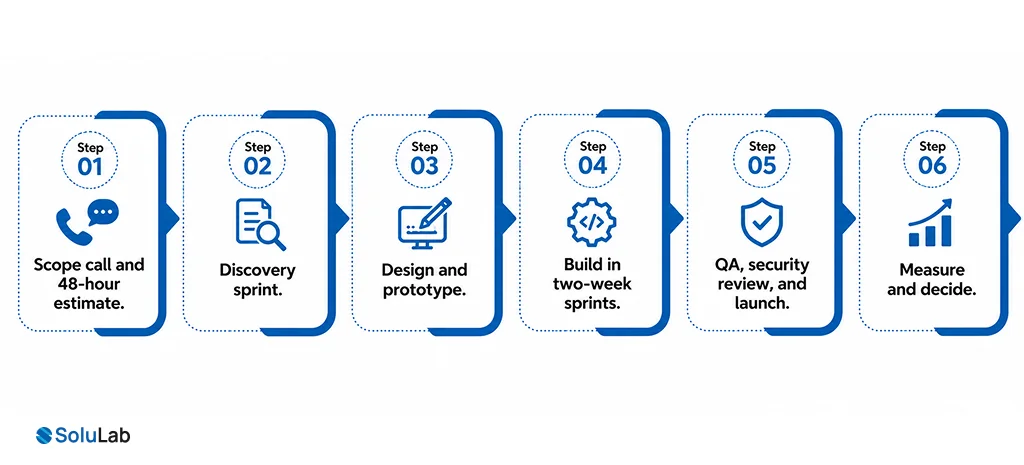
Our MVP development process runs in six steps, and the price is fixed at the end of step one. You see working software every two weeks from the first build sprint, on a staging link you can open yourself.
You tell us the idea, the user, and the deadline. Within 48 hours you get a written scope: must-have features, features that wait, assumptions, team plan, timeline, and a fixed price.
We map the user flows, name the riskiest assumption, agree on one success metric, and make the architecture decisions. The output is a build-ready backlog.
You approve a clickable prototype of the core flow before any code is written.
Each sprint ends with a demo. New ideas are welcome, with one rule: when a feature comes in, a feature of the same size goes out. That rule is what keeps a fixed price fixed.
We test on real devices, review access and data handling, and deploy to production. Blockchain MVPs go through a smart contract audit before mainnet.
With usage data in hand, you choose to iterate, change direction, or scale. We help you read the numbers honestly.
Most startup MVPs take two to four months from scope to launch, and the range depends on what the product has to connect to.
| MVP type | Typical build time |
|---|---|
| AI MVP on existing model APIs | 2 to 6 weeks |
| AI MVP with retrieval over your documents (RAG) | 4 to 10 weeks |
| Fintech trading platform MVP, web | 3 months with a team of 7 |
| Blockchain MVP | 8 to 16 weeks |
Third-party approvals are the usual cause: a KYC provider's onboarding, a payment processor's review, a brokerage API account, or app store review. On the lending platform described below, the build depended on seven outside services, including Plaid, Experian, DocuSign, and Jumio. We now start those applications in week one, in parallel with design.
The second cause is slow decisions. An MVP with one decision-maker on the founder's side moves faster than one with a committee. Appoint one person.
MVP development for startups costs anywhere from a few thousand dollars for a narrow AI feature to six figures for a regulated or on-chain product. Five things drive the number: how many platforms you launch on, how many outside systems you integrate, whether AI or blockchain sits at the core, the compliance load, and the depth of design.
| MVP type | SoluLab Cost |
|---|---|
| Web or SaaS MVP | $5,000 to $20,000 |
| Mobile app MVP, one platform | $5,000 to $25,000 |
| AI MVP on existing model APIs | $3,000 to $20,000 |
| AI MVP with retrieval (RAG) | $8,000 to $60,000 |
| AI MVP with a custom or fine-tuned model | $50,000 to $150,000+ |
| Blockchain MVP | $60,000 to $300,000 |
A fixed price works when the scope is fixed. That's the trade-off, and it's better to hear it now. If you know the user and the core workflow, fixed price protects your budget and puts the delivery risk on us. If you expect to discover the product while building it, a fixed scope will fdght you every sprint.
Scope is clear, and the budget is capped
Changes mean a swap or a change request
You expect to learn and adjust as you build
Final cost is a range, not a number
The MVP is live and you're iterating monthly
Needs a product owner on your side
SoluLab has built MVPs and first product versions in fintech, trading, and healthcare. The three below show different kinds of first builds: a regulated mobile product, a web platform shipped in a quarter, and a blockchain product.
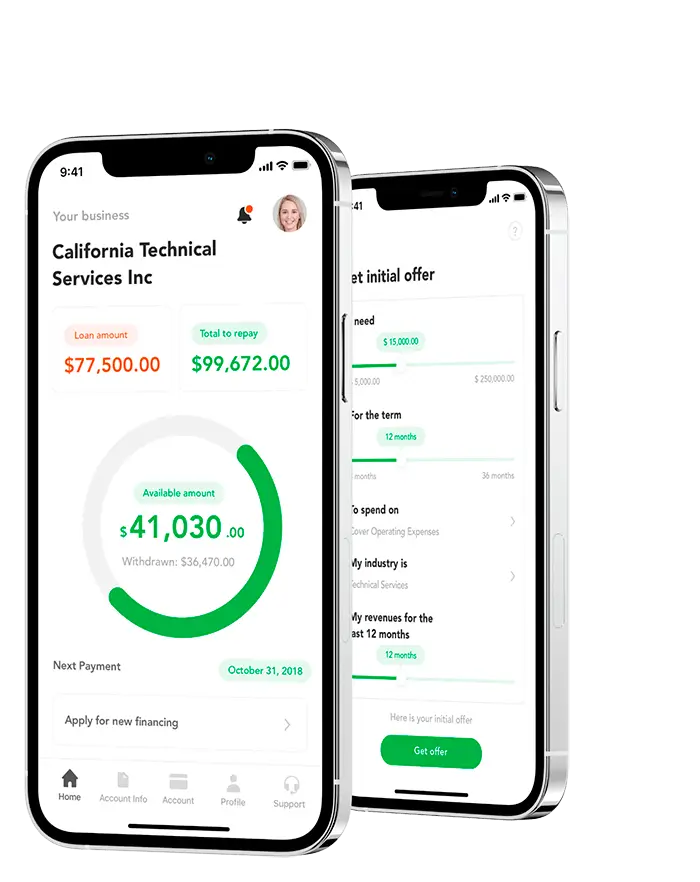
A fintech startup wanted to replace slow, manual small-business lending with a fully digital process. We built an iOS app, an admin module, and a back office covering the full loan cycle from application to repayment. It includes KYC checks, e-signed agreements, virtual card issuance, and a credit scoring model trained on credit history and transaction data.
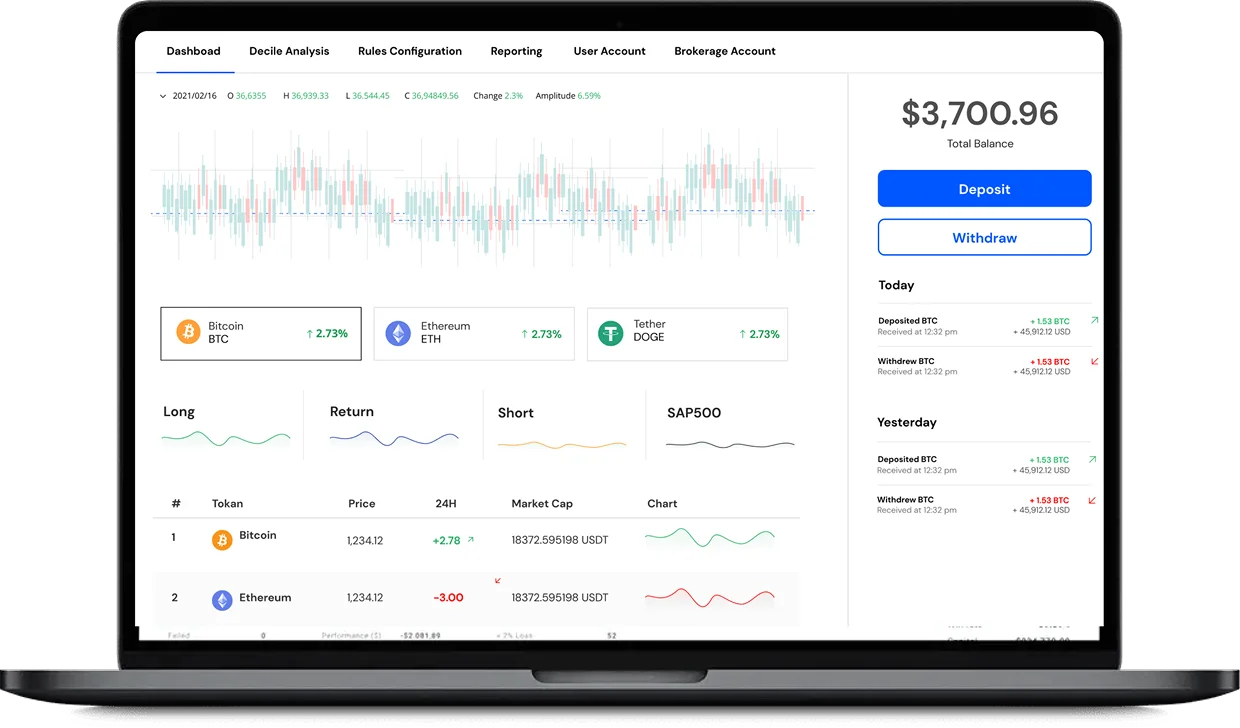
A wealth management firm with a 20-year-old trading strategy needed to turn it into a product clients could use themselves. We built and launched the MVP in three months: a SaaS web app where clients connect a brokerage account, set risk and leverage, and let the system trade for them.
Patient records rarely move cleanly between providers, and patients have little say over who sees them. We built a blockchain-based records platform where patients grant and revoke time-limited access, and updates are shared across the network in real time.
The best MVP development companies for startups share one trait: they tell you what to leave out. Any agency can quote your full feature list. The useful ones push back on it. Use these seven questions on every vendor you talk to, including us.
| Ask this | A good answer sounds like | Red flag |
|---|---|---|
| What would you cut from my scope? | Names specific features and explains why | "We can build all of it" |
| Who writes the code? | Named engineers you meet before signing | "Our team", with no names |
| When do I first see working software? | Within two to three weeks, on a link you can open | A big reveal near the end |
| Who owns the code and the accounts? | You do, with repository access from the first sprint | Access after final payment |
| What happens when scope changes? | A written swap or change-request rule | "We'll figure it out" |
| Have you built in my domain? | A case study with stack, team, and timeline | Logos without details |
| What happens after launch? | A handover plan and optional iteration sprints | Silence, or a long lock-in |
Startups choose SoluLab when the MVP needs more than screens and a database. We're a consulting-led engineering company focused on AI and blockchain, so the scope call starts with the business problem, and the answer is sometimes to build less.
Build and launch functional MVPs quickly to validate product-market fit and gather real user feedback before investing heavily in the full product.
Go beyond coding to define core features, user journeys, technology choices, and an MVP roadmap aligned with business objectives.
Build MVPs with a technical foundation that can support future users, features, integrations, and business growth without unnecessary complexity.
Access experienced developers across AI, blockchain, Web3, mobile, web, cloud, and other modern technologies under one team.
Prioritize high-impact features and avoid unnecessary development so startups can make better use of limited budgets and resources.
Integrate technologies such as generative AI, AI agents, RAG, blockchain, and automation when they provide a clear product or business advantage.
"Chintan leads SoluLab's product engineering teams across AI, blockchain, IoT, and enterprise software. Before co-founding SoluLab, he spent about a decade at Goldman Sachs, where he was a Vice President."
MVP development for startups is the process of building the smallest working version of a product that real users can use. It includes only the features needed for one core job. The goal is to test demand with real behaviour before the startup spends its budget on a full product.
MVP cost depends on platforms, integrations, compliance, and whether AI or blockchain sits at the core. SoluLab's published ranges start at $3,000 to $20,000 for an AI MVP on existing model APIs and reach $60,000 to $300,000 for blockchain MVPs. A 48-hour scope gives you one fixed number for your product.
MVP development usually takes two to four months from scope to launch. Narrow AI MVPs on existing models can ship in 2 to 6 weeks. Blockchain MVPs take 8 to 16 weeks. Third-party approvals such as KYC providers, payment processors, and app store review often add more time than the code does.
An MVP should include one core user flow, secure sign-in, payment if you're testing willingness to pay, and analytics on that flow. Leave out secondary features, complex user roles, extra languages, and a second mobile platform. Keep backups, monitoring, and automated deployment. Those are foundations, and they're painful to add later.
A proof of concept tests whether something can be built. A prototype tests whether people understand the design, and it usually has no working backend. An MVP is a working, deployed product used by real customers. Startups with a technical unknown start with a PoC. Startups with a demand question start with an MVP.
Yes. Many non-technical founders work with an MVP development company for the first version. Make sure you own the code, the cloud accounts, and the documentation, so a future CTO or in-house team can take over. You still need one person on your side who makes product decisions quickly.
Build in-house if you already have engineers and the product is your core technology. Hire an MVP development company if you need a full team now, covering design, backend, mobile, and QA, and you can't spend months recruiting. Many startups outsource the MVP and hire in-house once it shows traction.
You should own all code, designs, and intellectual property, and the contract should say so in plain words. Ask for repository access from the first sprint, and keep cloud and app store accounts in your company's name. [VERIFY: confirm SoluLab's standard IP and NDA terms before publishing this answer.]
A well-built MVP grows into the full product without a rewrite. That depends on early choices: a clean data model, a modular codebase, and mainstream technology. Some parts will be replaced as usage grows, which is normal. A full rebuild usually means the MVP was built as a throwaway demo.
Pick one success metric before launch and track it weekly. The most useful signals are activation (do new users complete the core action?), retention (do they return the next week?), and conversion to paid. Sign-ups alone say little. People who come back without being reminded are the strongest sign of demand.
Yes. AI and blockchain are SoluLab's two core practices. AI MVPs include assistants, document workflows, and prediction features built on existing or custom models. Blockchain MVPs include tokenization platforms, wallets, and DeFi products, with a smart contract audit before mainnet launch. The same team handles the web and mobile layers.
You share the idea, the target user, and your deadline on a short call or form. Within 48 hours, SoluLab sends a written scope with must-have features, deferred features, assumptions, team, timeline, and a fixed price. You can then adjust the scope to fit your budget before signing anything.
After launch, you measure usage for a few weeks and decide what to build next. SoluLab offers iteration sprints for founders who want to keep the same team, or a full handover with documentation for those hiring in-house. Either way, the decision should come from the data.
Explore 15 AI business ideas to start in 2026, from AI SaaS and automation to content, customer support, and industry-specific AI solutions.

Learn how to use LangChain for agentic AI development, from building AI agents and workflows to tool calling, orchestration, and deployment.
Learn how businesses are using AI in the workplace for automation, data analysis, customer support, content creation, and decision-making.