


Discovery and roadmap.
A written plan covering users, scope, architecture, cost, and sequence. It's the output of the first call and the basis of every estimate.

Software development for startups is the process of designing and building a product, usually starting with an MVP, within a limited budget and timeline so that each release tests a business assumption with real users. SoluLab provides startup software development services, including product discovery, MVP development, and dedicated engineering teams that scale as you grow.












Software development for startups is the practice of designing, building, and releasing a product in small, testable steps, so a young company can find out what customers want before its funding runs out.
The engineering is the same as anywhere else. The constraints aren't. An enterprise knows its users and has a budget for the year. A startup has a hypothesis and a runway. That changes almost every decision: what to build first, how much to polish, which tools to buy instead of build, and when to hire.
The cost of getting it wrong is well documented. CB Insights reviewed 431 venture-backed companies that shut down since 2023. 70% ran out of capital and 43% cited poor product-market fit (CB Insights, 2026). Good startup engineering attacks both numbers at once. It spends less per lesson learned, and it gets to those lessons sooner.
Our software development services for startups change with your stage. A pre-seed founder and a Series A team need different things from a development company, and selling both the same package helps neither.
A written plan covering users, scope, architecture, cost, and sequence. It's the output of the first call and the basis of every estimate.
The smallest product real users can use and pay for. See our dedicated page on MVP development for startups.
Taking the MVP to a full first version: more workflows, a proper admin side, billing, and the reliability paying customers expect. Most are web products built as SaaS applications or mobile apps.
Assistants, document processing, search, and prediction, added through our AI development team once you have data and a clear use for them.
Tokenization, wallets, and smart contracts from our blockchain development practice, for startups whose product lives on-chain.
Vetted engineers who join your existing team and sprint rhythm. Useful once you have a CTO and need capacity more than direction.
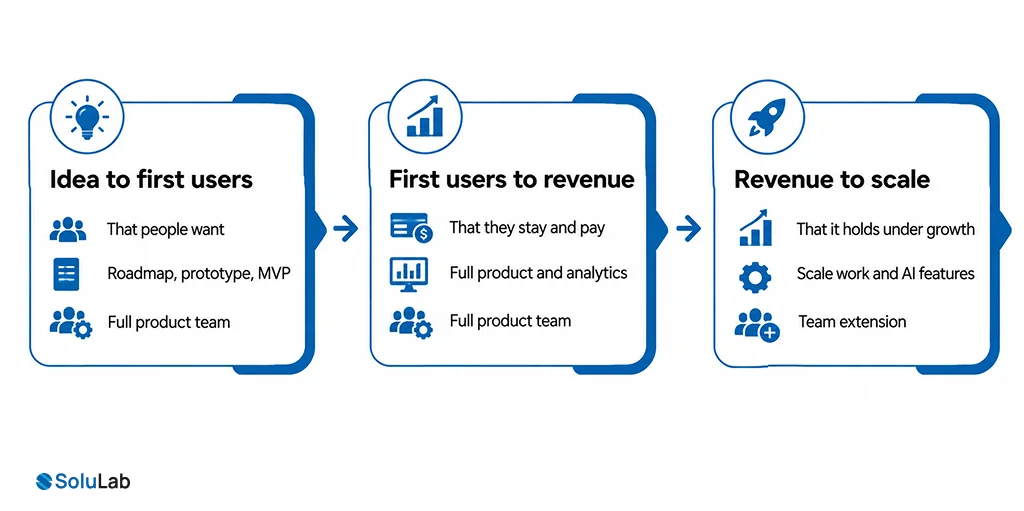
Early stages need a full product team that also sets direction. Later stages mostly need capacity added to a team that already exists.
Book a CallCustom software development for startups should be reserved for the part of the product that customers pay you for. Everything else is usually better bought. This is the advice founders least expect from a development company, and it saves them the most money.
A startup that custom-builds its billing system has spent a month on something no customer will ever notice. Our custom software development team builds the right-hand column and integrates the left. For US startups in regulated fields such as lending or health data, the build column grows, because compliance logic is rarely available off the shelf.

We'll map the next two releases with you and tell you what each should cost.
A tech-partner engagement with SoluLab starts with a call and a written roadmap, and it can stop there. Nothing commits you to the build.
You walk us through the idea, the stage, and the next milestone, such as a pilot customer or a funding round.
We send a written plan: what to build in which order, the team needed, and the cost of each phase.
User flows, architecture, and a build-ready backlog.
Each sprint ends with a demo on a link you can open.
Production release with analytics on the core flows.
We keep building with you, add engineers to your team, or hand over to your in-house hires with documentation.
Software development for startups at SoluLab costs from $10,000 for a discovery sprint or micro SaaS to $150,000 for a mid-complexity product. A SaaS MVP takes 8 to 16 weeks and costs $25,000 to $50,000. Teams that already have engineers can add SoluLab developers from $25 to $49 an hour.
Scope, architecture, and a priced roadmap
2 to 4 weeks
One AI feature tested with real users
2 to 6 weeks
One core workflow with sign-in and billing
4 to 8 weeks
Core workflows, billing, roles, and analytics
8 to 16 weeks
Several modules, integrations, and reporting
4 to 6 months
Smart contracts, wallet, and a testnet pilot
8 to 16 weeks
Vetted engineers in your own sprints
Start in 1 day to 2 weeks
All figures are SoluLab's published ranges from its SaaS development, AI MVP, MVP guide, and hire developers pages.
SoluLab has worked with startups as a full build team and as an extension of the founder's own engineers. These three engagements show both.
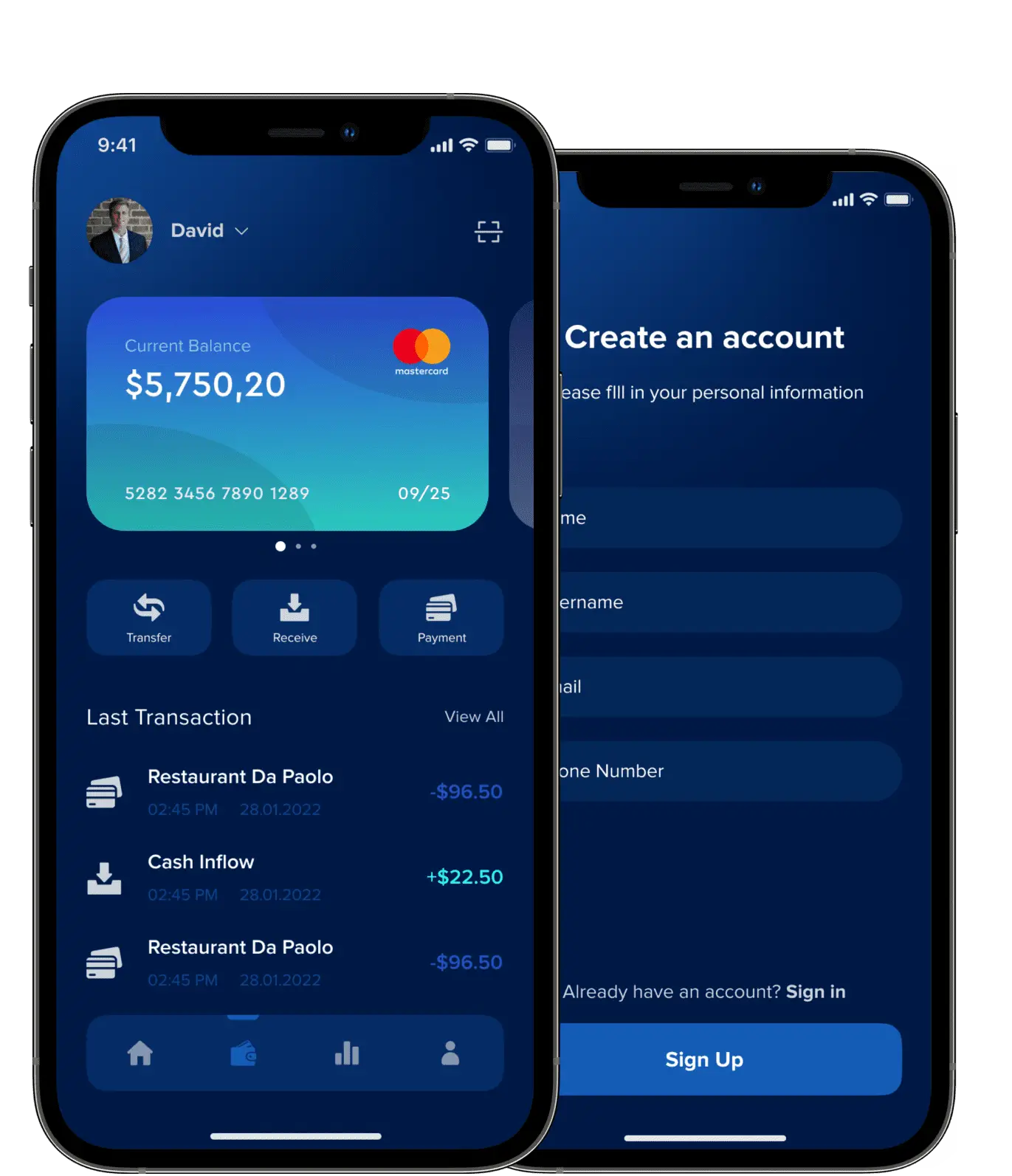
A Northern European fintech startup was building an eWallet that helps parents guide their children's spending. The product was already in development and needed mobile engineers with fintech experience to reach the market sooner. We placed a senior iOS developer and a mid-level Android developer, who joined the client's sprints within one week.
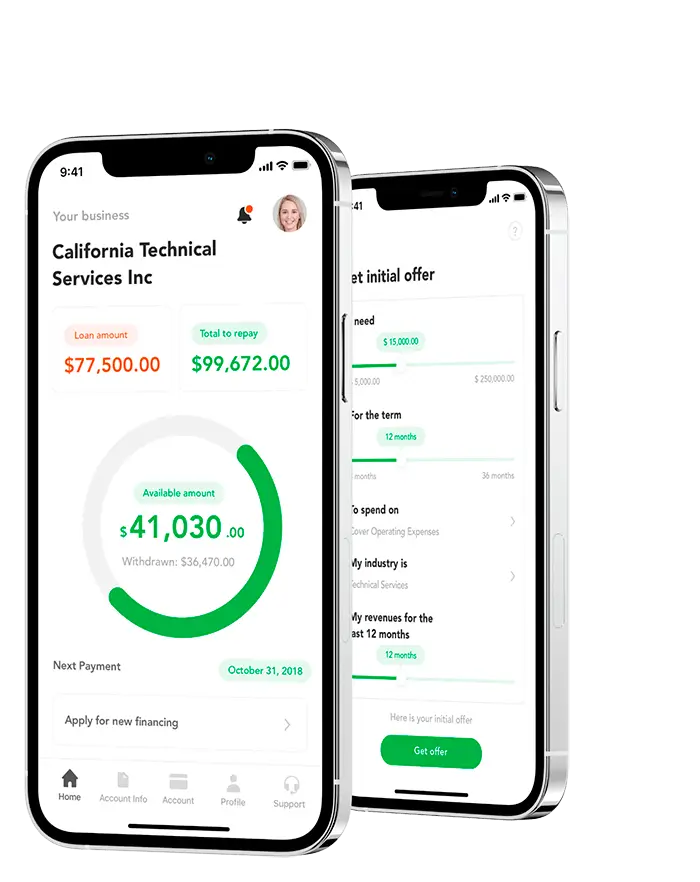
A fintech startup wanted to replace manual small-business lending with a fully digital process. A team of 8 built an iOS app, an admin module, and a back office covering the loan cycle from application to repayment, with KYC checks, e-signed agreements, and a credit scoring model.
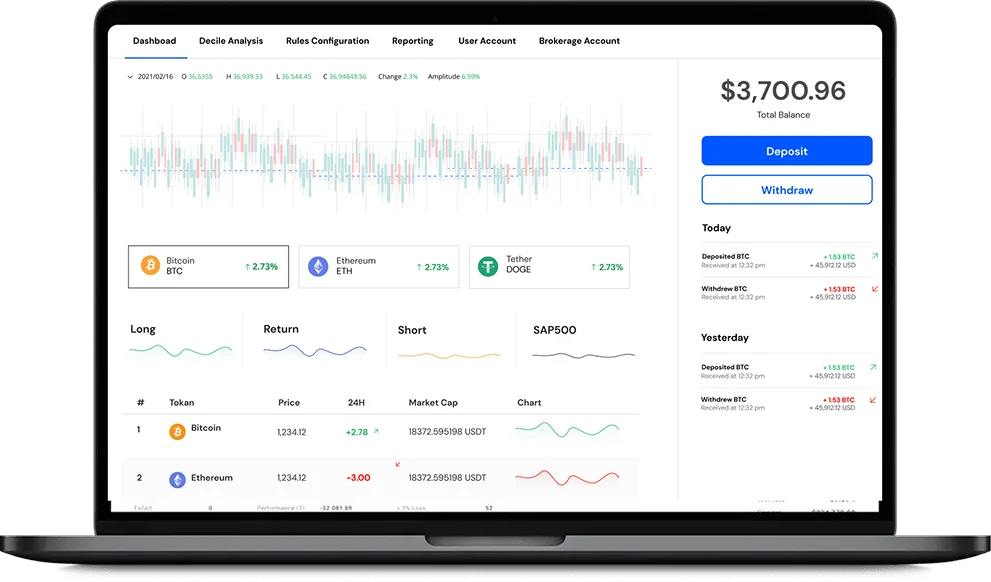
A wealth management firm turned its 20-year-old trading strategy into a SaaS product. A team of 7 built and launched the MVP in three months. Clients connect a brokerage account, set risk levels, and let the system trade.
 React
React
 Next.js
 Vue.js
 Swift
Swift
 Kotlin
 React Native
 Node.js
 Python (Django, FastAPI)
 .NET
.NET
 PostgreSQL
 MongoDB
 Redis
Redis
 AWS
AWS
 Azure
Azure
 Google Cloud
 Docker
 GitHub Actions
Python
GitHub Actions
Python
 OpenAI APIs
 LangGraph
 TensorFlow
 Stripe
 Auth0
Auth0
 AWS Cognito
 Solidity
 Ethereum
 Hyperledger Fabric
Startups choose SoluLab because one partner covers the whole path: roadmap, MVP, the product after it, and extra engineers when the team grows. We're a US-based, consulting-led engineering company with AI and blockchain as our core practices.
We help startups move from idea and prototype to MVP and production with a focused development approach.

We look beyond writing code. Our teams work around your product goals, user journeys, business model, and technical roadmap

From AI to blockchain, Web3, and modern web applications, startups can access specialized technology expertise.
We design applications with future growth in mind. The goal is to avoid costly rewrites.

Startups need visibility into where their time and budget are going, and we offer that.

Launching the product is only the beginning. We continue to support product improvements as and when needed.

"Chintan leads SoluLab's product engineering teams across AI, blockchain, IoT, and enterprise software. Before co-founding SoluLab, he spent about a decade at Goldman Sachs as a Vice President. He advises startups and enterprises in the US, Europe, and APAC on Web3, tokenization, and AI-driven automation."
I am extremely impressed with the collaborative efforts of AI-Build and SoluLab in developing our CAD product using generative AI. Their solution revolutionized our product development process by automating design generation, improving customization, and enhancing accuracy.

SoluLab successfully delivered the project on time, and we were very pleased with the team’s flexibility and honesty. They were considerate of our needs and even accommodated a few minor changes outside the original scope without additional charges. They delivered everything on time.

SoluLab did an excellent job. They were always eager to assist and find the best solution. Their technical expertise and willingness to work closely with us helped turn an ambitious product vision into a working blockchain gaming ecosystem.

They didn’t just execute tasks; they took the time to understand our goals. SoluLab built the core product, integrated third-party tools and APIs, and created a smoother user experience that resulted in higher engagement and better retention.

Start with what you need: one specialist, or a whole team. For a single well-defined task, a vetted freelancer works. For a full product, look for a software development company with startup case studies that name the team, stack, and timeline. Always interview the engineers who will do the work.
Write down the first milestone, then choose a route: in-house hires, a development company, or team extension. Check each candidate or vendor on past startup work, communication, and code ownership terms. Begin with a short paid phase, such as discovery or one sprint, before committing to a long contract.
Shortlist three to five companies with published startup work in your domain. Ask each what they would cut from your scope, who will be on the team, and when you will see working software. Compare written estimates with assumptions listed. Review sites such as Clutch and GoodFirms help verify client feedback.
Lower the cost by narrowing scope, launching on one platform, buying standard components such as billing and sign-in, and using a team that mixes senior and mid-level engineers. Avoid choosing on hourly rate alone. Cheap code that needs rebuilding costs more than careful code written once.
The best vendor for a startup is one with relevant case studies, named engineers, sprint demos, and contracts that give you the code and accounts. No single company is best for every founder. Match the vendor to your stage, your domain, and whether you need a full team or extra capacity.
A top custom software developer for startups builds only what is specific to your product and integrates proven tools for the rest. Look for experience with early-stage products, a habit of questioning scope, clean documentation, and code that an in-house team or an investor's reviewers can read easily.
Cost depends on scope, platforms, integrations, compliance, and team size, so honest answers come as a range tied to a written scope. A narrow MVP costs far less than a regulated fintech product. SoluLab provides a roadmap and estimate after the first tech-partner call, with each phase priced separately.
Outsource when you need a full team quickly and can't spend months recruiting. Build in-house when the technology is your core advantage and you have funding for salaries. Many startups outsource the first version, then hire in-house after traction, using team extension to cover the gap.
Software product development means building a product you sell to many customers, such as a SaaS platform or mobile app. Custom software development means building software for one organization's needs. Startups usually need product development, with custom work limited to the features that set the product apart.
Yes. SoluLab is a US-based company and works with startups in the United States, Europe, and the Gulf. Engagements run as a full product team or as a team extension, and they start with a tech-partner call that produces a written roadmap and estimate.