Key Takeaways
- LangChain 1.0 changed the framework structurally. LangGraph is now the runtime underneath every LangChain agent.
- The old patterns are legacy. initialize_agent is gone and AgentExecutor sits in maintenance mode, so most tutorials online are teaching a deprecated API.
- There is one idiomatic entry point now. handles the think-act-repeat loop and routes to LangGraph automatically.
- Middleware is the new customisation surface, replacing the ad-hoc callbacks and wrappers teams used to bolt onto the agent loop.
- LangChain earns its complexity on multi-agent graphs with shared state. For a single agent making tool calls, lighter libraries do it in fewer lines.
- Evaluation and observability are not optional extras here. Agents fail silently, and a per-step trace is how you find out.
Using LangChain for agentic AI means building systems where a model decides what to do next, calls tools, keeps state across steps, and works toward a goal rather than answering a single prompt. LangChain supplies the model interface, the tool layer, memory, and orchestration. Since version 1.0, LangGraph supplies the runtime those agents actually execute on.
The spend behind this is substantial. Deloitte’s 2026 Technology, Media and Telecommunications Predictions size the global agentic AI market at roughly $8.5 billion in 2026, growing toward $35 billion by 2030, and note that stronger enterprise orchestration could push it as high as $45 billion.
This guide covers what LangChain actually is now, which is not what most tutorials describe, plus how to build with it, when to choose something lighter instead, and where these projects break in production.
What Is LangChain for Agentic AI?
LangChain is an open-source framework for building applications on language models, and its agent layer is what makes it relevant to agentic AI. It gives you a unified model interface, a tool-calling system, memory, retrieval, and orchestration, so you write agent logic rather than provider plumbing.
1. What Makes a System Agentic
Three properties. The model decides what action to take rather than following a fixed script. It can call tools that reach outside the model, such as an API, a database or a file system. And it carries state across steps, so step seven knows what happened in step two.
A chain executes a predefined sequence. An agent chooses the sequence at runtime. That is the whole distinction, and it is why agents are harder to test.
2. What LangChain Handles for You
A single interface across a thousand-plus model providers, so switching from one vendor to another is a configuration change rather than a rewrite. Tool definition and invocation. Message and state handling. Retrieval integration. And the agent loop itself, which is the part most teams underestimate when they consider building it from scratch.
3. Where LangChain Sits Among the Alternatives
It is the most widely adopted option and the most criticised, which usually go hand in hand. Alternatives include lighter SDKs for single-agent work, role-based multi-agent frameworks, and provider-native agent SDKs. We cover the selection logic properly further down, and the broader landscape in our guide to AI agent development architecture.
What Changed in LangChain 1.0?
A great deal, and this is the section to read before following any tutorial. LangChain 1.0 and LangGraph 1.0 both reached general availability on 22 October 2025, and it was a structural reset rather than a version bump.
1. LangGraph Is Now the Runtime
Every LangChain agent runs on LangGraph underneath. This resolved the long-standing criticism that the agent loop was a black box, because LangGraph exposes the state graph and makes each step inspectable. You can stay at the high-level LangChain API or drop into LangGraph for full control without leaving the ecosystem.
2. The Old Agent Patterns Are Legacy
initialize_agent is gone. AgentExecutor remains only in maintenance mode, scheduled through December 2026. LangGraph’s own has been deprecated in favour of LangChain’s.
This matters commercially. A large share of the LangChain tutorials, courses, and blog posts currently ranking were written against the 0.x API. Code copied from them either fails or builds on a deprecated path. If your team is learning from search results, check the publication date first.
3. One Idiomatic Way to Build an Agent
It is the entry point. It handles the think, act, repeat loop and routes to the LangGraph runtime automatically. For most single-agent workloads, that is the whole API surface you need.
4. Middleware Replaced the Bolt-On Hacks
The 1.0 customisation surface is a middleware system with hooks around the agent loop: before the agent runs, before the model call, wrapping the model call, wrapping tool calls, after the model responds, and after the agent completes. Guardrails, logging, redaction and retry logic belong here rather than tangled into your agent code.
5. Practical Rule for Which Altitude to Work At
If you can describe the agent as think, act, repeat, use . If you find yourself drawing a flowchart with branches and conditions in it, you want LangGraph directly. You are not choosing between two frameworks. You are choosing an altitude, and our walkthrough on how to build AI agents with LangGraph covers the lower one in detail.
How Does LangChain Enable Agentic AI Systems?
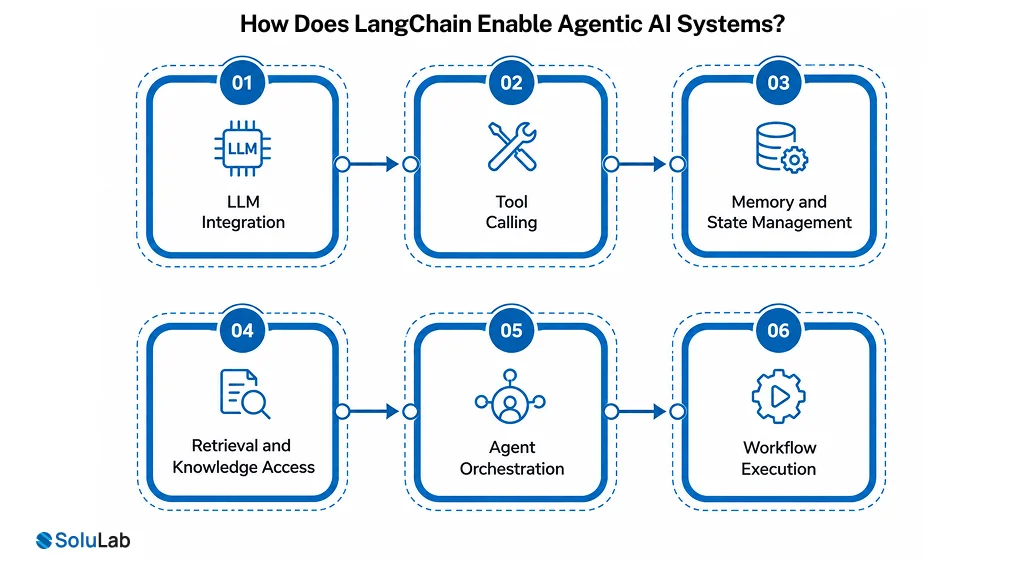
Six capabilities, and together they are the reason teams reach for a framework rather than writing the loop themselves.
1. LLM Integration
One interface across providers for chat models and embeddings. Model choice becomes a parameter, which matters more than it sounds when pricing or capability shifts every few months.
2. Tool Calling
Python functions, APIs, and services exposed to the model as callable tools with typed signatures. The model decides which to invoke and with what arguments. Tool design quality determines agent reliability more than model choice does.
3. Memory and State Management
Short-term conversation state and longer-term persistence, now handled through the LangGraph checkpointer in production. Checkpointing is what allows an agent to resume rather than restart after a failure.
4. Retrieval and Knowledge Access
Vector stores, retrievers and document loaders connect the agent to your own content. Most useful agents are retrieval agents underneath, which is why building a RAG platform often precedes agent work in the sequence.
5. Agent Orchestration
Coordinating multiple agents with different roles and shared state. This is where LangChain is genuinely strong and lighter alternatives fall away, and it connects directly to AI agent orchestration at enterprise scale.
6. Workflow Execution
Running the graph: nodes, edges, conditional routing, human-in-the-loop interrupts and persistence between steps. The interrupt capability is underrated, because it is how you get a human approval gate without rebuilding the loop.
What Are the Key LangChain Components for Building AI Agents?
Eight components cover almost every production agent. Learn these and the rest of the framework becomes navigable.
1. Models
Chat models and embedding models behind a common interface. Configure the provider, temperature and token limits in one place.
2. Prompts
Templates with variable injection, plus system messages defining the agent’s role and constraints. Version these like code, because a prompt change is a behaviour change.
3. Tools
Functions the agent can call, each with a name, a description and a typed schema. The description is not documentation. It is what the model reads to decide whether to call the tool, so write it for the model.
4. Agents
The loop itself, created through and executed on LangGraph. Give it a model, a set of tools and a system prompt, and it reasons about which tool to invoke until the task completes.
5. Retrievers
The interface between the agent and your knowledge base. Vector search, keyword search or hybrid, returning ranked passages with source metadata for citation.
6. Memory
State that survives across turns and across sessions, persisted by the checkpointer. Distinguish between what the agent needs in context right now and what it needs to recall later, because conflating the two inflates cost fast.
7. Structured Outputs
Schema-enforced responses so the agent returns typed objects rather than prose you have to parse. This is the difference between an agent you can integrate and a demo.
8. Middleware
The 1.0 hook surface wrapping the agent loop. Input validation, output filtering, PII redaction, rate limiting, logging and retry policy all live here, which keeps your agent definition clean.
How Do You Build an Agentic AI System With LangChain?
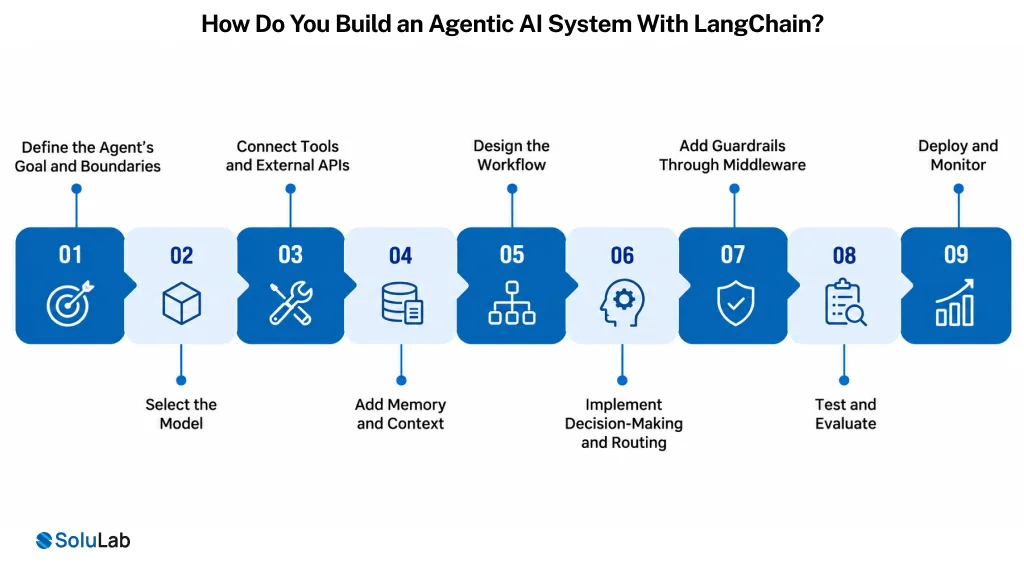
Nine steps. Steps one and three determine whether the thing works, and they are the two most often rushed.
1. Define the Agent’s Goal and Boundaries
Write down what the agent completes, what it must never do, and what it escalates. Vague scope produces agents that wander. This is the same discipline described in our guide to implementing agentic AI in your business.
2. Select the Model
Match the model to the task. Tool-calling reliability matters more than raw benchmark performance for agent work, and a cheaper model often handles routing while a stronger one handles the reasoning step.
3. Connect Tools and External APIs
Define each tool with a precise schema and a description written for the model. Start read-only. Promoting a tool from read to write should be a deliberate decision with a test plan, not a config change.
4. Add Memory and Context
Configure the checkpointer and decide what persists. Dragging an ever-growing transcript into every call is the most common cost mistake in agent development.
5. Design the Workflow
For simple loops, is sufficient. For branching, parallel paths or approval gates, model it as a graph with explicit nodes and edges. Multi-agent setups are covered in our breakdown of multi-agent systems.
6. Implement Decision-Making and Routing
Define how the agent chooses between tools and when it stops. Set iteration limits. An agent without a termination condition will happily loop until your budget runs out.
7. Add Guardrails Through Middleware
Input validation, output filtering, PII handling, tool permission scoping, and rate limits. Put these in middleware rather than in the agent, so they survive a refactor.
8. Test and Evaluate
Build an evaluation set of real tasks with known correct outcomes before you tune anything. Trace every step. Agents fail silently in ways single-turn systems do not, and aggregate accuracy hides which step broke.
9. Deploy and Monitor
Self-hosted or managed, with per-step tracing, cost tracking and drift monitoring in production. This is MLOps discipline applied to non-deterministic systems, and it belongs in the original scope rather than a later phase. The fuller end-to-end sequence is in our guide on how to build an AI agent system.
When Should You Use LangChain, and When Should You Not?
Use LangChain when your workload is a graph of agents sharing state. Use something lighter when it is one agent making tool calls. That single question resolves most framework debates.
1. Where LangChain Wins
Multi-agent coordination with shared state. Complex conditional workflows with branching and human-in-the-loop gates. Heavy retrieval integration. Provider flexibility, where switching models is a configuration change. And the largest integration ecosystem of any agent framework, which matters when you need a connector nobody wants to write.
2. Where It Is Overkill
A single agent calling three tools in a loop. Lighter SDKs ship the same behaviour in fewer lines with a much smaller dependency surface. The complexity tax in LangChain is real, and the abstraction layers that made the 0.x releases feel heavy have not all disappeared.
3. How the Alternatives Compare
| Framework Type | Best For | Trade-Off |
| LangChain plus LangGraph | Multi-agent graphs, branching workflows, heavy retrieval | Largest dependency surface, steepest learning curve |
| Lightweight agent SDKs | Single agent, tool calling, fast shipping | Thin on orchestration, multi-agent and persistence |
| Role-based multi-agent frameworks | Simulated teams of specialised agents | Less control over the execution graph |
| Provider-native agent SDKs | Deep integration with one model vendor | Vendor lock-in, weaker provider portability |
| Building it yourself | Full control, minimal dependencies | You maintain the loop, the retries and the state layer |
4. The Honest Position
Adoption is high, and production deployment is not. In Deloitte’s State of AI in the Enterprise research, 85% of companies expect to customise agents to their own needs, while only 25% have moved 40% or more of their AI experiments into production. Framework choice is rarely what separates those two groups. Evaluation, guardrails, and integration are.
Why Do LangChain Agent Projects Fail in Production?
Mostly on reliability, evaluation, and scope rather than on the framework. Gartner predicts that more than 40% of agentic AI projects will be canceled by the end of 2027, citing escalating costs, unclear business value and inadequate risk controls.
1. The Compounding Reliability Problem
An agent completing a ten-step task at 95% per-step accuracy succeeds about 60% of the time. That arithmetic is why demos impress, and deployments disappoint. Attack it with verification steps, checkpointing and explicit recovery paths rather than a better prompt.
2. Building Against Deprecated Tutorials
Covered earlier and worth repeating, because it costs real time. Code written against initialize_agent or AgentExecutor is on a legacy path. Check the date on anything you copy, and prefer the official migration guide over a blog post.
3. No Evaluation Harness
Without a scored eval set, you are shipping on vibes. Every prompt change, model swap or tool adjustment becomes a guess. This is the single strongest predictor of whether an agent project survives contact with production.
4. Unbounded Tool Permissions
An agent with write access to systems and no permission scoping is an incident waiting to happen. Scope each tool, log every call, and start read-only. The reasoning is the same as in any agentic RAG deployment where the retrieval step can trigger an action.
5. Choosing the Framework Before the Problem
Teams commit to LangChain, or reject it, before defining the workload. Decide whether you have a loop or a graph first. That answer picks the framework, and it is a far better starting point than a framework comparison thread. Where capability is missing internally, an experienced AI agent development company can make that call quickly.

Conclusion
LangChain in 2026 is a different framework from the one most of the internet describes. LangGraph is the runtime, is the entry point, middleware is where customisation belongs, and the old patterns are on a deprecation clock. Anything you read that starts with initialize_agent was written for a version that no longer represents the project.
If you are deciding whether to use it, skip the framework debate and describe your workload. Think, act, repeat means stay high-level and ship quickly. A flowchart with branches and approval gates means LangGraph, and LangChain is the strongest option in the market for that shape of problem. A single agent with three tools probably does not need either.
SoluLab, an Agentic AI development company, can help your business choose the right framework for the workload, build agents with evaluation and guardrails designed in rather than added later, and connect them to the systems you already run. We will also tell you plainly when a lighter library would serve you better than a framework.
FAQs
Neha is a curious content writer with a knack for breaking down complex technologies into meaningful, reader-friendly insights. With experience in blockchain, digital assets, and enterprise tech, she focuses on creating content that informs, connects, and supports strategic decision-making.