Key Takeaways
- Loop engineering focuses on continuous improvement by helping AI agents observe, evaluate, and refine their decisions over time.
- Reliable AI agents need more than prompt engineering; they require memory, feedback loops, reasoning, and execution controls.
- Well-designed loops reduce errors and prevent repetitive mistakes, making AI systems more consistent and scalable.
- Loop engineering is becoming essential for multi-step, autonomous workflows where agents must adapt to changing conditions and complex tasks.
- Businesses adopting agentic AI can gain better performance, cost efficiency, and automation outcomes by investing in robust loop engineering practices.
You have built an AI agent. It can answer questions, use tools, and even complete tasks autonomously.
But then reality hits.
The agent keeps making the same mistakes. It gets stuck in endless reasoning cycles, produces inconsistent results, and struggles when faced with complex, multi-step workflows.
The answer is Loop Engineering.
As AI agent development becomes more autonomous, success no longer depends solely on powerful language models or clever prompts. What matters is how agents observe outcomes, evaluate performance, learn from feedback, and continuously improve their decisions. This is where loop engineering comes in.
In this guide, we’ll explore what loop engineering is, how it works, why it’s becoming a critical discipline in AI agent development, and how businesses can use it to build more reliable and scalable AI systems.
What Does Loop Engineering Actually Mean?
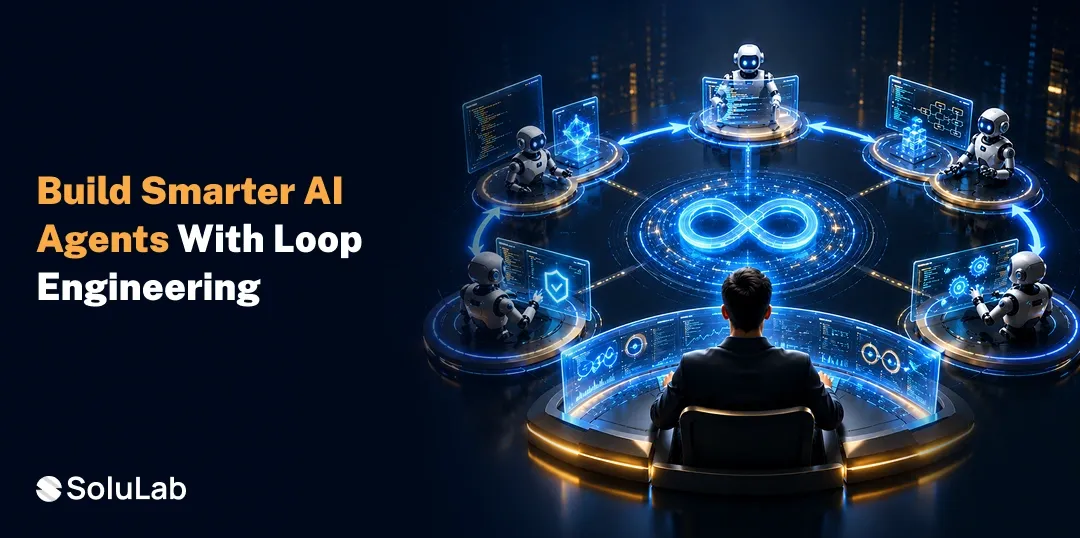
Loop Engineering is the practice of designing, managing, and optimizing the feedback loops that allow AI agents to continuously observe, reason, act, evaluate outcomes, and improve future decisions.
Unlike traditional prompt engineering, which focuses on crafting a single input, Loop Engineering focuses on the entire cycle of agent behavior: how an AI agent learns from results, corrects mistakes, gathers additional information, and refines its actions until it achieves a goal.
In fact, Peter Steinberger, creator of OpenClaw, who now works with OpenAI, recently said, “You shouldn’t be prompting coding agents anymore. You should be designing loops that prompt your agents.
How the AI agent loop lifecycle works
- Observe: The agent collects information from its environment, databases, APIs, documents, sensors, or user inputs to understand the current situation.
Example: A customer support agent receives a query about a delayed order and retrieves shipping details from the logistics system.
- Reason: The agent analyzes the collected information, identifies patterns, and determines the best action to achieve its objective.
Example: The agent checks the shipment status, recognizes a carrier delay, and decides the customer needs an updated delivery timeline.
- Act: The agent executes a task, provides a response, or interacts with external systems based on its reasoning.
Example: The agent sends the customer a delivery update and automatically creates a support ticket if further investigation is needed.
- Evaluate: The agent assesses the outcome of its action to determine whether the objective was achieved successfully.
Example: The agent monitors whether the customer’s issue was resolved or if additional follow-up questions were submitted.
- Improve: The agent uses feedback, outcomes, and performance data to refine future decisions and responses.
Example: After noticing recurring customer concerns about delivery delays, the agent begins proactively including tracking updates and estimated arrival times in future responses.
Why Is Everyone Talking About Loop Engineering for AI Agents?
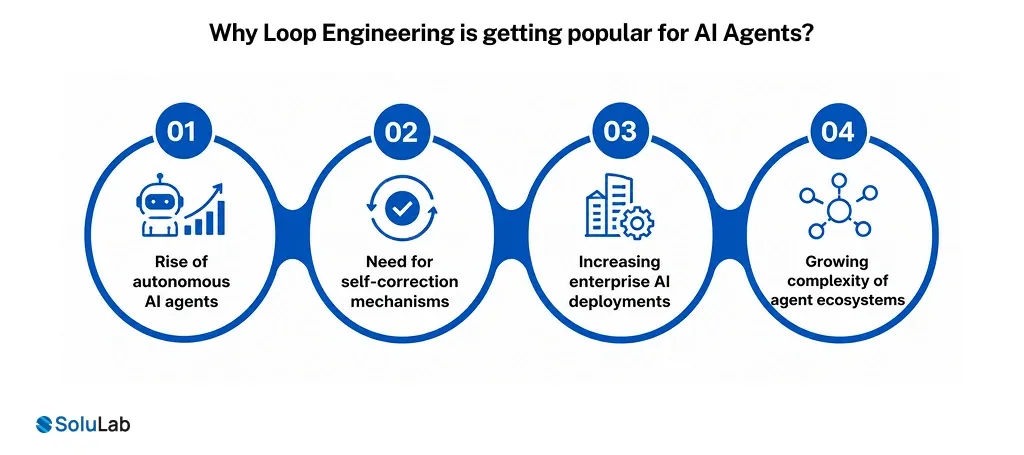
As AI agents evolve from simple chatbots to autonomous AI Agent systems, organizations are realizing that success depends on continuous feedback, adaptation, and optimization, making loop engineering for AI agents a rapidly growing focus area.
- Rise of autonomous AI agents: Autonomous AI agents handle multi-step workflows, requiring continuous evaluation and improvement to maintain accuracy and reliability.
- Need for self-correction mechanisms: Static prompts are insufficient for complex tasks, driving adoption of AI agent loop engineering practices that enable iterative refinement.
- Increasing enterprise AI deployments: Businesses demand scalable, production-ready agents capable of learning from outcomes and adapting to changing environments.
- Growing complexity of agent ecosystems: Multi-agent systems, tools, APIs, and data sources require structured feedback loops to coordinate actions effectively.
Which Tools Are Involved in Loop Engineering for AI Agent Development?
Modern AI agents rely on multiple AI technologies working together to create feedback-driven systems that continuously learn, adapt, and improve performance through iterative decision-making loops.
- Large Language Models (LLMs) serve as the reasoning engine, enabling agents to analyze information, generate responses, and make context-aware decisions throughout the loop cycle.
- Memory Systems: Store previous interactions, task history, and contextual data, helping agents maintain continuity and improve future decision-making accuracy.
- Vector Databases: Retrieve relevant information from large knowledge repositories, allowing agents to access contextual insights during complex workflows.
- Orchestration Frameworks: Coordinate multiple agent actions, tools, and workflows, ensuring seamless execution across interconnected tasks and decision loops.
- Knowledge Bases and RAG Systems: Supply up-to-date information from enterprise AI documents and external sources, reducing hallucinations and improving reliability.
- Automation and API Connectors: Enable agents to interact with business applications, databases, and third-party services to complete tasks autonomously.
- Feedback and Analytics Platforms: Capture user responses, performance metrics, and outcomes, helping refine the overall loop engineering in the AI agents process.
- Agent Frameworks: Provide the infrastructure needed for loop-based AI development, supporting planning, reasoning, memory, and execution capabilities.
- Testing and Simulation Environments: Validate agent behavior under different scenarios, strengthening the effectiveness of the AI loop engineering framework before deployment.
How to Implement Loop Engineering for AI Agents?
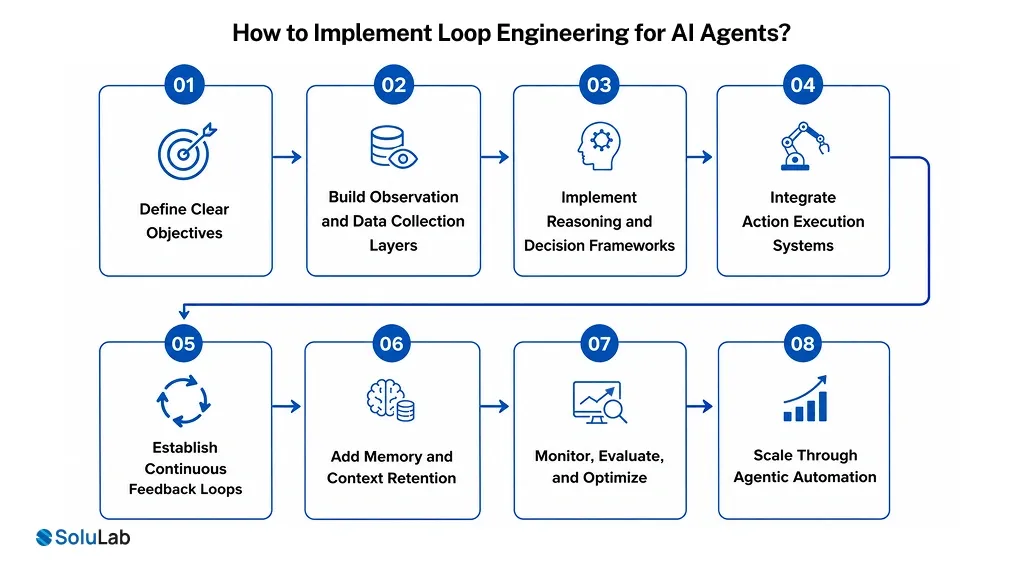
Implementing Loop Engineering requires more than connecting AI models to workflows. Organizations must build structured feedback mechanisms that help agents learn, adapt, evaluate outcomes, and improve continuously.
1. Define Clear Objectives
Start by identifying what the AI agent should accomplish and how success will be measured. Clear goals ensure loops are optimized toward meaningful business outcomes.
- Establish measurable performance benchmarks
- Define task completion criteria
- Align objectives with business goals
2. Build Observation and Data Collection Layers
AI agents need access to relevant information before making decisions. Effective data collection strengthens context awareness and decision quality.
- Capture real-time operational data
- Integrate APIs and databases
- Collect user interaction signals
3. Implement Reasoning and Decision Frameworks
Develop structured AI agent reasoning processes that guide how agents analyze information and determine appropriate actions during workflows.
- Create decision-making workflows
- Enable contextual reasoning capabilities
- Support multi-step task planning
4. Integrate Action Execution Systems
Allow agents to perform tasks through applications, automation tools, and enterprise systems while maintaining operational consistency.
- Connect business software platforms
- Automate repetitive task execution
- Enable cross-system interactions
5. Establish Continuous Feedback Loops
Feedback mechanisms help agents understand whether actions achieved intended outcomes and where improvements are required.
- Track outcome effectiveness continuously
- Gather user satisfaction signals
- Monitor task completion accuracy
6. Add Memory and Context Retention
Persistent memory enables agents to learn from previous interactions and maintain continuity across complex workflows.
- Store historical interaction data
- Retain contextual task knowledge
- Improve future decision quality
7. Monitor, Evaluate, and Optimize
Regular performance evaluation is essential for successful loop engineering for AI initiatives. Monitoring reveals bottlenecks, failures, and optimization opportunities.
- Analyze agent performance metrics
- Detect recurring failure patterns
- Continuously refine workflows
8. Scale Through Agentic Automation
As systems mature, organizations can expand agentic AI loop engineering across departments, enabling autonomous decision-making at a greater scale.
- Deploy multi-agent architectures
- Expand enterprise automation capabilities
- Improve autonomous workflow execution
Loop Engineering vs Prompt Engineering: What’s the Difference?
As AI systems evolve from simple interactions to autonomous workflows, understanding the distinction between prompt engineering and loop engineering becomes essential for building scalable, intelligent AI agents.
| Aspect | Prompt Engineering | Loop Engineering |
| Primary Focus | Optimizing prompts to generate better responses from AI models. | Designing continuous feedback cycles that improve agent performance over time. |
| Objective | Improve output quality for a single interaction. | Enable learning, adaptation, and optimization across multiple interactions. |
| Scope | Focuses on input instructions and prompt structure. | Covers observation, reasoning, action, evaluation, and improvement loops. |
| Memory Usage | Limited to session context or prompt content. | Leverages long-term memory and historical interactions. |
| Automation Level | Suitable for one-time tasks and conversations. | Powers autonomous agents handling complex workflows. |
| Error Handling | Relies on prompt adjustments when outputs fail. | Detects, evaluates, and corrects failures through feedback loops. |
| Enterprise Applications | Content generation, chatbots, and query responses. | Workflow automation, intelligent assistants, and autonomous systems. |
| Business Value | Improves immediate response accuracy. | Enhances long-term agent reliability and scalability. |
How to Engineer Better Loops in Building AI Agents?
Effective loop engineering requires more than adding feedback cycles. Teams must design clear boundaries, evaluation mechanisms, and control systems that keep AI agents efficient, reliable, and goal-oriented.
1. Define Termination Conditions Before You Start
Every agent loop should have clear stopping criteria. Without termination conditions, AI agents can enter endless cycles, waste resources, and generate inconsistent results.
- Prevent infinite execution loops
- Reduce compute and API costs
- Improve workflow predictability
2. Give the Agent Structured Feedback, Not Just Raw Output
Agents improve faster when feedback is organized, measurable, and actionable. Structured feedback helps identify exactly what succeeded, failed, or requires refinement.
- Create measurable improvement signals
- Enable targeted decision corrections
- Improve loop learning efficiency
3. Set Strict Tool Call Budgets
Limiting tool usage prevents excessive API requests, unnecessary reasoning cycles, and inefficient task execution while maintaining performance and cost control.
- Control resource consumption effectively
- Prevent excessive tool dependency
- Improve execution speed consistency
4. Design Clear Escalation Paths
Not every task should remain inside an autonomous loop. Define when the agent should request human input or transfer complex cases.
- Reduce unresolved edge cases
- Improve human-agent collaboration
- Maintain operational reliability
5. Monitor Loop Performance Continuously
Regular monitoring helps identify bottlenecks, repetitive failures, and optimization opportunities within the AI agent loop framework and broader workflows.
- Track loop success rates
- Identify recurring failure patterns
- Improve long-term agent performance
6. Optimize Multi-Agent Coordination
When multiple agents collaborate, effective AI agent orchestration ensures tasks are distributed correctly and feedback flows efficiently between systems.
- Improve cross-agent communication
- Reduce task duplication risks
- Enhance workflow scalability
Why Prompt Engineering Alone Can’t Build Reliable AI Agents?
Prompt engineering can improve individual responses, but reliable AI agents require memory, feedback loops, reasoning, and execution controls that enable continuous adaptation, learning, and goal-oriented performance.
- Limited Context Retention: Prompts alone cannot maintain long-term memory across complex tasks.
- No Self-Correction Mechanism: Agents need feedback loops to identify and fix mistakes.
- Weak Multi-Step Decision Making: Complex workflows require planning beyond single-prompt interactions.
- Inconsistent Performance Over Time: Results vary without structured evaluation and improvement processes.
- Lack of Environmental Awareness: Agents must react to changing data and external events.
- No Built-In Learning Capability: Static prompts cannot continuously improve future task execution.
- Poor Scalability for Enterprise Workflows: Large operations demand robust AI agent architecture and governance.
- Limited Tool Coordination: Reliable agents need seamless integration across multiple systems and APIs.
- Challenges in Workflow Automation: Advanced AI workflow automation services require monitoring, reasoning, and execution loops.
- Insufficient Process Management: Effective AI agent workflow design depends on feedback, memory, and adaptive decision-making.
How SoluLab Fits Into Loop Engineering for AI Development?
As businesses move from simple AI assistants to autonomous agents, effective loop engineering becomes essential for building systems that continuously learn, adapt, and deliver measurable business outcomes.
- Custom AI Agent Development
- AI-Led Development Solutions
- Multi-Agent System Development
- Agentic Workflow Design
- AI Agent Orchestration
- Autonomous Workflow Automation
- Feedback Loop Engineering
- Conversational AI Development
- AI Governance and Security Implementation
For best-class AI-led development solutions, SoluLab is a leading name to partner with.
We recently worked on AI powered recruitment solution, the project focused on automation of the recruitment process with efficient and easy job matching and candidate consulting. To explore more, read the full case study here.
Conclusion
AI agents are evolving from simple task executors into autonomous systems capable of reasoning, learning, and adapting. However, achieving reliable performance requires more than advanced models and prompt engineering.
Loop engineering provides the feedback mechanisms, evaluation processes, memory systems, and decision-making structures that enable agents to improve continuously over time.
As organizations adopt increasingly complex agentic workflows, well-designed loops become essential for scalability, accuracy, cost control, and business impact.
SoluLab, an AI development company, can help your business design, build, and scale production-ready agentic solutions.
FAQs
Neha is a curious content writer with a knack for breaking down complex technologies into meaningful, reader-friendly insights. With experience in blockchain, digital assets, and enterprise tech, she focuses on creating content that informs, connects, and supports strategic decision-making.