Key Takeaways
In 2026, the AI industry has pivoted from “Probabilistic Chat” to “Deterministic Reasoning.” Static LLMs are being replaced by Reasoning Agents—autonomous systems using inference-time compute to solve multi-step problems. By leveraging OpenAI o3-mini for high-velocity logic and DeepSeek-R1 for transparent, open-source sovereignty, SoluLab’s AI agent development services roadmap transitions businesses from experimental Proofs of Concept (PoCs) to full-scale, blockchain-secured production environments.
As we move through the second quarter of 2026, the global business landscape has reached a “Logic Tipping Point.” The era of “stochastic parrots”—AI models that simply predict the next likely word—has ended. In its place is the Reasoning Economy, where the value of an AI is measured by its Inference-Time Scaling (the ability to allocate more “thinking time” to harder problems).
For enterprises, this shift is existential. Legacy AI (GPT-4 era) was prone to “reasoning gaps”—it could write a poem but couldn’t reliably audit a complex balance sheet or navigate a 20-step supply chain crisis without human hand-holding.
SoluLab’s 2026 Thesis: To achieve a $3.70 ROI for every $1 spent on AI, businesses must stop building “bots” and start building “AI Agents.” These Reasoning AI agents require a specialized architecture that combines System 2 thinking (deliberative logic) with Agentic Traceability (verifiable decision logs).
Choosing the Brain: o3-mini vs. DeepSeek-R1
A Custom reasoning AI agent is only as effective as the underlying model’s ability to “think” in chains. In 2026, two titans dominate the specialized agent market.
OpenAI o3-mini: The “High-Velocity Logic” Engine
OpenAI’s o3-mini represents the pinnacle of “Small-but-Mighty” reasoning. It is designed specifically for STEM, coding, and complex instruction-following where latency matters.
- The “Effort” Variable: o3-mini allows developers to toggle “Reasoning Effort” (Low, Medium, High). SoluLab, with its premium AI development services, utilizes this to optimize your API Budget—routing simple queries to Low Effort and complex legal audits to High Effort.
- Performance Benchmarks: It consistently clears 80%+ on the AIME (American Invitational Mathematics Examination), making it the gold standard for financial logic.
DeepSeek-R1: The “Sovereign Thinker”
DeepSeek AI-R1 has disrupted the market by offering performance that rivals OpenAI’s o1-series but with an Open-Source (MIT License) heart.
- The Transparency Advantage: Unlike closed-source models, R1’s “Chain-of-Thought” (CoT) is fully visible. This is critical for industries like Healthcare, where the why behind a decision is just as important as the what.
- Private Cloud Deployment: For enterprises with strict data residency requirements, SoluLab deploys DeepSeek-R1 on private NVIDIA Blackwell clusters, ensuring no sensitive data ever hits a third-party server.
| Feature | OpenAI o3-mini | DeepSeek-R1 |
| Logic Type | Proprietary / Optimized | Open / Fully Transparent |
| Primary Moat | Speed & Ecosystem Integration | Sovereignty & Cost-Efficiency |
| Best For | Real-time Finance / SaaS Ops | Healthcare / On-Prem Legal |
| Quantization | Managed by OpenAI | FP8 / MXFP4 (Highly flexible) |
SoluLab’s 4-Stage Agentic Development Lifecycle (ADLC)
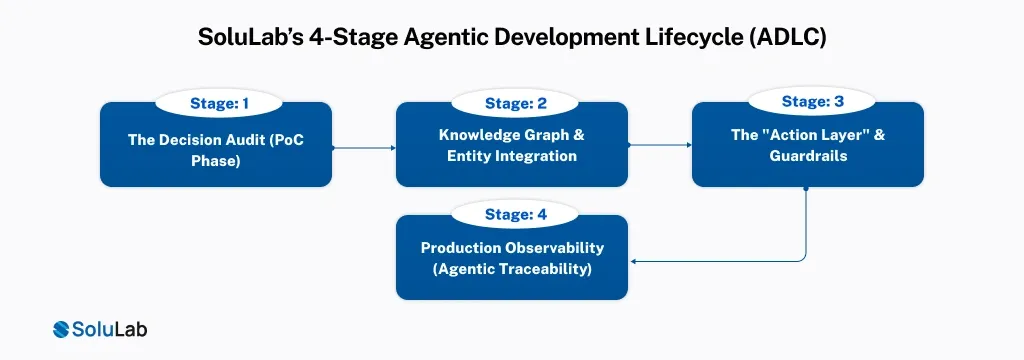
Building an intelligent agent system that survives the transition from a “cool demo” to a “production workhorse” requires a disciplined lifecycle. At Solulab, we adhere to delivering flawless, agile AI agent development in 4 stages:
Stage 1: The Decision Audit (PoC Phase)
We begin by identifying your company’s Logic Bottlenecks. We don’t ask “Where can we use AI?” We ask, “Where are humans currently acting as ‘Logic Routers’ between two systems?”
- Deliverable: A functional AI PoC within 4 weeks that demonstrates the agent’s ability to handle a “3-Step Logic Leap” (e.g., Identifying an invoice discrepancy, checking it against a contract, and drafting a dispute).
Stage 2: Knowledge Graph & Entity Integration
Agentic reasoning models are only as good as the data they can “reach.” We build a Vector-Graph Hybrid (RAG + Knowledge Graph) that allows the agent to understand relationships between your entities (e.g., “Client A” is a “Sub-subsidiary of Company B”).
- Entity Association: We link the AI agent to high-trust sources like Gartner, Bloomberg, or Statista for real-time market validation.
Stage 3: The “Action Layer” & Guardrails
This is where the custom reasoning AI agent model gains “hands.” We build custom connectors to your ERP (SAP/Oracle), CRM (Salesforce), and specialized tools.
- Recursion Guards: We implement logic gates that prevent the reasoning agent from entering an infinite “Thinking Loop” that could exponentially increase costs.
- Human-in-the-Loop (HITL) Triggers: For any action exceeding a specific risk threshold (e.g., a $10,000+ wire transfer), the agent is hard-coded to pause and request human authorization.
Stage 4: Production Observability (Agentic Traceability)
Once live, we monitor the agent using Agentic Traceability. We log not just the answer, but the internal Chain-of-Thought.
- Why this matters: In 2026, the “Black Box” is a liability. Our logs provide a forensic audit trail of every logical step the AI took, satisfying the EU AI Act and SEC transparency requirements.

The Web3 Convergence: Blockchain-Integrated Agents
One of SoluLab’s core strengths is the fusion of AI and Web3. In 2026, AI agents are no longer just “software”—they are Economic Entities.
Why Blockchain for AI Agents?
- Autonomous Treasury: Agents can hold their own “wallets” to pay for their own compute or settle micro-transactions with other agents.
- Immutable Audit Trails: By hashing the agent’s “Logic Logs” onto a blockchain (like Solana or Polygon), we create a tamper-proof record of what the AI did.
- Smart Contract Auditing: Using o3-mini’s superior coding reasoning, we build agents that monitor smart contracts in real-time, identifying “Reentrancy Attacks” or “Logic Bombs” before they can be exploited.
Case Study: Decentralized Supply Chain Reasoner
An international logistics firm used a SoluLab agent to manage “Dispute Resolution.”
- The Logic: The agent monitored IoT sensors on shipping containers. If a temperature drop occurred, the agent reasoned through the insurance contract, calculated the loss, and initiated an automated “On-Chain Insurance Claim” via a smart contract.
- The Result: Dispute resolution time dropped from 14 days to 4 minutes.
For deeper insights on Reasoning AI agents use cases in Supply chain and logistics,
click here- The Role of AI Agents in Supply Chain and Logistics
Vertical Deep Dives: Engineering Authority
To understand the depth of SoluLab’s reasoning agents, we must look at how they solve sector-specific “Impossible Problems.”
A. Healthcare: The “Clinical Path” Reasoner
In healthcare, a standard LLM might suggest a medication. A Reasoning Agent built on DeepSeek-R1 will:
- Analyze the patient’s 10-year history.
- Cross-reference the latest 2026 NIH research papers.
- Reason through potential drug-drug interactions.
- Draft a “Prior Authorization” request that justifies the treatment logic to the insurer.
- Impact: SoluLab’s healthcare AI agents have reduced administrative “Drift” by 55% in pilot hospitals.
B. FinTech: Deterministic Fraud Detection
Most fraud detection is “Pattern Matching.” SoluLab’s o3-mini Agents use “Intent Reasoning.”
Instead of just seeing a $5,000 transaction, the agent reasons about the intent: “Why is this user moving funds at 3 AM to a wallet they’ve never interacted with, following a password reset?”
- Impact: This reduces “False Positives” by 40%, allowing legitimate transactions to flow while stopping sophisticated, AI-driven fraud.
The 2026 ROI Blueprint: The “Reasoning Budget”
A common enterprise fear is that “Thinking AI” is too expensive. SoluLab’s Hybrid Routing architecture solves this.
| Workload Type | Model Used | Reasoning Level | Cost Impact |
| Standard FAQ | Llama 4 Scout (SLM) | Probabilistic | $ (Minimal) |
| Data Extraction | GPT-4o-mini | Low Reasoning | $$ |
| Complex Logic Audit | OpenAI o3-mini | High Reasoning | $$$ |
| Sovereign/Private Ops | DeepSeek-R1 | Full Traceability | $$$ (Fixed) |
Strategic Stat: SoluLab clients who implement “Adaptive Routing”—where the system chooses the cheapest model capable of the required logic—see a 62% decrease in monthly API spend compared to “Mono-model” architectures.
Overcoming the “Hallucination Tax”
In 2024, businesses paid a “Hallucination Tax”—the cost of hiring humans to double-check every word an AI wrote. In 2026, SoluLab’s AI-driven reasoning agents use Verification Loops to eliminate this tax.
The “Self-Correction” Protocol:
When an agent is tasked with a “Zero-Error” mission (like calculating tax compliance), we deploy a Dual-Agent Architecture:
- Agent A (The Worker): Proposes the solution.
- Agent B (The Auditor): Tries to find flaws in Agent A’s reasoning.
- Resolution: The solution is only presented to the user once Agent B finds zero logic gaps.

Why SoluLab for your 2026 Roadmap?
The difference between a generic AI agency and SoluLab, one of the trusted names for AI agent development services, is our Systems Engineering heritage. We don’t just “connect an API”; we build robust, scalable infrastructures.
- 250+ Specialized Engineers: Experts in both Frontier AI (Reasoning Models) and Deep-Level Blockchain.
- Proprietary Scaffolding: Our “SoluAgent” framework allows us to jumpstart your PoC in days, not months.
- 2026 Compliance Ready: Every agent we build is designed with the latest global AI regulations in mind, ensuring your investment is future-proof.
FAQ: Navigating the Agentic Future
The Final Verdict: From Theory to Production
In the 2026 landscape, the “Moat” is no longer just your data; it is your Agentic Workflow. A company that can reason through its data 1,000x faster than its competitors will win the market.
SoluLab is your partner in this Agentic reasoning transition. We take you from the initial spark of a PoC to a global, blockchain-secured, reasoning-powered production environment.
Book a free 45 min discovery session to know more!
Shipra Garg is a tech-focused content strategist and copywriter specializing in Web3, blockchain, and artificial intelligence. She has worked with startups and enterprise teams to craft high-conversion content that bridges deep tech with business impact. Her work translates complex innovations into clear, credible, and engaging narratives that drive growth and build trust in emerging tech markets.