



As a founder, I don’t allocate capital based on hype. I allocate it based on numbers, defensible use cases, and systems that compound value over time.
That’s why ROI is non‑negotiable when talking about blockchain for me. Ignoring ROI when adopting new technology is equivalent to making capital allocation decisions without a risk model. In the enterprise world, blockchain development solutions are not launched for novelty; they are launched to reduce cost, lower risk, or unlock new revenue streams, you launch them because they cut costs, reduce risk, or unlock new revenue streams.
By 2026, the economics of blockchain adoption have reached a point where ignoring them becomes a strategic liability. Enterprises are already reporting 42% positive ROI on early‑mover projects, with well‑scoped blockchain pilots delivering 200–400% ROI over 3–5 years in supply chain, cross‑border payments, and B2B workflows.
Global blockchain spending is on track to hit $100B+ by 2030, and the clearest trend is this disciplined, use‑case‑first projects no longer require seven‑figure budgets to prove ROI.
The real founder question in 2026 is how to deploy blockchain without extending the burn cycle or delaying breakeven. The answer lies in hitting breakeven in 12–18 months with 25–40% IRR, and that’s absolutely achievable with the right stack and strategy.
Why Founders Must Prioritize ROI from Day One?
Blockchain ROI is the dividing line between strategic operators and experimental adopters.
For any founder:
- ROI determines whether you are building a durable business or shipping an isolated technical demonstration.
- It helps you compare blockchain vs legacy systems, vs AI‑driven automation, vs good‑old SaaS.
- It signals to investors whether you understand risk exposure, scalability constraints, and long-term unit economics.
In 2026, the question is not Should we explore blockchain? — it’s Which blockchain‑driven use case will give us clear, measurable ROI within 12–24 months?
Blockchain technology should not be treated as an IT initiative; it is a business model leveraged with balance-sheet implications.
This is why founder-level cost and ROI analysis must precede any hiring or development decision.
How Blockchain Technology Is Delivering Real Business Value for Enterprises in 2026?
By 2026, enterprise deployment data confirms what experienced founders already know: blockchain is a precision tool, not a general-purpose solution
- Supply-chain-provenance pilots demonstrate 95%+ counterfeit detection accuracy and an 80% faster recall response.
- Cross-organizational data-sharing use cases deliver a 70–90% reduction in manual verification time.
- Digital credentialing and compliance workflows reduce verification costs by ~90%, with checks decreasing from days to seconds.
These are the same patterns being shipped today by logistics, finance, and pharma incumbents, who are leveraging permissioned chains, appchains, or L2 rails with low-cost transactions and predictable governance.
When you map these patterns to your existing stack:
- Start on L2s or optimized chains (e.g., Polygon, Arbitrum, Base, Solana) to keep deploy costs at $2–$20 and average transaction fees under $0.05.
- Reserve mainnet‑style public chains only for high‑value, low‑frequency settlement or token‑native products.
- Lean on open‑source permissioned stacks like Hyperledger Fabric for internal or consortium‑style pilots where you need zero‑network‑ops cost and tight control.
When deployed this way, blockchain transitions from an experimental cost center to a profit-adjacent infrastructure layer.
Critical Data Inputs You Must Define Before ROI Calculation
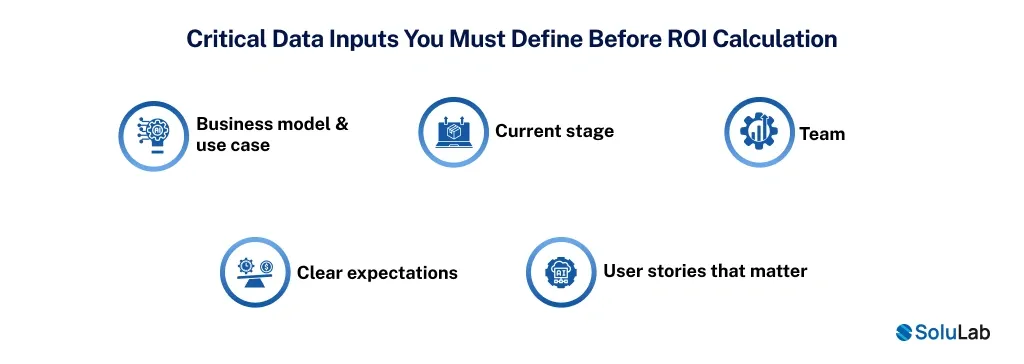
Before you even think about investing in a blockchain POC, you need to answer, in plain language:
- Business model & use case
- What’s the problem?
- How does blockchain solve it better than any other stack?
- Current stage
- Is this an idea, a PoC, an MVP, or a live product?
- Team
- Who’s on deck? Full‑stack devs, blockchain architects, smart‑contract specialists, legal/compliance advisors?
- Clear expectations
- What should the system do?
- What KPIs will move? (e.g., settlement time, reconciliation cost, fraud rate.)
- User stories that matter
- Not hypothetical users, but real roles: suppliers, buyers, finance teams, partners, regulators.
- How do blockchain‑driven changes improve their reality?
Forget beautiful architecture diagrams. If you can’t answer these questions clearly, your ROI model will be garbage.
Why You Should Not Ignore the Hidden Power of Intangible Benefits?
Most founders over-index on visible costs and systematically undervalue intangible economic gains. That’s a mistake.
In 2026, common intangible gains include:
- Less fraud and hacking because data is distributed and immutable.
- Fewer reconciliation errors because there’s a single source of truth.
- Faster information sharing between partners, regulators, and internal teams.
- Stronger brand trust, customers, and partners know you’re not hiding data.
For example, a blockchain‑driven shipping tracker doesn’t just show where a container is. It can surface a delay before it becomes a breach, let you adjust contracts, and avoid disputes.
That is reputational risk mitigated, not merely an operating expense reduced.
Smart contracts let you automate:
- Payments and settlements.
- Escrow and compliance checks.
- KYC and AML flows, where appropriate.
And because there’s no central party controlling the ledger, you’re removing a single point of failure and a single point of control, which is a huge advantage in regulated industries.

The Three Key Phases of Blockchain ROI Generation
In 2026, most founders move through three distinct ROI phases:
Phase 1: Pilot / PoC
- Value is low or invisible.
- Focus is on technical feasibility and learning.
- You’re spending money but not proving economics yet.
This is where the $15k–$40k PoC benchmarks matter: you’re not building a full‑stack product yet, you’re proving a single blockchain use case with clear KPIs.
If you can’t validate something measurable here, you shouldn’t scale.
Phase 2: Commercial Market
- ROI becomes visible but fragile.
- You add more blockchain developers, integrations, governance, and operational overhead.
- You’re building a real system, not a demo.
This is where the $40k–$120k MVP band becomes critical.
If you’re building a multi‑party supply‑chain tracker, enterprise cash‑flow application, or compliance layer, you’re designing rules, incentives, and exit‑ramps.
Phase 3: Network of Networks
- This is where network effects begin to dominate, and winner-take-most dynamics emerge.
- You’re connecting multiple blockchains, ecosystems, and platforms.
- You may outsource ongoing blockchain interoperability and management to a Web3‑native stack provider.
At this stage, well‑designed networks deliver 200%+ cumulative ROI over 3 years, as more participants join, more data flows in, and the system becomes a shared infrastructure layer, not just a feature.
How Founders Can Perform a Blockchain Cost–Benefit Analysis Before Building?
You do not need academic rigor here; you need a checklist that can withstand board-level scrutiny.
- Define clear objectives
- Example: Reduce cross‑border payment cost by 30% in 18 months.
Not: Explore blockchain.
- Example: Reduce cross‑border payment cost by 30% in 18 months.
- Identify all costs
- Blockchain Development cost (platform, modules, smart contracts).
- Onboarding (training, documentation, integration).
- Operations (infrastructure, support, security, compliance).
- Hidden costs: governance, consortium dues, audit, and regulatory consultation.
As per my Analysis, I found that lean founders can launch a blockchain‑based MVP using low‑code tools, open‑source stacks like Hyperledger Fabric, or L2s such as Polygon and Arbitrum, with development costs typically between $40,000 and $120,000 for a production‑ready MVP.
At these levels, maintenance runs at roughly 15–20% of initial dev spend annually, covering RPC access, monitoring, and periodic security audits.
Here’s a compact 2026 benchmark table you can plug directly into your board deck or investor update:
| Launch Stage | Typical Cost Range | Primary Cost Drivers | Payback Period | Expected ROI / IRR | Anchor Example (Scaled for Startups) |
| PoC / Early Pilot | $15k–$40k | Low‑code tools (e.g., Moralis, Hyperledger testnets), 1–2 devs | 3–6 months | Validation only | Free Hyperledger Fabric pilot on AWS Managed |
| Full MVP (Production‑Ready) | $40k–$120k | Smart contracts, basic integrations, security audit, L2 deployment (Polygon/Arbitrum) | 12–18 months | 25–40% IRR | Supply‑chain provenance tracker mirroring Walmart/IBM Food Trust mechanics |
| Scaled Commercial | $150k–$400k (cumulative) | Multi‑party onboarding, governance, and ongoing node operations | 18–24 months | 200%+ cumulative over 3 yrs | Banks: $8–12M annual settlement savings; startups capture 20–30% supply‑chain cost reduction |
To turn this into a concrete calculator:
- Plug your projected transaction volume, fraud rate, and reconciliation overhead into a simple Excel model.
- Most founders who follow the objective-driven, cost-clarity steps outlined here see their numbers swing from a fragile Phase 2 to a network-effect Phase 3 within the 12–to 24–month window you’re targeting.
- Measure and aggregate benefits
- Faster settlement and dispute resolution.
- Lower fraud and reconciliation costs.
- Higher trust‑driven transaction volume.
- Sensitivity‑test the model
- Vary user growth, transaction volume, and fraud reduction assumptions.
- Stress‑test under conservative and optimistic scenarios.
- Calculate NPV, ROI, BCR, and payback
- Compare against the legacy system baseline, not some imaginary status quo that never changes.
- Compare with alternatives
- Would AI‑driven automation or a SaaS stack deliver the same ROI faster?
Founders who run this honestly almost always land on blockchain only when trust, multi‑party coordination, or immutable provenance are core to the problem.
- Would AI‑driven automation or a SaaS stack deliver the same ROI faster?
If you want to learn more, please read this research by Panuparb Patara.
Why Measuring Blockchain ROI Is Still a Challenge for Enterprises?
Even with better data, blockchain ROI still feels uncertain because:
- Costs scale with network usage and node count.
- Public vs private vs consortium models have very different cost and governance profiles.
- Onboarding, membership, and transaction fees can quietly eat into early gains.
- Infrastructure, monitoring, and compliance are often underestimated.
But the 2026 playbook is clear:
- Use low‑cost layer 2 [L2] blockchains or open‑source permissioned stacks for minimum‑investment launches.
- Treat 15–20% of dev spend as annual maintenance.
- Aim for 25–40% IRR within 18 months and be ready to walk away if you can’t model that.
Founders who follow this end up with 200–400% ROI over 3–5 years in high‑friction verticals like supply chain, payments, and compliance, not by chasing the next chain, but by starting with the right question and the right economics.

What Founders Can Expect Over the Next 3 Years in Web3?
By 2029, over 80–85% of enterprise CTOs are expected to have active blockchain initiatives in their roadmap.
- Regulators are demanding transparency in cross‑border trade and finance.
- Customers are increasingly demanding proof of origin and assurance of ethical sourcing.
- Competitors are already shipping Web3‑native workflows.
Blockchain will increasingly help enterprises:
- Manage invoices and reconciliation at scale.
- Track goods and shipments in real time.
- Automate compliance and audit workflows.
But as a founder, you don’t need to wait for the full blockchain revolution to start.
You can start small, measure impact, and compound, and the 2026 benchmarks above give you exactly the numbers you need to do that.
What Y Combinator and a16z Are Actively Backing Builders to Create in Web3 in 2026
I analysed research from YC and a16z, and here is what I found:
- Build yield infrastructure that separates principal and yield for on-chain structured products.
- Create customizable, permissioned lending markets for institutional capital.
- Develop restaking services to manage, insure, and optimize ETH across networks.
- Build ZK-first execution tools to replace re-execution with proof-based verification.
- Create ZK developer tooling for zkVMs and zkEVMs.
- Design L2 apps for ecosystems with real distribution and active users.
- Build AI agent orchestration platforms for identity, payments, and coordination.
- Create agent-native wallets and account for AI-to-AI transactions.
- Develop on-chain intelligence that turns blockchain data into actions.
- Build regulated stablecoin yield products for businesses and treasuries.
- Create compliant platforms for tokenized real-world assets.
- Build a plug-and-play DeFi ecosystem and compliance infrastructure.
I would suggest starting to build these narratives ASAP.
A Founder’s Perspective on Social Blockchain Cost Analysis
ROI isn’t just about profit. It’s about impact.
In 2026, more founders are thinking about:
- Social ROI: How blockchain improves financial inclusion, transparency in aid, and ethical supply chains.
- Environmental ROI: How blockchain proves provenance and reduces waste in physical and digital supply chains.
If you can use blockchain to both improve efficiency and fund social or ESG programs, you’re building a platform with purpose.
When Blockchain Adds Complexity Instead of Value?
A founder’s real edge isn’t blind conviction in a technology, it’s knowing when not to use it.
Ironically, being honest about the limits of blockchain increases trust with investors, partners, and your own team more than any blockchain‑first slide ever will.
When Blockchain Does NOT Make Economic Sense
- Single‑party workflows – If only one entity controls the entire process and there’s no need for shared, auditable records, blockchain is pure overhead. Use a relational database with strict access control instead.
- Low‑trust‑variance environments – If your counterparties are already highly trusted (e.g., internal teams, tightly controlled partners), the cost of coordination and cryptography often exceeds the marginal benefit of decentralization.
- Problems solvable cleanly with databases + APIs – If you’re just building a dashboard, a CRUD app, or a simple backend service, a traditional stack with robust APIs and proper logging is cheaper, faster, and easier to maintain.
Founders who speak candidly about when blockchain is the wrong choice earn more trust than those who try to force it into every product, and Capital‑efficient founders optimize for the right tool, not the trendiest one, and that’s exactly how you build durable Web3 products with real ROI.
Partner with SoluLab to Build a High-ROI Blockchain Product in 2026
At SoluLab, we work with founders and enterprise leaders who want to launch blockchain products with minimum investment and maximum ROI, and we design specifically for the $12k–$145k MVP band you just saw in the table above.
As a leading Blockchain consulting company, we help you:
- Define the right use case, not just the hottest one, but the one that moves your core KPIs.
- Design a realistic roadmap from PoC to production, with clear metrics at every stage.
- Optimize your architecture and cost structure so you aren’t stuck paying for a demo that never scales.
If you’re a founder asking, How do I launch a blockchain product in 2026 without blowing the runway? – We can help you:
- Model real‑world ROI for your specific vertical.
- Avoid common cost traps and governance blind spots.
- Build and deploy enterprise‑grade Web3 solutions that grow with your network.
Let’s connect, and I’ll share a simple blockchain ROI checklist tailored for founders, and if you want a practical ROI framework tailored to your use case, I’m happy to share one or walk through it directly.


![How to Choose a Blockchain Development Company [2026 Edition]](https://www.solulab.com/wp-content/uploads/2026/09/Banner-Before-You-Hire-Check-These-Blockchain-Essentials.webp)