Key Takeaways
- The application layer decides success, not the sensors. Continuous data is worthless if the alert doesn’t reach someone with the authority and the means to act.
- Connectivity is the constraint most teams discover late. Range, power draw and data volume conflict. So pick the protocol before you pick the sensor, not after.
- Build for offline first. Remote sites lose connectivity. However, edge buffering and store-and-forward turn a dropped link into a delayed reading rather than a gap in the record.
- Start with one asset class and one failure mode. Plants that pilot narrow reach production. By contrast, plants that instrument everything at once usually stall in integration.
An IoT remote monitoring solution collects sensor data from equipment, vehicles or facilities you can’t physically watch. It sends that data over a network to a central platform. Then it turns it into alerts and dashboards people act on. In short, it replaces manual inspection rounds with continuous visibility.
On this page: what these systems do and the four architecture layers. Then connectivity options, cost, timelines, and how to choose a partner.
Most remote monitoring projects don’t fail on the sensors. Instead, they fail because data reaches a dashboard nobody opens, or an alert fires to an inbox nobody owns. So this guide covers the parts that decide whether an IoT remote monitoring solution gets used. If you’re already scoping a build, our IoT development company page covers delivery and engagement models.
What is an IoT remote monitoring solution?
An IoT remote monitoring solution is a connected system of sensors, network transport, a data platform and an application layer. Together, they let a team observe the condition of distant assets in real time. As a result, the team can respond before a problem becomes an outage.
The pattern is the same for a pump in a remote field, a refrigerated truck, HVAC across forty retail sites, or a patient’s vitals at home. First, something measures a physical condition. Then the reading travels somewhere central, rules decide whether it matters, and a person or system acts. For the wider picture, see our article on IoT and the future of innovation.
What varies is everything practical. For example, how often you sample, how much power the sensor has, and whether the site has connectivity. Acceptable latency and the regulation that applies to the data also differ.
What can you monitor remotely?
The use cases cluster into four groups. However, the engineering differs more than the marketing suggests.
- Equipment condition. Vibration, temperature, current draw and pressure on motors, pumps, compressors and HVAC. This data also feeds predictive maintenance and predictive analytics models.
- Environmental and facility. Temperature, humidity, air quality, water level and energy consumption across buildings or sites. This is often tied to compliance reporting or sustainability targets, and increasingly to AI agents for energy consumption.
- Asset location and status. GPS, door sensors and cold-chain temperature on vehicles, containers and high-value equipment. For example, see our work on IoT asset tracking devices.
- Health and patient monitoring. Vitals from home or wearable devices back to a clinical team. This adds HIPAA scope and a much higher bar on reliability and data handling.
A note on the last one. Remote patient monitoring is the most-written-about use case in this category, yet the least representative. Its regulatory burden, device certification and clinical liability make it a poor template for industrial monitoring. So if you’re monitoring pumps, don’t copy an RPM architecture.

Which connectivity option should you use?
Connectivity is the decision that constrains every other layer of an IoT remote monitoring solution. The trade-off is always the same three-way tension between range, power draw and data volume. In the end, you get two.
| Option | Range | Power draw | Data volume | Best for |
| Wi-Fi | Short, in-building | High | High | Sites with existing coverage and mains power |
| Bluetooth LE | Very short | Very low | Low | Wearables, short-hop sensors to a local gateway |
| LoRaWAN | Long, several km | Very low | Very low | Battery sensors across large sites, infrequent readings |
| NB-IoT / LTE-M | Wide, carrier coverage | Low | Low to moderate | Distributed assets with no local network |
| Cellular (4G/5G) | Wide | High | High | Vehicles, video, high-frequency telemetry |
| Wired Ethernet | Fixed | Mains | Highest | Fixed industrial equipment where cable runs already exist |
Here’s the heuristic. If the sensor runs on a battery you don’t want to change for years, you’re in LoRaWAN or NB-IoT territory, which caps how much data you can send. Teams often specify a sampling rate first, then discover the power budget won’t support it. Instead, work backwards from battery life.
On the protocol layer, MQTT is the near-universal messaging standard for device-to-platform communication. Its publish-subscribe design and small footprint are why it beats HTTP for constrained devices. The MQTT specification is maintained by OASIS, so read it before your team invents its own message format.
What does the architecture look like in practice?
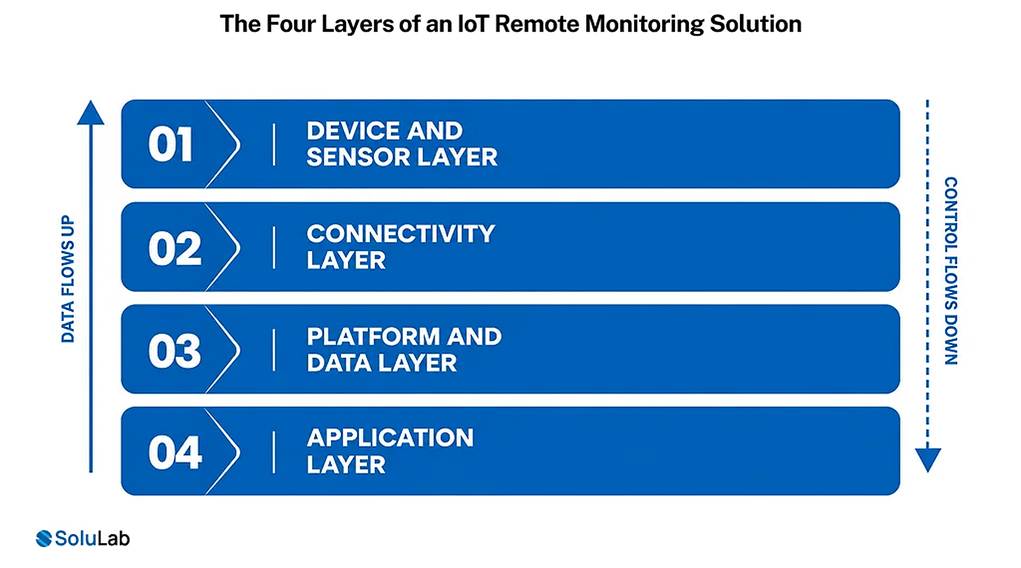
There are four layers, shown in the diagram above. Here’s what each one actually decides.
- Device and sensor layer. Sampling rate, power budget, and how much filtering happens at the edge. Sending every raw reading is usually wasteful. Instead, sending only what changed, plus a heartbeat, is usually enough.
- Connectivity layer. Protocol, bandwidth cost and offline tolerance. Assume the link drops. Then edge gateways that buffer and forward on reconnect decide whether you get a delayed reading or a hole in your compliance record.
- Platform and data layer. Ingestion, a device registry and time-series storage. The registry tells you what’s deployed and what firmware it runs. On top sit a rules engine for thresholds and anomaly detection where fixed thresholds aren’t good enough.
- Application layer. Dashboards, alert routing, mobile access and writes into the ERP or maintenance system. This is where the value shows up, but also where most projects underinvest.
One detail is easy to skip and expensive to retrofit: a device registry with over-the-air update capability. Fleets of sensors need firmware patches. Otherwise, you send someone to a remote site to update a device, which is the cost that quietly kills the business case. For a consumer-side example of the same layers, see our AI and IoT smart home architecture guide.
What tech stack is used for IoT remote monitoring?
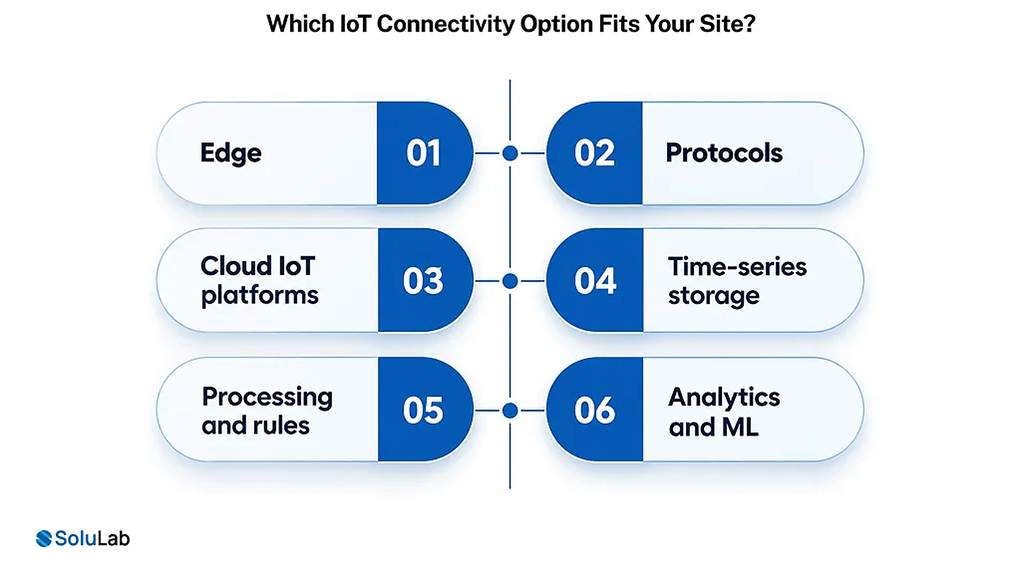
Production builds tend to draw from a fairly stable set:
- Edge: Raspberry Pi or industrial gateways, ESP32 for constrained nodes, Node-RED or custom firmware for edge logic.
- Protocols: MQTT, CoAP, Modbus and OPC-UA for industrial equipment, LwM2M for device management.
- Cloud IoT platforms: AWS IoT Core, Azure IoT Hub or, since Google retired Cloud IoT Core in 2023, a Google Cloud alternative. Alternatively, a self-hosted EMQX or Mosquitto broker where data must stay on-premise.
- Time-series storage: TimescaleDB, InfluxDB, or Amazon Timestream.
- Processing and rules: Apache Kafka for streaming, Node.js or Python services, Grafana for operational dashboards.
- Analytics and ML: anomaly detection and forecasting where thresholds are insufficient. This often runs as edge AI when latency or bandwidth rules out sending raw data to the cloud.
Choose the platform based on where your other systems already run. Otherwise, running the ingestion side of an IoT remote monitoring solution on a different cloud from your ERP creates an integration tax you pay every sprint.
What does an IoT remote monitoring solution look like in production?
Here are two anonymised SoluLab builds where remote monitoring was the core of the system.
Energy monitoring across commercial facilities. A utilities client had no real-time view of consumption across its portfolio. As a result, inefficiencies surfaced only in monthly bills. We built a platform on IoT sensors and Azure IoT Hub with Python, TensorFlow, PostgreSQL, Grafana and building-management system integrations. It forecasts demand, flags abnormal consumption and automates reporting. Outcome: 23% lower energy costs, 31% better operational efficiency and 19% lower carbon emissions.
Fleet and telematics monitoring for a logistics operator. Fuel costs were rising and delivery schedules were unpredictable. So we built a fleet platform with Python, OR-Tools, TensorFlow, FastAPI, PostgreSQL, React and AWS. It ingests telematics, monitors fleet performance, predicts ETAs, recommends maintenance and re-routes around traffic. Outcome: 24% lower fuel costs, 38% better on-time delivery and 32% higher fleet utilisation.
Both built the application layer properly. The energy platform wrote into the client’s existing reporting workflow. Meanwhile, the fleet platform pushed re-routes to drivers rather than to a screen in an office. That’s not a coincidence: it’s what makes an IoT remote monitoring solution get used.
How much does an IoT remote monitoring solution cost?
Four drivers set the cost, roughly in order of impact. First, the number of sites and devices. Second, whether the sites already have connectivity. Third, how much custom integration the application layer needs. Finally, whether data residency forces self-hosting instead of a managed cloud platform.
Per-device hardware cost gets the attention, but it’s rarely the deciding factor. Instead, connectivity subscriptions across a large fleet usually dominate the multi-year total, along with the field labour to install and service devices. For example, a sensor that needs a technician visit every eighteen months costs far more than its price tag suggests.
So the total cost of an IoT remote monitoring solution depends far more on scope and site conditions than on the sensors themselves.
How long does it take to build?
A single-site pilot covering one asset class typically runs 6 to 12 weeks, including hardware procurement. A multi-site production rollout with ERP or maintenance-system integration commonly runs 4 to 8 months. However, hardware lead times and site access, not software, usually cause the slippage.
How do you choose an IoT remote monitoring partner?
Ask five questions. Above all, weight them toward evidence rather than capability lists.
- Have you deployed to a site with poor connectivity? Anyone can build a dashboard. However, handling intermittent links, buffering and clock drift across a fleet separates experience from theory.
- How do you handle firmware updates in the field? If the answer isn’t over-the-air with rollback, then budget for technician visits forever.
- What happens to the data, and where does it live? Get residency, retention and access answered before kickoff. This matters most in energy, healthcare and defence.
- Who owns the device firmware and the platform code? Some vendors retain firmware, which locks you to them at hardware refresh time.
- How will this integrate with the systems our team already uses? A platform that doesn’t write into the maintenance system creates a second place to look. As a result, people stop looking at one of them.
For a view of the wider vendor landscape, see our roundup of top IoT companies. Also, if your use case involves device data integrity or multi-party trust, blockchain and IoT applications explain where that combination is warranted and where it’s overkill.
Frequently asked questions
Shipra Garg is a tech-focused content strategist and copywriter specializing in Web3, blockchain, and artificial intelligence. She has worked with startups and enterprise teams to craft high-conversion content that bridges deep tech with business impact. Her work translates complex innovations into clear, credible, and engaging narratives that drive growth and build trust in emerging tech markets.