
Key Takeaways
- An enterprise IoT platform is not the hardware. Device selection matters, but the platform is where the programme succeeds or stalls.
- Device management is the layer teams underestimate in an enterprise IoT platform. Provisioning, over-the-air updates and remote diagnostics for thousands of devices is a product, not a feature.
- Connectivity choice is a ten-year decision. It constrains battery life, coverage, cost per device and which markets you can deploy in.
- Integration is where value appears. Data that never reaches your ERP, CRM or maintenance system produces dashboards nobody acts on.
- Pilot economics lie. A hundred devices tell you nothing about what ten thousand cost to run.
An enterprise IoT platform is the software layer that connects your devices, manages them at scale, processes what they send, and pushes the results into the systems your business already runs on. It sits between hardware in the field and applications in the office. Without it, a connected device platform turns into dozens of point integrations that nobody can maintain.
On this page: what the platform layers do, build versus buy, connectivity choices, security, the tech stack, how a rollout runs, what it costs, and what to check before selecting a partner.
If you are past the evaluation stage and comparing delivery partners, our IoT development services page covers scope and engagement models.
What Does an Enterprise IoT Platform Actually Do?
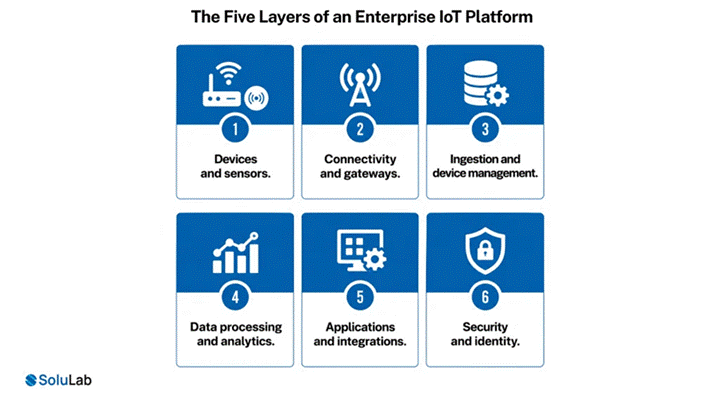
An enterprise IoT platform works in five layers, with security running through all of them. Each layer has a different owner, a different failure mode and a different cost curve. So it helps to look at the IoT platform architecture one layer at a time.
1. Devices and Sensors
This is the physical estate an enterprise IoT platform has to manage: meters, trackers, controllers, cameras and industrial equipment. It’s often a mix of new hardware and machinery that predates the programme by twenty years.
2. Connectivity and Gateways
This is how data leaves the device. Cellular, Wi-Fi, LoRaWAN, NB-IoT or wired links usually run through gateways. Those gateways aggregate local devices and translate protocols for older equipment.
3. Ingestion and Device Management
The platform receives telemetry at volume. More importantly, it acts as an IoT device management platform for the whole fleet: provisioning new devices, pushing firmware over the air, monitoring health and retiring units. This is the layer that separates a pilot from a programme.
4. Data Processing and Analytics
Streaming rules raise real-time alerts, storage keeps historical data, and models handle forecasting and anomaly detection. Some processing runs at the edge when latency or bandwidth demands it. If you plan to build forecasting models on this data, our data science and analytics services cover that layer.
5. Applications and Integrations
Dashboards and mobile apps sit here, but the critical work is the connection into ERP, CRM, maintenance and billing systems. Value shows up when a sensor reading raises a work order automatically, not when it appears on a screen. That integration work is usually enterprise software development rather than IoT work in the narrow sense.
6. Security and Identity
Security spans every layer of an enterprise IoT platform: device identity and certificates, encrypted transport, access control, and a way to revoke a compromised device without touching it physically.
Should You Build an Enterprise IoT Platform or Buy One?
Most enterprises do neither outright. The realistic choice is how much of the enterprise IoT platform stack you assemble yourself.
| Dimension | Commercial platform | Hyperscaler IoT services | Custom-built platform |
| Time to first deployment | Fastest | Moderate | Slowest |
| Fit to unusual hardware | Limited to supported devices | Flexible with work | Whatever you need |
| Cost shape | Per device, per month | Usage-based, scales with data | High upfront, lower marginal |
| Lock-in risk | High (the data model is theirs) | Moderate (services are partly portable) | Low |
| Team required | Small | Moderate, cloud-skilled | Substantial, ongoing |
| Best fit | Standard use cases, fast pilots | Most enterprise programmes | Unusual constraints, regulated or offline-heavy environments |
The common pattern in 2026 is hyperscaler services for ingestion, device management and storage, with custom application and integration layers on top. This avoids rebuilding commodity infrastructure. It also keeps the business logic, the part that differentiates you, under your control. Because the hyperscaler choice shapes everything above it, our cloud computing consulting work usually starts here.
The wrong reason to build from scratch is cost. The right reasons are hardware the platforms don’t support, data residency rules that exclude the available regions, or a deployment that has to keep working with no connectivity for days at a time.
CTA1- Get a Build vs Buy Recommendation for Your Estate

Which Connectivity Options Suit an Enterprise IoT Platform?
Connectivity decides battery life, coverage and running cost per device for the life of the fleet. That’s why it should be settled before you pick an enterprise IoT platform, not after. Here’s how the common options compare.
| Option | Range | Power use | Data rate | Typical fit |
| Cellular (LTE-M) | Wide area, carrier coverage | Low to moderate | Moderate, handles firmware updates well | Asset trackers and equipment that moves between sites |
| NB-IoT | Wide area, strong indoor reach | Very low | Low | Static meters and sensors sending small, infrequent readings |
| LoRaWAN | Kilometres from a gateway | Very low | Very low | Campuses, farms and utilities running their own gateways |
| Wi-Fi | Building scale | High | High | Mains-powered devices inside facilities you control |
| Wired (Ethernet, fieldbus) | Site scale | Not battery-bound | High, most reliable | Production lines and legacy industrial equipment |
Two checks prevent most connectivity regrets. First, test coverage in the actual environment, because basements, metal enclosures and rural sites behave very differently from the office. Second, confirm network availability in every market you plan to enter, since LTE-M and NB-IoT support varies by country and carrier.
In practice, many fleets end up hybrid. Cellular covers mobile assets, while LoRaWAN or wired links handle fixed sites.
What Capabilities Should an Enterprise IoT Platform Have?
A credible IoT platform for enterprise use needs this baseline:
- Device provisioning at scale, so an installer can activate units in the field without an engineer present.
- Over-the-air firmware updates, with staged rollout and rollback. Devices you can’t update remotely become a security liability the first time a vulnerability appears.
- Remote diagnostics, so a fault can be triaged before a truck is dispatched.
- Protocol support for legacy equipment, such as Modbus and OPC UA, because most industrial estates are not greenfield.
- Edge processing where latency, bandwidth cost or patchy connectivity make cloud round-trips impractical.
- Rules and alerting that operations staff can configure without a developer.
- Open APIs and webhooks for integration into the systems that already run the business.
- Multi-tenancy and role-based access, particularly if you serve multiple sites, regions or customers.
Sometimes the data itself becomes an asset, through provenance, shared ledgers across parties or machine-to-machine settlement. In that case, the pattern we cover in Web3 in IoT is worth understanding before you fix the data architecture. Our guide to asset management with blockchain and IoT shows the same idea applied to tracked equipment.
How Do You Secure Devices on an Enterprise IoT Platform?
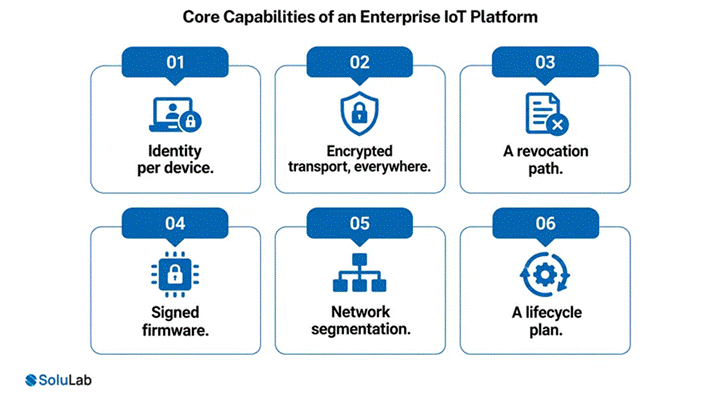
1. Identity Per Device
Every unit needs its own certificate or key, provisioned during manufacture or first boot. Shared credentials across a fleet mean one compromised device exposes all of them.
2. Encrypted Transport Everywhere
Use TLS to the platform and encryption at rest for anything sensitive. Constrained devices make this harder, but never optional.
3. A Revocation Path
You need to disable a compromised or stolen device remotely and immediately, without a site visit.
4. Signed Firmware
Devices should refuse any update that isn’t cryptographically signed. Otherwise, your OTA channel becomes an attack channel.
5. Network Segmentation
Devices belong on their own network segment with tightly scoped access to internal systems. Historically, a compromised sensor has been a route into corporate networks.
6. A Lifecycle Plan
Devices deployed today will outlive several security standards. So decide up front how long you will support each hardware generation and what decommissioning looks like.
The physical dimension is what makes IoT security distinct: an attacker can hold your device in their hand. Assume the hardware can be opened and the firmware extracted. Then design so a single compromised unit stays contained. Our breakdown of IoT security challenges and how to overcome them goes deeper into the common attack paths.
What Tech Stack Powers an Enterprise IoT Platform?
There’s no single standard stack for an enterprise IoT platform. Still, most production builds draw on the same set of proven components, and the table below shows what typically sits at each layer.
| Layer | Common choices | What drives the choice |
| Device protocols | MQTT, CoAP and HTTPS; Modbus and OPC UA for industrial equipment | Power budget, payload size and what legacy machines already speak |
| Edge runtime | AWS IoT Greengrass, Azure IoT Edge, containerised gateways | Offline operation and local processing needs |
| Ingestion and device management | AWS IoT Core, Azure IoT Hub, open-source MQTT brokers such as EMQX or Mosquitto | Cloud commitment, fleet size and lock-in tolerance |
| Streaming and storage | Apache Kafka, time-series databases such as TimescaleDB or InfluxDB, object storage for raw data | Message volume, query patterns and retention period |
| Analytics and ML | Python, TensorFlow or PyTorch, plus a pipeline to retrain and monitor models | Whether models run in the cloud, at the edge or both |
| Applications | React or Flutter front ends, Grafana for operational dashboards, REST and GraphQL APIs | Who uses the output and on which device |
Pick components by operational constraints, not popularity. A broker your team can run and debug at 3 a.m. is worth more than a long feature list. Managed services can also disappear: Google Cloud retired its IoT Core service in August 2023, which forced its users to migrate. So keep your device data model portable even when you buy an enterprise IoT platform.
Anomaly-detection models drift as equipment ages, so plan MLOps consulting for retraining from day one. Likewise, treat firmware builds and cloud infrastructure as code through a DevOps pipeline, since manual releases don’t survive a fleet of thousands.
How Does an Enterprise IoT Platform Rollout Run?
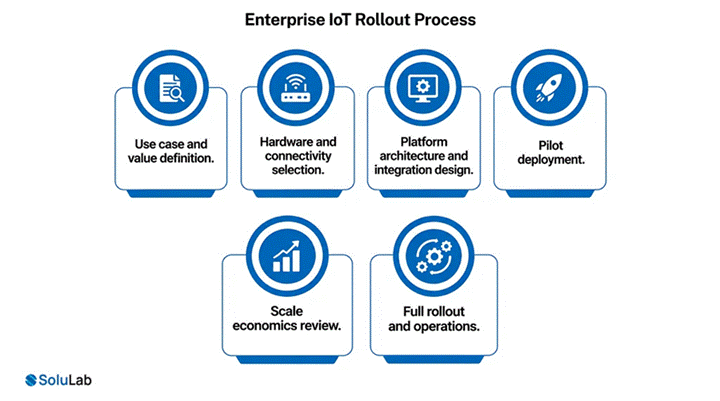
1. Use Case and Value Definition
Name the decision the data will change and the number it will move. “Visibility” isn’t an outcome.
2. Hardware and Connectivity Selection
Weigh battery life, coverage, environment and cost per device per year. Then test in the actual environment, not the office.
3. Platform Architecture and Integration Design
Decide the build-versus-buy split, the data model, and which business systems consume the output.
4. Pilot Deployment
Run a small fleet in real conditions, instrumented so you learn about failure modes rather than feasibility.
5. Scale Economics Review
Model connectivity, platform, support and replacement costs at full fleet size. This is where programmes should stop if the numbers don’t work. It’s also where most of them don’t stop.
6. Full Rollout and Operations
Field installation, support processes, spares, firmware management and monitoring become permanent functions.
The step teams skip is the fifth. Pilots run on generous engineering attention and vendor goodwill. Once an enterprise IoT platform reaches full scale, however, the recurring cost per device and the field-failure rate decide whether the programme pays for itself.
What Does an Enterprise IoT Platform Cost?
The cost of an enterprise IoT platform splits into four buckets, and only the first is one-off. Hardware and installation come first. After that come connectivity subscriptions per device, platform and cloud fees that scale with device count and data volume, and integration, support and replacement as ongoing operating cost.
Three items routinely go missing from business cases. Field service is the first: someone has to physically visit devices that fail, and that cost scales with fleet size and geography. Data egress and storage growth is the second, because it compounds quietly as retention periods extend. Device replacement is the third, since sensors and batteries have a finite life and a fleet has a refresh cycle whether you plan one or not.
Model these at full scale before the pilot, not after it. The most reliable estimate for an enterprise IoT platform comes from a scoped discovery against your actual device count, geography and integration list.
How Do You Choose an Enterprise IoT Platform Partner?
Before you commit to an enterprise IoT platform partner, run these five checks, in order.
- Have they deployed at your scale, in your environment? A thousand devices in the field behave nothing like fifty in a lab.
- Can they work with your existing hardware? Most estates are brownfield, so greenfield-only experience is a warning sign.
- Who owns the data and the data model? Get it in writing, including the export format and what happens at contract end.
- What is the device management story? Ask specifically how provisioning, OTA updates and remote diagnostics work at fleet scale.
- What does post-launch support cover? Firmware, security patching, connectivity issues and field failures are continuous work.
For where IoT data meets analytics and automation, our enterprise AI development page covers the layer above the platform. Our IoT application development page covers the applications built on top of it. And if you’re still surveying the market, our roundup of top IoT companies is a useful starting point.

How SoluLab Delivers an Enterprise IoT Platform
We have built software for over eleven years with a team of 250+ engineers. Our enterprise IoT solutions focus on the layers where programmes usually stall: device management at fleet scale, integration into the ERP and maintenance systems that already run the business, and analytics that produce actions rather than dashboards.
One example is the smart building and yacht management app we built for Enmatrix. It controls lighting, HVAC, cameras, media and energy monitoring, and its server relays commands to KNX, ZigBee and IR gateways over LAN or internet sockets.
We hold ISO 27001:2022 and SOC 2 certification and are assessed at CMMI Level 3, which matters when devices sit inside operational infrastructure.
Most enterprise IoT platform engagements start with a scoped assessment of the estate and the integration targets, because platform choice is hard to reverse once hardware is in the field. You can see the full scope of our enterprise IoT development work on the service page.
Enterprise IoT Platform FAQs
Shipra Garg is a tech-focused content strategist and copywriter specializing in Web3, blockchain, and artificial intelligence. She has worked with startups and enterprise teams to craft high-conversion content that bridges deep tech with business impact. Her work translates complex innovations into clear, credible, and engaging narratives that drive growth and build trust in emerging tech markets.