
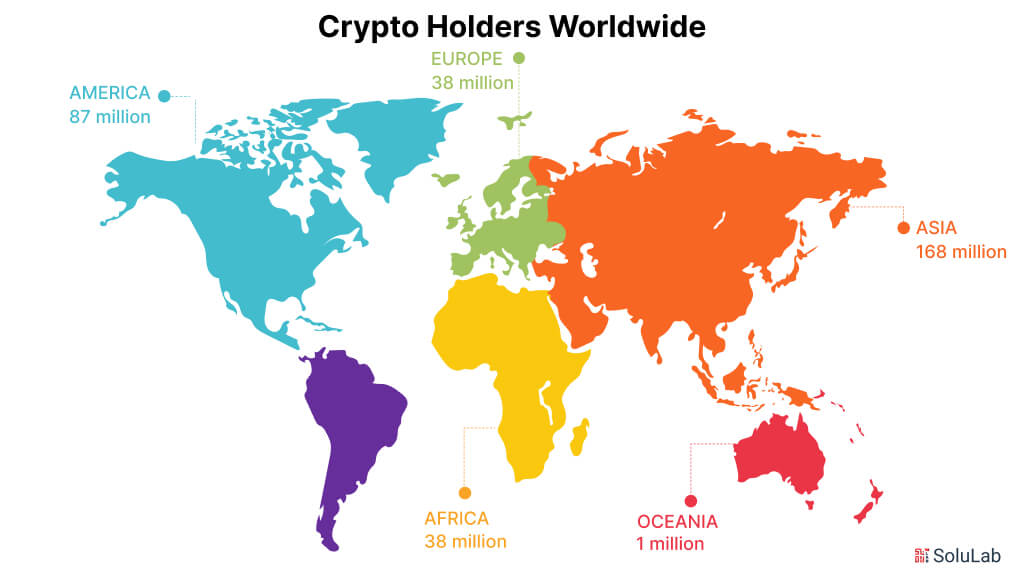
Bitcoin came first. It’s still the name everyone recognizes. But today the market is home to thousands of cryptocurrencies and tens of millions of people who hold them.
By 2025, the crypto user base is projected to hit 107.30 million, with a user growth rate of around 7.41% in 2024 climbing to 7.35% in 2025. Average revenue per user is estimated at $61.5 in 2024. The money moving through this sector is real, and it keeps growing.
Most people’s first move in crypto is picking an exchange. That platform becomes their entry point, the place where they buy, sell, and manage everything. Private operators already run many of these exchanges, and sharp founders have spotted the opportunity to build their own.
If that’s on your mind, knowing how to build a crypto exchange is where you start. You need solid planning, the right technology choices, and a clear read of what users actually want from a platform.
This guide covers the whole picture, whether you plan to build a cryptocurrency exchange website from zero or get to market faster with a white-label solution.
What is a Cryptocurrency Exchange & How Does It Work?
A cryptocurrency exchange is a platform where holders can trade their digital assets for other assets. These platforms sit between buyers and sellers, processing the transactions that make the market move.
Once you create an account, you can trade Bitcoin (BTC), Ether (ETH), Dogecoin (DOGE), and hundreds of other tokens depending on what the exchange supports.
At the structural level, exchanges fall into two categories:
1. Fiat-to-crypto exchanges: Users swap traditional currency for crypto, or the other way around.
2. Crypto-to-crypto exchanges: Users trade one cryptocurrency directly for another, no fiat involved.
The best-known names in the space are Binance, Coinbase, Kraken, FTX, and KuCoin.
Each platform differs in how many coins it lists and what services it offers. Some lock your assets on the platform; others let you move funds freely to external wallets. That distinction matters a lot to serious traders.
And if you want to build something in this space rather than just use it, you could start your own exchange and offer that service to a growing base of users.
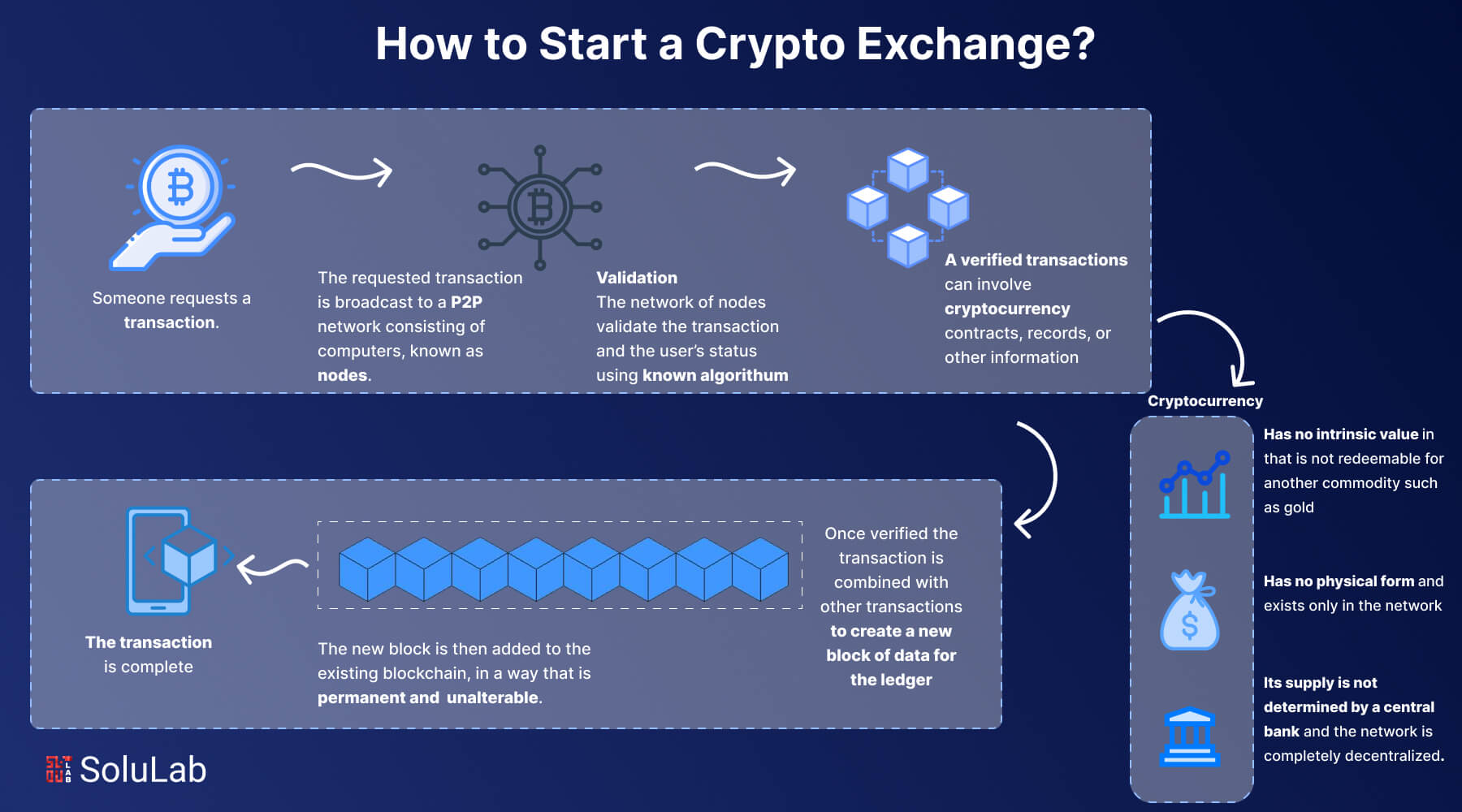
The image below shows how a cryptocurrency exchange functions at a basic level.
Why Create a Cryptocurrency Exchange?
Cryptocurrency is a multi-billion-dollar market, and it’s still picking up speed. The numbers below give you a clearer sense of the opportunity.
- The global crypto market cap currently stands at $2.28 trillion, up 0.94% in the last 24 hours and 105.19% from a year ago. Bitcoin alone commands a $1.25 trillion market cap with 54.92% dominance.
- Binance ranked among the world’s top exchanges in 2025, posting a daily trading volume of $19.38 billion.
- With an average daily trade volume of $11.05 billion, Binance holds second place, followed by FutureX Pro at $4.33 billion.
- Binance recorded 2.27 trillion in sales in 2024, a 37.3% increase so far this year.
- More than 560 million people owned or used cryptocurrency worldwide in 2025.
- The global blockchain technology market is growing at a CAGR of 52.8% from 2024 to 2032, moving from USD 27.84 billion to an estimated USD 825.93 billion.
The market keeps expanding. That’s why so many companies are now looking at building their own exchange, aiming to capture a slice of what Binance and Coinbase have built.
Types of Cryptocurrency Exchanges
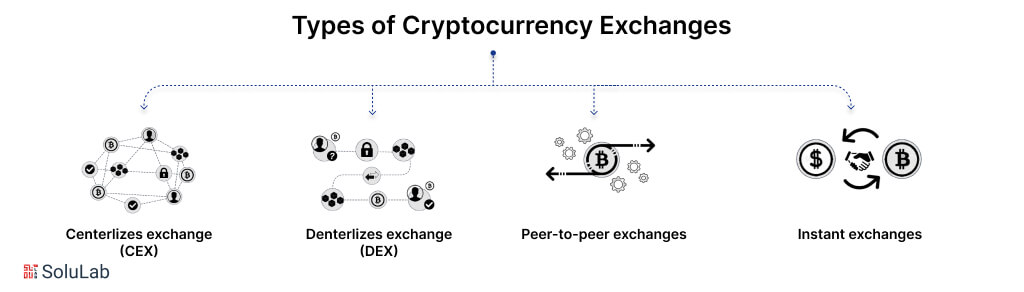
Four main types exist:
- Centralized Exchanges (CEX)
- Decentralized Exchanges (DEX)
- Peer-to-Peer (P2P) Exchanges
- Instant Exchanges
Each one works differently, and each has real trade-offs. Here’s a breakdown to help you decide which model fits your goals.
1. Centralized Exchanges (CEX)
Centralized exchanges act as the middleman between buyers and sellers. They’re also called custodian exchanges because the platform itself holds user assets. You can trade crypto for other tokens or convert to fiat, all in one place.
These exchanges charge a trading fee that typically runs from 0.1% to 8%. Coinbase, Binance, and Kraken are the most recognized names in this category.
Advantages:
- User-friendly
- Feature-rich with multiple trading options
- Can handle millions of transactions per second
Disadvantages:
- Weaker security against hacks
- Users must keep their assets on the platform
- Trading fees can go as high as 8% (which is unfavorable for users but profitable for exchange operators)
If you’re thinking about launching, CEX is still the most widely used model. There’s a reason for that: it’s what most users expect and know how to use.
2. Decentralized Exchanges (DEX)
Decentralized exchanges (DEXs) are non-custodial. The platform never touches user funds. Trades happen directly between wallets through the blockchain, no third party in the middle.
DEXs see lower trading volumes and less liquidity than CEXs, but they’re growing. PancakeSwap, Binance DEX, and Uniswap are the familiar names here.
Advantages:
- Quick registration and verification for new users
- Low fees (up to 0.25%), which users love even if operators make less
- Users keep control of their assets, cutting the risk of losing funds to a platform breach
Disadvantages:
- No third-party oversight
- Chargebacks via PayPal or bank cards are problematic
- Users have to wait for a counterparty before a trade can go through
DEX is the right call if user asset control is central to what you want to offer.

3. Peer-to-Peer (P2P) Crypto Exchanges
P2P exchanges give users the infrastructure to trade directly with each other. Where they differ from DEXs: P2P platforms use escrow to hold funds in check until both sides complete the transaction as agreed.
Best P2P crypto exchanges are especially common in regions where centralized crypto exchanges are restricted, like parts of Africa. Local Bitcoins and Paxful are well-known examples.
Advantages:
- Beginner-friendly, with simple buy and sell options
- Buyers pay no fees for deposits, exchanges, or withdrawals
- Seller ratings add a layer of safety
Disadvantages:
- Trades can be slow to settle
- Sending funds to the wrong user is a real risk
- Disputes are hard to resolve
If you build a P2P exchange, the most common monetization approach is taking a cut of each completed transaction.
4. Instant Exchanges
Instant exchanges let users swap one cryptocurrency for another without any account or asset storage involved. Speed is the whole point. The platform never holds your funds, so the transaction goes through fast.
Letsexchange, Changelly, FixedFloat, and SwapZone all operate this way.
Advantages:
- Fastest transaction speeds
- Handles large-volume trades
- No liability for stored user assets
Disadvantages:
- Refunds get complicated
- Less accessible for beginners
White-label crypto exchange solutions can get an instant exchange off the ground quickly if this model fits what you’re building.
These four types cover most of what’s out there. Whether you want to start a full cryptocurrency exchange or go with a white-label approach, each model has a different risk profile, revenue structure, and user base worth thinking through carefully.
Read Also: Build Hack Resistant Crypto Exchange
How to Start a Cryptocurrency Exchange?
There are two main paths to starting a crypto exchange: a white-label solution or a full custom build. Each has a different risk profile, timeline, and long-term ceiling.
A. White Label Cryptocurrency Exchange Development Solution
White-label crypto exchange solutions come pre-built with the core pieces you need: a trading engine, user interface, liquidity integration, wallet, and admin panel. You’re not building from zero. You’re configuring something that already works.
Advantages of using a white-label solution:
- Faster time to market: You can launch months ahead of a custom build.
- Lower cryptocurrency exchange development cost: No custom development means less spend upfront.
- Immediate access to basic features: Core functionality is ready out of the box, so you can start operating sooner.
Disadvantages of using a white-label solution:
- Dependence on a third-party provider: If the vendor stops supporting the software, your platform absorbs that risk.
- Limited customization options: The pre-built nature constrains how much you can tailor features to your specific needs.
- Challenges with scaling: Growing beyond the platform’s original scope can be a real headache.
- Potential security risks: Third-party software introduces vulnerabilities you don’t fully control.
White-label is fast and affordable. But the vendor dependency and scaling ceiling are worth thinking through before you commit.
Check Out Our Blog Post: How to Launch a Crypto Exchange in Switzerland?
B. Custom Cryptocurrency Exchange Development
Building from scratch means you own every component: trading engine, wallet, admin panel, user interface. Nothing is inherited from a vendor. Everything is yours to design and control.
Advantages of custom development:
- No third-party reliance: Full control over the platform with no external dependencies.
- Unlimited customization possibilities: Build exactly what you need, from the design to the feature set.
- Scalability: You can architect the platform to grow alongside your business.
- Unique UX/UI design: A custom interface that actually stands apart from competitors.
Disadvantages of custom development:
- Longer time to market: Building everything takes significantly more time than a ready-made solution.
- Higher development costs: The complexity and resources required push costs up.
It costs more and takes longer. But if you want full ownership, real scalability, and a platform built around your specific vision, custom development is the right path.
A Step-by-Step Guide on How to Start a Cryptocurrency Exchange
To create a cryptocurrency exchange, work through each of these steps before you write a line of code.
Step 1: Choose Which Countries to Operate In
Where you operate determines your regulatory load, your banking partners, and which currencies you support. Starting in your home country makes sense early on since you’ll already understand the local rules around crypto exchange development. From there, your cryptocurrency exchange business plan can include an expansion roadmap. Going multi-country from day one is possible if you have the resources, but it multiplies complexity fast: different laws, different fiat support, different banking relationships.
Step 2: Define Your Target Audience
Once you know where you’re operating, figure out who you’re building for. Spend time in crypto forums and social communities where traders actually talk about what they need from a crypto exchange development project. Where are the gaps in the current market? Users who want interest-earning options or access to uncommon altcoins are often underserved. That’s a signal worth following.
Step 3: Adhere to Legal Requirements & Obtain a Crypto Trading License
Legal compliance is not optional, and the rules vary significantly by country. Before you create a crypto exchange platform, bring in a legal team that knows the local laws in your target markets. If a crypto trading license is required, secure it before development starts. Getting this wrong after the platform is built is expensive in every sense.
Step 4: Choose Cryptocurrency Exchange Features
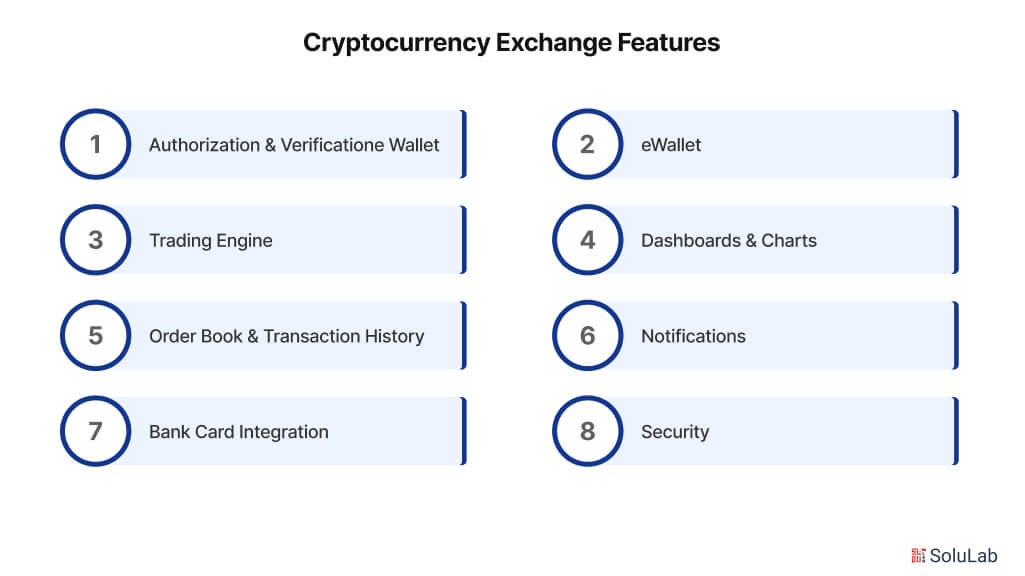
Lock down your feature list before development begins. Additions mid-build are costly. These are the pieces you should not skip:
- Authorization & Verification: Secure login through Single Sign-On (SSO), Multi-Factor Authentication (MFA), and biometric authentication keeps the platform trustworthy.
- eWallet: For centralized exchanges, a built-in wallet lets users store, manage, and convert crypto to fiat without leaving the platform.
- Trading Engine: This is the core of the whole operation. It matches orders, handles real-time pricing, and processes every transaction.
- Dashboards & Charts: Traders need clear visual tools for price history and live rates. Don’t underestimate how much this matters to experienced users.
- Order Book & Transaction History: Users want to see open orders and a full record of completed trades.
- Notifications: Customizable push alerts for price moves, new listings, and account activity keep users engaged.
- Bank Card Integration: If you’re offering fiat on-ramps, credit card support is a must.
- Security: Encryption, secure authentication, and regular audits are the floor, not the ceiling. Exchanges get targeted constantly.
These features form the foundation of any serious cryptocurrency exchange business plan.
Check Out Our Blog Post: Launch a Crypto Exchange in Indonesia
Step 5: Find a Cryptocurrency Exchange Development Company
If you don’t have the technical depth to build a top decentralized crypto exchange or a centralized exchange in-house, you need a development partner. Clutch and GoodFirms are solid places to start the search. Look at portfolios, read client reviews, and check for real crypto exchange work specifically. Don’t go with the lowest bid. Cheap builds in this space tend to create expensive problems later.
Step 6: Design a Cryptocurrency Exchange Platform
Design is where a lot of exchange launches quietly fail. The platform needs to work for experienced traders AND first-timers, which is a harder design problem than it sounds. Clear navigation, a smooth onboarding flow, and readable interfaces matter. If a new user can’t figure out how to make their first trade, they leave and don’t come back.
Step 7: Start Cryptocurrency Exchange Development
Architecture decisions here have long-term consequences. Monolithic, microservices, and distributed systems each have different trade-offs. Microservices give you better scalability. A distributed architecture works well for cloud-based platforms expecting high user volumes.
For the tech stack: Swift and Kotlin for mobile, Java or PHP with Laravel for web. MongoDB and MySQL are common database choices. AWS and Google Cloud Platform handle infrastructure for most teams. APIs like Binance API, CoinBase API, and CoinMarketCap API cover the essential market data feeds.
Step 8: Launch & Promote Your Cryptocurrency Exchange
Start building your community before you launch, not after. Twitter and Reddit are where crypto conversations happen. Influencer partnerships can accelerate awareness. Working with agencies like Odd Angles Media is an option if you want outside support. Collaboration with crypto services and communities, plus media outreach, helps establish the brand faster.
Once live, user feedback is your most direct signal. Collect it, act on it, and keep improving. Whether you’re running a centralized or decentralized exchange, the platforms that retain users do so by actually being reliable, not just by launching with a big feature list.
Follow these eight steps and you’ll have a clear path to building and launching a crypto exchange that’s secure, functional, and positioned to grow.
How Much Does it Cost to Start a Crypto Exchange?
Expect to spend between $130,000 and $200,000 to launch a crypto exchange. Development typically takes 6 to 9 months, depending on scope and complexity.
Several variables move that number: the type of platform, the features you want, how many APIs you’re integrating, and so on. Here’s a cost breakdown by development stage:
| Stage | Cost |
| Design | $5,000 – $10,000 |
| Development | $40,000 – $50,000 |
| API Integration | $50,000 – $80,000 |
| Blockchain | $10,000 – $15,000 |
| Testing | $25,000 – $30,000 |
| Total Cost | $130,000 – $185,000 |
These are approximate figures. The real number depends on your specific project requirements. Talk to a development team to get a breakdown tailored to what you’re building.
Building a cryptocurrency exchange website, centralized or decentralized, starts with a solid business plan. That plan should cover every feature, integration, and API you need before any code gets written.
One of the biggest cost drivers is the build path: white-label crypto exchange solutions cost less and get you live faster, while custom development costs more but gives you full flexibility. Neither is objectively better. It depends on your timeline, budget, and how much control you need over the platform long-term.
Whatever you choose, the planning you do upfront on design, architecture, and features will have a bigger impact on the final cost than almost any other decision you make.

How SoluLab Can Help Start a Crypto Exchange?
SoluLab works with businesses that want to build crypto exchanges, from initial concept through to a live, production-ready platform. Whether you’re building a decentralized exchange or a centralized one, the team covers the full development scope: platform design, API integrations, blockchain setup, and security architecture. The focus is on platforms that can scale, handle real transaction loads, and meet the demands of an evolving market.
SoluLab, a P2P crypto exchange development company, recently launched a crypto borrowing and lending platform, Borrowland,, which brings blockchain technology to traditional lending. The platform lets users borrow, lend, swap, deposit, and transfer crypto assets while earning daily interest. SoluLab integrated Persona for instant KYC verification and BitGo for secure transactions, and also built in features to reduce gas fees, automate interest transactions, and run a referral system for user growth. Loan liquidation safeguards and currency swapping round out a platform built to be both secure and practical.
SoluLab offers both white-label crypto exchange solutions and custom development, depending on what your business model calls for. You get a team with real blockchain experience, a faster path to market than most in-house builds, and platform architecture built to last. Ready to build? Contact us today to talk through your project.
FAQs
Shipra Garg is a tech-focused content strategist and copywriter specializing in Web3, blockchain, and artificial intelligence. She has worked with startups and enterprise teams to craft high-conversion content that bridges deep tech with business impact. Her work translates complex innovations into clear, credible, and engaging narratives that drive growth and build trust in emerging tech markets.